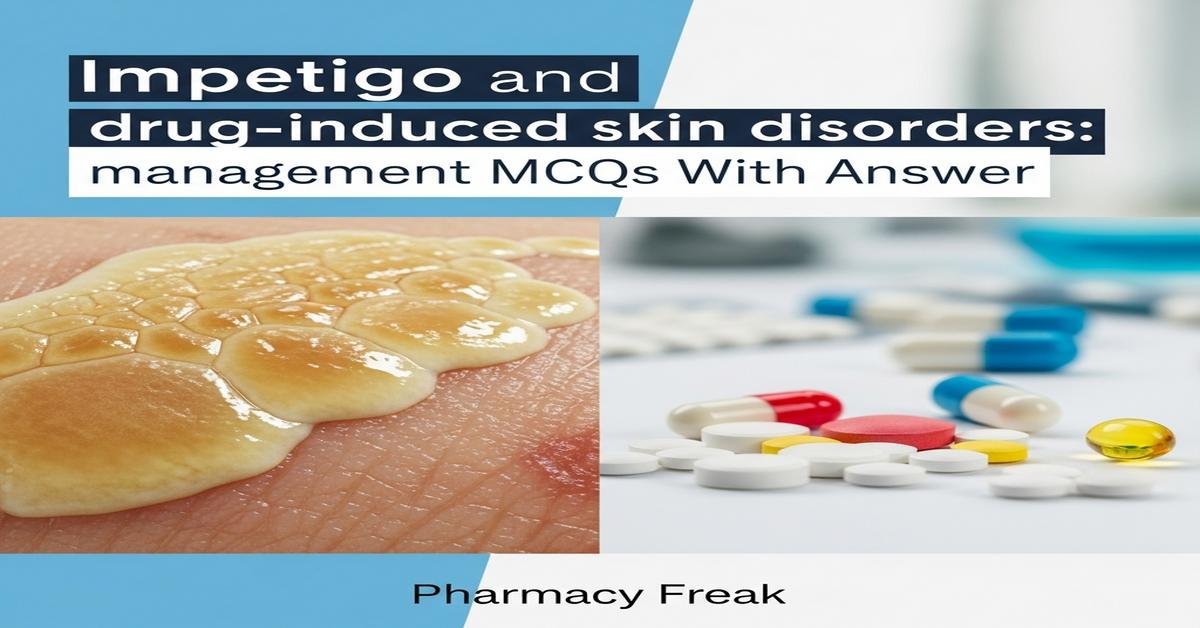
Impetigo and drug-induced skin disorders: management MCQs With Answer
This quiz collection is designed for M.Pharm students studying Pharmacotherapeutics I (MPP 102T). It focuses on clinical management, pharmacology, and practical decision-making for impetigo and drug-induced cutaneous reactions (including SJS/TEN, DRESS, AGEP). Questions emphasize drug selection (topical vs systemic), mechanisms of action, resistance and MRSA considerations, dosing/duration principles, adjunctive measures, and evidence-based approaches to severe immune‑mediated skin reactions — including when to stop offending drugs and use systemic immunomodulators (steroids, IVIG, cyclosporine). Answers are provided to reinforce learning and prepare students for clinical reasoning and examination-level problem solving.
Q1. Which organism is the predominant cause of non-bullous impetigo in children?
- Staphylococcus aureus (predominant cause)
- Streptococcus pneumoniae
- Pseudomonas aeruginosa
- Candida albicans
Correct Answer: Staphylococcus aureus (predominant cause)
Q2. What is the recommended first-line topical antibiotic for localized impetigo in most guidelines?
- Mupirocin ointment
- Topical clotrimazole
- Topical hydrocortisone cream
- Oral amoxicillin
Correct Answer: Mupirocin ointment
Q3. For extensive impetigo requiring systemic therapy in a pediatric patient, which oral antibiotic is commonly preferred targeting methicillin-sensitive Staphylococcus aureus (MSSA)?
- Oral flucloxacillin (anti-staphylococcal penicillin)
- Oral amoxicillin–clavulanate
- Oral azithromycin
- Oral metronidazole
Correct Answer: Oral flucloxacillin (anti-staphylococcal penicillin)
Q4. If community-associated MRSA is a suspected cause of impetigo, which oral agent is an appropriate outpatient choice for older children or adults?
- Trimethoprim–sulfamethoxazole (effective against community MRSA)
- Penicillin V
- Oral cephalexin (ineffective against many MRSA strains)
- Topical amphotericin B
Correct Answer: Trimethoprim–sulfamethoxazole (effective against community MRSA)
Q5. What is the typical recommended duration of topical mupirocin treatment for localized impetigo?
- 3 days
- 5 days
- 10 days
- 14 days
Correct Answer: 5 days
Q6. What is the primary mechanism of antibacterial action of mupirocin?
- Inhibition of bacterial isoleucyl‑tRNA synthetase
- Inhibition of peptidoglycan cross-linking (transpeptidase)
- DNA gyrase inhibition
- 30S ribosomal subunit blockade
Correct Answer: Inhibition of bacterial isoleucyl‑tRNA synthetase
Q7. Which statement best describes the role of antiseptic washes (e.g., chlorhexidine) in impetigo management?
- They are first-line monotherapy for extensive impetigo
- They are useful adjuncts to reduce skin bacterial colonization and household transmission
- They cure systemic complications of impetigo
- They should be avoided because they increase resistance
Correct Answer: They are useful adjuncts to reduce skin bacterial colonization and household transmission
Q8. Which post-infectious complication is classically associated with streptococcal impetigo?
- Post‑streptococcal glomerulonephritis
- Rheumatoid arthritis
- Stevens‑Johnson syndrome
- Herpes zoster reactivation
Correct Answer: Post‑streptococcal glomerulonephritis
Q9. Which drug-induced reaction is characterized by widespread epidermal necrosis with full‑thickness epidermal detachment and mucosal involvement?
- Stevens–Johnson syndrome / toxic epidermal necrolysis (SJS/TEN)
- Drug reaction with eosinophilia and systemic symptoms (DRESS)
- Acute generalized exanthematous pustulosis (AGEP)
- Fixed drug eruption
Correct Answer: Stevens–Johnson syndrome / toxic epidermal necrolysis (SJS/TEN)
Q10. What is the immediate first step when a severe cutaneous adverse reaction (e.g., SJS/TEN, DRESS) is suspected?
- Immediately discontinue the suspected offending drug(s)
- Start high‑dose oral antibiotics
- Apply topical steroids and continue the drug
- Perform patch testing before stopping drugs
Correct Answer: Immediately discontinue the suspected offending drug(s)
Q11. Which is the most appropriate initial inpatient management strategy for a patient with extensive epidermal detachment from TEN?
- Immediate transfer to a burn or specialized intensive care unit for supportive care (fluid, electrolytes, wound management)
- Routine dermatology outpatient follow‑up
- High‑dose oral antibiotics only
- Topical antiseptics at home
Correct Answer: Immediate transfer to a burn or specialized intensive care unit for supportive care (fluid, electrolytes, wound management)
Q12. Which drug is classically implicated as a common trigger of DRESS syndrome?
- Allopurinol
- Paracetamol (acetaminophen)
- Topical corticosteroids
- Oral probiotics
Correct Answer: Allopurinol
Q13. Which laboratory finding is most characteristic of DRESS syndrome?
- Eosinophilia with evidence of systemic organ involvement (e.g., elevated liver enzymes)
- Neutropenia without other abnormalities
- Isolated thrombocytopenia only
- Normal blood counts and chemistry always
Correct Answer: Eosinophilia with evidence of systemic organ involvement (e.g., elevated liver enzymes)
Q14. What is the mainstay of pharmacologic therapy for severe DRESS with organ involvement?
- Systemic corticosteroids (e.g., oral prednisone or IV methylprednisolone)
- Topical emollients only
- Long‑term oral antibiotics
- Oral antihistamines alone
Correct Answer: Systemic corticosteroids (e.g., oral prednisone or IV methylprednisolone)
Q15. Which statement about systemic corticosteroid use in SJS/TEN is most accurate?
- Systemic corticosteroids are universally recommended and clearly reduce mortality in all cases
- Their use is controversial; they may help if given very early but can increase infection risk and are not uniformly recommended
- They are contraindicated in all cases of SJS/TEN
- They should always be given topically instead of systemically
Correct Answer: Their use is controversial; they may help if given very early but can increase infection risk and are not uniformly recommended
Q16. Intravenous immunoglobulin (IVIG) is proposed to benefit SJS/TEN by which primary mechanism?
- Neutralization of Fas‑mediated keratinocyte apoptosis
- Direct antibacterial activity against skin flora
- Stimulation of epidermal proliferation
- Blockade of histamine H1 receptors
Correct Answer: Neutralization of Fas‑mediated keratinocyte apoptosis
Q17. Cyclosporine has been used in severe SJS/TEN. What is its main therapeutic action relevant to these reactions?
- Inhibition of T‑cell activation via calcineurin blockade
- Direct keratinocyte antibacterial effect
- Activation of eosinophils
- Enhancement of complement activation
Correct Answer: Inhibition of T‑cell activation via calcineurin blockade
Q18. Which class of drugs is most commonly associated with acute generalized exanthematous pustulosis (AGEP)?
- Beta‑lactam antibiotics (e.g., aminopenicillins)
- Topical retinoids
- Proton pump inhibitors
- Statins
Correct Answer: Beta‑lactam antibiotics (e.g., aminopenicillins)
Q19. Which diagnostic test can be useful in identifying the culprit drug in certain delayed T‑cell mediated cutaneous drug reactions?
- Patch testing (useful for some delayed drug eruptions)
- Skin prick testing (best for delayed reactions)
- Serum IgE specific testing for all delayed reactions
- Urine drug levels
Correct Answer: Patch testing (useful for some delayed drug eruptions)
Q20. For recurrent household impetigo with S. aureus carriage, which decolonization strategy is recommended to reduce transmission?
- Intranasal mupirocin plus chlorhexidine body washes for household contacts
- Year‑long oral antibiotics for all family members
- Daily topical steroids to carriers
- Immediate vaccination against S. aureus
Correct Answer: Intranasal mupirocin plus chlorhexidine body washes for household contacts

