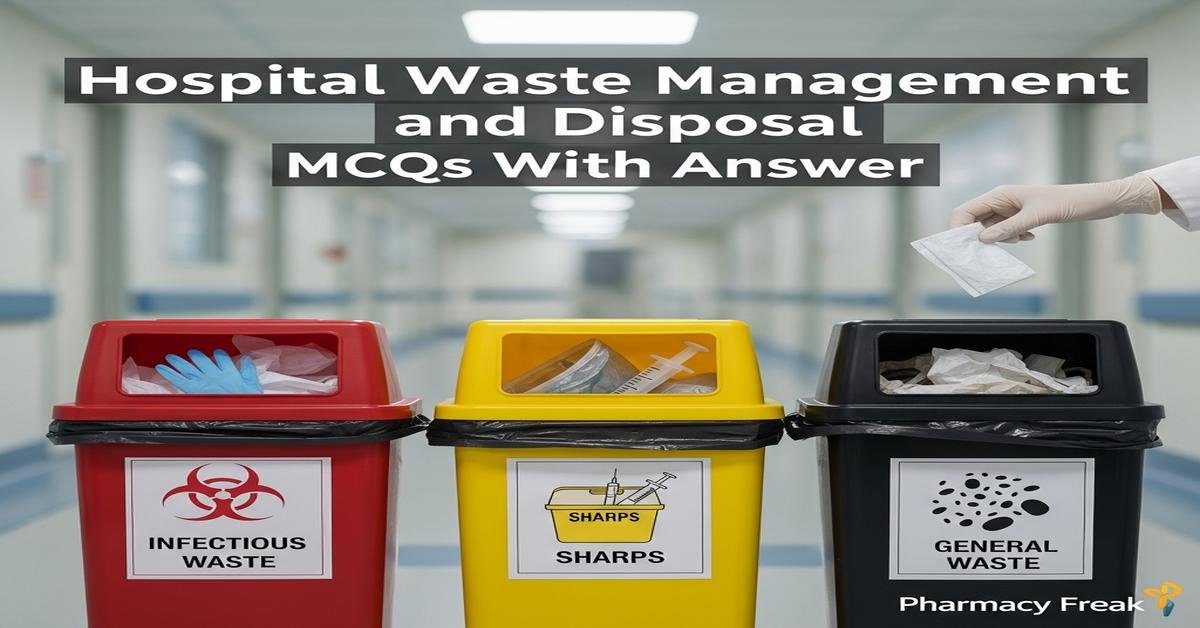
Introduction: Hospital waste management and disposal MCQs With Answer is a focused quiz resource tailored for M.Pharm students studying Hospital & Community Pharmacy (MPP 103T). This collection highlights critical principles of segregation, color-coding, handling, treatment technologies (autoclaving, incineration, chemical disinfection), and regulatory frameworks that govern biomedical waste. Questions emphasize practical decision-making for pharmaceutical and clinical waste streams, occupational safety, record-keeping, and environmental protection. The aim is to reinforce conceptual depth and applied competence so students can both understand the science behind waste treatment methods and comply with national/international guidelines while designing safe, compliant hospital waste management protocols.
Q1. Which color-coded bag is typically used for human anatomical and highly infectious waste requiring incineration?
- Red bag – recyclable contaminated waste
- Yellow bag – human anatomical and highly infectious waste requiring incineration
- Black bag – general municipal waste
- White/translucent container – sharps only
Correct Answer: Yellow bag – human anatomical and highly infectious waste requiring incineration
Q2. What is the recommended immediate container for disposal of used needles and other sharps at the point of generation?
- Yellow plastic bag for incineration
- Open cardboard box lined with plastic
- White/translucent puncture-proof safety (sharps) container
- Black municipal waste bin
Correct Answer: White/translucent puncture-proof safety (sharps) container
Q3. Which regulation currently provides the primary legal framework for biomedical waste management in India?
- Biomedical Waste (Management and Handling) Rules, 1998
- Biomedical Waste Management Rules, 2016
- National Environment Policy, 2006
- Drug and Cosmetics Act, 1940
Correct Answer: Biomedical Waste Management Rules, 2016
Q4. Which of the following wastes should be placed in a yellow category container according to standard hospital segregation?
- Used disposable plastic syringes to be autoclaved and recycled
- Human anatomical waste (tissues, organs)
- General kitchen waste from hospital cafeteria
- Labelled pharmaceutical empty packaging for recycling
Correct Answer: Human anatomical waste (tissues, organs)
Q5. Autoclaving is most appropriate for which type of hospital waste?
- Cytotoxic drug residues and expired chemotherapeutics
- Human anatomical remains and large pathologic specimens
- Sterilization of infectious, non-anatomical waste (e.g., culture plates, contaminated dressings)
- Radioactive diagnostic waste
Correct Answer: Sterilization of infectious, non-anatomical waste (e.g., culture plates, contaminated dressings)
Q6. High-temperature incineration is the preferred treatment for which category of pharmaceutical waste?
- Unused, non-hazardous over-the-counter tablets
- Cytotoxic and cytostatic drug residues that are hazardous and persistent
- Biodegradable food waste from hospital kitchens
- Recyclable plastic packaging after decontamination
Correct Answer: Cytotoxic and cytostatic drug residues that are hazardous and persistent
Q7. How should expired antibiotics and other hazardous pharmaceuticals be managed before final disposal?
- Flushed into the sanitary sewer after dilution
- Mixed with municipal waste for landfill
- Segregated as pharmaceutical hazardous waste and sent for incineration at a licensed facility
- Given to staff for personal use
Correct Answer: Segregated as pharmaceutical hazardous waste and sent for incineration at a licensed facility
Q8. Which of the following best describes the management of mercury-containing devices (e.g., old thermometers) in hospitals?
- Crush and discard in yellow bag
- Collect separately and send to an authorized recycler for mercury recovery
- Autoclave with other infectious waste
- Incinerate in a small onsite furnace
Correct Answer: Collect separately and send to an authorized recycler for mercury recovery
Q9. What is the primary objective of an effluent treatment plant (ETP) in a hospital setting?
- Convert solid waste into compost
- Treat liquid waste to reduce BOD/COD and disinfect before safe discharge
- Destroy radioactive isotopes chemically
- Segregate sharps from general waste
Correct Answer: Treat liquid waste to reduce BOD/COD and disinfect before safe discharge
Q10. Sodium hypochlorite (bleach) as a chemical disinfectant is most effective against which class of microbes?
- Prions and bacterial spores under normal concentrations
- Vegetative bacteria and many viruses (less effective against spores/prions)
- All microorganisms equally, including spores
- Only fungi and yeasts
Correct Answer: Vegetative bacteria and many viruses (less effective against spores/prions)
Q11. Which practice is essential when handling and disposing of cytotoxic drug waste in oncology wards?
- Mix cytotoxic waste with general waste for dilution
- Place cytotoxic waste in clearly labelled, specially segregated containers and send for high-temperature incineration
- Autoclave cytotoxic waste and return residuals to pharmacy
- Flush cytotoxic liquids down the sink after neutralization with water
Correct Answer: Place cytotoxic waste in clearly labelled, specially segregated containers and send for high-temperature incineration
Q12. What is the purpose of a biomedical waste manifest system?
- To record clinical outcomes for patients with infectious diseases
- To track the transfer and final treatment/disposal of biomedical waste from the generator to the authorized facility
- To document medication errors in the pharmacy
- To schedule staff shifts in waste handling
Correct Answer: To track the transfer and final treatment/disposal of biomedical waste from the generator to the authorized facility
Q13. Following a needle-stick injury, what is the immediate recommended action for a healthcare worker?
- Continue work and monitor symptoms at home
- Wash the site thoroughly with soap and water and report the incident for further evaluation
- Apply adhesive bandage only without reporting
- Expose the wound to alcohol and resume duties
Correct Answer: Wash the site thoroughly with soap and water and report the incident for further evaluation
Q14. According to good hospital practice, maximum recommended storage time for segregated infectious waste at the point-of-generation before collection is generally:
- Less than 48 hours under controlled conditions
- Up to 2 weeks at room temperature
- Indefinite if sealed
- At least one month to accumulate sufficient volume
Correct Answer: Less than 48 hours under controlled conditions
Q15. Which authority is primarily responsible for regulation of radioactive waste generated by medical procedures?
- Central Pollution Control Board (CPCB)
- Atomic Energy Regulatory Board (AERB)
- Drug Controller General of India (DCGI)
- Food Safety and Standards Authority of India (FSSAI)
Correct Answer: Atomic Energy Regulatory Board (AERB)
Q16. What is the safest long-term disposal method for pathological large tissue specimens that cannot be incinerated onsite?
- Deep burial in an unlined pit within hospital premises
- Contain, transport in a sealed container to a licensed incineration facility for high-temperature destruction
- Autoclave and dispose as municipal solid waste
- Dilute with disinfectant and pour into sewer
Correct Answer: Contain, transport in a sealed container to a licensed incineration facility for high-temperature destruction
Q17. Which of the following is NOT a core function of a Hospital Biomedical Waste Management Committee?
- Developing and monitoring waste segregation and disposal protocols
- Training staff and auditing compliance
- Clinical diagnosis and selection of patient drug therapy
- Coordinating with authorized waste treatment facilities
Correct Answer: Clinical diagnosis and selection of patient drug therapy
Q18. Which waste treatment method is most reliable for destroying prions associated with diseases like Creutzfeldt-Jakob disease?
- Standard autoclaving at 121°C for 15 minutes
- Incineration at very high temperatures or validated alkaline hydrolysis
- Sodium hypochlorite at household concentrations
- Microwaving at low-power settings
Correct Answer: Incineration at very high temperatures or validated alkaline hydrolysis
Q19. What personal protective equipment (PPE) is essential for hospital waste handlers when collecting infectious waste bags?
- Open-toe footwear and no gloves
- Gloves, impermeable gown, face mask, eye protection, and rubber boots
- Only a surgical gown without gloves or mask
- Personal clothing to speed up collection
Correct Answer: Gloves, impermeable gown, face mask, eye protection, and rubber boots
Q20. Which practice is considered inappropriate when managing biomedical waste streams?
- Segregating waste at the point of generation into dedicated color-coded containers
- Maintaining records and manifests for transferred waste
- Reusing single-use contaminated tubing after chemical washing
- Training staff regularly on waste handling and PPE use
Correct Answer: Reusing single-use contaminated tubing after chemical washing


I am a Registered Pharmacist under the Pharmacy Act, 1948, and the founder of PharmacyFreak.com. I hold a Bachelor of Pharmacy degree from Rungta College of Pharmaceutical Science and Research. With a strong academic foundation and practical knowledge, I am committed to providing accurate, easy-to-understand content to support pharmacy students and professionals. My aim is to make complex pharmaceutical concepts accessible and useful for real-world application.
Mail- Sachin@pharmacyfreak.com