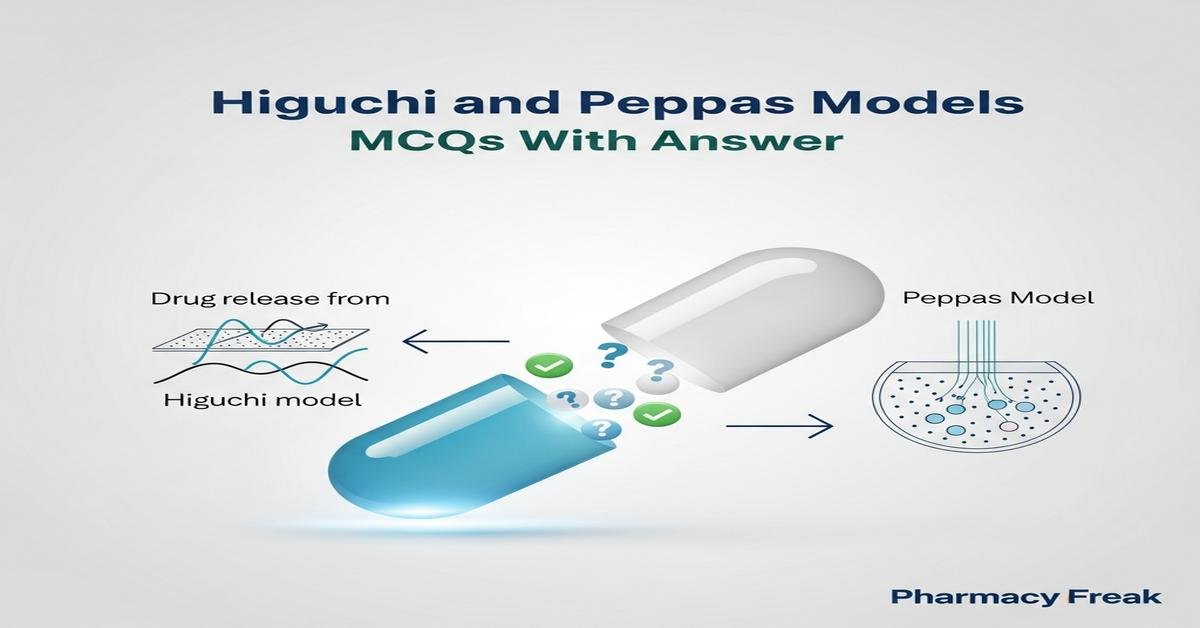
Higuchi and Peppas models MCQs With Answer are designed to strengthen your understanding of mathematical models that describe drug release from matrix systems. For M. Pharm students in Modern Pharmaceutics (MPH 103T), mastering these models is essential for interpreting in vitro release data, selecting appropriate dosage form designs, and elucidating roles of diffusion, polymer relaxation, and geometry. The Higuchi model explains diffusion-controlled release under specific assumptions (e.g., initial drug load much higher than solubility, non-swelling matrices), while the Korsmeyer–Peppas model generalizes early-time release behavior and mechanistic inference through the diffusional exponent (n). This quiz emphasizes equations, assumptions, linearization methods, mechanistic cut-offs, parameters (D, ε, τ, Cs), and practical interpretation of plots and units.
Q1. Which expression correctly represents the Higuchi model for drug release from a planar matrix?
- Q = kH t
- Q = kH t1/2
- Mt/M∞ = k tn
- ln(Mt) = k t
Correct Answer: Q = kH t1/2
Q2. In the Korsmeyer–Peppas model (Mt/M∞ = k tn), the exponent n primarily indicates:
- The solubility of the drug in the release medium
- The mechanism of release relative to device geometry
- The partition coefficient between polymer and medium
- The effect of agitation speed on release
Correct Answer: The mechanism of release relative to device geometry
Q3. For a planar (slab) device, the Fickian diffusion value of n in the Korsmeyer–Peppas model is:
- 0.43
- 0.45
- 0.50
- 0.89
Correct Answer: 0.50
Q4. Which is a key assumption of the classical Higuchi model for a solid drug dispersed in a non-swelling matrix?
- Initial drug concentration is much lower than its solubility
- Matrix swells extensively during release
- Drug diffusion coefficient increases exponentially with time
- Initial drug concentration is much higher than its solubility
Correct Answer: Initial drug concentration is much higher than its solubility
Q5. The most appropriate linear plot to verify the Higuchi model is:
- Cumulative amount released per unit area (Q) versus time (t)
- Q versus t1/2
- log(Mt/M∞) versus log t
- 1/Q versus 1/t
Correct Answer: Q versus t1/2
Q6. For the Korsmeyer–Peppas model, linearization typically uses:
- Q versus t
- Q versus t1/2
- log(Mt/M∞) versus log t
- ln(Mt/M∞) versus t
Correct Answer: log(Mt/M∞) versus log t
Q7. The Higuchi constant (kH) in porous matrices is primarily influenced by:
- Diffusion coefficient, drug solubility, porosity, and tortuosity
- Agitation speed and vessel geometry only
- pH of the medium only
- Particle size of the dissolution medium
Correct Answer: Diffusion coefficient, drug solubility, porosity, and tortuosity
Q8. For hydrophilic matrices that swell and undergo polymer relaxation, which model is commonly used to characterize early-time release?
- Higuchi model
- Korsmeyer–Peppas model
- Hixson–Crowell model
- Noyes–Whitney equation
Correct Answer: Korsmeyer–Peppas model
Q9. For a cylindrical device, the n value corresponding to case II (zero-order) transport in the Korsmeyer–Peppas model is approximately:
- 0.45
- 0.50
- 0.85
- 0.89
Correct Answer: 0.89
Q10. For a spherical device under Fickian diffusion, the expected n value in the Peppas model is approximately:
- 0.43
- 0.50
- 0.60
- 1.00
Correct Answer: 0.43
Q11. If the initial drug concentration in a matrix is below its solubility (C0 < Cs), the Higuchi model will typically:
- Hold perfectly with a straight line through the origin
- Fail, and release may approach first-order behavior
- Convert to zero-order kinetics
- Predict super case II transport
Correct Answer: Fail, and release may approach first-order behavior
Q12. Increasing tortuosity (τ) of a porous matrix will generally:
- Increase kH because diffusion paths become straighter
- Decrease kH because diffusion paths become more convoluted
- Have no effect on kH
- Convert diffusion from Fickian to non-Fickian
Correct Answer: Decrease kH because diffusion paths become more convoluted
Q13. If Q is expressed as mg/cm² and time in hours, the unit of the Higuchi constant kH is:
- mg cm⁻² h⁻¹
- mg cm⁻² h⁻¹ᐟ²
- mg cm⁻²
- h⁻¹
Correct Answer: mg cm⁻² h⁻¹ᐟ²
Q14. The Korsmeyer–Peppas model is most appropriately applied to:
- The entire release profile (0–100%) for all geometries
- Only the last 40% of release
- The initial portion, typically up to about 60% release
- Only zero-order systems
Correct Answer: The initial portion, typically up to about 60% release
Q15. The porous-matrix form of the Higuchi equation can be written as:
- Q = [D (2A Cs − Cs²) (ε/τ)]1/2 t1/2
- Q = D (A/Cs) t
- Mt/M∞ = k tn
- Q = (ε/τ) D t
Correct Answer: Q = [D (2A Cs − Cs²) (ε/τ)]1/2 t1/2
Q16. In the linearized Korsmeyer–Peppas plot (log(Mt/M∞) vs log t), the intercept corresponds to:
- n
- log k
- k
- 1/n
Correct Answer: log k
Q17. A data set yields an excellent linear fit for Q versus t1/2 (R² ≈ 0.99). The most appropriate inference is:
- Release follows diffusion control consistent with the Higuchi mechanism
- Release is purely erosion-controlled
- Release follows zero-order kinetics
- Release is governed by convective transport
Correct Answer: Release follows diffusion control consistent with the Higuchi mechanism
Q18. In a cylindrical matrix, the slope of log(Mt/M∞) vs log t is 0.65. The mechanism is best classified as:
- Fickian diffusion
- Anomalous (non-Fickian) transport
- Case II transport
- Super case II transport
Correct Answer: Anomalous (non-Fickian) transport
Q19. From a Higuchi plot, the slope kH is 15 mg cm⁻² h⁻¹ᐟ². The time needed to release 75 mg cm⁻² is:
- 5 h
- 15 h
- 25 h
- 50 h
Correct Answer: 25 h
Q20. If the diffusion coefficient (D) doubles with all other parameters constant in a Higuchi system, kH will:
- Double
- Increase by a factor of √2
- Remain unchanged
- Decrease by half
Correct Answer: Increase by a factor of √2


I am a Registered Pharmacist under the Pharmacy Act, 1948, and the founder of PharmacyFreak.com. I hold a Bachelor of Pharmacy degree from Rungta College of Pharmaceutical Science and Research. With a strong academic foundation and practical knowledge, I am committed to providing accurate, easy-to-understand content to support pharmacy students and professionals. My aim is to make complex pharmaceutical concepts accessible and useful for real-world application.
Mail- Sachin@pharmacyfreak.com