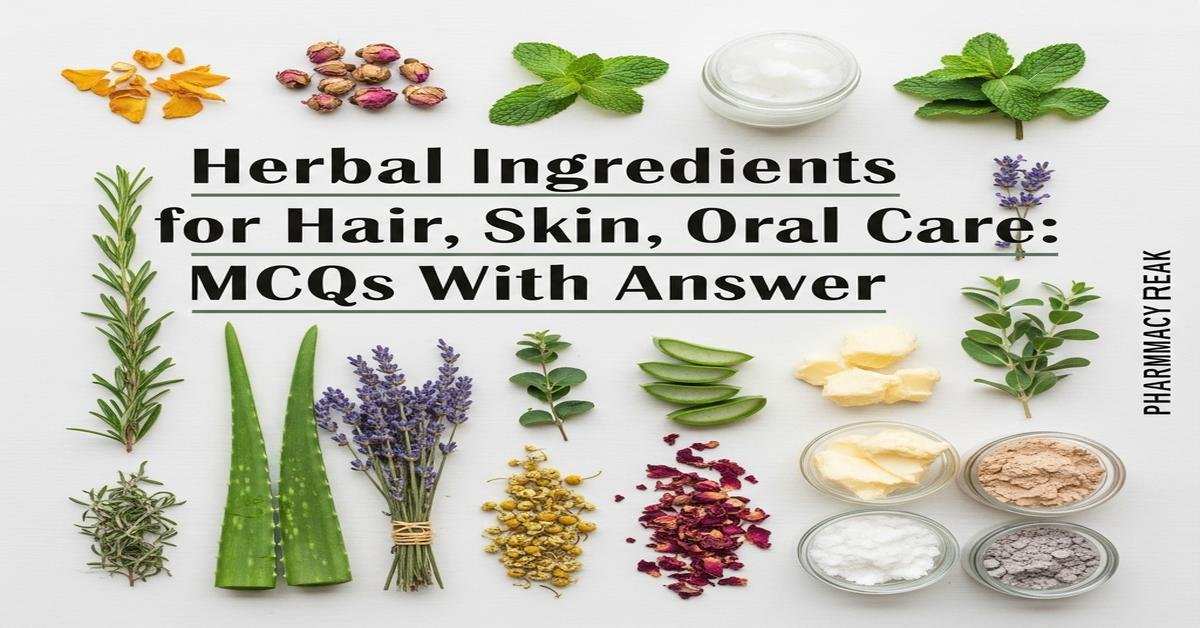
Introduction: Herbal ingredients for hair, skin, and oral care MCQs With Answer is designed for M.Pharm students preparing for advanced coursework and exams in Cosmetics & Cosmeceuticals (MPH 204T). This collection focuses on scientifically relevant herbal actives, their phytochemistry, mechanisms of action, formulation considerations, quality control, and safety issues. Each question emphasizes deeper understanding—marker compounds, analytical methods, pharmacological targets, and practical formulation challenges—rather than superficial recall. The quiz will help students integrate pharmacognosy, analytical techniques, and topical/oral delivery concepts while preparing for viva, theory exams, and research in herbal cosmeceuticals.
Q1. Which primary constituent in Aloe vera gel is responsible for skin hydration and stimulation of dermal fibroblasts?
- Polysaccharides (acemannan) that enhance hydration and stimulate fibroblasts
- Essential oils (menthol) providing cooling effect
- Alkaloids that act as keratolytic agents
- High molecular weight proteins causing occlusion
Correct Answer: Polysaccharides (acemannan) that enhance hydration and stimulate fibroblasts
Q2. The primary phytochemical in Emblica officinalis (Amla) contributing to antioxidant-mediated hair growth promotion is:
- Ascorbic acid (vitamin C) with strong antioxidant activity
- Alkaloids that inhibit 5-alpha reductase
- Fixed oils that act as emollients
- Saponins that provide antimicrobial action
Correct Answer: Ascorbic acid (vitamin C) with strong antioxidant activity
Q3. Which neem (Azadirachta indica) constituents are primarily linked to its antimicrobial and anti-inflammatory effects used in oral care?
- Limonoids such as nimbidin and gedunin
- Flavonoids like quercetin only
- Volatile monoterpenes like limonene exclusively
- High levels of simple sugars
Correct Answer: Limonoids such as nimbidin and gedunin
Q4. Green tea catechin (EGCG) exerts anti-aging effects on skin mainly by which mechanism?
- Inhibition of matrix metalloproteinases (MMPs) and scavenging reactive oxygen species
- Direct blockade of melanocyte proliferation increasing pigmentation
- Acting as a strong surfactant to remove sebum
- Providing occlusive film formation to prevent TEWL
Correct Answer: Inhibition of matrix metalloproteinases (MMPs) and scavenging reactive oxygen species
Q5. Which compound from Glycyrrhiza glabra (licorice) is recognized for skin lightening through tyrosinase inhibition?
- Glabridin, a potent tyrosinase inhibitor
- Saponins that physically exfoliate the stratum corneum
- Essential oils that bleach melanocytes
- High molecular weight polysaccharides increasing hydration
Correct Answer: Glabridin, a potent tyrosinase inhibitor
Q6. Which rosemary phytochemicals are exploited in hair formulations for antioxidant and shelf-life enhancement of oils?
- Carnosic acid and rosmarinic acid
- Alkaloids such as atropine
- High volatile sulphur compounds
- Simple monosaccharides
Correct Answer: Carnosic acid and rosmarinic acid
Q7. For standardization of a herbal cosmeceutical extract, which analytical parameter is considered primary for quantitative quality control?
- Quantitative marker assay by HPLC (marker compound content)
- Only organoleptic evaluation (color and smell)
- pH test alone irrespective of active content
- Viscosity measurement as sole standard
Correct Answer: Quantitative marker assay by HPLC (marker compound content)
Q8. Curcumin from Curcuma longa reduces skin inflammation primarily via which molecular pathway?
- Inhibition of NF-κB activation and downregulation of COX-2 expression
- Activation of tyrosinase to increase melanin synthesis
- Direct antimicrobial lysis of bacterial membranes
- Acting as a strong anionic surfactant
Correct Answer: Inhibition of NF-κB activation and downregulation of COX-2 expression
Q9. Which herbal component is widely used in dental analgesia but can be cytotoxic or irritating to mucosa at high concentrations?
- Eugenol from clove oil
- Ascorbic acid from citrus fruits
- Saponins from soapwort
- Polysaccharides from aloe
Correct Answer: Eugenol from clove oil
Q10. Which constituent found in bergamot oil is responsible for phototoxic reactions and must be controlled in topical formulations?
- Bergapten (a furanocoumarin) causing phototoxicity
- Terpinen-4-ol causing systemic sedation
- Acemannan causing keratolysis
- Rosmarinic acid causing hyperpigmentation
Correct Answer: Bergapten (a furanocoumarin) causing phototoxicity
Q11. Which class of plant constituents is commonly used as natural penetration enhancers in transdermal and topical herbal formulations?
- Terpenes (e.g., limonene, cineole) that disrupt stratum corneum lipids
- High molecular weight polysaccharides that occlude skin
- Basic alkaloids that increase skin pH permanently
- Insoluble waxes that decrease permeation
Correct Answer: Terpenes (e.g., limonene, cineole) that disrupt stratum corneum lipids
Q12. Anthocyanin-rich extracts (e.g., hibiscus) exhibit best color stability under which pH conditions for topical formulations?
- Acidic pH (around 3–4) to maintain flavylium cation form and color stability
- Strongly alkaline pH (above 10) for maximum stability
- Neutral pH (7) where anthocyanins polymerize to pigments
- pH is irrelevant for anthocyanin stability
Correct Answer: Acidic pH (around 3–4) to maintain flavylium cation form and color stability
Q13. The major antimicrobial constituent in tea tree oil (Melaleuca alternifolia) responsible for activity against Gram-positive pathogens is:
- Terpinen-4-ol
- Menthol
- Eugenol
- Curcumin
Correct Answer: Terpinen-4-ol
Q14. Which analytical technique is most appropriate for detecting adulteration and profiling volatile components of herbal essential oils used in cosmetics?
- Gas chromatography–mass spectrometry (GC–MS) fingerprinting
- Colorimetric pH strip testing only
- Viscosity measurement by capillary viscometer
- Simple gravimetric residue on ignition
Correct Answer: Gas chromatography–mass spectrometry (GC–MS) fingerprinting
Q15. Which herbal oil has demonstrated activity against Malassezia species and is commonly used in anti-dandruff formulations?
- Tea tree oil (Melaleuca alternifolia)
- Castor oil with only occlusive properties
- Mineral oil lacking antimicrobial activity
- Almond oil primarily a solvent oil
Correct Answer: Tea tree oil (Melaleuca alternifolia)
Q16. Salvadora persica (miswak) confers oral hygiene benefits primarily due to which set of constituents?
- Fluoride, silica, and antimicrobial alkaloids (e.g., salvadorine)
- High triglyceride content acting as an emollient
- Proteinaceous enzymes that digest enamel
- Photosensitizing furanocoumarins
Correct Answer: Fluoride, silica, and antimicrobial alkaloids (e.g., salvadorine)
Q17. In hair care, saponins from botanical sources primarily function as:
- Natural surfactants providing cleansing and foaming action
- Keratin cross-linkers strengthening hair shaft chemically
- UV absorbers preventing photo-degradation
- Metalloproteinase inhibitors for follicle protection
Correct Answer: Natural surfactants providing cleansing and foaming action
Q18. Which herbal ingredient is known for causing photosensitivity and clinically significant CYP enzyme interactions when used systemically, warranting caution?
- St. John’s Wort (Hypericum perforatum)
- Chamomile (Matricaria recutita) which is inert systemically
- Green tea at topical doses only
- Aloe vera gel applied topically without systemic effect
Correct Answer: St. John’s Wort (Hypericum perforatum)
Q19. Which herb-derived compound is commonly used in commercial mouthwashes for broad-spectrum antiseptic activity?
- Thymol (from Thymus vulgaris)
- Acemannan from aloe as a primary antiseptic
- Glabridin as an oral anesthetic
- Anthocyanins as anticalculus agents
Correct Answer: Thymol (from Thymus vulgaris)
Q20. Which herbal active typically requires formulation in hydroalcoholic or solubilized systems due to poor aqueous solubility for effective topical delivery?
- Curcumin (from Curcuma longa) with low water solubility
- Simple sugars that are freely water soluble
- Low molecular weight peptides dissolving in water
- Inorganic fluoride salts that are water soluble
Correct Answer: Curcumin (from Curcuma longa) with low water solubility


I am a Registered Pharmacist under the Pharmacy Act, 1948, and the founder of PharmacyFreak.com. I hold a Bachelor of Pharmacy degree from Rungta College of Pharmaceutical Science and Research. With a strong academic foundation and practical knowledge, I am committed to providing accurate, easy-to-understand content to support pharmacy students and professionals. My aim is to make complex pharmaceutical concepts accessible and useful for real-world application.
Mail- Sachin@pharmacyfreak.com