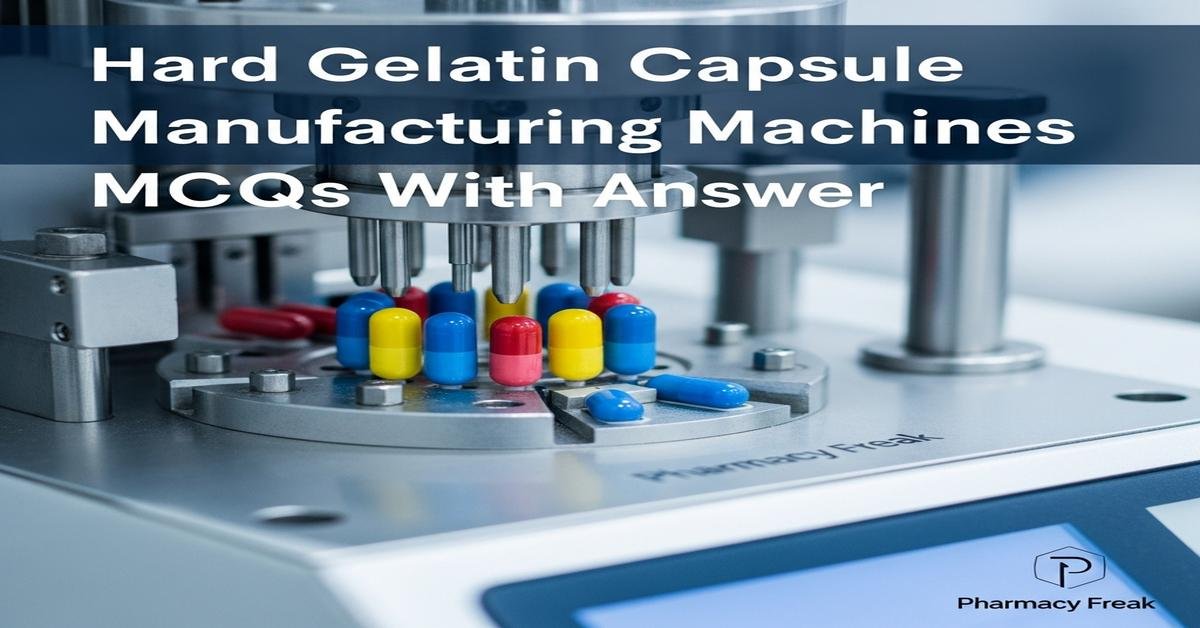
Hard Gelatin Capsule Manufacturing Machines MCQs With Answer is a focused collection of multiple-choice questions designed for M.Pharm students studying Pharmaceutical Production Technology (MIP 203T). This set targets the mechanical, operational, and quality-control aspects of hard gelatin capsule production — including dipping, pin-plate systems, capsule trimming, drying, polishing, and automated filling machines. Questions probe design features, process variables, common defects, maintenance, and regulatory considerations to deepen understanding beyond basic concepts. Each question is followed by plausible alternatives and a clear answer to help students prepare for exams and practical lab scenarios, reinforcing critical thinking about manufacturing equipment and process control in capsule production.
Q1. Which component is the primary film-forming material used to make conventional hard gelatin capsule shells?
- Polyvinyl alcohol
- Methylcellulose
- Gelatin
- Polyethylene glycol
Correct Answer: Gelatin
Q2. In the dip-coating process for hard gelatin capsules, what is the function of the pin plate?
- To cut capsule bodies to length
- To control capsule wall thickness by determining gelatin layer uptake
- To dry the capsules rapidly under vacuum
- To polish completed capsules before filling
Correct Answer: To control capsule wall thickness by determining gelatin layer uptake
Q3. Which of the following machine types is used to manufacture large batches of filled hard gelatin capsules with minimal manual intervention?
- Semi-automatic filling bench
- Automatic capsule filler (encapsulator)
- Manual hand-filling device
- Rotary capsule polishing machine
Correct Answer: Automatic capsule filler (encapsulator)
Q4. What is the primary purpose of the vacuüm system on a rotary capsule filling machine?
- To coat capsule shells with plasticizer
- To hold capsule bodies and caps in alignment during filling
- To dry the capsules after filling
- To eject defective capsules from the line
Correct Answer: To hold capsule bodies and caps in alignment during filling
Q5. Which operating parameter most directly influences capsule weight variation when filling powders in hard gelatin capsules?
- Ambient room color
- Punch and die clearance of the jacket
- Fill depth control and tamping settings
- Gelatin bloom strength only
Correct Answer: Fill depth control and tamping settings
Q6. What defect in capsule shells is typically caused by excessive humidity during drying or storage, leading to stickiness and distortion?
- Cross-linking
- Capsule blistering
- Capsule sticking and deformation
- Over-polymerization
Correct Answer: Capsule sticking and deformation
Q7. Which excipient is commonly added to gelatin mass to act as a plasticizer, improving shell flexibility?
- Magnesium stearate
- Sorbitol or glycerin
- Talc
- Sodium chloride
Correct Answer: Sorbitol or glycerin
Q8. In hard gelatin capsule manufacturing, what is the critical consequence of using gelatin with very low bloom strength?
- Excessive shell hardness and brittleness
- Weak capsule shells with poor mechanical strength
- Increased resistance to cross-linking
- Faster drying time and reduced tack
Correct Answer: Weak capsule shells with poor mechanical strength
Q9. Which part of an encapsulation line is responsible for trimming the pin-attached gelatin film to form separated body and cap portions?
- Drying tunnel
- Trimming knives or cutting station
- Polishing drum
- Deposit pump
Correct Answer: Trimming knives or cutting station
Q10. What is the main advantage of a rotary over a reciprocating (stationary) capsule filling machine?
- Lower initial capital cost but lower speed
- Higher throughput and continuous operation
- Better manual control for small batches
- Elimination of the need for a vacuum system
Correct Answer: Higher throughput and continuous operation
Q11. Which analytical measure on production monitors is most useful to detect early trends toward increased capsule leakage or cap-body separation?
- Ambient light intensity
- Percent defective or reject rate per hour
- Operator shift lengths
- Gelatin color variation
Correct Answer: Percent defective or reject rate per hour
Q12. Cross-linking of gelatin capsules is often induced by which of the following during storage or processing?
- Exposure to high humidity only
- Exposure to aldehydes or reactive formaldehyde-producing preservatives
- Short-term refrigeration
- Use of non-aqueous lubricants
Correct Answer: Exposure to aldehydes or reactive formaldehyde-producing preservatives
Q13. Which maintenance activity is essential for ensuring consistent fill weights and preventing powder bridging in a capsule filling machine?
- Regular calibration and inspection of the dosator or tamping stations
- Applying more lubricant to capsule shells
- Increasing ambient humidity in the production room
- Changing capsule sizes mid-run
Correct Answer: Regular calibration and inspection of the dosator or tamping stations
Q14. What is the role of a polishing drum or trommel in the post-filling section of a capsule line?
- To dry capsules under vacuum
- To remove dust, buff surfaces, and improve visual appearance
- To seal capsule seams with heat
- To check fill weight electronically
Correct Answer: To remove dust, buff surfaces, and improve visual appearance
Q15. Which environmental condition must be closely controlled in the capsule dipping and drying area to avoid shell defects?
- Airborne microbial counts only
- Temperature and relative humidity
- Background music volume
- Room wall color
Correct Answer: Temperature and relative humidity
Q16. In automatic capsule fillers, what is the purpose of the tamping station when filling powdered formulations?
- To seal the capsule with adhesive
- To compact powder in the capsule body to achieve desired weight and density
- To polish the capsule exterior
- To cool the capsule before packaging
Correct Answer: To compact powder in the capsule body to achieve desired weight and density
Q17. Which measurement technique is routinely used to verify uniformity of fill weight for hard gelatin capsules?
- High-performance liquid chromatography of the capsule shell
- Gravimetric weight checks of individual capsules
- Visual color comparison
- pH testing of capsule contents
Correct Answer: Gravimetric weight checks of individual capsules
Q18. What engineering feature helps minimize cross-contamination when switching products on a multi-purpose encapsulation line?
- Use of open bowls for powder handling
- Quick-release, clean-in-place (CIP) and validated changeover procedures
- Increasing production speed
- Leaving residual powder to save time
Correct Answer: Quick-release, clean-in-place (CIP) and validated changeover procedures
Q19. Which capsule machine parameter would you adjust to reduce the incidence of capping (capsule tops coming off) during speed increase?
- Increase the gelatin viscosity by adding more water
- Optimize cap-body locking force and alignment, and ensure proper vacuum hold
- Reduce the capsule size only
- Remove the polishing step
Correct Answer: Optimize cap-body locking force and alignment, and ensure proper vacuum hold
Q20. During validation of a new automatic capsule filling machine, which qualification activity specifically demonstrates consistent performance under routine operating conditions?
- Design Qualification (DQ)
- Operational Qualification (OQ)
- Performance Qualification (PQ)
- Decommissioning Qualification (DQ)
Correct Answer: Performance Qualification (PQ)

