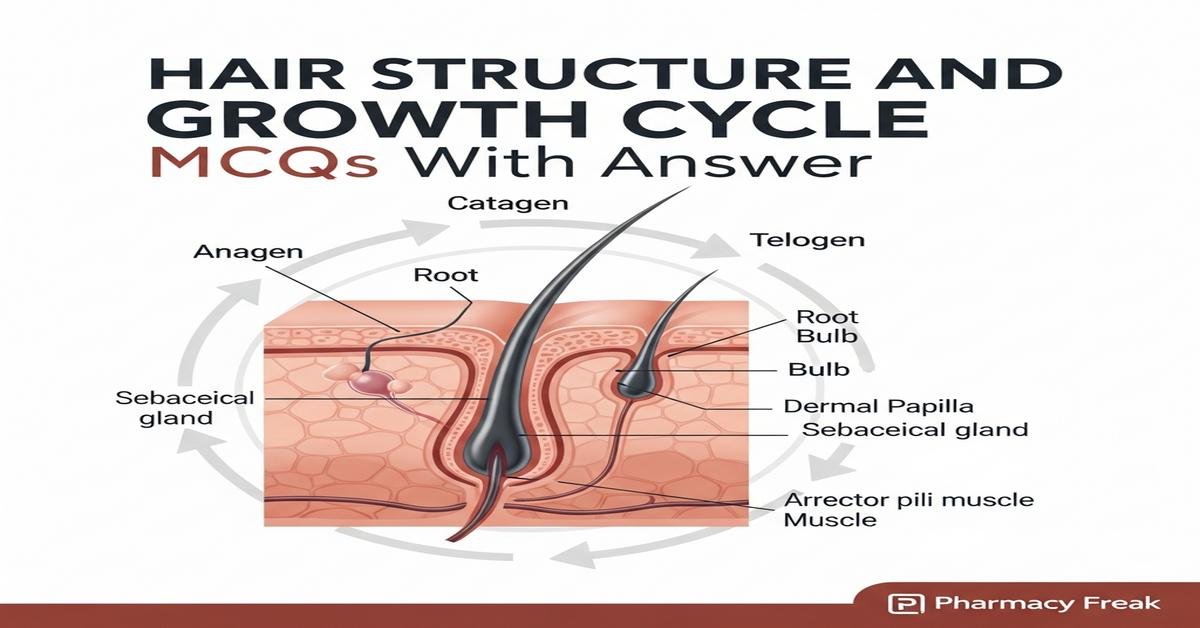
Hair structure and growth cycle MCQs With Answer
Introduction: This collection of multiple-choice questions is designed for M.Pharm students studying Cosmetics & Cosmeceuticals. It focuses on detailed aspects of hair anatomy, follicular biology, keratin biochemistry, pigmentation, and the physiological and molecular regulation of the hair growth cycle. Questions probe knowledge of anagen/catagen/telogen/exogen phases, cellular players such as matrix keratinocytes and dermal papilla, androgen and enzyme roles, clinical disorders like androgenetic alopecia and telogen effluvium, and mechanisms of common therapeutics. Use these MCQs to reinforce conceptual understanding and prepare for rigorous postgraduate examinations in formulation science and cosmeceutical therapeutics.
Q1. What are the three primary structural layers of the hair shaft?
- Cuticle, cortex and medulla
- Cuticle, cortex and bulb
- Cuticle, dermal papilla and cortex
- Medulla, bulb and follicle
Correct Answer: Cuticle, cortex and medulla
Q2. Which cell population is the main source of keratinocytes that form the hair shaft?
- Outer root sheath keratinocytes
- Matrix keratinocytes of the hair bulb
- Infundibular keratinocytes
- Dermal papilla fibroblasts
Correct Answer: Matrix keratinocytes of the hair bulb
Q3. Typical duration of the anagen phase for human scalp hair is:
- 2–7 years (variable)
- 2–3 weeks
- 3 months
- One day
Correct Answer: 2–7 years (variable)
Q4. Which description best fits the catagen phase?
- A growth phase where hair elongates rapidly
- A programmed apoptotic involution phase lasting about 2–3 weeks
- A long resting phase of approximately 2–7 years
- The active shedding of the hair shaft
Correct Answer: A programmed apoptotic involution phase lasting about 2–3 weeks
Q5. The telogen phase is best described as:
- A proliferative phase with high mitotic index
- A resting phase lasting ~3 months (around 100 days)
- The initial embryonic formation of the follicle
- A phase characterized by follicular apoptosis only
Correct Answer: A resting phase lasting ~3 months (around 100 days)
Q6. What is the difference between exogen and kenogen?
- Exogen is new hair formation; kenogen is pigment production
- Exogen is active shedding of hair; kenogen is interval when follicle remains empty after shedding
- Exogen is the resting phase; kenogen is the growth phase
- Exogen and kenogen are synonymous terms
Correct Answer: Exogen is active shedding of hair; kenogen is interval when follicle remains empty after shedding
Q7. The hair bulb contains which two intimately interacting structures essential for hair production?
- Infundibulum and isthmus
- Dermal papilla (mesenchymal capillary tuft) and matrix keratinocytes
- Cuticle and medulla
- Arrector pili and sebaceous gland
Correct Answer: Dermal papilla (mesenchymal capillary tuft) and matrix keratinocytes
Q8. Hair pigmentation is primarily determined by which cells and pigments?
- Keratinocytes producing carotenoids
- Melanocytes in the hair bulb producing eumelanin and pheomelanin
- Sebaceous gland cells secreting lipofuscin
- Dermal papilla secreting hemoglobin-derived pigments
Correct Answer: Melanocytes in the hair bulb producing eumelanin and pheomelanin
Q9. Which type of keratin predominates in the hair shaft and contributes to its mechanical strength?
- Soft (beta) keratin low in cysteine
- Hard (alpha) keratin rich in cysteine disulfide bonds
- Simple epithelial keratin I only
- Collagen-like keratin lacking disulfide bonds
Correct Answer: Hard (alpha) keratin rich in cysteine disulfide bonds
Q10. The key androgen implicated in androgenetic alopecia acts primarily through which molecule?
- Testosterone binding to estrogen receptors
- Dihydrotestosterone (DHT) produced by 5α-reductase type II in follicle
- Cortisol produced by sebaceous glands
- Progesterone metabolite that activates keratinocytes
Correct Answer: Dihydrotestosterone (DHT) produced by 5α-reductase type II in follicle
Q11. Minoxidil’s principal mechanism in promoting hair growth is:
- Direct inhibition of 5α-reductase
- Opening KATP channels causing vasodilation and prolongation of anagen phase
- Blocking androgen receptors in dermal papilla
- Stimulating melanocyte proliferation
Correct Answer: Opening KATP channels causing vasodilation and prolongation of anagen phase
Q12. Finasteride treats androgenetic alopecia by:
- Antagonizing androgen receptors on keratinocytes
- Selective inhibition of 5α-reductase type II, reducing DHT formation
- Stimulating sebaceous gland activity to nourish follicles
- Increasing systemic estrogen levels
Correct Answer: Selective inhibition of 5α-reductase type II, reducing DHT formation
Q13. Which statement best describes alopecia areata?
- Scarring hair loss due to fungal infection
- Autoimmune, T-cell mediated, non-scarring patchy hair loss with ‘exclamation mark’ hairs
- Diffuse telogen shedding caused by metabolic stress
- Androgen-driven progressive miniaturization of follicles
Correct Answer: Autoimmune, T-cell mediated, non-scarring patchy hair loss with ‘exclamation mark’ hairs
Q14. Telogen effluvium is most commonly triggered by which of the following?
- Localized fungal infection of follicles
- Diffuse increased hair shedding triggered by physiological or emotional stressors (e.g., fever, surgery, postpartum)
- Genetic polymorphism in keratin genes only
- Topical application of oils exclusively
Correct Answer: Diffuse increased hair shedding triggered by physiological or emotional stressors (e.g., fever, surgery, postpartum)
Q15. Average human scalp hair growth rate is approximately:
- 0.03–0.04 mm per day
- Approximately 0.3–0.4 mm per day (about 1 cm per month)
- 3–4 mm per day
- 10 mm per month
Correct Answer: Approximately 0.3–0.4 mm per day (about 1 cm per month)
Q16. Follicular miniaturization in androgenetic alopecia refers to:
- Enlargement of sebaceous glands around follicles
- Progressive miniaturization of terminal follicles into vellus-like follicles
- Acute inflammation causing scarring alopecia
- Excessive medullary thickening of shafts
Correct Answer: Progressive miniaturization of terminal follicles into vellus-like follicles
Q17. The cuticle of the hair shaft primarily functions to:
- Produce melanin
- Serve as a sensory receptor
- Overlapping scale-like cells that protect cortex and determine hair smoothness and shine
- Supply blood and nutrients to the hair shaft
Correct Answer: Overlapping scale-like cells that protect cortex and determine hair smoothness and shine
Q18. The medulla of hair is:
- Always present in all hair types
- Often absent in fine (vellus) hairs; present in thick terminal hairs
- The active mitotic zone producing keratinocytes
- Generated by the sebaceous gland
Correct Answer: Often absent in fine (vellus) hairs; present in thick terminal hairs
Q19. Does the hair follicle show immune privilege and where is it located?
- No, follicles are highly immunogenic throughout
- Yes — the bulb region maintains immune privilege through low MHC expression and immunosuppressive factors
- Yes — the infundibulum alone is immune privileged
- Only sebaceous glands show immune privilege
Correct Answer: Yes — the bulb region maintains immune privilege through low MHC expression and immunosuppressive factors
Q20. In hair biology, the ‘growth fraction’ refers to:
- The ratio of sebaceous gland cells dividing to resting
- The proportion of follicles in active anagen phase at a given time
- The percentage of hair shafts containing medulla
- The fraction of follicles undergoing apoptosis
Correct Answer: The proportion of follicles in active anagen phase at a given time


I am a Registered Pharmacist under the Pharmacy Act, 1948, and the founder of PharmacyFreak.com. I hold a Bachelor of Pharmacy degree from Rungta College of Pharmaceutical Science and Research. With a strong academic foundation and practical knowledge, I am committed to providing accurate, easy-to-understand content to support pharmacy students and professionals. My aim is to make complex pharmaceutical concepts accessible and useful for real-world application.
Mail- Sachin@pharmacyfreak.com