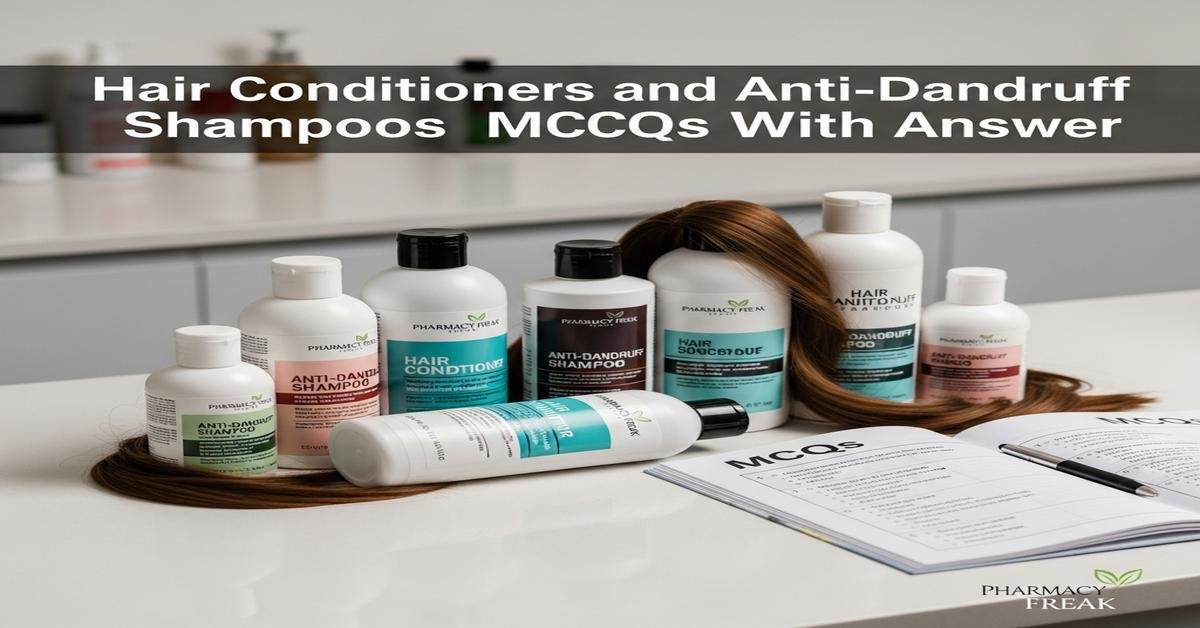
Introduction: This concise, keyword-rich overview on hair conditioners and anti-dandruff shampoos is tailored for B. Pharm students. It emphasizes formulation science, mechanisms of action of actives (zinc pyrithione, ketoconazole, selenium sulfide, coal tar, salicylic acid), surfactants and conditioning agents (quaternary ammoniums, silicones), HLB and emulsification, preservative choice, stability, safety and irritation concerns, efficacy testing (foam, combing force, substantivity, preservative challenge), and regulatory classification. The material links pharmaceutical principles to practical formulation and clinical use, preparing you for both exams and laboratory work. Now let’s test your knowledge with 30 MCQs on this topic.
Q1. What is the primary purpose of a hair conditioner?
- Neutralize scalp sebum
- Smooth hair cuticle and reduce friction
- Cure fungal infections
- Increase scalp pH
Correct Answer: Smooth hair cuticle and reduce friction
Q2. Which class of conditioning agents binds effectively to negatively charged hair surfaces?
- Nonionic surfactants
- Anionic surfactants
- Cationic quaternary ammonium compounds
- Chelating agents
Correct Answer: Cationic quaternary ammonium compounds
Q3. Which silicone is most commonly used in rinse-off conditioners to impart slip and shine?
- Dimethicone
- Cyclomethicone
- Amodimethicone
- PEG-40
Correct Answer: Dimethicone
Q4. In conditioner formulation, what does HLB indicate?
- Determines antimicrobial activity
- Indicates emulsifier balance for oil-in-water or water-in-oil
- Measures viscosity
- Predicts color stability
Correct Answer: Indicates emulsifier balance for oil-in-water or water-in-oil
Q5. Which antifungal agent is widely used in anti-dandruff shampoos for broad-spectrum activity?
- Ketoconazole
- Zinc pyrithione
- Selenium sulfide
- Salicylic acid
Correct Answer: Ketoconazole
Q6. What is the primary mechanism of action of zinc pyrithione in anti-dandruff shampoos?
- Inhibits fungal mitosis by binding DNA
- Chelates calcium and promotes shedding
- Disrupts membrane transport by chelating metal ions and inhibiting respiration
- Acts primarily as a keratolytic agent
Correct Answer: Disrupts membrane transport by chelating metal ions and inhibiting respiration
Q7. Selenium sulfide reduces dandruff primarily by which action?
- Acting as a surfactant
- Reducing epidermal proliferation and having antifungal effect
- Providing emollient properties
- Lowering hair pH
Correct Answer: Reducing epidermal proliferation and having antifungal effect
Q8. How does coal tar help in dandruff and seborrheic dermatitis?
- Acts as a surfactant
- Functions as an antiproliferative and reduces scaling by slowing epidermal mitosis
- Serves as a conditioning agent
- Neutralizes fungal enzymes
Correct Answer: Functions as an antiproliferative and reduces scaling by slowing epidermal mitosis
Q9. What is the role of salicylic acid in anti-dandruff formulations?
- Keratolytic
- Antibacterial
- Foam booster
- pH adjuster
Correct Answer: Keratolytic
Q10. What is the recommended pH range for most hair conditioners to preserve cuticle integrity?
- 2.0–3.0
- 4.5–5.5
- 7.5–8.5
- 9.0–10.0
Correct Answer: 4.5–5.5
Q11. Which preservative is commonly used and compatible with many shampoo and conditioner systems?
- Phenoxyethanol
- Benzalkonium chloride
- Sodium lauryl sulfate
- Cetyl alcohol
Correct Answer: Phenoxyethanol
Q12. Cetrimonium chloride in conditioners primarily functions as what?
- Anionic surfactant
- Cationic conditioning agent and antistatic
- Keratolytic
- Chelator
Correct Answer: Cationic conditioning agent and antistatic
Q13. Which evaluation test directly measures improvement in combing after conditioning?
- Foam test
- Combing force test
- pH test
- Viscosity test
Correct Answer: Combing force test
Q14. The major organism implicated in dandruff pathogenesis is:
- Malassezia yeast and increased epidermal turnover
- Staphylococcus aureus
- Excessive sun exposure
- Iron deficiency
Correct Answer: Malassezia yeast and increased epidermal turnover
Q15. For severe inflammatory seborrheic dermatitis of the scalp, which shampoo active is often recommended?
- Ketoconazole 2%
- Zinc pyrithione 0.25%
- Salicylic acid 0.5%
- Dimethicone 1%
Correct Answer: Ketoconazole 2%
Q16. Which ingredient class improves wet combing and reduces frizz by forming a hydrophobic film?
- Silicones like dimethicone
- Selenium sulfide
- Coal tar
- Salicylic acid
Correct Answer: Silicones like dimethicone
Q17. Why are cationic surfactants often incompatible with anionic surfactants in the same formulation?
- They increase pH excessively
- They form insoluble complexes and reduce efficacy
- They enhance foaming synergistically
- They both act as preservatives
Correct Answer: They form insoluble complexes and reduce efficacy
Q18. What is the standard test to assess preservative efficacy in shampoos and conditioners?
- Challenge test (preservative efficacy test)
- Patch test
- Viscosity test
- pH stability test
Correct Answer: Challenge test (preservative efficacy test)
Q19. For stable oil-in-water conditioners, best practice to incorporate oils is to:
- Use a low HLB emulsifier
- Add oil directly without emulsifier
- Use a high HLB emulsifier and proper homogenization
- Heat the oil below 30°C
Correct Answer: Use a high HLB emulsifier and proper homogenization
Q20. Why is viscosity control important in conditioner formulations?
- It influences spreadability, stability, and consumer perception
- It determines product color
- It directly kills fungal pathogens
- It replaces the need for preservatives
Correct Answer: It influences spreadability, stability, and consumer perception
Q21. What is the role of chelating agents like EDTA in shampoo formulations?
- Enhance foam stability by binding metal ions
- Act as primary surfactants
- Provide fragrance
- Function as conditioning agents
Correct Answer: Enhance foam stability by binding metal ions
Q22. A major safety consideration for selenium sulfide treatment is:
- Avoid in pregnant women due to teratogenicity
- Avoid in newborns and inflamed skin due to irritation risk
- Contraindicated with silicones
- Cannot be rinsed out and thus accumulates
Correct Answer: Avoid in newborns and inflamed skin due to irritation risk
Q23. What distinguishes a leave-on conditioner from a rinse-off conditioner?
- There is no difference in function
- Leave-on is not rinsed and provides longer conditioning; rinse-off is applied then rinsed
- Rinse-off remains on hair permanently
- Leave-on contains only antifungal actives
Correct Answer: Leave-on is not rinsed and provides longer conditioning; rinse-off is applied then rinsed
Q24. Which amphoteric surfactant is commonly used to reduce irritation and boost foam in shampoos?
- Cocamidopropyl betaine
- Sodium lauryl sulfate
- Cetyl alcohol
- Dimethicone
Correct Answer: Cocamidopropyl betaine
Q25. How does hard water affect shampoo performance?
- No significant effect
- Hard water cations reduce foam and cause precipitates with anionic surfactants
- Hard water enhances antimicrobial activity
- Hard water lowers formulation pH
Correct Answer: Hard water cations reduce foam and cause precipitates with anionic surfactants
Q26. What term describes the ability of a conditioning agent to remain on hair after rinsing?
- Substantivity
- Volatility
- Foamability
- Hydrophilicity
Correct Answer: Substantivity
Q27. Which anti-dandruff active also provides keratolytic action to remove scales?
- Salicylic acid
- Ketoconazole
- Zinc pyrithione
- Dimethicone
Correct Answer: Salicylic acid
Q28. What is a major safety concern associated with coal tar use in scalp treatments?
- Photosensitivity and potential carcinogenic impurities
- Severe antifungal resistance
- Enhances hair conditioning excessively
- Acts as a strong pH neutralizer
Correct Answer: Photosensitivity and potential carcinogenic impurities
Q29. Which analytical technique is most appropriate to quantify zinc pyrithione concentration in a shampoo?
- HPLC
- Microscopy
- pH meter
- Viscometry
Correct Answer: HPLC
Q30. How are anti-dandruff shampoos commonly classified by regulators?
- Cosmetic, medicinal depending on claims and active ingredients
- Always cosmetic
- Always prescription drug
- Food product
Correct Answer: Cosmetic, medicinal depending on claims and active ingredients


I am a Registered Pharmacist under the Pharmacy Act, 1948, and the founder of PharmacyFreak.com. I hold a Bachelor of Pharmacy degree from Rungta College of Pharmaceutical Science and Research. With a strong academic foundation and practical knowledge, I am committed to providing accurate, easy-to-understand content to support pharmacy students and professionals. My aim is to make complex pharmaceutical concepts accessible and useful for real-world application.
Mail- Sachin@pharmacyfreak.com