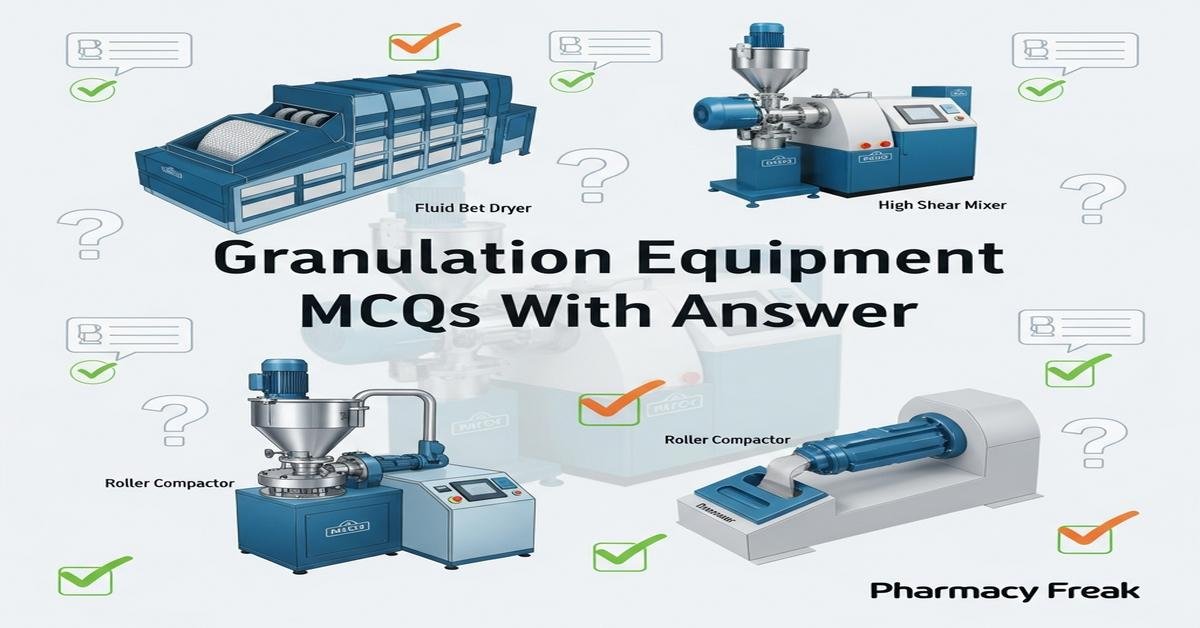
Granulation Equipment MCQs With Answer
This quiz collection is designed specifically for M.Pharm students studying MIP 203T – Pharmaceutical Production Technology. It focuses on granulation equipment — covering principles, operation, process parameters, scale-up considerations, and common manufacturing challenges. Questions probe understanding of high-shear granulators, fluidized bed systems, roller compactors, twin‑screw granulators, atomizers, and downstream handling. Each item emphasizes practical and mechanistic aspects such as binder spray, impeller/chopper function, residence time, atomization, granule properties, and equipment design for cleaning and containment. Use these MCQs to assess and reinforce advanced conceptual and application-level knowledge needed for pharmaceutical granulation processes and equipment selection.
Q1. What is the primary purpose of granulation in solid dosage manufacturing?
- To improve powder flow and compressibility
- To chemically stabilize the active ingredient
- To sterilize the powder blend
- To reduce API potency
Correct Answer: To improve powder flow and compressibility
Q2. Which granulation equipment typically contains an impeller and a chopper working inside a mixing bowl?
- Fluidized bed granulator
- High-shear granulator (planetary mixer/rapid mixer granulator)
- Rotary tablet granulator
- Twin-screw extruder
Correct Answer: High-shear granulator (planetary mixer/rapid mixer granulator)
Q3. Which type of fluidized bed granulator is most commonly used for top-spray wet granulation?
- Wurster (bottom-spray) insert
- Top-spray fluidized bed granulator
- Rotary drum granulator
- V-cone granulator
Correct Answer: Top-spray fluidized bed granulator
Q4. In a high-shear granulator, the chopper is primarily used to:
- Atomize binder into fine droplets
- Provide heat for drying
- Break oversized agglomerates and control granule size
- Increase residence time by slowing the mix
Correct Answer: Break oversized agglomerates and control granule size
Q5. What is a major advantage of twin-screw wet granulation over batch high-shear processes?
- It requires no binder
- Continuous processing with better process control and narrow residence time distribution
- Always produces larger granules with poor flow
- Eliminates the need for downstream drying
Correct Answer: Continuous processing with better process control and narrow residence time distribution
Q6. Roller compaction is categorized as which type of granulation process?
- Wet granulation producing spherical pellets
- Dry granulation producing compacted ribbons or flakes for milling
- Spray granulation in a fluidized bed
- Extrusion-spheronization
Correct Answer: Dry granulation producing compacted ribbons or flakes for milling
Q7. Which atomizer type is typically used to produce very fine spray droplets in binder spraying?
- Rotary atomizer
- Two-fluid (pneumatic) nozzle
- Pressure (hydraulic) nozzle
- Spray bar with large orifices
Correct Answer: Two-fluid (pneumatic) nozzle
Q8. Which process parameter most directly controls granule growth rate during wet granulation?
- Binder spray rate
- Drying oven color
- Tablet press turret speed
- API particle density only
Correct Answer: Binder spray rate
Q9. Which configuration is best suited when intent is to perform layering/coating and granulation in a single fluidized bed step (e.g., pellet coating)?
- Top-spray fluidized bed without insert
- Fluidized bed with Wurster (bottom-spray) insert
- High-shear granulator with open bowl
- Rotary tablet press
Correct Answer: Fluidized bed with Wurster (bottom-spray) insert
Q10. Over-wetting during wet granulation commonly results in:
- Formation of dense, non-porous granules and sticking to equipment surfaces
- Excessively fine powder and reduced particle size
- Instant drying with no need for dryer
- Complete elimination of fines without agglomeration
Correct Answer: Formation of dense, non-porous granules and sticking to equipment surfaces
Q11. Which test directly measures granule friability used to assess mechanical robustness?
- Loss on drying
- Friability test (percentage weight loss on tumbling)
- Disintegration test
- Viscosity of binder solution
Correct Answer: Friability test (percentage weight loss on tumbling)
Q12. The impeller design commonly used in high-shear granulators is referred to as:
- Axial-flow propeller
- Turbine-type impeller
- Paddle extruder
- Wurster rotor
Correct Answer: Turbine-type impeller
Q13. Which material is most commonly specified for product-contact parts of granulation equipment to meet pharmaceutical hygiene requirements?
- Carbon steel with paint
- 316L stainless steel (pharmaceutical grade)
- Aluminum alloy
- Brass with passivation
Correct Answer: 316L stainless steel (pharmaceutical grade)
Q14. Why is mean residence time important in continuous twin‑screw granulation?
- It determines the color of the final granules only
- It determines the extent of wetting, granule growth and size distribution
- It controls the electrical conductivity of the blend
- It is irrelevant for granule size control
Correct Answer: It determines the extent of wetting, granule growth and size distribution
Q15. During scale-up of a fluidized bed granulator, which hydrodynamic parameter must be maintained to ensure similar fluidization behavior?
- Minimum fluidization velocity (Umf) and similar gas velocity ratios
- Impeller tip speed only
- Exact bed mass regardless of geometry
- Binder concentration only
Correct Answer: Minimum fluidization velocity (Umf) and similar gas velocity ratios
Q16. Compared to direct compression and dry powder handling, wet granulation typically:
- Generates more airborne dust and higher inhalation risk
- Reduces airborne dust and improves operator safety for dusty APIs
- Eliminates the need for downstream compression
- Always increases tablet disintegration time
Correct Answer: Reduces airborne dust and improves operator safety for dusty APIs
Q17. Extrusion-spheronization as a granulation/pelletization route requires which sequence of equipment?
- High-shear granulator followed by fluid bed dryer
- Extruder followed by spheronizer
- Roller compactor followed by tablet press
- Pin mill followed by direct compression
Correct Answer: Extruder followed by spheronizer
Q18. Granule porosity most directly influences which product attributes?
- Dissolution rate and compaction behavior
- Color and taste only
- API chemical structure
- None of the physical properties
Correct Answer: Dissolution rate and compaction behavior
Q19. To minimize droplet size and improve atomization efficiency in a fluid bed spray, which nozzle is preferred?
- Plain spray bar
- Two-fluid (atomizing) nozzle
- Large-orifice manual spray gun
- Rotary pan spray bar
Correct Answer: Two-fluid (atomizing) nozzle
Q20. Which equipment design feature is most important to enable effective clean-in-place (CIP) for granulation vessels?
- Multiple internal dead legs for process sampling
- Smooth welds, sloped surfaces and full drainability
- Porous coatings on contact parts
- Complex internal baffles that are not removable
Correct Answer: Smooth welds, sloped surfaces and full drainability

