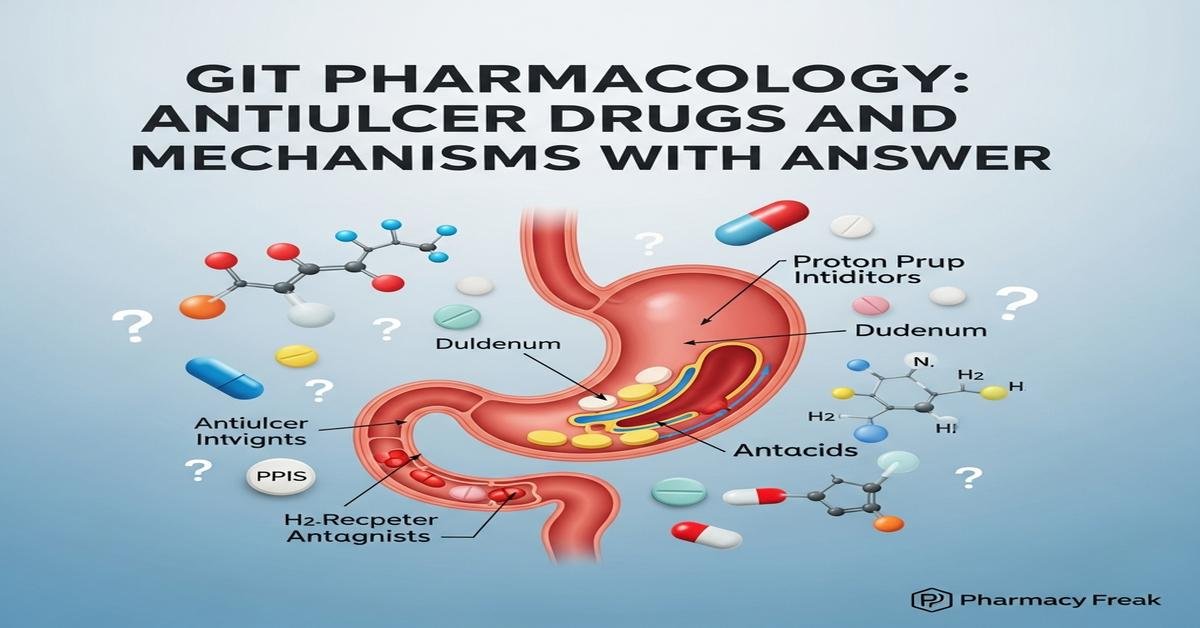
GIT pharmacology: antiulcer drugs and mechanisms MCQs With Answer
This quiz set is designed specifically for M.Pharm students preparing for Advanced Pharmacology-II examinations. It focuses on antiulcer pharmacology, integrating detailed mechanisms of acid secretion, cytoprotective strategies, and eradication therapies for Helicobacter pylori. Questions cover proton pump inhibitors, H2 receptor antagonists, antacids, prostaglandin analogs, mucosal protectants, bismuth compounds, pharmacokinetics, drug interactions, and adverse effect profiles. Each MCQ emphasizes mechanistic reasoning and clinically relevant pharmacology to reinforce understanding beyond rote memorization. Use these items for self-assessment, group discussion, and exam practice to sharpen application-level knowledge required in postgraduate pharmacy training.
Q1. Which statement best describes the mechanism of action of proton pump inhibitors (PPIs)?
- Omeprazole — reversible competitive antagonist at the H2 receptor
- Omeprazole — irreversible H+/K+ ATPase inhibitor activated in the canalicular space
- Omeprazole — neutralizes gastric acid through chemical buffering
- Omeprazole — increases mucosal prostaglandin synthesis to protect epithelium
Correct Answer: Omeprazole — irreversible H+/K+ ATPase inhibitor activated in the canalicular space
Q2. Which antiulcer agent’s therapeutic effect is primarily due to stimulation of prostaglandin E1 (PGE1) receptors leading to increased mucous and bicarbonate secretion?
- Ranitidine — H2 receptor antagonist
- Misoprostol — PGE1 analogue
- Sucralfate — sulfated sucrose-aluminum complex
- Bismuth subsalicylate — mucosal coating and weak antibacterial action
Correct Answer: Misoprostol — PGE1 analogue
Q3. Which of the following best explains why PPIs are more effective than H2 antagonists for healing duodenal ulcers?
- PPIs block gastrin receptors on parietal cells
- PPIs neutralize gastric acid directly in the lumen
- PPIs cause prolonged suppression of basal and meal-stimulated acid secretion by irreversible inhibition of the proton pump
- PPIs increase somatostatin release to inhibit acid secretion
Correct Answer: PPIs cause prolonged suppression of basal and meal-stimulated acid secretion by irreversible inhibition of the proton pump
Q4. Which antacid component carries a risk of hypermagnesemia in renal failure patients?
- Calcium carbonate
- Aluminium hydroxide
- Magnesium hydroxide
- Sodium bicarbonate
Correct Answer: Magnesium hydroxide
Q5. Sucralfate promotes ulcer healing primarily by which mechanism?
- Systemic increase in prostaglandin synthesis
- Local formation of viscous adhesive barrier that binds to exposed proteins in ulcer crater
- Neutralization of gastric acid through alkaline salts
- Inhibition of H. pylori urease enzyme
Correct Answer: Local formation of viscous adhesive barrier that binds to exposed proteins in ulcer crater
Q6. Which of the following is the most important drug–drug interaction concern when combining omeprazole with clopidogrel?
- Omeprazole induces CYP3A4 increasing clopidogrel activation
- Omeprazole inhibits CYP2C19 reducing clopidogrel bioactivation to its active metabolite
- Omeprazole increases renal clearance of clopidogrel
- Omeprazole increases gastric pH thereby increasing clopidogrel absorption
Correct Answer: Omeprazole inhibits CYP2C19 reducing clopidogrel bioactivation to its active metabolite
Q7. Which regimen is a standard triple therapy for H. pylori eradication?
- Omeprazole + metronidazole + bismuth subsalicylate
- Omeprazole + amoxicillin + clarithromycin
- Ranitidine + tetracycline + bismuth
- Sucralfate + amoxicillin + ciprofloxacin
Correct Answer: Omeprazole + amoxicillin + clarithromycin
Q8. Which H2 receptor antagonist is most likely to cause gynecomastia and drug interactions through CYP inhibition?
- Ranitidine
- Cimetidine
- Famotidine
- Nizatidine
Correct Answer: Cimetidine
Q9. Which statement about bismuth compounds used in peptic ulcer disease is correct?
- Bismuth has systemic bactericidal activity against H. pylori after rapid absorption
- Bismuth subsalicylate acts by local mucosal coating and has antibacterial action against H. pylori in the stomach
- Bismuth causes profound acid suppression by inhibiting H+/K+ ATPase
- Bismuth is contraindicated in combination with antibiotics for H. pylori
Correct Answer: Bismuth subsalicylate acts by local mucosal coating and has antibacterial action against H. pylori in the stomach
Q10. Which adverse effect is classically associated with misoprostol therapy and limits its use in women of childbearing potential?
- Constipation
- Uterine contractions and potential abortion
- Renal toxicity
- Severe hypertension
Correct Answer: Uterine contractions and potential abortion
Q11. Why are PPIs usually administered before breakfast rather than at bedtime?
- PPIs require food to convert into active metabolite in the intestine
- PPIs irreversibly inhibit pumps only when parietal cells are actively secreting, which occurs with meal-stimulated proton pump trafficking
- PPIs are unstable in the gastric lumen at night
- PPIs cause sleep disturbances if taken at night
Correct Answer: PPIs irreversibly inhibit pumps only when parietal cells are actively secreting, which occurs with meal-stimulated proton pump trafficking
Q12. Which of the following best describes the mechanism by which H2 receptor antagonists reduce gastric acid secretion?
- Block adenylate cyclase in parietal cells by antagonizing histamine H2 receptors, reducing cAMP-mediated activation of H+/K+ ATPase
- Competitive antagonism at muscarinic M3 receptors on parietal cells
- Direct inhibition of gastrin receptors on ECL cells
- Binding chloride channels on parietal cells to reduce acid secretion
Correct Answer: Block adenylate cyclase in parietal cells by antagonizing histamine H2 receptors, reducing cAMP-mediated activation of H+/K+ ATPase
Q13. A patient on long-term PPI therapy presents with recurrent fractures; which mechanism explains increased fracture risk with chronic PPI use?
- PPI-induced hypercalcemia causing bone resorption
- Reduced calcium absorption due to higher gastric pH leading to decreased bone mineral density
- Direct osteoclast activation by PPIs
- PPIs inhibit vitamin D activation in the kidney
Correct Answer: Reduced calcium absorption due to higher gastric pH leading to decreased bone mineral density
Q14. Which agent is most appropriate to rapidly neutralize gastric acid in acute symptomatic relief of heartburn?
- Omeprazole
- Calcium carbonate antacid
- Misoprostol
- Sucralfate
Correct Answer: Calcium carbonate antacid
Q15. Which of the following explains resistance of H. pylori to clarithromycin in eradication therapy?
- Mutations in 23S rRNA reducing macrolide binding
- Overexpression of urease enzyme
- Efflux pumps for penicillins
- Altered DNA gyrase preventing fluoroquinolone binding
Correct Answer: Mutations in 23S rRNA reducing macrolide binding
Q16. Which statement about sucralfate’s interaction profile is correct?
- Sucralfate is systemically absorbed and causes CYP450 induction
- Sucralfate binds to and can reduce absorption of concurrently administered drugs like fluoroquinolones and tetracyclines
- Sucralfate enhances absorption of H2 blockers
- Sucralfate increases renal clearance of benzodiazepines
Correct Answer: Sucralfate binds to and can reduce absorption of concurrently administered drugs like fluoroquinolones and tetracyclines
Q17. Which drug reduces gastric acid secretion by antagonizing muscarinic receptors on the parietal cell and is rarely used due to systemic anticholinergic effects?
- Propantheline — antimuscarinic agent
- Famotidine — H2 antagonist
- Omeprazole — PPI
- Sucralfate — mucosal protectant
Correct Answer: Propantheline — antimuscarinic agent
Q18. Which laboratory change is classically associated with bismuth subsalicylate overdose?
- Metabolic alkalosis due to bicarbonate retention
- Salicylate toxicity with tinnitus and metabolic acidosis
- Hyperkalemia from bismuth accumulation
- Hypoglycemia from pancreatic stimulation
Correct Answer: Salicylate toxicity with tinnitus and metabolic acidosis
Q19. Which of the following proton pump inhibitors is least dependent on CYP2C19 for metabolism and thus shows fewer interindividual differences due to CYP2C19 polymorphism?
- Omeprazole
- Esomeprazole
- Rabeprazole
- Lansoprazole
Correct Answer: Rabeprazole
Q20. Which mechanism most accurately describes how Helicobacter pylori contributes to peptic ulcer formation?
- Direct secretion of acid by H. pylori in the gastric lumen
- Production of urease creating ammonia that disrupts mucous layer and induces inflammation, combined with host immune response and toxins that damage epithelium
- Inhibition of parietal cell function leading to acid deficiency and mucosal ischemia
- Systemic endotoxemia causing generalized mucosal ulceration
Correct Answer: Production of urease creating ammonia that disrupts mucous layer and induces inflammation, combined with host immune response and toxins that damage epithelium

