GIT drug absorption mechanisms MCQs With Answer
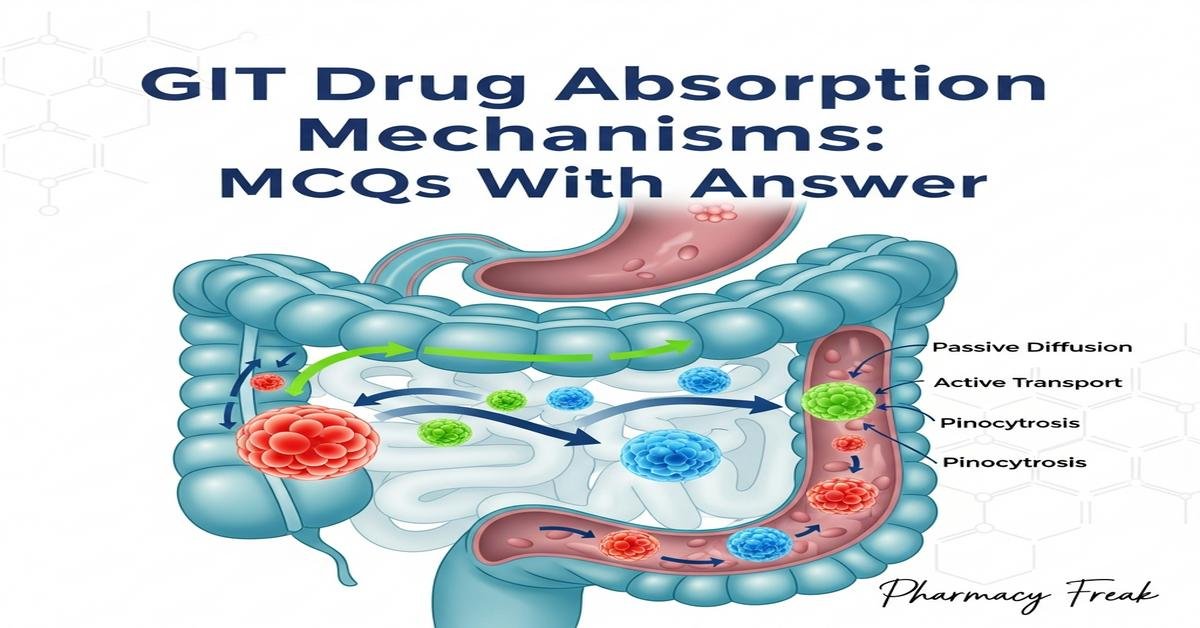
This set of MCQs is designed for M.Pharm students studying Advanced Biopharmaceutics & Pharmacokinetics (MPH 202T). The questions focus on detailed gastrointestinal (GIT) absorption mechanisms including transcellular and paracellular pathways, carrier-mediated transport, endocytosis, impact of pH and ionization, role of transporters and metabolic enzymes, influence of physiological factors (gastric emptying, intestinal transit, bile salt micelles), and concepts such as lymphatic uptake, first-pass metabolism, and BCS-related absorption limitations. Each item tests conceptual understanding and applied reasoning required to predict absorption behavior and optimize oral drug delivery strategies in formulation and clinical settings.
Q1. Which mechanism predominantly describes the movement of a small lipophilic unionized drug across enterocyte membranes down its concentration gradient without involvement of carriers or energy?
- Paracellular diffusion through tight junctions
- Facilitated diffusion via carrier proteins
- Passive transcellular diffusion across lipid bilayers
- Receptor-mediated endocytosis
Correct Answer: Passive transcellular diffusion across lipid bilayers
Q2. Which statement best explains the pH-partition hypothesis effect on oral absorption of weak bases?
- Weak bases are more ionized in the high pH of the intestine, reducing absorption there
- Weak bases are less ionized in the acidic stomach, always improving absorption in stomach
- Weak bases have increased unionized fraction in higher pH, favoring intestinal absorption
- Ionization of weak bases is independent of pH and does not affect absorption
Correct Answer: Weak bases are more ionized in the high pH of the intestine, reducing absorption there
Q3. Which transport process is saturable and follows Michaelis–Menten kinetics, often important for peptide drug absorption?
- Passive diffusion through the unstirred water layer
- Carrier-mediated active transport
- Paracellular passive transport
- Bile salt–mediated micellar solubilization
Correct Answer: Carrier-mediated active transport
Q4. Which physiological factor most directly decreases oral bioavailability by increasing first-pass hepatic metabolism?
- Increased gastric emptying time leading to delayed intestinal arrival
- Enhanced intestinal P-glycoprotein efflux activity
- Significant absorption from the portal-drained gut enabling hepatic extraction
- Increased lymphatic transport through chylomicron formation
Correct Answer: Significant absorption from the portal-drained gut enabling hepatic extraction
Q5. Which property most favors substantial intestinal lymphatic drug transport?
- High aqueous solubility and low logP (hydrophilicity)
- High molecular weight and formation of chylomicrons with long-chain triglycerides
- Extensive ionization at intestinal pH
- Minimal lipophilicity and rapid renal clearance
Correct Answer: High molecular weight and formation of chylomicrons with long-chain triglycerides
Q6. The unstirred water layer (UWL) adjacent to the intestinal mucosa primarily affects absorption by:
- Enhancing carrier-mediated uptake by increasing local transporter concentration
- Acting as an additional diffusional resistance for lipophilic drugs only
- Providing a diffusion barrier for poorly soluble or highly permeable drugs, altering apparent absorption rate
- Directly catalyzing drug ionization at the epithelial surface
Correct Answer: Providing a diffusion barrier for poorly soluble or highly permeable drugs, altering apparent absorption rate
Q7. Which of the following best describes the role of P-glycoprotein (P-gp) in intestinal absorption?
- P-gp enhances paracellular permeability by loosening tight junctions
- P-gp facilitates uptake of hydrophilic drugs into enterocytes
- P-gp actively effluxes substrates from enterocytes back into the lumen, reducing net absorption
- P-gp metabolizes drugs via oxidative reactions in the enterocyte
Correct Answer: P-gp actively effluxes substrates from enterocytes back into the lumen, reducing net absorption
Q8. A weak acid drug with pKa 4.0 will be predominantly unionized in which GI region, favoring passive absorption?
- Distal small intestine at pH 7.4
- Stomach at pH 1.5–3.5
- Proximal colon at pH 6.8–7.0
- Duodenum at pH 5.5–6.0
Correct Answer: Stomach at pH 1.5–3.5
Q9. Which formulation strategy is most suitable to enhance oral absorption of a BCS Class II drug (low solubility, high permeability)?
- Use of permeation enhancers to open tight junctions
- Particle size reduction and solubility enhancers like surfactants or amorphous solid dispersions
- Prodrug approach to decrease lipophilicity
- Designing an immediate-release formulation with large tablet size
Correct Answer: Particle size reduction and solubility enhancers like surfactants or amorphous solid dispersions
Q10. Which mechanism explains reduced absorption of an oral drug when given with a high-fat meal?
- Increased gastric emptying rate resulting in less intestinal contact time
- Enhanced bile salt–mediated solubilization always reducing absorption
- Altered gastrointestinal transit, increased solubilization in micelles and possible increased lymphatic uptake — food effect is drug-specific
- Complete inhibition of enterocyte transporters by dietary fat
Correct Answer: Altered gastrointestinal transit, increased solubilization in micelles and possible increased lymphatic uptake — food effect is drug-specific
Q11. Which phenomenon primarily limits absorption of very hydrophilic drugs through the intestinal epithelium?
- Excessive partitioning into enterocyte lipid bilayer
- Restricted paracellular pathway due to tight junction resistance
- Rapid incorporation into bile salt micelles preventing diffusion
- Carrier-mediated efflux into lymphatic circulation
Correct Answer: Restricted paracellular pathway due to tight junction resistance
Q12. Which statement correctly contrasts facilitated diffusion with active transport across the intestinal epithelium?
- Both require ATP hydrolysis to move substrates against concentration gradients
- Facilitated diffusion is carrier-mediated but not energy-dependent and moves down a concentration gradient; active transport requires energy to move against a gradient
- Facilitated diffusion always transports ions, while active transport only transports neutral molecules
- Active transport is nonsaturable whereas facilitated diffusion shows Michaelis–Menten kinetics
Correct Answer: Facilitated diffusion is carrier-mediated but not energy-dependent and moves down a concentration gradient; active transport requires energy to move against a gradient
Q13. Which of the following best explains why high intestinal CYP3A4 activity can limit oral bioavailability of certain drugs?
- CYP3A4 promotes drug transport into lymphatics, bypassing liver and reducing plasma levels
- CYP3A4 metabolizes substrates within enterocytes before they reach the portal circulation, contributing to presystemic intestinal first-pass metabolism
- CYP3A4 increases gastric pH leading to decreased drug dissolution
- CYP3A4 sequesters drugs into the unstirred water layer
Correct Answer: CYP3A4 metabolizes substrates within enterocytes before they reach the portal circulation, contributing to presystemic intestinal first-pass metabolism
Q14. Endocytosis-mediated uptake in the GIT is especially relevant for which class of molecules?
- Small lipophilic molecules with logP < 1
- Hydrophilic ions transported paracellularly
- Large macromolecules and particulate drug carriers such as nanoparticles or vitamin B12–intrinsic factor complexes
- Simple sugars absorbed by passive diffusion
Correct Answer: Large macromolecules and particulate drug carriers such as nanoparticles or vitamin B12–intrinsic factor complexes
Q15. Which factor most directly increases apparent permeability (Papp) measured in Caco-2 cell assays for a given drug?
- Decreasing drug lipophilicity while holding dissolved concentration constant
- Applying a P-gp inhibitor that reduces efflux of the drug
- Lowering donor concentration below Km of a carrier-mediated uptake system
- Reducing temperature to 4°C to slow active processes
Correct Answer: Applying a P-gp inhibitor that reduces efflux of the drug
Q16. The major reason paracellular absorption is generally limited compared to transcellular absorption is:
- Tight junctions provide a restrictive, size- and charge-selective pathway with low surface area compared to transcellular routes
- Paracellular route requires ATP and specialized transporters
- Paracellular transport is enhanced by bile salts making it dominant for lipophilic drugs
- Enterocytes actively pump drugs into tight junctions to prevent paracellular movement
Correct Answer: Tight junctions provide a restrictive, size- and charge-selective pathway with low surface area compared to transcellular routes
Q17. Which scenario would most likely convert a permeability-limited absorption profile into a dissolution-limited profile?
- Reducing drug particle size to submicron scale while keeping formulation unchanged
- Formulating a poorly soluble drug as an immediate-release tablet without solubilizers
- Adding a lipophilic excipient that enhances membrane permeation
- Co-administering a strong P-gp inducer to increase efflux
Correct Answer: Formulating a poorly soluble drug as an immediate-release tablet without solubilizers
Q18. Which descriptor best defines the absorption window concept in the gastrointestinal tract?
- Absorption window refers to the specific pH at which all drugs dissolve rapidly
- It is the anatomical region where a drug exhibits optimal permeability and stability for absorption; outside this region absorption decreases
- Absorption window means the time period during which transporters are expressed at night
- It is the microsomal enzyme expression gradient that only affects hepatic clearance
Correct Answer: It is the anatomical region where a drug exhibits optimal permeability and stability for absorption; outside this region absorption decreases
Q19. Which of the following best describes enterohepatic recirculation’s effect on oral drug plasma profiles?
- It always shortens half-life and reduces AUC
- It can produce secondary peaks in plasma concentration–time profiles and prolong apparent half-life and exposure
- It prevents any absorption from the small intestine by trapping drug in bile
- It only occurs for hydrophilic drugs cleared renally
Correct Answer: It can produce secondary peaks in plasma concentration–time profiles and prolong apparent half-life and exposure
Q20. Which experimental approach would best differentiate whether a drug’s poor oral bioavailability is due to dissolution limitation versus extensive intestinal metabolism?
- Measure solubility in simulated gastric fluid only
- Conduct an in situ intestinal perfusion study with and without metabolic enzyme inhibitors and compare with solubility/dissolution testing
- Administer the drug intravenously and assume absorption is dissolution-limited
- Measure urine pH after oral dosing
Correct Answer: Conduct an in situ intestinal perfusion study with and without metabolic enzyme inhibitors and compare with solubility/dissolution testing


I am a Registered Pharmacist under the Pharmacy Act, 1948, and the founder of PharmacyFreak.com. I hold a Bachelor of Pharmacy degree from Rungta College of Pharmaceutical Science and Research. With a strong academic foundation and practical knowledge, I am committed to providing accurate, easy-to-understand content to support pharmacy students and professionals. My aim is to make complex pharmaceutical concepts accessible and useful for real-world application.
Mail- Sachin@pharmacyfreak.com