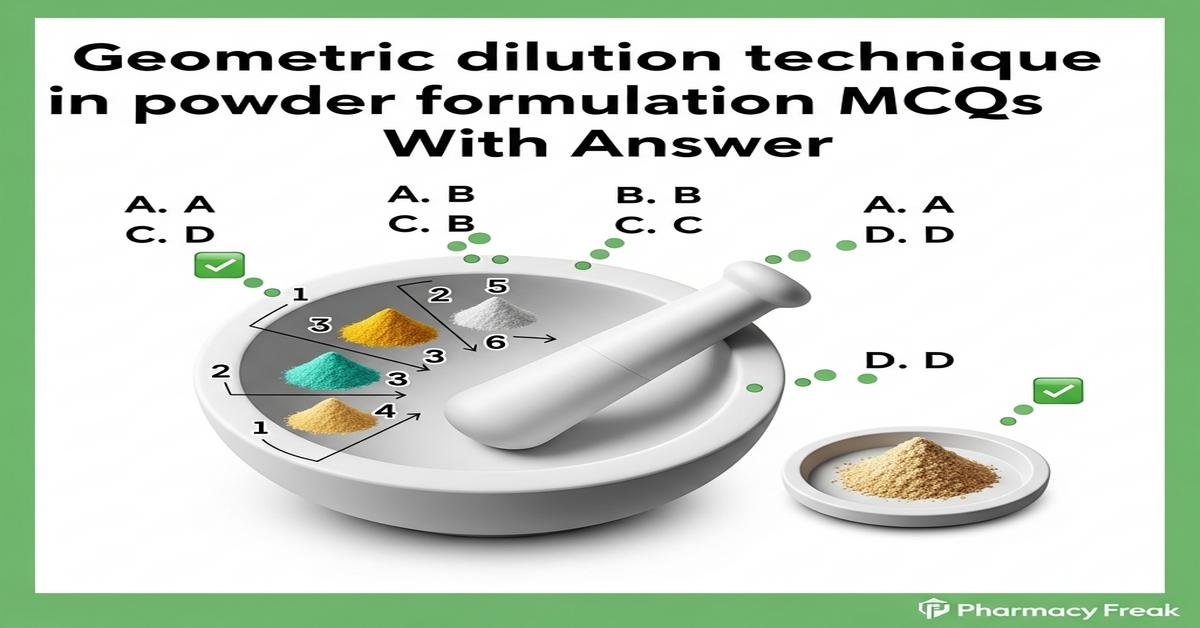
Geometric dilution technique in powder formulation is a fundamental mixing strategy used by B. Pharm students and formulators to achieve uniform distribution of potent or low-dose drugs within an excipient matrix. This stepwise method involves mixing the active pharmaceutical ingredient (API) with increasing quantities of diluent in a geometric progression (often by doubling), minimizing segregation, reducing content uniformity errors, and improving homogeneity for accurate dosing. Key keywords: geometric dilution technique, powder formulation, aliquot, content uniformity, trituration, particle size, segregation, potent drugs, scale-up, validation. Now let’s test your knowledge with 30 MCQs on this topic.
Q1. Which statement best defines the geometric dilution technique?
- Mixing a small amount of drug with progressively larger quantities of diluent using a geometric progression
- Mixing drug and excipient by vigorous tumbling without order
- Adding all ingredients at once and blending for a fixed time
- Mixing only by wet granulation techniques
Correct Answer: Mixing a small amount of drug with progressively larger quantities of diluent using a geometric progression
Q2. What is the main purpose of using geometric dilution in powder formulation?
- To reduce bulk density of the powder
- To ensure uniform distribution of a low-dose potent drug in the bulk powder
- To increase particle size by aggregation
- To sterilize the powder blend
Correct Answer: To ensure uniform distribution of a low-dose potent drug in the bulk powder
Q3. Geometric dilution is most appropriate when the active drug is present in which proportion?
- High concentration (>50% w/w)
- Moderate concentration (10–50% w/w)
- Low concentration (usually <5% w/w or very potent drugs)
- Only when drug is >20% w/w
Correct Answer: Low concentration (usually <5% w/w or very potent drugs)
Q4. What is the correct initial step in the geometric dilution procedure?
- Mix the entire batch at once in a tumbling blender
- Mix the small amount of drug with an equal weight of diluent (1:1) by trituration
- Add binder solution immediately to the API
- Heat the powder to reduce moisture
Correct Answer: Mix the small amount of drug with an equal weight of diluent (1:1) by trituration
Q5. The term “geometric” in geometric dilution refers to which mathematical concept?
- Arithmetic progression of additions
- Geometric progression, typically doubling the mixture in each step
- Random addition sequence
- Logarithmic decrement mixing
Correct Answer: Geometric progression, typically doubling the mixture in each step
Q6. Which equipment is most commonly used for geometric dilution at the laboratory scale?
- Planetary high-shear granulator
- Pneumatic conveyor
- Mortar and pestle (trituration)
- Twin-screw extruder
Correct Answer: Mortar and pestle (trituration)
Q7. One limitation of geometric dilution technique is:
- It always improves flow properties of powders
- It is unsuitable for hygroscopic or highly cohesive APIs that cake
- It eliminates the need for content uniformity testing
- It can be used only for liquids
Correct Answer: It is unsuitable for hygroscopic or highly cohesive APIs that cake
Q8. What is an “aliquot” in the context of geometric dilution?
- The final container for tablets
- A small representative portion of the API diluted to a workable amount before mixing with bulk excipient
- A type of binder used in granulation
- An instrument for measuring moisture content
Correct Answer: A small representative portion of the API diluted to a workable amount before mixing with bulk excipient
Q9. Which powder property most influences the effectiveness of geometric dilution?
- Color of the powder
- Particle size and density differences between API and excipient
- Melting point of the API only
- Optical rotation
Correct Answer: Particle size and density differences between API and excipient
Q10. To minimize electrostatic charging during geometric dilution, one should:
- Work in very dry conditions always
- Use antistatic measures, adjust humidity, or use antiadherents
- Always increase mixing speed to maximum
- Freeze the powders before mixing
Correct Answer: Use antistatic measures, adjust humidity, or use antiadherents
Q11. Which quality control test most directly assesses the success of geometric dilution?
- Disintegration test
- Content uniformity assay (assay of API in random samples)
- Viscosity measurement
- Loss on drying only
Correct Answer: Content uniformity assay (assay of API in random samples)
Q12. When scaling up geometric dilution from lab to production, the preferred industrial approach is:
- Maintain exact manual trituration steps at larger scale unchanged
- Apply the same principle using appropriate blenders (bin blenders, V-blenders) and validated mixing cycles
- Replace dilution with direct compression without testing
- Use only wet granulation irrespective of API properties
Correct Answer: Apply the same principle using appropriate blenders (bin blenders, V-blenders) and validated mixing cycles
Q13. Which of the following is NOT an advantage of geometric dilution?
- Improved homogeneity for low-dose drugs
- Reduced risk of content uniformity failures
- Guaranteed elimination of segregation in all cases
- Enables safe handling of potent drugs by minimizing sampling error
Correct Answer: Guaranteed elimination of segregation in all cases
Q14. Which mixing order is correct in geometric dilution?
- Add the entire diluent first, then add API
- Mix API with equal diluent, then successively add equal amounts of diluent to double the mass each step
- Add binder, then API, then diluent randomly
- Mix excipients first, then add API at the end without premix
Correct Answer: Mix API with equal diluent, then successively add equal amounts of diluent to double the mass each step
Q15. For very potent APIs (<1% w/w), additional precautions include:
- Using no premix and direct blending only
- Preparing multiple premixes, using contained equipment, and validating mixing to avoid cross-contamination
- Always using wet granulation to dilute the API
- Heating to volatilize impurities
Correct Answer: Preparing multiple premixes, using contained equipment, and validating mixing to avoid cross-contamination
Q16. If two powders show segregation after mixing, the most likely cause is:
- Identical particle size and density
- Differences in particle size, shape, or density leading to percolation and sifting
- Perfect geometric dilution performed
- Excessive lubrication only
Correct Answer: Differences in particle size, shape, or density leading to percolation and sifting
Q17. Which technique is preferred for mixing sticky or cohesive APIs where geometric dilution fails?
- Continue manual trituration longer
- Use wet granulation or high-shear granulation to improve cohesiveness and uniformity
- Add volatile solvents to dry powders
- Decrease batch size to one tablet
Correct Answer: Use wet granulation or high-shear granulation to improve cohesiveness and uniformity
Q18. During geometric dilution, why is it recommended to use similarly sized excipients?
- To increase electrostatic charge
- To minimize segregation and enhance blend uniformity by matching flow and packing behaviors
- To speed up chemical degradation
- To reduce the need for testing
Correct Answer: To minimize segregation and enhance blend uniformity by matching flow and packing behaviors
Q19. What is a practical rule when preparing an aliquot premix?
- Always make the aliquot smaller than the API quantity
- Make a premix by diluting the API until you have a workable mass that can be evenly mixed with the next portion of diluent
- Use only liquid diluents for the premix
- Never use mortar and pestle for potent drugs
Correct Answer: Make a premix by diluting the API until you have a workable mass that can be evenly mixed with the next portion of diluent
Q20. Which parameter should be monitored during validation of geometric dilution mixing?
- Only tablet hardness
- Blend uniformity (assay distribution), mixing time, and sampling plan
- Color change of the powder only
- Evaporation rate of the excipient
Correct Answer: Blend uniformity (assay distribution), mixing time, and sampling plan
Q21. Which excipient characteristic promotes ease of geometric dilution?
- Highly hygroscopic and sticky nature
- Free-flowing, non-cohesive character and compatible particle size
- Extremely light weight and electrostatic tendency
- Crystalline excipient with very high melting point only
Correct Answer: Free-flowing, non-cohesive character and compatible particle size
Q22. What role does trituration play in geometric dilution?
- Trituration dissolves the API into solvent
- Trituration mechanically mixes and reduces particle size, aiding homogeneity at each dilution step
- Trituration neutralizes the API chemically
- Trituration increases moisture content deliberately
Correct Answer: Trituration mechanically mixes and reduces particle size, aiding homogeneity at each dilution step
Q23. Which sampling approach is appropriate to assess blend uniformity after geometric dilution?
- Single sample from the center only
- Multiple samples taken from different locations with statistical evaluation of API content
- Only visual inspection of color uniformity
- No sampling required for low-dose drugs
Correct Answer: Multiple samples taken from different locations with statistical evaluation of API content
Q24. Which is a sign of an inadequate geometric dilution during manufacturing?
- Low assay variability between samples
- High relative standard deviation (RSD) in content uniformity tests
- Improved tablet dissolution uniformly
- Increased flowability consistently
Correct Answer: High relative standard deviation (RSD) in content uniformity tests
Q25. How can segregation be minimized after performing geometric dilution?
- By using narrow particle size distribution excipients and gentle handling to avoid vibration
- By pouring powders from a great height into the hopper
- By rapidly shaking containers after mixing
- By storing powders in warm, dry places with agitation
Correct Answer: By using narrow particle size distribution excipients and gentle handling to avoid vibration
Q26. The geometric dilution method is especially important for which dosage form?
- Large-dose bulk powders only
- Low-dose solid oral dosage forms like tablets and capsules
- Topical creams where API is >50%
- Sterile injections exclusively
Correct Answer: Low-dose solid oral dosage forms like tablets and capsules
Q27. Why is documentation of each mixing step critical when using geometric dilution commercially?
- It is not necessary for quality control
- To provide traceability, enable reproducibility, and support regulatory compliance and validation
- To make the manufacturing process slower intentionally
- To avoid any analytical testing later
Correct Answer: To provide traceability, enable reproducibility, and support regulatory compliance and validation
Q28. If an API sticks to the mortar during trituration, the best corrective action is:
- Increase mixing time aggressively
- Change to an alternative technique such as spatulation on a non-adhesive surface or consider wet granulation
- Heat the mortar to melt the API
- Add water to dissolve the API
Correct Answer: Change to an alternative technique such as spatulation on a non-adhesive surface or consider wet granulation
Q29. Which statement about geometric dilution and potency is true?
- Geometric dilution is unnecessary for potent drugs
- Geometric dilution helps achieve safe and accurate distribution of potent APIs by reducing weighing errors
- Geometric dilution increases required drug quantity per dose
- Geometric dilution always eliminates need for containment measures
Correct Answer: Geometric dilution helps achieve safe and accurate distribution of potent APIs by reducing weighing errors
Q30. Which practice improves reliability of geometric dilution results in production?
- Skipping assay checks to save time
- Implementing validated SOPs, appropriate equipment selection, and routine in-process blend testing
- Using random mixing methods without training
- Mixing under uncontrolled environmental conditions only
Correct Answer: Implementing validated SOPs, appropriate equipment selection, and routine in-process blend testing

