Introduction
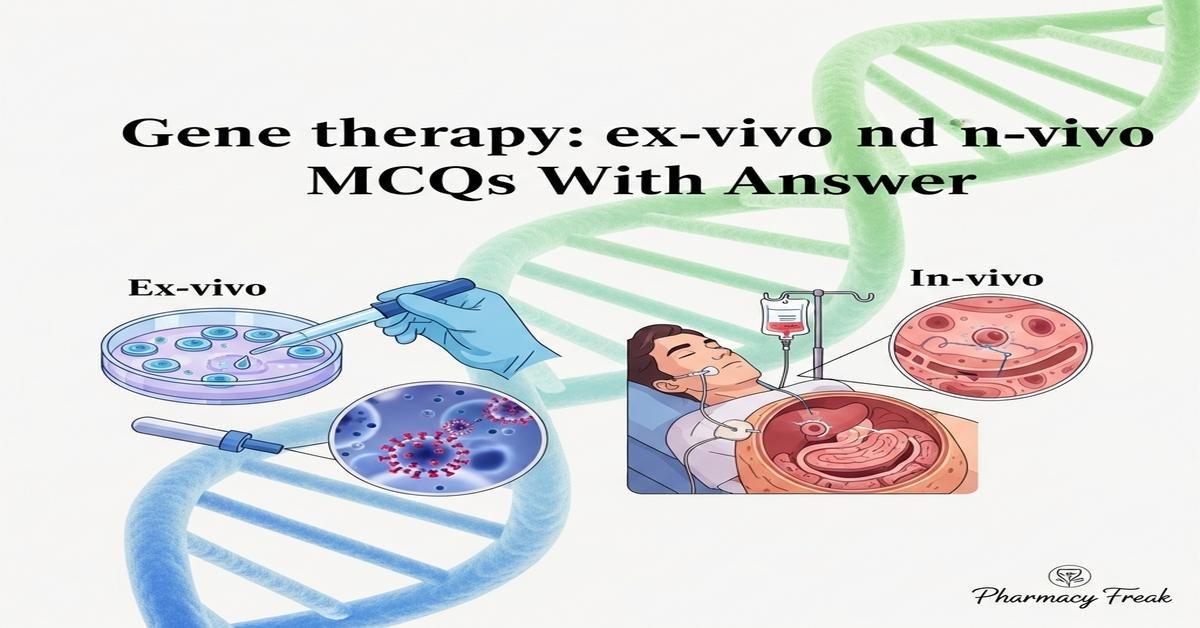
Gene therapy—delivering functional genetic material to correct or modify disease-causing genes—has rapidly evolved into a cornerstone of modern molecular pharmaceutics. This MCQ set focuses on ex‑vivo and in‑vivo strategies, vector selection, delivery technologies, safety concerns (like insertional mutagenesis and immune responses), clinical examples, and quality control considerations relevant to M.Pharm students. Questions emphasize mechanistic understanding, advantages and limitations of viral and non‑viral platforms, practical aspects of manufacturing and conditioning, and gene‑editing approaches used in therapeutic settings. Use these items to consolidate concepts required for advanced coursework and to prepare for examinations and practical decision‑making in gene therapy development.
Q1. What best defines ex‑vivo gene therapy?
- Direct infusion of vectors into the patient to transduce target tissues in situ
- Modification of patient cells outside the body followed by transplantation back into the patient
- Germline modification of embryos to correct genetic defects
- Topical application of DNA plasmids to accessible skin lesions
Correct Answer: Modification of patient cells outside the body followed by transplantation back into the patient
Q2. Which of the following is a classic example of an ex‑vivo gene therapy approach?
- Systemic AAV delivery for spinal muscular atrophy
- Intravitreal injection of AAV for inherited retinal disease
- CAR‑T cell therapy for hematologic malignancies
- Lipid nanoparticle mRNA vaccine administered intramuscularly
Correct Answer: CAR‑T cell therapy for hematologic malignancies
Q3. Which viral vector is most commonly used for stable genetic modification of hematopoietic stem cells ex‑vivo due to its integration ability and transduction of nondividing cells?
- Adeno‑associated virus (AAV)
- Lentiviral vector
- Non‑integrating adenoviral vector
- Naked plasmid DNA
Correct Answer: Lentiviral vector
Q4. Which vector is most appropriate for in‑vivo gene delivery when low immunogenicity and long‑term episomal expression in nondividing cells are desired?
- Adeno‑associated virus (AAV)
- First‑generation adenovirus
- Lentivirus
Correct Answer: Adeno‑associated virus (AAV)
Q5. Which is a primary advantage of ex‑vivo over in‑vivo gene therapy?
- Lower manufacturing complexity for large patient populations
- Ability to select, expand and quality‑control modified cells before infusion
- Easier repeat dosing without immune responses
- No need for conditioning or preparative regimens
Correct Answer: Ability to select, expand and quality‑control modified cells before infusion
Q6. What major safety concern is associated with integrating viral vectors used in ex‑vivo gene therapy?
- Rapid degradation of transgene RNA
- Insertional mutagenesis leading to oncogene activation
- Immediate hypersensitivity allergic reaction to vector
- Complete loss of transgene expression within 24 hours
Correct Answer: Insertional mutagenesis leading to oncogene activation
Q7. What is the approximate maximum single‑stranded DNA cargo capacity for adeno‑associated virus (AAV) vectors?
- ~100 kilobases
- ~20 kilobases
- ~4.7 kilobases
- ~50 kilobases
Correct Answer: ~4.7 kilobases
Q8. Which vector system is most suitable for delivering large transgenes (tens of kilobases) for in‑vivo applications?
- Self‑complementary AAV
- Helper‑dependent (gutless) adenoviral vectors
- Standard single‑stranded AAV
- Non‑integrating lentivirus
Correct Answer: Helper‑dependent (gutless) adenoviral vectors
Q9. Which non‑viral delivery platform is widely used for systemic in‑vivo mRNA delivery due to efficient endosomal escape and manufacturability?
- Electroporation alone
- Lipid nanoparticle (LNP) formulations
- Naked linearized plasmid DNA
- Polystyrene nanoparticles
Correct Answer: Lipid nanoparticle (LNP) formulations
Q10. For ex‑vivo CRISPR editing of primary T cells, which delivery method minimizes persistent nuclease expression and reduces off‑target edits?
- Viral integration of Cas9 expression cassette
- Electroporation of Cas9 ribonucleoprotein (RNP) complexes
- Plasmid DNA transfection carrying Cas9 and sgRNA
- Repeated systemic infusion of Cas9 adenovirus
Correct Answer: Electroporation of Cas9 ribonucleoprotein (RNP) complexes
Q11. Why is conditioning (myeloablation) often required prior to infusion of ex‑vivo modified hematopoietic stem cells?
- To permanently suppress immune surveillance against the vector
- To create marrow niche space and allow engraftment of modified HSCs
- To increase vector packaging capacity
- To transiently increase vector copy number in circulating plasma
Correct Answer: To create marrow niche space and allow engraftment of modified HSCs
Q12. Which approved gene therapy product is an in‑vivo AAV‑based treatment for a inherited retinal disease (RPE65 mutation)?
- Zolgensma (onasemnogene abeparvovec)
- Luxturna (voretigene neparvovec)
- Kymriah (tisagenlecleucel)
- Strimvelis (ex‑vivo ADA‑SCID therapy)
Correct Answer: Luxturna (voretigene neparvovec)
Q13. Zolgensma, an approved in‑vivo gene therapy for spinal muscular atrophy, uses which vector serotype for systemic delivery?
- AAV2
- AAV9
- Lentivirus
- Adenovirus type 5
Correct Answer: AAV9
Q14. What immune obstacle commonly limits repeat dosing of AAV‑based in‑vivo therapies?
- Rapid renal clearance of viral particles
- Pre‑existing and induced neutralizing antibodies against AAV capsid
- Complete degradation of AAV genomes within hours
- Inability of AAV to transduce target cells after first dose due to receptor loss
Correct Answer: Pre‑existing and induced neutralizing antibodies against AAV capsid
Q15. Which promoter is often chosen in lentiviral constructs to drive stable, moderate expression in hematopoietic lineages?
- CMV immediate‑early promoter (very strong, often silenced in hematopoietic cells)
- PGK promoter (phosphoglycerate kinase)
- T7 bacteriophage promoter
- SV40 minimal promoter only
Correct Answer: PGK promoter (phosphoglycerate kinase)
Q16. Which analytical method is routinely used to quantify vector copy number per cell in ex‑vivo modified cell products?
- Flow cytometry measuring GFP intensity
- qPCR (or ddPCR) to quantify vector copy number per cell
- ELISA for total protein content
- Light microscopy cell count
Correct Answer: qPCR (or ddPCR) to quantify vector copy number per cell
Q17. To experimentally map CRISPR‑Cas9 off‑target cleavage sites genome‑wide during development, which assay is commonly used?
- GUIDE‑seq
- Western blot for Cas9
- qPCR for on‑target allele only
- ELISA for sgRNA
Correct Answer: GUIDE‑seq
Q18. During CAR‑T cell manufacturing ex‑vivo, which reagent is commonly used to activate T cells before transduction?
- CD3/CD28 magnetic beads
- Heparin anticoagulant
- Polyethylene glycol (PEG)
- Low‑temperature incubation at 4°C
Correct Answer: CD3/CD28 magnetic beads
Q19. Which route of administration is typically used to target hepatocytes for in‑vivo gene therapy with AAV vectors?
- Intravenous (systemic) delivery
- Topical skin application
- Intrathecal injection into cerebrospinal fluid
- Inhalation aerosol to the lungs
Correct Answer: Intravenous (systemic) delivery
Q20. Which statement correctly describes the regulatory and ethical classification of most therapeutic gene therapy approaches in current clinical use?
- They are germline gene therapies that permanently alter future generations
- They are somatic gene therapies intended to modify only the treated individual’s cells
- They are dietary supplements and not subject to clinical regulation
- They universally allow unlimited repeat dosing without immunological concerns
Correct Answer: They are somatic gene therapies intended to modify only the treated individual’s cells


I am a Registered Pharmacist under the Pharmacy Act, 1948, and the founder of PharmacyFreak.com. I hold a Bachelor of Pharmacy degree from Rungta College of Pharmaceutical Science and Research. With a strong academic foundation and practical knowledge, I am committed to providing accurate, easy-to-understand content to support pharmacy students and professionals. My aim is to make complex pharmaceutical concepts accessible and useful for real-world application.
Mail- Sachin@pharmacyfreak.com