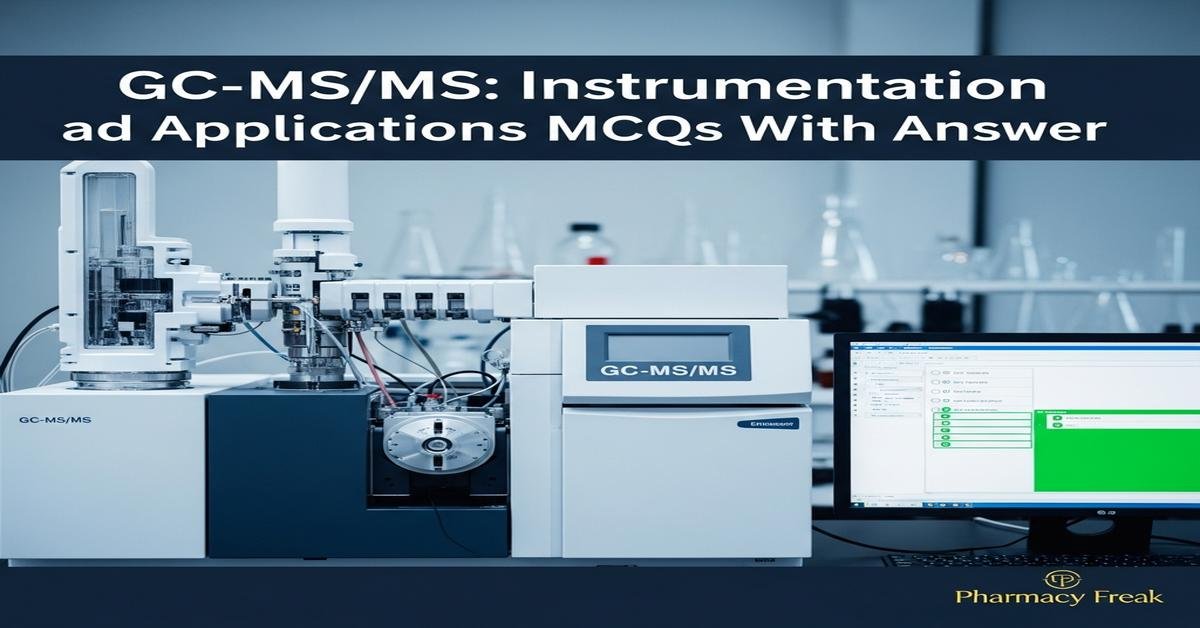
Gas chromatography–tandem mass spectrometry (GC-MS/MS) is a powerful analytical platform used to separate, identify, and quantify volatile and semi-volatile compounds with high sensitivity and selectivity. This concise overview emphasizes GC-MS/MS instrumentation — injectors, capillary columns, transfer lines, ionization sources (EI and CI), collision cells, and triple‑quadrupole analyzers — and practical applications in pharmaceutical analysis, drug metabolism, forensic toxicology, environmental monitoring, stability testing, and residue analysis. Core principles such as scan modes (full-scan, SIM, MRM), collision-induced dissociation, limits of detection, matrix effects, and quantitative workflows are highlighted to prepare B.Pharm students for laboratory practice and exam-style MCQs. Now let’s test your knowledge with 30 MCQs on this topic.
Q1. Which component in GC-MS/MS maintains the temperature required for chromatographic separation?
- Injector
- Mass analyzer
- Column oven
- Ion source
Correct Answer: Column oven
Q2. What is the main advantage of tandem mass spectrometry (MS/MS) over single-stage MS in quantitative assays?
- Lower running cost
- Improved chromatographic resolution
- Higher selectivity and reduced background
- Faster column equilibration
Correct Answer: Higher selectivity and reduced background
Q3. Which ionization method is most commonly used in GC-MS/MS for small volatile molecules?
- Electrospray ionization (ESI)
- MALDI
- Electron ionization (EI)
- Atmospheric pressure chemical ionization (APCI)
Correct Answer: Electron ionization (EI)
Q4. In triple-quadrupole MS, which quadrupole serves as the collision cell?
- Q1
- Q2
- Q3
- All three simultaneously
Correct Answer: Q2
Q5. What is MRM (multiple reaction monitoring) primarily used for?
- Full-scan qualitative profiling
- Targeted quantitative analysis with high specificity
- Column temperature programming
- Ion source tuning
Correct Answer: Targeted quantitative analysis with high specificity
Q6. Which parameter controls the energy applied for fragmentation in the collision cell?
- Dwell time
- Collision energy
- Transfer line temperature
- Carrier gas flow
Correct Answer: Collision energy
Q7. Which GC inlet type allows for large-volume injections and splitless introduction for trace analysis?
- Split inlet
- On-column inlet
- Programmed temperature vaporizing (PTV) inlet
- Headspace sampler
Correct Answer: Programmed temperature vaporizing (PTV) inlet
Q8. In GC-MS/MS, what is the purpose of a transfer line between the GC and MS?
- To cool the column effluent
- To maintain analyte vaporization and prevent condensation
- To ionize the analytes
- To perform chromatographic separation
Correct Answer: To maintain analyte vaporization and prevent condensation
Q9. Which scan mode is best for discovering unknown compounds in a sample?
- MRM
- SIM (selected ion monitoring)
- Full-scan mass spectrum
- Product ion scan only
Correct Answer: Full-scan mass spectrum
Q10. Chemical ionization (CI) differs from EI primarily because CI:
- Produces more extensive fragmentation than EI
- Is a hard ionization technique
- Produces more prominent molecular ions and less fragmentation
- Requires liquid chromatography
Correct Answer: Produces more prominent molecular ions and less fragmentation
Q11. Which gas is commonly used as the collision gas in Q2 for CID (collision-induced dissociation)?
- Oxygen
- Nitrogen
- Helium
- Argon
Correct Answer: Argon
Q12. In GC-MS/MS quantitation, why are stable isotope-labeled internal standards often used?
- They increase chromatographic retention time
- They provide matrix-matched calibration and correct for losses
- They change ionization method from EI to CI
- They eliminate the need for calibration curves
Correct Answer: They provide matrix-matched calibration and correct for losses
Q13. What does SRM (selected reaction monitoring) refer to in tandem MS?
- Monitoring a precursor ion only
- Monitoring a specific precursor-to-product ion transition
- Monitoring all product ions simultaneously
- Scanning full mass range repeatedly
Correct Answer: Monitoring a specific precursor-to-product ion transition
Q14. Which factor most directly affects chromatographic peak width and resolution in GC?
- Mass analyzer type
- Column length and internal diameter
- Ion source design
- Collision energy
Correct Answer: Column length and internal diameter
Q15. What is the primary reason for derivatization prior to GC-MS/MS analysis of certain pharmaceuticals?
- To reduce analyte volatility
- To increase analyte polarity
- To improve volatility and thermal stability for GC separation
- To decrease molecular weight
Correct Answer: To improve volatility and thermal stability for GC separation
Q16. In method validation for GC-MS/MS quantitative assays, which metric assesses the smallest concentration that can be measured with acceptable precision and accuracy?
- Linearity range
- Limit of detection (LOD)
- Limit of quantitation (LOQ)
- Retention index
Correct Answer: Limit of quantitation (LOQ)
Q17. Which maintenance task helps prevent contamination of the ion source in GC-MS/MS?
- Replacing the chromatographic column monthly
- Regularly cleaning or replacing the ion source and liners
- Changing carrier gas frequently
- Reducing oven temperature permanently
Correct Answer: Regularly cleaning or replacing the ion source and liners
Q18. In a triple quadrupole operating in MRM, what is ‘dwell time’?
- The time for column temperature ramp
- The time spent monitoring a single transition per cycle
- The total run time of the analysis
- The time for ionization to occur
Correct Answer: The time spent monitoring a single transition per cycle
Q19. Which application is GC-MS/MS especially suited for in pharmaceutical analysis?
- High-molecular-weight protein sequencing
- Analysis of non-volatile large peptides
- Quantification of volatile drug impurities and metabolites
- Direct analysis of intact antibodies
Correct Answer: Quantification of volatile drug impurities and metabolites
Q20. What does ‘selectivity’ mean in the context of GC-MS/MS assays?
- Ability to separate analytes by boiling point only
- Capacity to detect only the most abundant ions
- Ability to distinguish analyte signal from other matrix signals
- Speed of chromatographic run
Correct Answer: Ability to distinguish analyte signal from other matrix signals
Q21. Which mass analyzer type commonly provides high resolution and accurate mass but is less common for routine GC-MS/MS triple-quad workflows?
- Quadrupole
- Ion trap
- Time-of-flight (TOF) or Orbitrap
- Photomultiplier tube
Correct Answer: Time-of-flight (TOF) or Orbitrap
Q22. Matrix effects in GC-MS/MS are typically caused by:
- Column length variations
- Interference from co-eluting matrix components altering ionization
- Incorrect oven temperature only
- Using helium as carrier gas
Correct Answer: Interference from co-eluting matrix components altering ionization
Q23. For pesticide residue analysis in food by GC-MS/MS, which sample preparation is often required?
- Protein sequencing
- Liquid-liquid extraction or QuEChERS with cleanup
- Direct injection without cleanup
- Gel electrophoresis
Correct Answer: Liquid-liquid extraction or QuEChERS with cleanup
Q24. What role does the electron multiplier detector play in many GC-MS systems?
- Separating ions by m/z
- Generating ions from neutral molecules
- Amplifying ion signal for detection
- Controlling carrier gas flow
Correct Answer: Amplifying ion signal for detection
Q25. In interpreting MS/MS spectra, product ions are used to:
- Adjust column oven settings
- Confirm structural fragments of the precursor and provide selectivity
- Calibrate the carrier gas purity
- Measure column bleed only
Correct Answer: Confirm structural fragments of the precursor and provide selectivity
Q26. Which parameter would you adjust to increase sensitivity for a low-abundance MRM transition?
- Decrease collision gas pressure to zero
- Increase dwell time for that transition
- Shorten column length to 5 mm
- Switch from EI to MALDI
Correct Answer: Increase dwell time for that transition
Q27. Why is helium commonly used as a carrier gas in GC-MS, despite cost considerations?
- It reacts with analytes to form adducts
- It provides optimal efficiency and chromatographic performance on capillary columns
- It is heavier than nitrogen and increases retention
- It ionizes molecules in the source
Correct Answer: It provides optimal efficiency and chromatographic performance on capillary columns
Q28. Which practice improves assay robustness for routine GC-MS/MS in a pharmaceutical QC lab?
- Ignoring system suitability checks
- Using consistent internal standards and regular calibration checks
- Changing method parameters each run to optimize
- Avoiding maintenance to save time
Correct Answer: Using consistent internal standards and regular calibration checks
Q29. What is the effect of increasing column temperature ramp rate in GC?
- Longer analysis times and broader peaks
- Faster elution with potential loss of separation for closely eluting analytes
- No change in retention times
- Improves ionization efficiency in the MS
Correct Answer: Faster elution with potential loss of separation for closely eluting analytes
Q30. In forensic toxicology, GC-MS/MS is preferred for certain drug analyses because it offers:
- Low specificity but high throughput
- High sensitivity, selectivity, and confirmatory fragmentation patterns
- Only qualitative results without quantitation
- Inability to analyze volatile compounds
Correct Answer: High sensitivity, selectivity, and confirmatory fragmentation patterns


