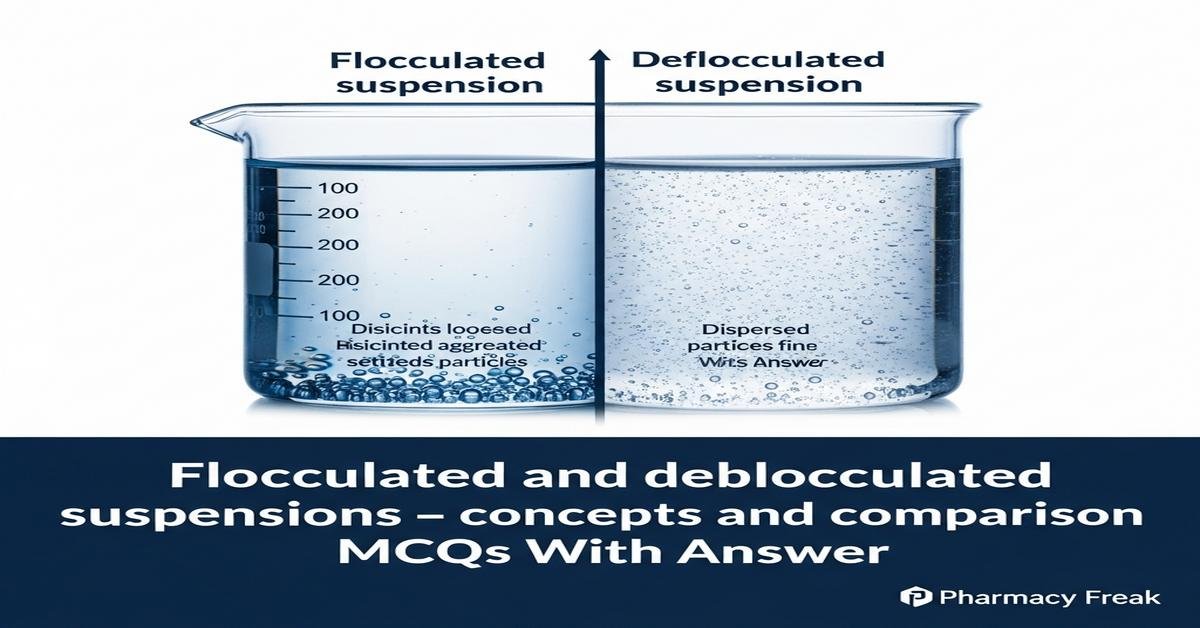
Flocculated and deflocculated suspensions are core concepts in pharmaceutics, crucial for formulation, stability, and patient safety. This introduction explains how particle interactions, zeta potential, DLVO theory, and additives (flocculating and dispersing agents) determine whether a suspension forms loose flocs or remains finely dispersed. You will learn how these states affect sedimentation, redispersion, rheology, dosing accuracy, and strategies to control stability using electrolytes, polymers, and surfactants. Emphasis is placed on practical implications for B. Pharm students preparing suspensions, evaluating sedimentation volume, and choosing suitable stabilizers. Now let’s test your knowledge with 30 MCQs on this topic.
Q1. What is the primary difference between flocculated and deflocculated suspensions?
- Flocculated suspensions form loose aggregates; deflocculated suspensions remain as individual particles
- Flocculated suspensions never settle; deflocculated ones settle instantly
- Deflocculated suspensions are always less viscous than flocculated suspensions
- Flocculated suspensions cannot be redispersed while deflocculated can
Correct Answer: Flocculated suspensions form loose aggregates; deflocculated suspensions remain as individual particles
Q2. Which parameter is most directly associated with the electrostatic stability of a suspension?
- Viscosity
- Zeta potential
- Density of medium
- Particle color
Correct Answer: Zeta potential
Q3. A suspension with a high magnitude zeta potential (e.g., ±35 mV) is likely to be:
- Flocculated due to weak electrostatic repulsion
- Deflocculated and electrostatically stabilized
- Prone to immediate coagulation
- Immune to any surfactant addition
Correct Answer: Deflocculated and electrostatically stabilized
Q4. Which of the following best describes the sediment of a flocculated suspension?
- Compact, hard cake difficult to redisperse
- Fluffy, loosely packed sediment easily redispersed
- Non-settling uniformly suspended system
- Dense crystalline precipitate
Correct Answer: Fluffy, loosely packed sediment easily redispersed
Q5. Sedimentation volume (F) is defined as:
- Ratio of particle diameter to medium viscosity
- Height of sediment divided by the original height of the suspension
- Time taken for complete settling
- Electrical conductivity of the suspension
Correct Answer: Height of sediment divided by the original height of the suspension
Q6. Which agent is commonly used to produce flocculation by reducing electrostatic repulsion?
- High molecular weight dispersant that increases zeta potential
- Electrolytes (e.g., calcium chloride)
- Strong organic bases that chelate particles
- Organic solvents miscible with water
Correct Answer: Electrolytes (e.g., calcium chloride)
Q7. DLVO theory combines which two interactions to explain stability?
- Hydrophobic attraction and covalent bonding
- Van der Waals attraction and electrical double-layer repulsion
- Magnetic attraction and gravitational force
- Thermal motion and osmotic pressure
Correct Answer: Van der Waals attraction and electrical double-layer repulsion
Q8. Peptization in suspensions refers to:
- Conversion of colloidal particles into flocs
- Breaking of flocs into dispersed colloidal particles by imparting charge
- Chemical degradation of the drug in suspension
- Increase in particle size by crystal growth
Correct Answer: Breaking of flocs into dispersed colloidal particles by imparting charge
Q9. Which of the following is a mechanism of polymeric flocculating agents?
- Electrostatic stabilization by increasing surface charge magnitude
- Bridging between particles to form loose aggregates
- Rapid dissolution of particles to form solution
- Decreasing medium temperature to induce aggregation
Correct Answer: Bridging between particles to form loose aggregates
Q10. A deflocculated suspension typically shows which sedimentation behavior?
- Fast settling with high sediment volume
- Slow settling with formation of compact hard cake
- No settling at all
- Immediate coagulation followed by precipitation
Correct Answer: Slow settling with formation of compact hard cake
Q11. Which property is most important when choosing a flocculating agent for an oral suspension?
- Toxicity and regulatory acceptability
- Ability to change particle color
- Capacity to increase osmotic pressure drastically
- High volatility at room temperature
Correct Answer: Toxicity and regulatory acceptability
Q12. Which experimental observation suggests controlled flocculation rather than coagulation?
- Formation of large, irreversible dense aggregates
- Rapid and complete clarification of supernatant with easily redispersible sediment
- Permanent loss of suspended drug activity
- Immediate precipitation as a crystalline solid
Correct Answer: Rapid and complete clarification of supernatant with easily redispersible sediment
Q13. Which parameter increases when a deflocculated suspension is converted to a flocculated one?
- Probability of forming compact sediment
- Ease of redispersion
- Time to reach equilibrium after settling decreases
- Intrinsic solubility of the drug
Correct Answer: Ease of redispersion
Q14. Which of the following would increase zeta potential magnitude and promote deflocculation?
- Addition of multivalent counter-ions to compress the double layer
- Adjusting pH away from the isoelectric point to increase surface charge
- Adding high concentration of bridging polymers
- Heating to evaporate the dispersion medium
Correct Answer: Adjusting pH away from the isoelectric point to increase surface charge
Q15. Degree of flocculation (β) is most useful for:
- Quantifying the extent of flocculation relative to a deflocculated state
- Measuring chemical purity of the drug
- Estimating pH-dependent solubility only
- Determining particle color uniformity
Correct Answer: Quantifying the extent of flocculation relative to a deflocculated state
Q16. A flocculated suspension often requires which additional formulation consideration?
- Minimizing dose uniformity because sediment is permanent
- Ensuring adequate rheological modifier for pourability and redispersion
- Maximizing evaporation rate to concentrate suspension
- Removing all electrolytes to prevent any interaction
Correct Answer: Ensuring adequate rheological modifier for pourability and redispersion
Q17. Which analytical method helps assess particle aggregation state in suspensions?
- UV-visible spectroscopy only for solutes
- Particle size distribution by laser diffraction or light scattering
- Thermogravimetric analysis for moisture content
- Nuclear magnetic resonance of the dispersion medium
Correct Answer: Particle size distribution by laser diffraction or light scattering
Q18. Which surfactant action can promote deflocculation in some suspensions?
- Reducing surface charge magnitude to zero
- Adsorbing and imparting like charge to particle surfaces, increasing electrostatic repulsion
- Forming irreversible covalent bonds between particles
- Inducing crystallization of the dispersed phase
Correct Answer: Adsorbing and imparting like charge to particle surfaces, increasing electrostatic repulsion
Q19. Why are flocculated suspensions often preferred in commercial liquid products?
- They never require shaking before use
- They settle to a loose sediment that redisperses easily, ensuring dose uniformity after simple shaking
- They are chemically more stable than solutions
- They have permanently fixed viscosity that cannot change
Correct Answer: They settle to a loose sediment that redisperses easily, ensuring dose uniformity after simple shaking
Q20. Which condition is most likely to cause deflocculation of a previously flocculated suspension?
- Addition of bridging polymer at high concentration
- Changing pH to increase surface charge magnitude and restore repulsion
- Adding multivalent salts to compress the double layer
- Decreasing temperature dramatically
Correct Answer: Changing pH to increase surface charge magnitude and restore repulsion
Q21. In flocculated systems, viscosity at low shear is usually:
- Lower than the corresponding deflocculated system due to loose structure
- Higher than deflocculated because of network formation
- Independent of particle interactions
- Zero since particles do not interact
Correct Answer: Higher than deflocculated because of network formation
Q22. Which statement about controlled flocculation is correct?
- It aims to create irreversible dense aggregates to speed sedimentation
- It balances rapid settling with easy redispersion using minimal flocculant
- It removes the need for any wetting agents
- It is achieved by increasing the formulation temperature only
Correct Answer: It balances rapid settling with easy redispersion using minimal flocculant
Q23. Which of the following is a sign of poor deflocculation (i.e., undesirable deflocculated state) in a suspension intended to be flocculated?
- Very slow settling with a compact cake difficult to redisperse
- Rapid formation of a loose sediment that redisperses easily
- Clear supernatant with fluffy sediment
- Stable particle size distribution with intended additives
Correct Answer: Very slow settling with a compact cake difficult to redisperse
Q24. Which of the following is NOT a typical flocculating agent?
- Sodium chloride at appropriate concentration
- Alginates and natural gums acting as bridging agents
- Sorbitol as a humectant
- Polymeric flocculants like polyacrylamide (in non-oral formulations)
Correct Answer: Sorbitol as a humectant
Q25. A pharmaceutical formulary suggests adjusting pH to achieve deflocculation. Which mechanism explains this approach?
- pH changes dissolve the particles completely
- pH alters the ionization of surface groups, changing zeta potential and electrostatic repulsion
- pH causes polymer bridging between particles
- pH increases medium viscosity to prevent settling
Correct Answer: pH alters the ionization of surface groups, changing zeta potential and electrostatic repulsion
Q26. Which testing parameter helps determine whether a suspension is flocculated or deflocculated?
- Flame point
- Sedimentation volume and rate
- Boiling point elevation
- Optical rotation only
Correct Answer: Sedimentation volume and rate
Q27. In the context of suspensions, “bridging flocculation” refers to:
- Electrostatic repulsion preventing aggregation
- Polymer chains adsorbing onto two or more particles, linking them into flocs
- Covalent bonding between particles
- Removal of water to force particles together
Correct Answer: Polymer chains adsorbing onto two or more particles, linking them into flocs
Q28. Which practical step would you take to improve redispersibility of a settled pharmaceutical suspension?
- Add an irreversible coagulant
- Include appropriate suspending agents and maintain controlled flocculation
- Heat the bottle to near boiling before shaking
- Remove all surfactants to prevent foaming
Correct Answer: Include appropriate suspending agents and maintain controlled flocculation
Q29. Which of the following accurately links particle size and the tendency to form flocs?
- Smaller particles always form irreversible aggregates
- Very fine particles with high surface energy often remain deflocculated unless flocculated intentionally
- Larger particles cannot be flocculated
- Particle size has no effect on flocculation behavior
Correct Answer: Very fine particles with high surface energy often remain deflocculated unless flocculated intentionally
Q30. Which strategy is commonly used to achieve controlled flocculation in oral suspensions?
- Using minimal, pharmaceutically acceptable electrolytes plus a polymeric suspending agent
- Eliminating all preservatives to encourage microbial growth
- Adding organic solvents to dissolve the solid phase
- Storing at extremely low temperatures only
Correct Answer: Using minimal, pharmaceutically acceptable electrolytes plus a polymeric suspending agent


I am a Registered Pharmacist under the Pharmacy Act, 1948, and the founder of PharmacyFreak.com. I hold a Bachelor of Pharmacy degree from Rungta College of Pharmaceutical Science and Research. With a strong academic foundation and practical knowledge, I am committed to providing accurate, easy-to-understand content to support pharmacy students and professionals. My aim is to make complex pharmaceutical concepts accessible and useful for real-world application.
Mail- Sachin@pharmacyfreak.com