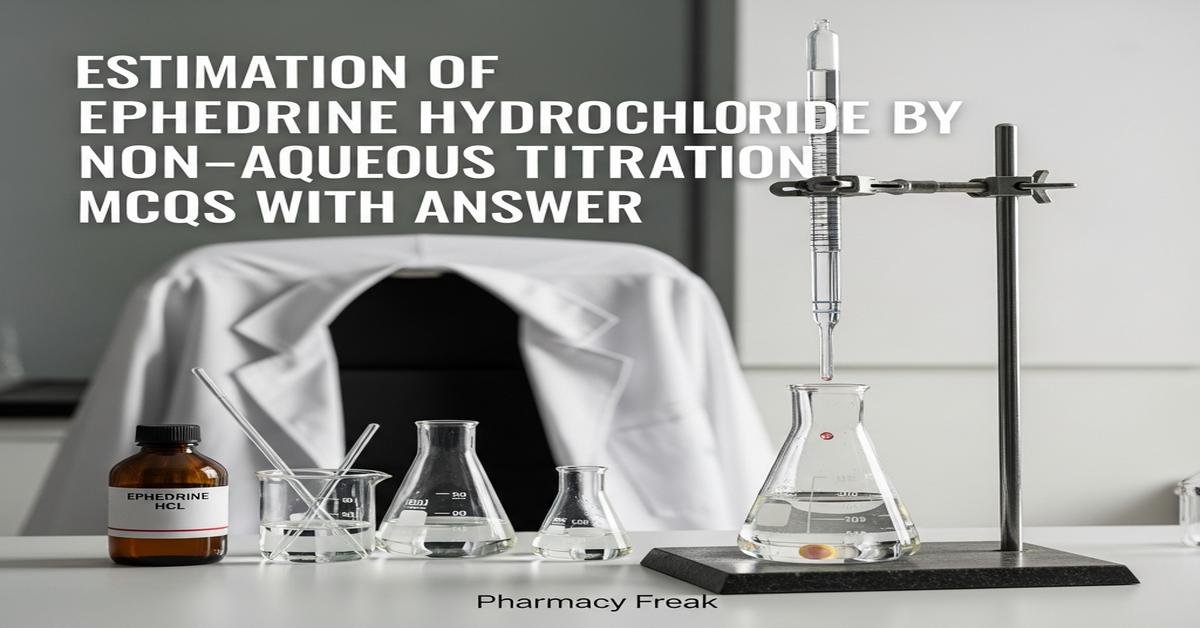
Estimation of ephedrine hydrochloride by non-aqueous titration MCQs With Answer presents a focused review for B. Pharm students on the titrimetric assay of ephedrine hydrochloride using non-aqueous media. This introduction covers principles of non-aqueous titration, choice of solvent and titrant, suitable indicators, sample preparation, sources of error, and validation parameters for accurate assay. Keywords: ephedrine hydrochloride, non-aqueous titration, titrimetric method, perchloric acid, glacial acetic acid, indicator, end point, equivalent weight, assay, analytical chemistry, validation. The content links theory to practical considerations so you can apply methods confidently in the lab. Now let’s test your knowledge with 30 MCQs on this topic.
Q1. What is the primary principle behind non-aqueous titration for estimating ephedrine hydrochloride?
- Titration of a weak base with a strong acid in a non-aqueous solvent to obtain a sharp end point
- Oxidation-reduction between ephedrine and an oxidant in water
- Complexometric chelation of ephedrine by EDTA
- Gravimetric precipitation of ephedrine as an insoluble salt
Correct Answer: Titration of a weak base with a strong acid in a non-aqueous solvent to obtain a sharp end point
Q2. Which titrant is most commonly used in non-aqueous titration of weak bases like ephedrine hydrochloride?
- Sodium hydroxide in ethanol
- Perchloric acid in glacial acetic acid
- Potassium permanganate in water
- Titrant is not required for non-aqueous titration
Correct Answer: Perchloric acid in glacial acetic acid
Q3. Which solvent is typically chosen for dissolving ephedrine hydrochloride in a non-aqueous titration?
- Glacial acetic acid
- Distilled water
- Petroleum ether
- 1 M sodium chloride solution
Correct Answer: Glacial acetic acid
Q4. Which indicator is commonly used for perchloric acid titration of weak bases in non-aqueous media?
- Crystal violet
- Methyl orange
- Starch
- Phenolphthalein in water
Correct Answer: Crystal violet
Q5. Ephedrine hydrochloride behaves primarily as which of the following in non-aqueous titrations?
- A weak base (proton acceptor)
- A strong acid (proton donor)
- An oxidizing agent
- An inert neutral compound
Correct Answer: A weak base (proton acceptor)
Q6. Why is non-aqueous titration preferred over aqueous titration for ephedrine?
- Non-aqueous media suppresses ionization of weak bases, giving sharper end points
- Non-aqueous titration is always faster than aqueous titration
- Ephedrine decomposes in non-aqueous media
- Aqueous titration cannot use indicators
Correct Answer: Non-aqueous media suppresses ionization of weak bases, giving sharper end points
Q7. Which primary standard is often used to standardize perchloric acid titrant in non-aqueous titrations?
- Benzoic acid
- Potassium permanganate
- Sodium carbonate
- Calcium carbonate
Correct Answer: Benzoic acid
Q8. What is the main role of the indicator in non-aqueous titration of ephedrine hydrochloride?
- To show a sudden color change at the equivalence point
- To react stoichiometrically with ephedrine
- To increase the solubility of the sample
- To neutralize excess titrant chemically
Correct Answer: To show a sudden color change at the equivalence point
Q9. Which of the following sample components is most likely to interfere with the non-aqueous titration of ephedrine hydrochloride?
- Another basic alkaloid present in the formulation
- Sugars and lactose
- Trace amounts of moisture only
Correct Answer: Another basic alkaloid present in the formulation
Q10. For titrimetric calculations, the equivalent weight of ephedrine hydrochloride is determined by which relationship?
- Molecular weight divided by the number of reactive protons exchanged (usually 1)
- Molecular weight multiplied by the pH
- Molecular weight divided by Avogadro’s number
- Molecular weight plus the titrant normality
Correct Answer: Molecular weight divided by the number of reactive protons exchanged (usually 1)
Q11. Which procedural precaution is most important when performing non-aqueous titration for ephedrine hydrochloride?
- Exclude moisture and use dry reagents and glassware
- Always perform the titration in direct sunlight
- Use tap water to rinse the titration vessel
- Add excess base before titration begins
Correct Answer: Exclude moisture and use dry reagents and glassware
Q12. What is a primary advantage of potentiometric end-point detection over color indicators in non-aqueous titration?
- Potentiometric detection gives objective and often more precise end points
- Potentiometric detection is always cheaper
- Indicators are unusable in non-aqueous media
- Potentiometry eliminates the need for a titrant
Correct Answer: Potentiometric detection gives objective and often more precise end points
Q13. How does moisture affect the accuracy of non-aqueous titration for ephedrine hydrochloride?
- Moisture reacts with titrant or solvent and causes erroneous titrant strength and end point shifts
- Moisture always improves endpoint sharpness
- Moisture converts ephedrine into an inert compound enhancing accuracy
- Moisture has no effect in non-aqueous titrations
Correct Answer: Moisture reacts with titrant or solvent and causes erroneous titrant strength and end point shifts
Q14. During sample preparation for assay, ephedrine hydrochloride is typically dissolved in which medium before titration?
- Glacial acetic acid containing the chosen indicator
- Distilled water with sodium chloride
- Petroleum ether to extract lipophilic impurities
- Concentrated ammonia solution
Correct Answer: Glacial acetic acid containing the chosen indicator
Q15. Which validation parameter specifically assesses the closeness of measured values to the true value in assay of ephedrine hydrochloride?
- Accuracy
- Precision
- Robustness
- Limit of detection
Correct Answer: Accuracy
Q16. What is the typical stoichiometry between ephedrine (a monobasic amine) and perchloric acid in non-aqueous titration?
- 1 mole ephedrine reacts with 1 mole perchloric acid (1:1)
- 2 moles ephedrine react with 1 mole perchloric acid (2:1)
- 1 mole ephedrine reacts with 2 moles perchloric acid (1:2)
- No stoichiometric reaction occurs
Correct Answer: 1 mole ephedrine reacts with 1 mole perchloric acid (1:1)
Q17. Which of the following is a common limitation of non-aqueous titration methods?
- Use of toxic or flammable solvents and hygroscopic reagents
- They are universally applicable to all drug substances
- They never require standardization of titrant
- They provide unlimited sensitivity for trace analysis
Correct Answer: Use of toxic or flammable solvents and hygienic reagents
Q18. (Note: one option intentionally paraphrased) Which operational step corrects for reagent consumption not due to sample during titration?
- Perform a blank titration and apply correction
- Skip standardization of titrant
- Increase sample mass to reduce error
- Always add excess indicator
Correct Answer: Perform a blank titration and apply correction
Q19. Which indicator is an alternative to crystal violet for non-aqueous titration of weak bases?
- Quinaldine red
- Starch
- 2,4-Dinitrophenol
- Bromothymol blue in water
Correct Answer: Quinaldine red
Q20. How is the percentage assay of ephedrine hydrochloride typically calculated after titration?
- From titrant normality, titrant volume, equivalent weight, and sample mass
- By dividing the titrant volume by sample color intensity
- By measuring the pH at the start only
- By comparing sample smell to a standard
Correct Answer: From titrant normality, titrant volume, equivalent weight, and sample mass
Q21. Which safety consideration is most important when handling perchloric acid titrant?
- Avoid heat and organic residues because perchloric acid can form explosive perchlorates
- Perchloric acid is harmless and requires no precautions
- Only wear gloves; no eye protection is necessary
- Store perchloric acid at high temperature to reduce strength
Correct Answer: Avoid heat and organic residues because perchloric acid can form explosive perchlorates
Q22. If an interfering basic impurity is present, which corrective approach is most appropriate?
- Separate the impurity by suitable extraction or chromatographic method before titration
- Ignore the impurity and proceed with titration
- Add more indicator to mask interference
- Increase titrant concentration without further cleanup
Correct Answer: Separate the impurity by suitable extraction or chromatographic method before titration
Q23. Why is standardization of the perchloric acid titrant required regularly?
- Titrant concentration may change due to moisture uptake or decomposition
- Titrant concentration is always constant and never needs checking
- Standardization is only for aqueous titrations
- To change the chemical identity of the titrant
Correct Answer: Titrant concentration may change due to moisture uptake or decomposition
Q24. Which analytical parameter is improved by performing titrations in a dry, temperature-controlled environment?
- Precision and reproducibility of end point
- Color of the indicator
- Ability to use water as solvent
- Complete elimination of all interferences
Correct Answer: Precision and reproducibility of end point
Q25. In method validation, robustness refers to which characteristic of the non-aqueous titration procedure?
- The ability to remain unaffected by small deliberate changes in method parameters
- How quickly a result can be produced
- The maximum concentration detectable by the method
- The purity of the titrant
Correct Answer: The ability to remain unaffected by small deliberate changes in method parameters
Q26. Which physical property of ephedrine hydrochloride makes it advantageous to assay by non-aqueous titration?
- Its basic nitrogen functionality that reacts with strong acid in non-aqueous media
- Its strong acidic carboxyl group
- Its inability to dissolve in any organic solvent
- Its metallic nature
Correct Answer: Its basic nitrogen functionality that reacts with strong acid in non-aqueous media
Q27. When preparing titrant, which practice reduces systematic error?
- Standardize the prepared titrant against a certified primary standard
- Assume concentration from supplier label without verification
- Always prepare titrant with tap water
- Use random glassware without calibration
Correct Answer: Standardize the prepared titrant against a certified primary standard
Q28. How does excess indicator concentration affect a non-aqueous titration end point?
- Too much indicator can obscure or shift the end point, causing error
- More indicator always improves end point sharpness
- Indicator concentration has no effect on titration
- Indicator will neutralize the titrant if in excess
Correct Answer: Too much indicator can obscure or shift the end point, causing error
Q29. Which documentation step is essential after completing the titration assay in the lab?
- Record raw titration readings, calculations, standardization data, and corrective blanks
- Only record the final percentage without raw data
- Dispose of all records immediately to save space
- Record only the indicator color change description
Correct Answer: Record raw titration readings, calculations, standardization data, and corrective blanks
Q30. What is a recommended practice if the titration end point is ambiguous or the color change is very gradual?
- Use potentiometric or potentiometric equivalence detection or improve sample cleanup to obtain a sharper end point
- Increase the indicator tenfold and ignore the result
- Repeat titration without changing any parameter indefinitely
- Discard the method as unusable without investigation
Correct Answer: Use potentiometric or potentiometric equivalence detection or improve sample cleanup to obtain a sharper end point

