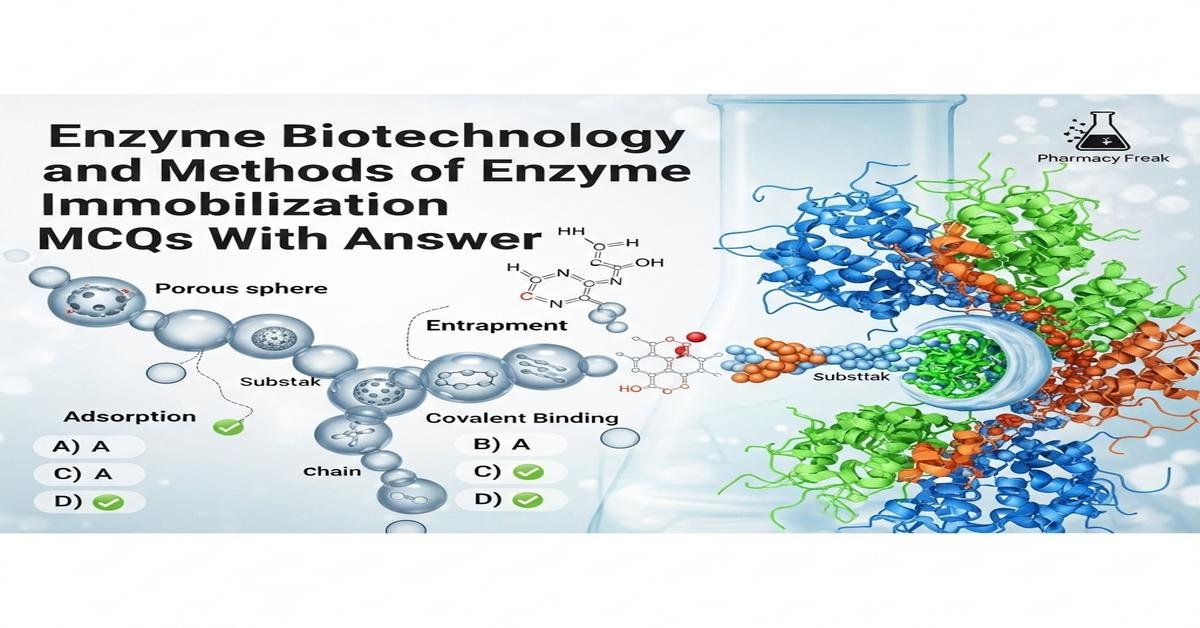
Introduction: Enzyme biotechnology explores the use of enzymes as biocatalysts in pharmaceutical research and production. This introduction covers enzyme immobilization — key methods such as adsorption, covalent binding, entrapment, encapsulation and cross-linking — and highlights carrier materials, immobilization kinetics, stability, reusability, and applications in drug synthesis, bioreactors and biosensors. Understanding immobilization techniques improves enzyme activity retention, operational stability, and process economics, essential for B. Pharm students learning industrial biocatalysis, formulation and analytical enzyme assays. Practical considerations include mass transfer, pH and temperature effects, and scale-up challenges. You will also encounter characterization techniques (FTIR, SEM, activity assays) and regulatory aspects relevant to quality control. Now let’s test your knowledge with 30 MCQs on this topic.
Q1. What is the primary purpose of enzyme immobilization in pharmaceutical bioprocesses?
- To permanently denature enzymes for disposal
- To increase enzyme solubility in organic solvents
- To enhance enzyme stability, reusability and facilitate separation
- To change the primary amino acid sequence of enzymes
Correct Answer: To enhance enzyme stability, reusability and facilitate separation
Q2. Which immobilization method relies mainly on weak physical interactions between enzyme and support?
- Covalent binding
- Adsorption
- Entrapment in polymer matrices
- Cross‑linking of enzyme molecules
Correct Answer: Adsorption
Q3. Covalent immobilization typically uses which reagent to form stable bonds between enzyme and support?
- Glutaraldehyde
- Sodium chloride
- Polyethylene glycol (PEG) at neutral pH
- Distilled water
Correct Answer: Glutaraldehyde
Q4. Which support material is commonly used for gentle entrapment of enzymes in ionic gels?
- Alginate
- Glass beads
- Gold nanoparticles
- Polyacrylamide resin with covalent crosslinks
Correct Answer: Alginate
Q5. Cross‑linked enzyme aggregates (CLEAs) are prepared by which main steps?
- Adsorption onto hydrophobic beads only
- Precipitation of enzymes followed by chemical cross‑linking
- Entrapment in alginate beads without crosslinkers
- Encapsulation inside liposomes exclusively
Correct Answer: Precipitation of enzymes followed by chemical cross‑linking
Q6. Immobilization often affects apparent Michaelis constant (Km). What general trend is commonly observed due to diffusion limitations?
- Apparent Km decreases because substrate affinity increases
- Apparent Km increases because substrate access is hindered
- Km is unaffected by immobilization
- Km becomes meaningless and is not measurable
Correct Answer: Apparent Km increases because substrate access is hindered
Q7. Which immobilization technique is most suitable when enzyme leakage must be minimized but substrate diffusion should remain high?
- Simple physical adsorption on porous beads
- Encapsulation in impermeable polymer capsules
- Covalent attachment to supports with spacer arms
- Spray‑drying without carrier
Correct Answer: Covalent attachment to supports with spacer arms
Q8. Which analytical method is most commonly used to visualize surface morphology of immobilized enzyme particles?
- UV‑visible spectrophotometry
- Scanning electron microscopy (SEM)
- High‑performance liquid chromatography (HPLC)
- Gel electrophoresis
Correct Answer: Scanning electron microscopy (SEM)
Q9. What is a major disadvantage of adsorption as an immobilization method in industrial reactors?
- Extremely high chemical stability
- Strong irreversible binding that inactivates the enzyme
- Possible enzyme leaching under changing conditions
- Requires expensive radioactive labels
Correct Answer: Possible enzyme leaching under changing conditions
Q10. Which property of an immobilized enzyme preparation is described by “immobilization yield”?
- Fraction of enzyme activity retained on the support relative to initial activity offered
- The mechanical strength of the support
- Thermal denaturation temperature of the free enzyme
- The molecular weight of the support polymer
Correct Answer: Fraction of enzyme activity retained on the support relative to initial activity offered
Q11. In a packed‑bed immobilized enzyme reactor, what is a common scale‑up challenge?
- Excessive free enzyme in the effluent
- Mass transfer limitations and channeling causing uneven substrate contact
- Lack of any pressure drop across the bed
- Too rapid mixing leading to enzyme dilution
Correct Answer: Mass transfer limitations and channeling causing uneven substrate contact
Q12. Which spacer arm property improves enzyme activity after covalent immobilization?
- Very short and rigid spacer that holds enzyme close to the surface
- Hydrophobic spacer that denatures enzymes
- Flexible, hydrophilic spacer that reduces steric hindrance
- Spacer containing heavy metals to catalyze reactions
Correct Answer: Flexible, hydrophilic spacer that reduces steric hindrance
Q13. What is the role of glutaraldehyde in cross‑linking immobilization procedures?
- Acts as a mild detergent to solubilize the enzyme
- Forms Schiff base linkages between amino groups producing covalent bridges
- Serves as a reducing agent to break disulfide bonds
- Increases hydrophobicity of enzyme surface without covalent bonding
Correct Answer: Forms Schiff base linkages between amino groups producing covalent bridges
Q14. Which immobilization approach is most compatible with multienzyme cascade reactions in a single reactor?
- Co‑immobilization of enzymes on a common support
- Using separate free enzymes in different vessels only
- Embedding enzymes in completely separate, impermeable capsules
- Denaturing enzymes and mixing them as powders
Correct Answer: Co‑immobilization of enzymes on a common support
Q15. Entrapment differs from encapsulation primarily by which feature?
- Entrapment uses chemical bonding; encapsulation uses only physical adsorption
- Entrapment confines enzymes within a porous polymer network; encapsulation surrounds enzymes inside a membrane or capsule
- Entrapment always forms covalent bonds with enzyme
- They are identical with no practical differences
Correct Answer: Entrapment confines enzymes within a porous polymer network; encapsulation surrounds enzymes inside a membrane or capsule
Q16. Which parameter directly indicates improved operational stability of an immobilized enzyme?
- Higher initial free enzyme activity in solution
- Retention of activity over multiple reaction cycles
- Increased solubility in organic solvents only
- Lower molecular weight of the immobilized enzyme
Correct Answer: Retention of activity over multiple reaction cycles
Q17. Which support is particularly noted for biocompatibility in immobilized enzyme biosensors?
- Chitosan
- Polystyrene foam
- Lead glass
- Pure crystalline carbonates
Correct Answer: Chitosan
Q18. Which technique helps confirm covalent attachment of enzyme to a support by identifying new functional groups?
- Mass spectrometry of the support only
- Fourier transform infrared spectroscopy (FTIR)
- Simple visual inspection
- Paper chromatography of the support
Correct Answer: Fourier transform infrared spectroscopy (FTIR)
Q19. Immobilization can improve enzyme tolerance to organic solvents. What is one mechanistic explanation?
- Support materials increase solvent polarity permanently
- Immobilization restricts conformational flexibility, reducing denaturation
- Enzymes on supports lose their active site
- Immobilized enzymes always gain new catalytic residues
Correct Answer: Immobilization restricts conformational flexibility, reducing denaturation
Q20. What does “specific activity” refer to in the context of immobilized enzymes?
- Total mass of support per unit reactor volume
- Activity per unit mass of enzyme (or protein) after immobilization
- Number of immobilization steps used
- The color change observed during assay
Correct Answer: Activity per unit mass of enzyme (or protein) after immobilization
Q21. Which immobilization strategy is most likely to preserve native enzyme conformation and activity?
- Harsh covalent coupling at multiple lysine residues without control
- Gentle adsorption under mild conditions on a compatible support
- High‑temperature cross‑linking above enzyme Tm
- Use of strong organic solvents during immobilization
Correct Answer: Gentle adsorption under mild conditions on a compatible support
Q22. In studying immobilized enzyme kinetics, what experimental observation suggests internal diffusion limitations?
- Reaction rate independent of substrate concentration at all ranges
- Observed Vmax is lower and apparent Km is higher compared to free enzyme
- Apparent Km is significantly lower than free enzyme
- Complete loss of measurable activity immediately after immobilization
Correct Answer: Observed Vmax is lower and apparent Km is higher compared to free enzyme
Q23. Which immobilization parameter describes the amount of enzyme bound per unit mass of support?
- Immobilization yield
- Enzyme loading
- Specific activity of the free enzyme
- Particle porosity index
Correct Answer: Enzyme loading
Q24. For continuous pharmaceutical production, which reactor type is commonly used with immobilized enzymes to maximize contact time?
- Batch reactor with free enzyme only
- Packed‑bed (fixed‑bed) reactor
- Open pond reactor
- Vortex mixer without support
Correct Answer: Packed‑bed (fixed‑bed) reactor
Q25. Which chemical activation is commonly used to introduce aldehyde groups on carbohydrate supports for covalent coupling?
- Periodate oxidation of polysaccharide supports
- Reduction with sodium borohydride only
- Thermal annealing at 300°C
- Silylation with chlorosilanes
Correct Answer: Periodate oxidation of polysaccharide supports
Q26. What is a key advantage of immobilized enzyme biosensors in pharmaceutical analysis?
- They eliminate the need for calibration
- Enhanced operational stability and potential for repeated measurements
- They require no cofactors for any enzyme
- They make enzymes soluble in nonpolar solvents
Correct Answer: Enhanced operational stability and potential for repeated measurements
Q27. Which factor should be optimized to reduce enzyme leaching from an adsorptive support?
- Increase ionic strength or use covalent cross‑linking after adsorption
- Always lower pH to extreme values
- Remove all salts from the buffer
- Increase temperature to promote desorption
Correct Answer: Increase ionic strength or use covalent cross‑linking after adsorption
Q28. Co‑immobilization of two enzymes can improve cascade efficiency by which mechanism?
- Physically separating intermediates to avoid transfer
- Shortening diffusion path for intermediates and increasing local concentration
- Completely preventing substrate access to active sites
- Always increasing the Km of both enzymes drastically
Correct Answer: Shortening diffusion path for intermediates and increasing local concentration
Q29. Which test best evaluates thermal stability improvement after immobilization?
- Measuring activity retention after incubation at elevated temperature over time
- Determining the pH of the support
- Measuring UV absorbance at 280 nm of the support
- Observing color change under visible light only
Correct Answer: Measuring activity retention after incubation at elevated temperature over time
Q30. Which regulatory consideration is most relevant when applying immobilized enzymes in pharmaceutical manufacturing?
- Ensuring immobilized enzyme support and reagents meet purity and leachables limits
- Selecting supports that are radioactive for tracking
- Using uncharacterized industrial byproducts as supports to reduce cost
- Avoiding documentation for immobilization procedures
Correct Answer: Ensuring immobilized enzyme support and reagents meet purity and leachables limits

