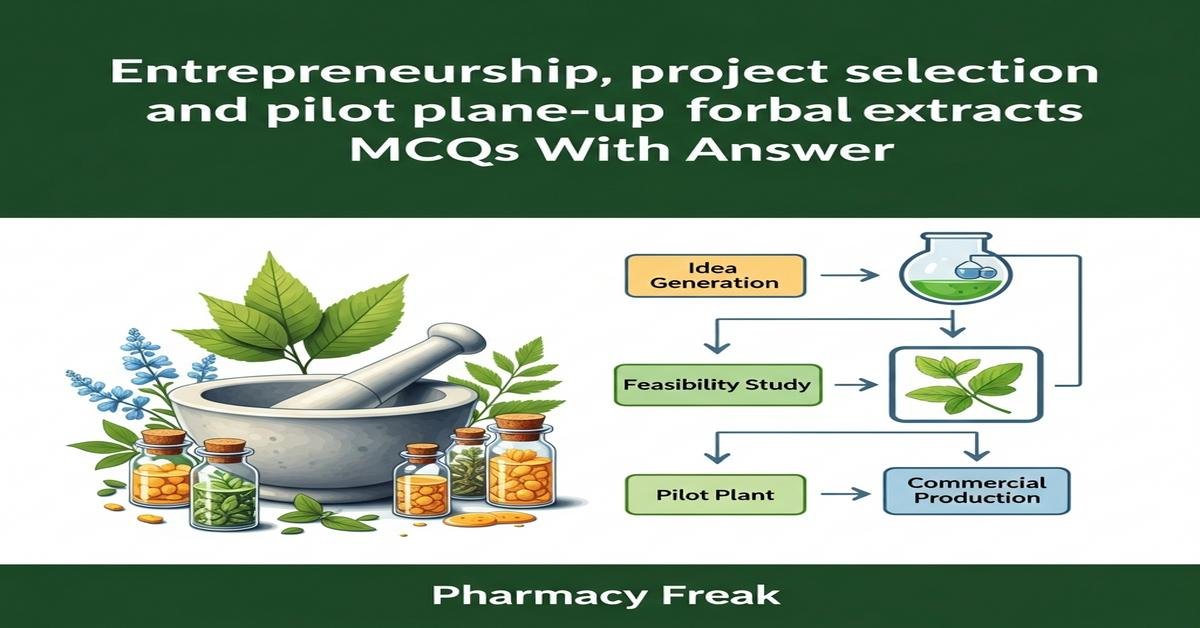
Introduction: This quiz collection focuses on entrepreneurship, project selection, and pilot plant scale-up specifically for herbal extracts, tailored for M.Pharm students studying Industrial Pharmacognostical Technology (MPG 104T). It combines technical scale-up concepts—extraction kinetics, solvent selection, mass and heat transfer, equipment sizing—with business and regulatory aspects such as market assessment, techno-economic feasibility, CAPEX/OPEX estimation, quality systems, and regulatory compliance for herbal products. Each question is designed to test practical understanding useful for designing pilot plants, drafting project reports, and preparing for industry roles or startups in phytopharmaceuticals. Use these MCQs to assess readiness for real-world process development and entrepreneurship in herbal extraction technologies.
Q1. Which primary component should be evaluated first when conducting a techno-economic feasibility study for a herbal extract production project?
- Laboratory-scale extraction yield and consistency
- Availability and seasonal variability of raw herbal material
- Preferred packaging designs
- Branding and marketing strategy
Correct Answer: Availability and seasonal variability of raw herbal material
Q2. In selecting a project for herbal extract manufacturing, the term ‘market pull’ refers to:
- A regulatory mandate to produce a specific extract
- Customer demand driving product development
- A technology push from academic research
- Availability of low-cost raw materials
Correct Answer: Customer demand driving product development
Q3. For pilot plant scale-up of a solvent extraction process, which parameter is most critical to scale geometrically to maintain similar mass transfer?
- Impeller diameter to tank diameter ratio (D/T)
- Number of operators per shift
- Color of the vessel lining
- Supplier lead time for spare parts
Correct Answer: Impeller diameter to tank diameter ratio (D/T)
Q4. When moving from lab to pilot scale for solid-liquid extraction of plant material, the most direct effect of increasing particle size is:
- Increased extraction rate due to higher porosity
- Decreased solvent viscosity
- Reduced surface area leading to slower extraction kinetics
- Change in solvent polarity
Correct Answer: Reduced surface area leading to slower extraction kinetics
Q5. A key benefit of running pilot batches before full commercial production is:
- Elimination of all regulatory requirements
- Validation of process reproducibility and identification of scale-dependent problems
- Instant reduction of raw material cost
- Guarantee of market success
Correct Answer: Validation of process reproducibility and identification of scale-dependent problems
Q6. Which heat transfer concern becomes especially important when concentrating herbal extracts in large evaporators during scale-up?
- Electrical conductivity of the extract
- Fouling and reduced overall heat transfer coefficient
- Color of the extraction vessel
- Operator uniformity in tasting samples
Correct Answer: Fouling and reduced overall heat transfer coefficient
Q7. In pilot plant design for herbal extracts, the primary reason to include a solvent recovery system is:
- To enhance the color of the final product
- To reduce solvent consumption, lower operating cost and minimize environmental impact
- To increase raw material weight
- To speed up packaging operations
Correct Answer: To reduce solvent consumption, lower operating cost and minimize environmental impact
Q8. For regulatory compliance of herbal extracts produced at pilot scale, which document is essential to demonstrate process control and reproducibility?
- Design drawings of the marketing logo
- Batch manufacturing records and process validation reports
- Employee personal emails
- Supplier catalogs for office furniture
Correct Answer: Batch manufacturing records and process validation reports
Q9. When estimating CAPEX for a pilot plant, which cost element is most sensitive to increases in scale?
- Office stationery
- Major process equipment (reactors, evaporators, dryers)
- Number of cafeteria meals
- Promotional brochure printing
Correct Answer: Major process equipment (reactors, evaporators, dryers)
Q10. Which extraction solvent property is most important for efficient extraction of active phytoconstituents while ensuring regulatory acceptability?
- High color index
- Appropriate polarity and acceptable toxicity/residue profile
- Extremely high boiling point regardless of toxicity
- Odor intensity only
Correct Answer: Appropriate polarity and acceptable toxicity/residue profile
Q11. During pilot scale-up, what is the main purpose of conducting a scale-up mass balance?
- To calculate office electricity bills
- To verify material inputs and outputs, yields and identify losses at each unit step
- To design company stationery
- To determine staff vacation schedules
Correct Answer: To verify material inputs and outputs, yields and identify losses at each unit step
Q12. Which drying technique is most suitable to preserve heat-sensitive phytochemicals at pilot scale?
- High-temperature tray drying without control
- Freeze drying (lyophilization)
- Open-air sun drying in uncontrolled conditions
- Extended high-shear milling while hot
Correct Answer: Freeze drying (lyophilization)
Q13. For extraction process scale-up, using dimensionless numbers helps because they:
- Eliminate need for any engineering calculations
- Allow dynamic similarity between lab and pilot scales accounting for fluid flow and mass transfer
- Only apply to electrical systems
- Are irrelevant for herbal extracts
Correct Answer: Allow dynamic similarity between lab and pilot scales accounting for fluid flow and mass transfer
Q14. A project report for a new herbal extract plant should include which critical regulatory section for product approval?
- Detailed recipes for employee meals
- Quality specification, analytical methods, stability data and regulatory compliance plan
- List of local tourist attractions
- Designs of company T-shirts
Correct Answer: Quality specification, analytical methods, stability data and regulatory compliance plan
Q15. In pilot plant extraction, what is the likely effect of insufficient solvent-to-solid ratio compared to the lab-optimized ratio?
- Improved extraction completeness
- Lower extraction yield and possible incomplete mass transfer
- Instant sterilization of the product
- Elimination of need for downstream purification
Correct Answer: Lower extraction yield and possible incomplete mass transfer
Q16. Which economic metric best indicates how quickly initial project investment might be recovered for a herbal extract venture?
- Number of laboratory notebooks
- Payback period
- Color of packaging
- Employee headcount
Correct Answer: Payback period
Q17. For pilot plant safety, what is the primary concern when using flammable organic solvents at scale?
- Improper label design
- Ignition sources, solvent vapor accumulation and need for explosion-proof equipment
- Excess humidity only
- Low staff training costs
Correct Answer: Ignition sources, solvent vapor accumulation and need for explosion-proof equipment
Q18. Which approach is most appropriate when extrapolating extraction kinetics from bench to pilot scale?
- Assume identical time profiles regardless of geometry
- Use mechanistic models or dimensionless correlations to account for diffusional and convective effects
- Rely solely on vendor brochures
- Double all process times arbitrarily
Correct Answer: Use mechanistic models or dimensionless correlations to account for diffusional and convective effects
Q19. In project selection, the SWOT analysis component ‘Threats’ typically evaluates:
- Internal strengths such as skilled staff
- External challenges such as competitor entry, regulatory changes, and raw material scarcity
- Company logos
- Preferred supplier lunch menus
Correct Answer: External challenges such as competitor entry, regulatory changes, and raw material scarcity
Q20. A critical quality attribute (CQA) for a standardized herbal extract that must be monitored during scale-up is:
- Employee birthday dates
- Assay of bioactive marker compound and impurity profile
- Number of pages in the marketing brochure
- Office parking space dimensions
Correct Answer: Assay of bioactive marker compound and impurity profile

