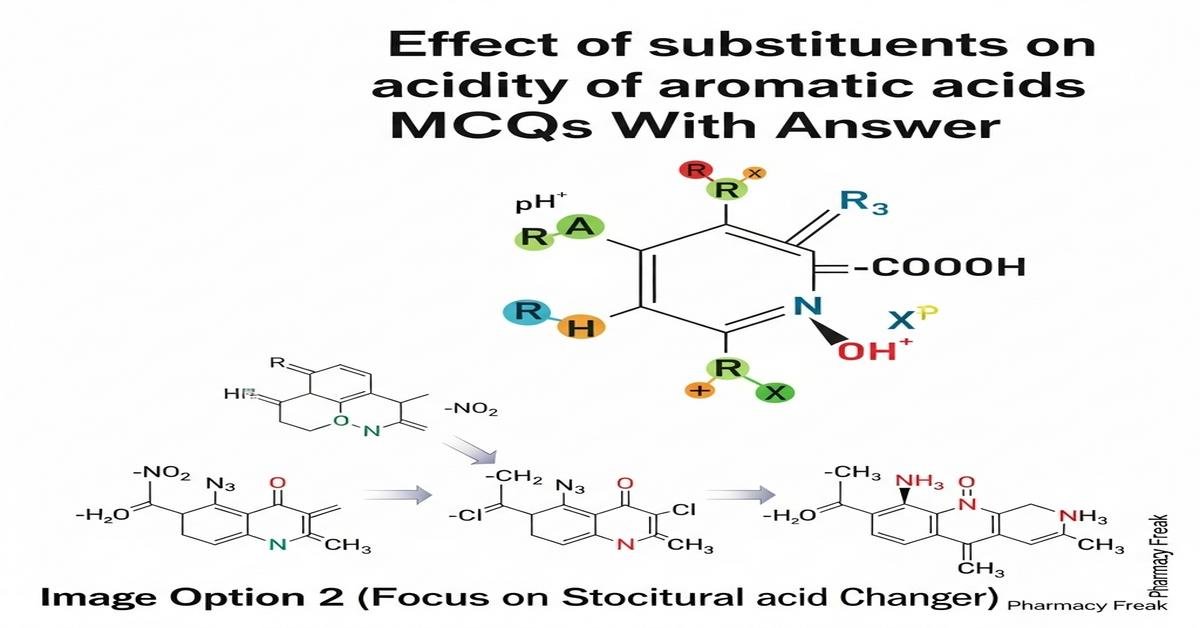
Understanding the effect of substituents on acidity of aromatic acids is essential for B. Pharm students studying drug design, formulation and pharmacokinetics. Substituents modify acidity mainly via inductive (-I/+I) and resonance (-M/+M) effects, and through steric or intramolecular hydrogen-bonding at ortho positions, which alter pKa and conjugate-base stability. Recognizing how electron-withdrawing groups (nitro, carbonyl, halogens) and electron-donating groups (alkyl, methoxy, amino) change acidity helps predict ionization, solubility and bioavailability of aromatic drug molecules. This focused, concept-driven practice with explanations links organic reactivity to pharmaceutical implications. Now let’s test your knowledge with 50 MCQs on this topic.
Q1. Which effect primarily stabilizes the conjugate base of an aromatic carboxylic acid, thereby increasing acidity?
- Electron-donating resonance (+M) from a substituent
- Electron-withdrawing inductive (-I) effect from a substituent
- Increased steric hindrance at para position
- Protonation of the aromatic ring
Correct Answer: Electron-withdrawing inductive (-I) effect from a substituent
Q2. Which substituent generally increases the acidity of benzoic acid the most?
- Methyl (-CH3)
- Nitro (-NO2)
- Methoxy (-OCH3)
- Amino (-NH2)
Correct Answer: Nitro (-NO2)
Q3. Why does a nitro group at the para position increase aromatic acid acidity?
- Strong +M resonance donation stabilizes the neutral acid
- Strong -M and -I effects stabilize the carboxylate anion by delocalizing negative charge
- It forms an intramolecular hydrogen bond with the acid proton
- It increases steric hindrance preventing deprotonation
Correct Answer: Strong -M and -I effects stabilize the carboxylate anion by delocalizing negative charge
Q4. Which position(s) allow resonance interaction of a substituent with the carboxyl group in benzene derivatives?
- Meta only
- Ortho and para
- Para only
- Any position equally
Correct Answer: Ortho and para
Q5. How does an electron-donating methoxy group at para position affect benzoic acid acidity?
- Increases acidity by -I effect
- Decreases acidity because +M resonance destabilizes the conjugate base
- No effect on acidity
- Increases acidity by forming hydrogen bonds
Correct Answer: Decreases acidity because +M resonance destabilizes the conjugate base
Q6. For substituent effects on acidity, what is the main difference between inductive and resonance effects?
- Inductive is through-bond; resonance is through-space
- Inductive works only in para positions; resonance works only in meta
- Inductive is a sigma-electron effect transmitted through bonds; resonance involves delocalization via pi-system
- There is no difference; they are the same phenomenon
Correct Answer: Inductive is a sigma-electron effect transmitted through bonds; resonance involves delocalization via pi-system
Q7. Which substituent shows a +M (electron-donating by resonance) effect?
- Nitro (-NO2)
- Amino (-NH2)
- Trifluoromethyl (-CF3)
- Carboxyl (-COOH)
Correct Answer: Amino (-NH2)
Q8. A substituent at meta position mainly influences acidity via which effect?
- Resonance (+M or -M)
- Inductive (-I or +I)
- Through-space hydrogen bonding only
- No influence at all
Correct Answer: Inductive (-I or +I)
Q9. Why does ortho substitution often give different acidity effects than para or meta?
- Only ortho allows resonance effects
- Ortho can produce steric hindrance and intramolecular hydrogen bonding that alter acidity
- Ortho substituents never affect acidity
- Because ortho substituents remove the carboxyl group
Correct Answer: Ortho can produce steric hindrance and intramolecular hydrogen bonding that alter acidity
Q10. How does an electron-withdrawing group stabilize the conjugate base of an aromatic acid?
- By donating electrons into the ring
- By delocalizing or pulling electron density away from the negatively charged carboxylate, reducing its energy
- By increasing the basicity of the conjugate base
- By forming covalent bonds with the carboxylate
Correct Answer: By delocalizing or pulling electron density away from the negatively charged carboxylate, reducing its energy
Q11. Which statement about halogen substituents on benzoic acid is generally correct?
- Halogens always strongly increase acidity by resonance donation
- Halogens exhibit -I inductive withdrawal but also lone-pair +M donation; net effect is modest and position-dependent
- Halogens have no electronic effects on acidity
- Halogens convert benzoic acid into a base
Correct Answer: Halogens exhibit -I inductive withdrawal but also lone-pair +M donation; net effect is modest and position-dependent
Q12. Which substituent would most likely decrease acidity of benzoic acid?
- Trifluoromethyl (-CF3)
- Nitro (-NO2)
- Methoxy (-OCH3)
- Cyano (-CN)
Correct Answer: Methoxy (-OCH3)
Q13. In terms of Hammett sigma constants, a positive sigma value indicates:
- Electron-donating character
- Electron-withdrawing character
- No electronic effect
- Steric hindrance only
Correct Answer: Electron-withdrawing character
Q14. How does conjugation between the aromatic ring and the carboxyl group affect acidity?
- Conjugation always decreases acidity
- Conjugation allows resonance stabilization of the conjugate base, often increasing acidity if substituted appropriately
- Conjugation prevents deprotonation completely
- Conjugation only affects color, not acidity
Correct Answer: Conjugation allows resonance stabilization of the conjugate base, often increasing acidity if substituted appropriately
Q15. For phenols, how does an electron-withdrawing substituent at the para position affect acidity?
- It decreases acidity by stabilizing the phenol
- It increases acidity by stabilizing the phenoxide anion
- It has no effect on acidity
- It converts phenol into an amine
Correct Answer: It increases acidity by stabilizing the phenoxide anion
Q16. Which is a major pharmaceutical implication of substituent-induced acidity changes?
- Ionization state at physiological pH affects solubility and membrane permeability
- Substituents only change color, not drug behavior
- All drugs become more potent with electron-donating groups
- Acidity has no effect on absorption
Correct Answer: Ionization state at physiological pH affects solubility and membrane permeability
Q17. Why do strong electron-withdrawing groups increase the acidity of aromatic acids?
- They reduce the stability of the conjugate base
- They stabilize the conjugate base by delocalizing negative charge away from the carboxylate
- They donate protons to the solvent
- They increase steric crowding around the proton
Correct Answer: They stabilize the conjugate base by delocalizing negative charge away from the carboxylate
Q18. Which of the following best explains why para-nitrobenzoic acid is more acidic than benzoic acid?
- Para-nitro donates electrons into the ring enhancing basicity
- Para-nitro withdraws electrons by resonance and induction, stabilizing the carboxylate
- Nitro group forms a hydrogen bond with the proton
- Para position has no effect; only ortho matters
Correct Answer: Para-nitro withdraws electrons by resonance and induction, stabilizing the carboxylate
Q19. Which substituent will make aromatic acid the least acidic among the choices?
- Nitro (-NO2)
- Cyano (-CN)
- Methyl (-CH3)
- Trifluoromethyl (-CF3)
Correct Answer: Methyl (-CH3)
Q20. How does protonation of an amino substituent on an aromatic acid influence acidity?
- Protonation converts -NH2 into -NH3+, which is electron-withdrawing and increases acidity
- Protonation makes the substituent more electron-donating and decreases acidity
- Protonation has no electronic consequences
- Protonation always decreases solubility
Correct Answer: Protonation converts -NH2 into -NH3+, which is electron-withdrawing and increases acidity
Q21. Which effect explains increased acidity of o-nitrobenzoic acid compared to m-nitrobenzoic acid?
- Meta nitro stabilizes via resonance; ortho does not
- Ortho nitro gives additional intramolecular hydrogen bonding and strong resonance/inductive stabilization
- Ortho causes steric hindrance that blocks acid dissociation
- There is no difference between ortho and meta
Correct Answer: Ortho nitro gives additional intramolecular hydrogen bonding and strong resonance/inductive stabilization
Q22. In assessing substituent effects on acidity, which is a reliable qualitative rule?
- Electron-withdrawing groups increase acidity; electron-donating groups decrease acidity
- Electron-donating groups always increase acidity
- Only steric effects matter for acidity
- The solvent is the only determinant of acidity
Correct Answer: Electron-withdrawing groups increase acidity; electron-donating groups decrease acidity
Q23. Which substituent combination would most stabilize a carboxylate anion?
- Two para methoxy groups
- A para nitro and an ortho nitro
- Two para methyl groups
- A para amino and para methoxy
Correct Answer: A para nitro and an ortho nitro
Q24. Which of the following statements about the resonance effect (-M / +M) is true?
- Only sigma bonds transmit resonance effects
- Resonance effects can stabilize or destabilize the conjugate base depending on substituent polarity
- Resonance effects are strongest at meta positions
- Resonance has no impact on acidity
Correct Answer: Resonance effects can stabilize or destabilize the conjugate base depending on substituent polarity
Q25. For aromatic acids, which is generally more important at long distances (several bonds away): induction or resonance?
- Resonance predominates at long distances through sigma bonds
- Inductive effect decays with distance but can still operate; resonance requires conjugation (ortho/para)
- Neither effect operates over distances
- Steric effects dominate at long distances
Correct Answer: Inductive effect decays with distance but can still operate; resonance requires conjugation (ortho/para)
Q26. Which substituent pattern will most likely make a phenolic OH less acidic?
- Para-nitro substitution
- Ortho,para-dimethoxy substitution
- Para-cyano substitution
- Ortho-nitro substitution
Correct Answer: Ortho,para-dimethoxy substitution
Q27. How does intramolecular hydrogen bonding at ortho position affect acidity of aromatic acids?
- Always decreases acidity by stabilizing neutral acid relative to conjugate base
- Can either increase or decrease acidity depending on whether hydrogen bonding stabilizes acid or conjugate base
- Has no effect on acidity
- Only affects optical rotation
Correct Answer: Can either increase or decrease acidity depending on whether hydrogen bonding stabilizes acid or conjugate base
Q28. Which pair correctly describes the electronic effect and its influence on acidity?
- +I increases acidity; -I decreases acidity
- -M decreases acidity; +M increases acidity
- -I increases acidity; +M decreases acidity when conjugation destabilizes the conjugate base
- All electronic effects always increase acidity
Correct Answer: -I increases acidity; +M decreases acidity when conjugation destabilizes the conjugate base
Q29. When comparing p-nitrophenol and p-methoxyphenol, which is more acidic and why?
- p-Methoxyphenol is more acidic because methoxy withdraws by induction
- p-Nitrophenol is more acidic because nitro stabilizes the phenoxide via -M and -I effects
- Both have same acidity
- p-Methoxyphenol is more acidic due to intramolecular hydrogen bonding
Correct Answer: p-Nitrophenol is more acidic because nitro stabilizes the phenoxide via -M and -I effects
Q30. How does resonance donation (+M) from a substituent affect the negative charge distribution in the conjugate base?
- It delocalizes negative charge away from the conjugate base making it more stable
- It donates electron density into the ring increasing electron density on the conjugate base and destabilizing it
- It removes the conjugate base entirely
- It converts the conjugate base into an acid
Correct Answer: It donates electron density into the ring increasing electron density on the conjugate base and destabilizing it
Q31. Which effect is most responsible for the acidity increase caused by trifluoromethyl (-CF3) substituent?
- Strong +M resonance donation
- Strong -I inductive electron withdrawal
- Intramolecular hydrogen bonding
- Steric hindrance preventing solvation
Correct Answer: Strong -I inductive electron withdrawal
Q32. In drug molecules, why is understanding substituent effects on acidity important for formulation scientists?
- Because acidity determines only the taste of the drug
- Because acidity affects ionization, solubility, stability, and partitioning, critical to formulation design
- Because substituents always make drugs toxic
- Because acidity is only relevant for solid-state color
Correct Answer: Because acidity affects ionization, solubility, stability, and partitioning, critical to formulation design
Q33. Which substituent at para position will most strongly stabilize a negative charge on the aromatic ring?
- Para-amino (-NH2)
- Para-nitro (-NO2)
- Para-methyl (-CH3)
- Para-alkyl chain
Correct Answer: Para-nitro (-NO2)
Q34. Which is true about a substituent with a positive Hammett sigma value at para position?
- It generally donates electrons and reduces acidity
- It generally withdraws electrons and enhances acidity
- It has no predictable effect
- It always increases basicity
Correct Answer: It generally withdraws electrons and enhances acidity
Q35. How does the presence of an adjacent electron-donating group affect a carboxylic acid’s pKa?
- It lowers pKa by stabilizing conjugate base
- It raises pKa by destabilizing the conjugate base
- It converts the acid into an ester
- It has no effect on pKa
Correct Answer: It raises pKa by destabilizing the conjugate base
Q36. Which substitution pattern would most likely produce the greatest resonance stabilization of the conjugate base?
- Meta electron-withdrawing substituents only
- Ortho and para electron-withdrawing substituents enabling conjugation
- Ortho alkyl substituents only
- Random unsubstituted ring
Correct Answer: Ortho and para electron-withdrawing substituents enabling conjugation
Q37. Why are meta nitro substituents less effective at resonance stabilization of conjugate base than para nitro?
- Meta position does not allow resonance interaction with the carboxyl group
- Meta position always donates electrons
- Meta nitro groups evaporate in solution
- Para nitro groups are sterically hindered
Correct Answer: Meta position does not allow resonance interaction with the carboxyl group
Q38. What is the expected effect of alkyl substituents (e.g., methyl, ethyl) on aromatic acid acidity?
- They strongly increase acidity by -I effect
- They are electron-donating by +I, slightly decreasing acidity
- They convert acids into bases
- They form hydrogen bonds increasing acidity
Correct Answer: They are electron-donating by +I, slightly decreasing acidity
Q39. Which factor is NOT primarily electronic but can still influence acidity of ortho-substituted benzoic acids?
- Inductive effect
- Intramolecular hydrogen bonding and steric hindrance (ortho effect)
- Resonance effect
- Hammett sigma constant
Correct Answer: Intramolecular hydrogen bonding and steric hindrance (ortho effect)
Q40. How would protonation state at physiological pH differ for a substituted benzoic acid with lower pKa?
- Lower pKa means the acid is less ionized at physiological pH
- Lower pKa means the acid is more ionized (more deprotonated) at physiological pH
- pKa has no relation to ionization at physiological pH
- Lower pKa means the molecule is always neutral
Correct Answer: Lower pKa means the acid is more ionized (more deprotonated) at physiological pH
Q41. Which substituent would most likely increase the acidity of salicylic acid’s phenolic OH through intramolecular effects?
- Ortho-methoxy that forms hydrogen bonding with OH
- Ortho-nitro that stabilizes the phenoxide via -M and -I effects
- Para-alkyl that donates electrons
- Meta-methyl with no resonance impact
Correct Answer: Ortho-nitro that stabilizes the phenoxide via -M and -I effects
Q42. In the context of medicinal chemistry, why might one introduce an electron-withdrawing substituent on an aromatic drug acid?
- To decrease water solubility
- To increase acidity, enhancing ionization at physiological pH and possibly improving solubility
- To remove the aromaticity
- To make the molecule non-ionizable
Correct Answer: To increase acidity, enhancing ionization at physiological pH and possibly improving solubility
Q43. Which of the following best describes the para effect of a halogen on aromatic acid acidity?
- Para-halogen always strongly donates electrons increasing acidity
- Para-halogen exerts -I and +M; net effect is usually mild electron-withdrawal, modestly increasing or slightly decreasing acidity depending on specific halogen
- Halogens never affect acidity
- Halogens always produce extremely high acidity
Correct Answer: Para-halogen exerts -I and +M; net effect is usually mild electron-withdrawal, modestly increasing or slightly decreasing acidity depending on specific halogen
Q44. When an aromatic acid has both electron-withdrawing and electron-donating substituents, overall acidity will depend on:
- Only the donating group strength
- The relative strengths and positions (ortho/para/meta) of both substituents and their combined resonance/inductive effects
- Only steric interactions
- Only the solvent used
Correct Answer: The relative strengths and positions (ortho/para/meta) of both substituents and their combined resonance/inductive effects
Q45. Which statement about resonance stabilization of benzoate ion is correct?
- Negative charge is localized entirely on one oxygen
- Negative charge is delocalized over both oxygens and the aromatic ring when resonance donors/withdrawers allow
- Resonance cannot delocalize the charge into the ring
- Resonance always destabilizes the benzoate ion
Correct Answer: Negative charge is delocalized over both oxygens and the aromatic ring when resonance donors/withdrawers allow
Q46. Which substituent effect would you exploit to design a prodrug that is less ionized in the stomach (acidic) and more ionized in the intestine (basic)?
- Add a strong electron-donating group to increase acidity
- Add an electron-withdrawing group to lower pKa so it is ionized at intestinal pH but not excessively at gastric pH
- Remove aromaticity entirely
- Add bulky alkyl groups to ensure no ionization
Correct Answer: Add an electron-withdrawing group to lower pKa so it is ionized at intestinal pH but not excessively at gastric pH
Q47. Which observation supports that resonance is the dominant effect at para position?
- Meta substituents show identical acidity changes as para
- Para nitro strongly increases acidity relative to meta nitro due to resonance stabilization
- Ortho substituents never change acidity
- Solvent choice eliminates resonance effects
Correct Answer: Para nitro strongly increases acidity relative to meta nitro due to resonance stabilization
Q48. For an aromatic acid bearing an amino group at para, what is the expected acidity trend and why?
- Acidity increases because amino is a strong -I group
- Acidity decreases because amino donates electrons by +M, destabilizing the conjugate base
- Acidity is unchanged because amino is neutral
- Acidity increases due to intramolecular hydrogen bonding only
Correct Answer: Acidity decreases because amino donates electrons by +M, destabilizing the conjugate base
Q49. Which technique is most appropriate to experimentally determine the effect of a substituent on acidity?
- IR spectroscopy of neutral compound only
- Measure pKa values (potentiometric titration or spectrophotometric pKa determination) and compare series of substituted acids
- Thin-layer chromatography retention factor only
- Melting point comparison
Correct Answer: Measure pKa values (potentiometric titration or spectrophotometric pKa determination) and compare series of substituted acids
Q50. Which general conclusion can B. Pharm students draw about substituent effects on aromatic acid acidity?
- Only steric factors matter; electronics are irrelevant
- Electron-withdrawing substituents (especially at ortho/para) increase acidity by stabilizing the conjugate base; electron-donating groups decrease acidity, with position and secondary effects (steric, H-bonding) modifying outcomes
- All substituents increase acidity equally
- Substituents only change physical color, not acidity
Correct Answer: Electron-withdrawing substituents (especially at ortho/para) increase acidity by stabilizing the conjugate base; electron-donating groups decrease acidity, with position and secondary effects (steric, H-bonding) modifying outcomes


I am a Registered Pharmacist under the Pharmacy Act, 1948, and the founder of PharmacyFreak.com. I hold a Bachelor of Pharmacy degree from Rungta College of Pharmaceutical Science and Research. With a strong academic foundation and practical knowledge, I am committed to providing accurate, easy-to-understand content to support pharmacy students and professionals. My aim is to make complex pharmaceutical concepts accessible and useful for real-world application.
Mail- Sachin@pharmacyfreak.com