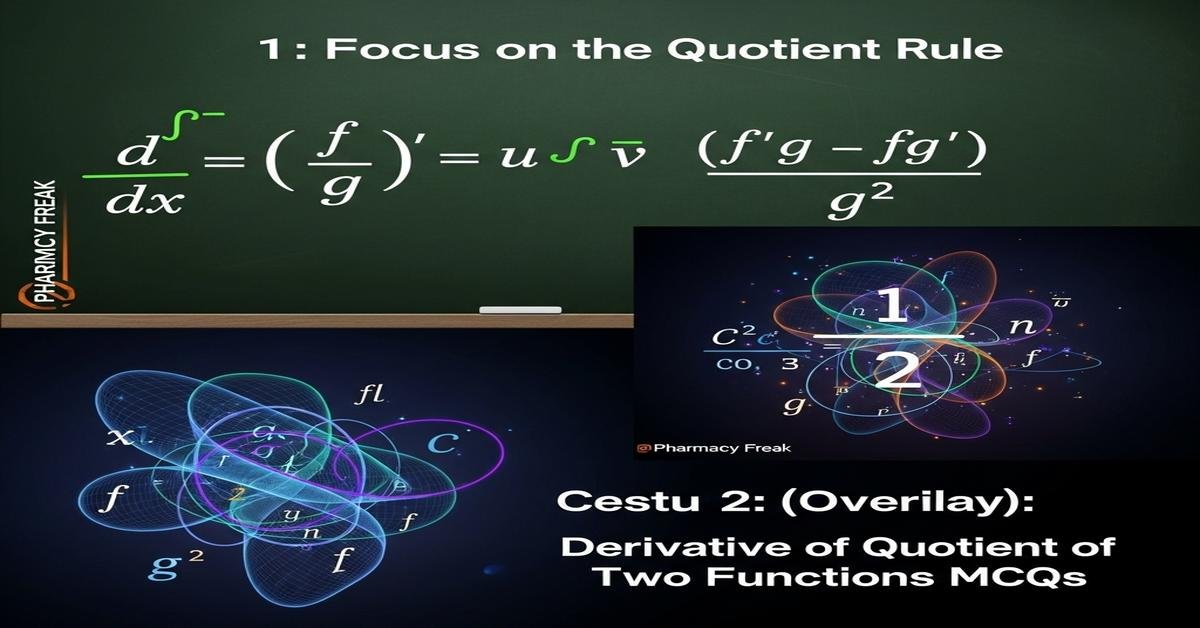
Derivative of quotient of two functions MCQs With Answer is a focused practice set designed for B. Pharm students to master the quotient rule and its applications in pharmacokinetics and drug kinetics. This introduction covers practical techniques for differentiating u/v, rewriting quotients as products, handling exponentials, logs and trigonometric ratios, and interpreting rates of change in concentration-time models. Emphasis is placed on common pitfalls—like forgetting the denominator squared—and on simplifying derivatives for clear pharmacological interpretation. Ideal for exam prep and applied calculations, these MCQs link calculus concepts directly to B. Pharm problems such as drug concentration, clearance and rate equations. Now let’s test your knowledge with 50 MCQs on this topic.
Q1. What is the correct quotient rule for derivative of u(x)/v(x)?
- (u’v + uv’)/v^2
- (u’v – uv’)/v^2
- (v’u – vu’)/u^2
- (u’ – v’)/v
Correct Answer: (u’v – uv’)/v^2
Q2. If f(x) = (x^2 + 1)/x, what is f'(x)?
- (2x – 1)/x^2
- (x^2 – 1)/x^2
- 1 – 1/x
- 2x/x
Correct Answer: (x^2 – 1)/x^2
Q3. For f(x) = sin(x)/x, the derivative f'(x) is:
- (cos x – sin x)/x
- (x cos x – sin x)/x^2
- (cos x + sin x)/x^2
- (cos x)/x
Correct Answer: (x cos x – sin x)/x^2
Q4. Compute derivative of f(x) = e^x / x^2.
- e^x(x^2 – 2x)/x^4
- e^x(x – 2)/x^3
- e^x/x^2
- (e^x – 2x)/x^2
Correct Answer: e^x(x – 2)/x^3
Q5. Which method is algebraically equivalent and sometimes easier than applying the quotient rule to u/v?
- Write u/v as u * v and use product rule
- Write u/v as u * (1/v) and use product + chain rules
- Differentiate v/u instead and invert
- Use integration by parts
Correct Answer: Write u/v as u * (1/v) and use product + chain rules
Q6. If f(x) = (x + 1)/(x – 1), what is f'(2)?
- 1
- -1/2
- -2
- 2
Correct Answer: -2
Q7. For C(t) = t/(1 + t^2) representing simplified concentration, C'(t) equals:
- (1 – t^2)/(1 + t^2)^2
- (1 + t^2 – 2t)/(1 + t^2)^2
- 1/(1 + t^2)
- t/(1 + t^2)^2
Correct Answer: (1 – t^2)/(1 + t^2)^2
Q8. Differentiate f(x) = (ln x)/x.
- (1 – ln x)/x^2
- (ln x – 1)/x
- (1/x)/x
- ln x / x^2
Correct Answer: (1 – ln x)/x^2
Q9. Which is the simplest derivative for f(x) = x^3 / sqrt(x)?
- 3x^2 / sqrt(x)
- (5/2) x^{3/2}
- (5/2) x^{3/2}
- (5/2) x^{3/2}
Correct Answer: (5/2) x^{3/2}
Q10. The derivative of tan x, using quotient rule on sin x / cos x, is:
- sec x
- sec^2 x
- csc^2 x
- tan x * sec x
Correct Answer: sec^2 x
Q11. If v(a) = 0 for u(x)/v(x), what can be concluded about the derivative at x = a?
- The derivative is zero
- The derivative is undefined or does not exist unless numerator also zero with removable limit
- The derivative equals u'(a)
- Derivative equals v'(a)/u(a)
Correct Answer: The derivative is undefined or does not exist unless numerator also zero with removable limit
Q12. If drug amount A(t) and volume V (constant) give concentration C(t)=A(t)/V, then C'(t) is:
- A'(t) * V
- A'(t)/V
- V’/A(t)
- A(t)/V’
Correct Answer: A'(t)/V
Q13. Differentiate f(x) = (3x^2 – 1)/(x + 2).
- (6x(x + 2) – (3x^2 – 1))/ (x + 2)^2
- ((6x)(x + 2) – (3x^2 – 1)*1)/(x + 2)^2
- (3x^2 – 1)/(x + 2)^2
- (6x – 1)/(x + 2)
Correct Answer: ((6x)(x + 2) – (3x^2 – 1)*1)/(x + 2)^2
Q14. For f(x) = (x^2 + x)/(x^3), best simplified derivative is:
- Use quotient rule to get (2x + 1)x^3 – (x^2 + x)3x^2)/x^6
- Simplify first to x^{-1} + x^{-2} then differentiate to -x^{-2} -2x^{-3}
- Derivative is 0
- (x^2 + x)’ / x^3
Correct Answer: Simplify first to x^{-1} + x^{-2} then differentiate to -x^{-2} -2x^{-3}
Q15. Using quotient rule, derivative of f(x) = 1/g(x) is:
- g'(x)/g(x)
- -g'(x)/g(x)^2
- 1/g'(x)
- -1/g'(x)
Correct Answer: -g'(x)/g(x)^2
Q16. If u(x)=x^2 and v(x)=e^x, then derivative of u/v at x=0 equals:
- (0 * 1 – 0 * 1)/1
- (0*e^0 – 0*e^0)/e^0
- 0
- Undefined
Correct Answer: 0
Q17. For f(x) = (arctan x)/x, f'(1) equals:
- (1/(1+1^2) *1 – arctan 1 *1)/1^2 = (1/2 – pi/4)
- (1 – arctan 1)/1
- (1/2 – pi/4)
- pi/4
Correct Answer: (1/2 – pi/4)
Q18. Identify common algebraic simplification of (u’v – uv’)/v^2 when u = v * h (u is v times h):
- Derivative reduces to h’ when u = v*h
- Derivative reduces to v h’/v^2
- Derivative reduces to h’/v
- Derivative equals 0
Correct Answer: Derivative reduces to h’/v
Q19. If f(x) = (x^2 + 2x +1)/(x), recognizing numerator as (x+1)^2, f'(x) simplifies to:
- (2x + 2)/x – (x+1)^2/x^2
- Derivative of x + 2 + 1/x
- Use division: f(x)=x+2+1/x so f'(x)=1 – 1/x^2
- (2x+2)/x^2
Correct Answer: Use division: f(x)=x+2+1/x so f'(x)=1 – 1/x^2
Q20. For a ratio R(t)=A(t)/B(t), which expression gives R'(t)?
- (A’B + AB’)/B^2
- (A’B – AB’)/B^2
- A’/B’
- (A – B’)/B
Correct Answer: (A’B – AB’)/B^2
Q21. Derivative of f(x) = (e^{2x})/(x) is:
- (2e^{2x} * x – e^{2x})/x^2
- (2e^{2x} – e^{2x})/x
- e^{2x}/x
- (2x – 1)e^{2x}/x^2
Correct Answer: (2e^{2x} * x – e^{2x})/x^2
Q22. If f(x) = (sin x)^2 / x, using quotient rule the numerator of the derivative is:
- (2 sin x cos x) * x – (sin x)^2 * 1
- (2 sin x cos x – sin^2 x)/x
- 2 sin x cos x – sin^2 x
- sin^2 x * x
Correct Answer: (2 sin x cos x) * x – (sin x)^2 * 1
Q23. For f(x) = (x)/(e^x), which simplification helps find f'(x) easily?
- Write as x * e^{-x} and use product rule
- Apply quotient rule directly always
- Write as e^x / x and flip
- Integrate instead
Correct Answer: Write as x * e^{-x} and use product rule
Q24. If f(x) = (1 + x^2)/(1 – x^2), the derivative f'(0) equals:
- 0
- 2
- -2
- 1
Correct Answer: 0
Q25. When differentiating a ratio of two differentiable functions, which is a common mistake?
- Forgetting to square the denominator
- Multiplying numerator and denominator by derivative
- Applying chain rule twice
- Neglecting domain of numerator
Correct Answer: Forgetting to square the denominator
Q26. Derivative of f(x) = (x^2 + 1)/(x^2 – 1) at x = 2 is:
- ((2x)(x^2 – 1) – (x^2 +1)(2x))/(x^2 – 1)^2 evaluated at 2 gives 0
- 1/3
- -1/3
- 2
Correct Answer: ((2x)(x^2 – 1) – (x^2 +1)(2x))/(x^2 – 1)^2 evaluated at 2 gives 0
Q27. For f(x) = (ln(1+x))/(x), which technique simplifies differentiation?
- Differentiate using quotient rule directly
- Expand ln(1+x) as series always
- Use product form ln(1+x) * x^{-1} and product + chain rules
- Use integration
Correct Answer: Use product form ln(1+x) * x^{-1} and product + chain rules
Q28. True or false: If u and v are differentiable, (u/v)’ = (u’v – uv’)/v^2 always holds even if v=0 at some points.
- True for all x
- False; formula holds only where v(x) ≠ 0
- True if u’ = 0
- True if v’ = 0
Correct Answer: False; formula holds only where v(x) ≠ 0
Q29. For pharmacokinetic model C(t)= (At)/(B + t^2), C'(t) equals (choose best form):
- ((A)(B + t^2) – (At)(2t))/(B + t^2)^2
- (A(B + t^2) – 2At^2)/(B + t^2)^2
- (A(B – t^2))/(B + t^2)^2
- (AB + At^2 – 2At^2)/(B + t^2)^2
Correct Answer: ((A)(B + t^2) – (At)(2t))/(B + t^2)^2
Q30. Given f(x)=(x^4)/(x^2+1), the highest power in denominator after applying quotient rule is:
- (x^2 +1)
- (x^2 +1)^2
- x^4
- (x^2 +1)^3
Correct Answer: (x^2 +1)^2
Q31. Which rewrite leads to simpler differentiation of f(x) = (x^3)/(1+x)?
- Keep quotient and apply quotient rule
- Divide polynomial: use polynomial division to split into simpler terms
- Use integration
- Write as (1+x)/x^3
Correct Answer: Divide polynomial: use polynomial division to split into simpler terms
Q32. For f(x) = (cos x)/(x^2), f'(x) simplifies to:
- (-sin x * x^2 – cos x * 2x)/x^4
- ((-sin x)x^2 – cos x * 2x)/x^4
- (-sin x)/x^2
- (-sin x – 2 cos x)/x^3
Correct Answer: ((-sin x)x^2 – cos x * 2x)/x^4
Q33. If u(x)=x^2+1 and v(x)=x^2-1, then (u/v)’ simplifies to which of these?
- 0
- (4x)/(x^2 -1)^2
- (4x)/(x^2 +1)^2
- (2x)/(x^2 -1)
Correct Answer: (4x)/(x^2 -1)^2
Q34. For f(x) = (sqrt(x))/ (1 + x), which is derivative via quotient rule?
- ((1/(2 sqrt(x)))(1+x) – sqrt(x)*1)/(1+x)^2
- ((1+x) – 2x)/(1+x)^2
- 1/(2 sqrt(x)(1+x))
- (1 – x)/(1+x)^2
Correct Answer: ((1/(2 sqrt(x)))(1+x) – sqrt(x)*1)/(1+x)^2
Q35. Which step correctly derives (u/v)’ using product and chain rules?
- Differentiate u * v and divide by v^2
- D/dx[u * v^{-1}] = u’ v^{-1} + u (-1) v^{-2} v’ giving (u’v – uv’)/v^2
- Differentiate numerator only
- Differentiate denominator only
Correct Answer: D/dx[u * v^{-1}] = u’ v^{-1} + u (-1) v^{-2} v’ giving (u’v – uv’)/v^2
Q36. For f(x) = (x + sin x)/(x^2), which part of derivative causes trig term?
- Derivative of sin x yields cos x in numerator piece u’v
- Denominator differentiation creates cos x
- There is no trig term
- Only v’ term gives cos x
Correct Answer: Derivative of sin x yields cos x in numerator piece u’v
Q37. If C(t) = (k1 e^{-k2 t}) / (1 + t), the derivative requires which rules combined?
- Only quotient rule
- Product, chain and quotient rules (since numerator has chain rule inside exponential)
- Only chain rule
- Only product rule
Correct Answer: Product, chain and quotient rules (since numerator has chain rule inside exponential)
Q38. Differentiating f(x) = (x^2 – 1)/(x^2 + 1) yields which odd/even symmetry property of f’?
- f’ is an odd function
- f’ is an even function
- f’ is constant
- f’ is neither odd nor even
Correct Answer: f’ is an odd function
Q39. Evaluate derivative at x=1 for f(x) = (ln x)/(x^2):
- ((1/x)*x^2 – ln x * 2x)/x^4 at x=1 = (1*1 – 0*2)/1 = 1
- 0
- 1/2
- -1
Correct Answer: ((1/x)*x^2 – ln x * 2x)/x^4 at x=1 = (1*1 – 0*2)/1 = 1
Q40. For f(x) = (x^2 + 1)^{-1} written as 1/(x^2 + 1), the derivative equals:
- -2x/(x^2 + 1)^2
- 2x/(x^2 + 1)^2
- -1/(x^2 + 1)
- 0
Correct Answer: -2x/(x^2 + 1)^2
Q41. For f(x) = (x^3 + x)/(x), why is quotient rule unnecessary?
- Because f simplifies to x^2 + 1 before differentiating
- Because denominator derivative is zero
- Because quotient rule gives wrong answer
- Because numerator is constant
Correct Answer: Because f simplifies to x^2 + 1 before differentiating
Q42. If u(x)=sin x and v(x)=x, what is d/dx (u/v) at x = pi?
- (cos pi * pi – sin pi)/pi^2 = (-1 * pi – 0)/pi^2 = -1/pi
- 0
- 1/pi
- -pi
Correct Answer: (cos pi * pi – sin pi)/pi^2 = (-1 * pi – 0)/pi^2 = -1/pi
Q43. Which expression is equivalent to derivative of (g/h) using differential notation?
- d(g/h) = (g’ h – g h’)/h^2 dx
- d(g/h) = (g’ + h’)/h dx
- d(g/h) = g’/h’ dx
- d(g/h) = g h dx
Correct Answer: d(g/h) = (g’ h – g h’)/h^2 dx
Q44. For f(x) = (e^x + x)/(e^x – x), what is sign of f'(0)?
- Positive
- Negative
- Zero
- Undefined
Correct Answer: Zero
Q45. When differentiating rate C'(t) from C(t)=N(t)/D(t) in a kinetics model, which interpretation is valid?
- Numerator differentiation reflects production/absorption rate, denominator influences dilution
- Denominator differentiation is irrelevant to rate
- Only numerator matters physically
- Derivative gives total amount, not rate
Correct Answer: Numerator differentiation reflects production/absorption rate, denominator influences dilution
Q46. Using quotient rule, derivative of f(x) = (x^2 – 4)/(x – 2) simplifies to:
- Use cancellation first: (x+2) so derivative is 1
- Derivative equals 2x/(x-2)^2
- Derivative equals (2x(x-2) – (x^2 -4)*1)/(x-2)^2
- Undefined for all x
Correct Answer: Use cancellation first: (x+2) so derivative is 1
Q47. For f(x) = (sin x)/(x^2), what is behavior of f'(x) as x -> 0 (use series intuition)?
- f'(x) -> 0
- f'(x) -> infinity
- f'(x) -> finite nonzero limit
- f'(x) oscillates without limit
Correct Answer: f'(x) -> 0
Q48. If u and v are differentiable and u = constant, what is (u/v)’?
- 0
- -u v’/v^2
- u’/v
- u/v’
Correct Answer: -u v’/v^2
Q49. For f(x) = (x)/(1 + e^x), which derivative component comes from denominator?
- The term with -x e^x from -u v’ in numerator
- Denominator yields no derivative contribution
- Denominator gives only squared term
- Denominator gives positive contribution only
Correct Answer: The term with -x e^x from -u v’ in numerator
Q50. Which check verifies algebra after applying quotient rule?
- Differentiate numerically at a sample point and compare to analytical result
- Assume result is correct without checking
- Ignore denominator domain
- Only check asymptotic behavior
Correct Answer: Differentiate numerically at a sample point and compare to analytical result

