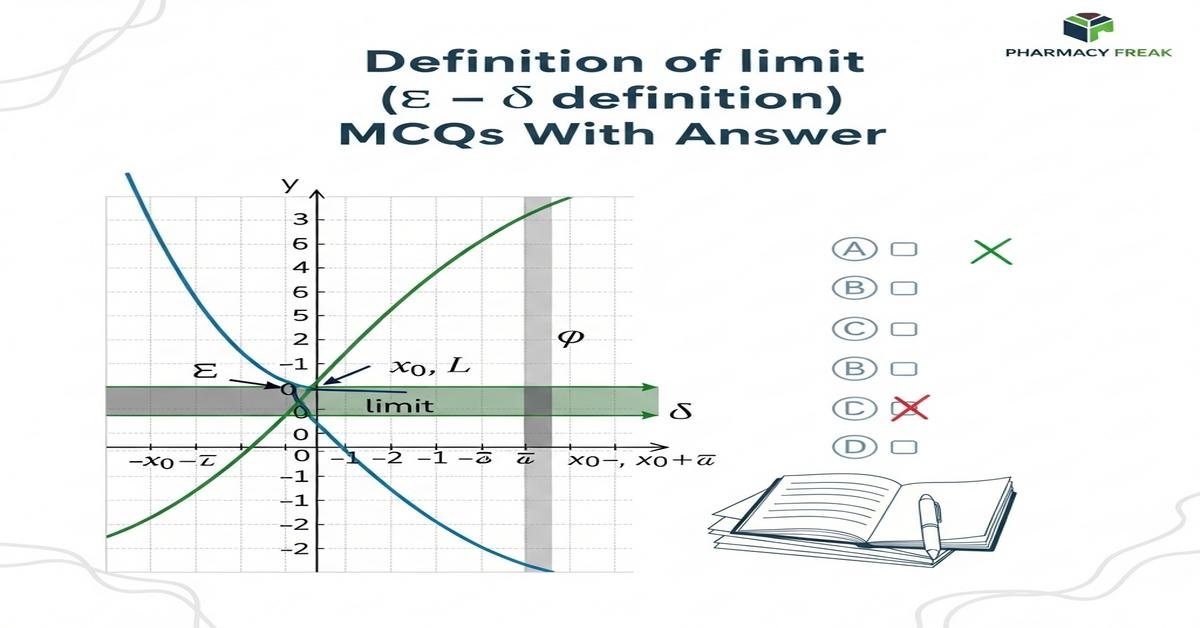
Definition of limit (ε – δ definition) MCQs With Answer
The epsilon-delta definition of limit is a formal, rigorous way to describe how a function approaches a value as the input approaches a point. B. Pharm students studying calculus for pharmaceutical modeling must master this concept to analyze rate processes, dissolution curves, and pharmacokinetic functions. This collection emphasizes key ideas: the roles of ε (epsilon) and δ (delta), quantifier order, constructing δ for given ε, one-sided limits, uniqueness, and common proof techniques. Focused examples include polynomials, rational and trigonometric cases and negations of the definition to avoid common mistakes. Now let’s test your knowledge with 50 MCQs on this topic.
Q1. What is the formal ε-δ definition of limit lim_{x→a} f(x) = L?
- For every ε > 0 there exists δ > 0 such that 0 < |x − a| < δ implies |f(x) − L| < ε.
- There exists ε > 0 such that for every δ > 0, 0 < |x − a| < δ implies |f(x) − L| < ε.
- For every δ > 0 there exists ε > 0 such that 0 < |x − a| < δ implies |f(x) − L| < ε.
- For some ε > 0 and δ > 0, 0 < |x − a| < δ implies |f(x) − L| < ε.
Correct Answer: For every ε > 0 there exists δ > 0 such that 0 < |x − a| < δ implies |f(x) − L| < ε.
Q2. In the ε-δ definition, which quantifier order is correct?
- For every ε > 0, there exists δ > 0.
- There exists δ > 0, for every ε > 0.
- There exists ε > 0, for every δ > 0.
- For every δ > 0, there exists ε > 0.
Correct Answer: For every ε > 0, there exists δ > 0.
Q3. If lim_{x→2} (3x + 1) = 7, which δ works for a given ε?
- δ = ε/3
- δ = 3ε
- δ = ε + 3
- δ = ε^3
Correct Answer: δ = ε/3
Q4. For f(x) = 2x, a = 1, to show lim_{x→1} 2x = 2, choose δ as:
- δ = ε/2
- δ = 2ε
- δ = ε^2
- δ = ε – 2
Correct Answer: δ = ε/2
Q5. Which statement is the logical negation of “lim_{x→a} f(x) = L”?
- There exists ε > 0 such that for every δ > 0 there exists x with 0 < |x−a| < δ and |f(x)−L| ≥ ε.
- For every ε > 0 there exists δ > 0 such that for all x, |f(x)−L| < ε.
- There exists δ > 0 such that for every ε > 0, if 0 < |x−a| < δ then |f(x)−L| < ε.
- For every δ > 0 there exists ε > 0 such that |f(x)−L| < ε.
Correct Answer: There exists ε > 0 such that for every δ > 0 there exists x with 0 < |x−a| < δ and |f(x)−L| ≥ ε.
Q6. If f(x) = x^2, a = 3, and we want |x^2 − 9| < ε, which factorization helps choose δ?
- |x^2 − 9| = |x − 3||x + 3|
- |x^2 − 9| = |x − 3|^2
- |x^2 − 9| = |x + 3| − |x − 3|
- |x^2 − 9| = (x − 3) + (x + 3)
Correct Answer: |x^2 − 9| = |x − 3||x + 3|
Q7. To bound |x+3| near a = 3, we often restrict δ ≤ 1 so that |x+3| ≤
- 7
- 6
- 4
- 3
Correct Answer: 7
Q8. For f(x) = x^2 at a = 3, using δ = min(1, ε/7) ensures what?
- If 0<|x−3|<δ then |x^2−9|<ε.
- If 0<|x−3|<δ then |x^2−9|>ε.
- δ is independent of ε.
- The limit does not exist.
Correct Answer: If 0<|x−3|<δ then |x^2−9|<ε.
Q9. Which of the following is a one-sided ε-δ definition for lim_{x→a+} f(x) = L?
- For every ε>0 there exists δ>0 such that 0 < x−a < δ implies |f(x)−L| < ε.
- For every ε>0 there exists δ>0 such that −δ < x−a < 0 implies |f(x)−L| < ε.
- For every ε>0 there exists δ>0 such that |x−a| < δ implies |f(x)−L| > ε.
- There exists ε>0 such that for all δ>0, |f(x)−L| < ε.
Correct Answer: For every ε>0 there exists δ>0 such that 0 < x−a < δ implies |f(x)−L| < ε.
Q10. If lim_{x→a} f(x) = L and lim_{x→a} g(x) = M, what is lim_{x→a} (f+g)(x)?
- L + M
- LM
- Only L or M, whichever is larger
- Limit may not exist
Correct Answer: L + M
Q11. Which property ensures the uniqueness of a limit at a point?
- If lim_{x→a} f(x) equals L and also equals M, then L = M.
- Two different sequences can give different limits.
- Functions can have multiple limits at same point.
- Limits are always infinity.
Correct Answer: If lim_{x→a} f(x) equals L and also equals M, then L = M.
Q12. For f(x) = (x^2 − 4)/(x − 2) for x ≠ 2, what is lim_{x→2} f(x)?
- 4
- 2
- 0
- Does not exist
Correct Answer: 4
Q13. The squeeze (sandwich) theorem helps prove limits when:
- f(x) ≤ g(x) ≤ h(x) and lim of f and h equal the same L at a point.
- f(x) > g(x) > h(x) only.
- All functions are discontinuous at a point.
- Limits approach infinity only.
Correct Answer: f(x) ≤ g(x) ≤ h(x) and lim of f and h equal the same L at a point.
Q14. Which of these describes continuity at a point a?
- lim_{x→a} f(x) = f(a)
- lim_{x→a} f(x) does not exist
- f has a removable discontinuity at a
- f(a) is undefined
Correct Answer: lim_{x→a} f(x) = f(a)
Q15. When proving lim_{x→0} x sin(1/x) = 0 using ε-δ, which bound is useful?
- |x sin(1/x)| ≤ |x|
- |x sin(1/x)| ≤ 1
- |x sin(1/x)| ≤ x^2
- |x sin(1/x)| ≥ |x|
Correct Answer: |x sin(1/x)| ≤ |x|
Q16. If for some function f, for every ε>0 there exists δ>0 such that |x−a|<δ implies |f(x)−L|<ε, what is true about x=a?
- The definition concerns values of x different from a (0<|x−a|), so f(a) may be anything.
- f(a) must equal L.
- f(a) is undefined.
- f is continuous everywhere.
Correct Answer: The definition concerns values of x different from a (0<|x−a|), so f(a) may be anything.
Q17. For rational function f(x) = (x^2+ x − 6)/(x−2), after cancellation what is the simplified expression for x ≠ 2?
- x + 3
- x − 3
- x^2 − 2x
- 3x
Correct Answer: x + 3
Q18. For a linear function f(x)=mx+b, how can you choose δ in terms of ε to prove lim_{x→a} f(x)=ma+b?
- δ = ε/|m| when m ≠ 0
- δ = |m|/ε
- δ = ε^m
- No δ can be chosen
Correct Answer: δ = ε/|m| when m ≠ 0
Q19. Which is true about limits at infinity, lim_{x→∞} f(x) = L?
- For every ε>0 there exists M such that x>M implies |f(x)−L|<ε.
- For every δ>0 there exists ε>0 such that |f(x)−L|<ε for large x.
- Limit at infinity uses 0<|x−a|<δ.
- Limits at infinity require x to approach finite a.
Correct Answer: For every ε>0 there exists M such that x>M implies |f(x)−L|<ε.
Q20. Which is a correct approach to prove lim_{x→1} x^3 = 1 using ε-δ?
- Factor x^3 − 1 = (x−1)(x^2 + x + 1) and bound x^2+x+1 near 1.
- Use l’Hôpital’s rule.
- Assume limit equals 2 and derive contradiction.
- Replace x by 0 always.
Correct Answer: Factor x^3 − 1 = (x−1)(x^2 + x + 1) and bound x^2+x+1 near 1.
Q21. When proving limits for polynomials at a, the typical strategy is:
- Factor difference and bound remaining polynomial terms near a.
- Use series expansion only.
- Always choose δ = ε^2.
- Polynomials do not have limits.
Correct Answer: Factor difference and bound remaining polynomial terms near a.
Q22. If lim_{x→a} f(x) = L and c is a constant, what is lim_{x→a} c f(x)?
- cL
- L/c
- c + L
- Undefined unless c = 1
Correct Answer: cL
Q23. For f(x)=1/x, does lim_{x→0} f(x) exist as a finite number?
- No, it diverges (infinite or does not exist).
- Yes, equals 0.
- Yes, equals 1.
- Yes, equals −1.
Correct Answer: No, it diverges (infinite or does not exist).
Q24. If lim_{x→a} f(x) = L and lim_{x→a} g(x) = M with M ≠ 0, what is lim_{x→a} f(x)/g(x)?
- L/M
- LM
- L + M
- Undefined always
Correct Answer: L/M
Q25. To show lim_{x→0} (sin x)/x = 1 with ε-δ, which inequality is used near 0?
- |sin x| ≤ |x| and limit of ratio tends to 1
- |sin x| ≥ |x| always
Correct Answer: |sin x| ≤ |x| and limit of ratio tends to 1
Q26. Which of these is NOT part of an ε-δ proof?
- Choosing δ in terms of ε
- Showing implication 0<|x−a|<δ ⇒ |f(x)−L|<ε
- Assuming for contradiction that ε = 0
- Bounding expressions using triangle inequality
Correct Answer: Assuming for contradiction that ε = 0
Q27. For piecewise functions, existence of limit at a requires:
- Left-hand and right-hand limits equal at a.
- Only left-hand limit exists.
- Only right-hand limit exists.
- Function values differ by finite amount.
Correct Answer: Left-hand and right-hand limits equal at a.
Q28. If lim_{x→a} f(x) = L and h(x)=g(f(x)) where g is continuous at L, then lim_{x→a} h(x) =
- g(L)
- f(L)
- L/g(L)
- Does not exist
Correct Answer: g(L)
Q29. Which inequality is central to many δ selection arguments?
- Triangle inequality |u+v| ≤ |u| + |v|
- Cauchy-Schwarz inequality
- Arithmetic mean ≥ geometric mean
- Bernoulli’s inequality only
Correct Answer: Triangle inequality |u+v| ≤ |u| + |v|
Q30. To prove lim_{x→0} x^2 = 0, one can choose δ =
- min(1, √ε)
- ε^2
- ε + 1
- 1/ε
Correct Answer: min(1, √ε)
Q31. If limit depends on path (in multivariable case), what happens?
- Limit does not exist.
- Limit exists and is unique.
- Function is continuous.
- Use one-sided δ only.
Correct Answer: Limit does not exist.
Q32. For function f(x)=|x|, what is lim_{x→0} f(x)?
- 0
- 1
- Does not exist
- Infinity
Correct Answer: 0
Q33. To show lim_{x→a} (f(x)−f(a)) = 0, this is equivalent to showing:
- f is continuous at a
- f has a jump at a
- f diverges at a
- f is unbounded near a
Correct Answer: f is continuous at a
Q34. Which statement about limits and sequences is true?
- lim_{x→a} f(x) = L iff for every sequence x_n → a with x_n ≠ a, f(x_n) → L.
- Sequence convergence is unrelated to limits of functions.
- Sequence approach only works for discrete functions.
- If one sequence gives a different limit then original limit still exists.
Correct Answer: lim_{x→a} f(x) = L iff for every sequence x_n → a with x_n ≠ a, f(x_n) → L.
Q35. In ε-δ proofs, choosing δ as a minimum of several expressions is useful because:
- It satisfies multiple bounding conditions simultaneously.
- It makes δ as large as possible always.
- It removes dependence on ε entirely.
- It proves the limit diverges.
Correct Answer: It satisfies multiple bounding conditions simultaneously.
Q36. For f(x)=sqrt(x), does lim_{x→4} sqrt(x) = 2 hold and how to choose δ for small ε?
- Yes; choose δ = ε(2+ε) approx, using |√x−2|<ε ⇒ |x−4|<ε(√x+2).
- No limit does not exist.
- Yes; choose δ = ε^2 always.
- Only one-sided limit exists.
Correct Answer: Yes; choose δ = ε(2+ε) approx, using |√x−2|<ε ⇒ |x−4|<ε(√x+2).
Q37. If lim_{x→a} f(x) = L and f(x) ≥ 0 near a, what can we say about L?
- L ≥ 0
- L ≤ 0
- L must be 1
- L must be undefined
Correct Answer: L ≥ 0
Q38. For function f(x)= (x−1)sin(1/(x−1)) at a=1, what is lim_{x→1} f(x)?
- 0
- 1
- Does not exist
- Infinity
Correct Answer: 0
Q39. Which is true: If lim_{x→a} f(x) exists and is finite, then f is necessarily:
- Not necessarily continuous at a
- Always continuous at a
- Unbounded near a
- Always differentiable at a
Correct Answer: Not necessarily continuous at a
Q40. To show lim_{x→0} (x sin x) = 0, one can use:
- |x sin x| ≤ |x|⋅|sin x| ≤ |x|^2 for small x is false; correct bound is |x sin x| ≤ |x|.
- |x sin x| ≥ |x| always
- sin x behaves like 1/x
- No bound exists
Correct Answer: |x sin x| ≤ |x|⋅|sin x| ≤ |x|^2 for small x is false; correct bound is |x sin x| ≤ |x|.
Q41. Which technique is most direct for proving limits of rational functions where numerator and denominator are polynomials and denominator ≠ 0 at a?
- Plug in a and use polynomial continuity.
- Use L’Hôpital’s rule always.
- Use squeeze theorem only.
- Limits do not exist for rational functions.
Correct Answer: Plug in a and use polynomial continuity.
Q42. For f(x)= (x^2−a^2)/(x−a) when x ≠ a, what is lim_{x→a} f(x)?
- 2a
- a^2
- a
- 0
Correct Answer: 2a
Q43. If a function has different left and right limits at a, then the two-sided limit:
- Does not exist
- Equals their average
- Equals left-hand limit only
- Equals right-hand limit only
Correct Answer: Does not exist
Q44. When bounding |f(x)−L| by sums, which inequality helps split terms?
- |f(x)−L| = |(f(x)−g(x)) + (g(x)−L)| ≤ |f(x)−g(x)| + |g(x)−L|
- |f(x)−L| ≥ |f(x)−g(x)| + |g(x)−L| always
- |f(x)−L| = product of terms
- No inequality applies
Correct Answer: |f(x)−L| = |(f(x)−g(x)) + (g(x)−L)| ≤ |f(x)−g(x)| + |g(x)−L|
Q45. Which of these is a valid δ choice strategy when g is known to be close to its value at a?
- Pick δ small so that |g(x)−g(a)|<ε/2 and |f(x)−f(a)|<ε/2 then use triangle inequality.
- Pick δ large to ignore closeness.
- Choose δ independent from ε always.
- Set δ = 0
Correct Answer: Pick δ small so that |g(x)−g(a)|<ε/2 and |f(x)−f(a)|<ε/2 then use triangle inequality.
Q46. The phrase “for every ε>0 there exists δ>0” means:
- No matter how small a tolerance on f, you can find an x-interval that guarantees it.
- There is a single δ that works for all ε.
- Limits are independent of ε.
- Only large ε are allowed.
Correct Answer: No matter how small a tolerance on f, you can find an x-interval that guarantees it.
Q47. For f(x)=sin x, what is lim_{x→0} (sin x)/x?
- 1
- 0
- Does not exist
- Infinity
Correct Answer: 1
Q48. Which approach helps when f(x) contains a product of two functions and one limit is zero?
- Use bound on the nonzero factor and multiply by small bound for the other factor.
- Ignore the zero limit and only consider the product as constant.
- Use only algebraic cancellation not bounds.
- Product laws of limits never apply.
Correct Answer: Use bound on the nonzero factor and multiply by small bound for the other factor.
Q49. When proving lim_{x→a} f(x) = L using sequences, you must show:
- For every sequence x_n → a with x_n ≠ a, f(x_n) → L.
- There exists one sequence x_n → a such that f(x_n) → L.
- Sequences are irrelevant to limits of functions.
- Sequence convergence only shows divergence.
Correct Answer: For every sequence x_n → a with x_n ≠ a, f(x_n) → L.
Q50. The ultimate goal of mastering ε-δ definitions for B. Pharm students is to:
- Provide precise understanding of how model outputs behave near critical parameter values and ensure rigorous justification of approximations used in drug modeling.
- Only pass exams without real-world application.
- Avoid all use of calculus in pharmaceutical sciences.
- Replace experimental validation entirely.
Correct Answer: Provide precise understanding of how model outputs behave near critical parameter values and ensure rigorous justification of approximations used in drug modeling.

