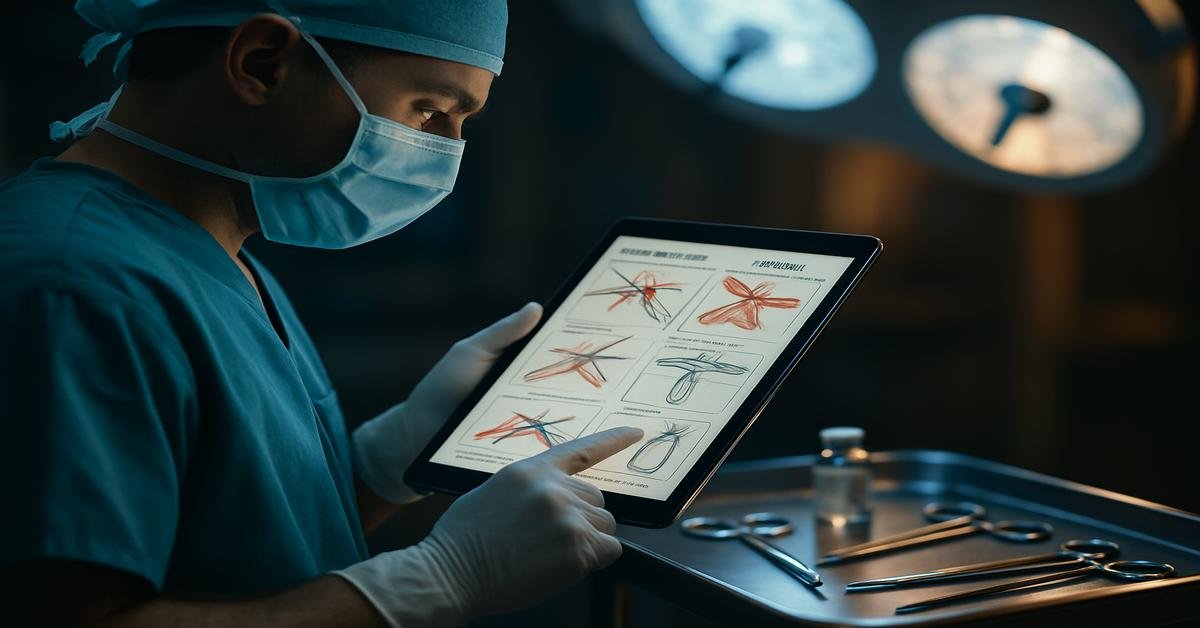
The CSFA exam expects more than good recall. It tests whether you understand what the surgeon is trying to achieve, what can go wrong, and how a first assistant helps keep the operation safe, efficient, and controlled. Advanced surgical techniques and hemostasis are high-yield because they affect almost every case. If tissue handling is poor, exposure is weak, or bleeding is not controlled early, the whole operation becomes harder. This study guide focuses on the concepts that show up often and matter in real practice: dissection methods, stapling and suturing decisions, energy devices, hemostatic tools, and the assistant’s role in preventing complications.
Why advanced technique and hemostasis matter so much on the CSFA exam
These topics are tested heavily because they connect judgment with action. A first assistant does not just “help.” The assistant anticipates the next step, protects tissue, improves visibility, controls bleeding, and supports efficiency without sacrificing safety.
On exam questions, the best answer is often the one that shows you understand why a technique is used. For example:
- Sharp dissection is chosen when planes must be defined precisely and delicate structures must be preserved.
- Blunt dissection is useful when natural tissue planes can be separated with less risk of cutting hidden structures.
- Immediate hemostasis matters because even modest bleeding obscures the field, slows the case, and increases the chance of error.
Think like this on every question: What is the goal? What structure is at risk? What tool gives control with the least collateral damage?
Core surgical principles the exam keeps coming back to
Before getting into tools and techniques, know the principles that guide them.
- Exposure drives safety. Good exposure reduces guessing. Proper retraction creates a clean view of tissue planes, vessels, and critical anatomy.
- Tissue respect reduces complications. Crushed, dried, burned, or over-handled tissue heals poorly and bleeds more.
- Hemostasis is continuous, not a final step. Bleeding should be controlled as it appears, not left to build up.
- Tension must be controlled. Too much traction tears vessels and tissue. Too little traction makes planes hard to see.
- The least destructive effective method is usually best. If a clip, tie, or precise cautery works, there is no reason to create wide thermal spread.
These ideas help with scenario questions because they apply across specialties.
High-yield dissection techniques for surgical assistants
Dissection is not one skill. It is a set of choices based on anatomy, pathology, visibility, and the risk of injury.
Sharp dissection
Sharp dissection uses scissors, a scalpel, or another cutting instrument to divide tissue accurately. It is best when anatomy is tight or delicate. Examples include freeing scarred tissue from a vessel, opening fascia cleanly, or staying in a precise plane during oncologic work.
Why it matters: sharp dissection gives control. It reduces blind tearing. But it also requires clear exposure and stable traction. As the assistant, your job is to create tension that opens the plane without distorting anatomy.
Blunt dissection
Blunt dissection separates tissue along natural planes using fingers, sponges, suction, or blunt instruments. It is useful when tissues are loosely connected and critical structures are not densely adherent.
Why it matters: done well, it can be fast and tissue-sparing. Done poorly, it can avulse vessels or enter the wrong plane. This is especially important in inflamed tissue, where normal anatomy is distorted.
Combination dissection
Many cases use both. A common pattern is blunt dissection to identify a plane, then sharp dissection to divide dense attachments. The exam may test whether you can recognize when blunt technique is no longer safe and a more precise method is needed.
Hydrodissection and suction-assisted dissection
These techniques are used in selected settings to define planes and improve visibility. Suction can act as both an exposure tool and a gentle dissector. This is high yield because assistants often manage suction positioning. Poor suction technique can injure tissue or collapse the field; good technique clears blood without stealing space from the surgeon.
Retraction, exposure, and countertraction: the assistant’s technical role
On the CSFA exam, exposure questions often have simple wording but test deep understanding. The assistant must know where to retract, how much force to use, and when to adjust.
Retraction should expose the target, not just pull tissue away. Good retraction creates tension that opens a plane. Bad retraction hides anatomy, tears tissue, or puts nerves and vessels at risk.
Examples:
- In abdominal surgery, lifting the abdominal wall or bowel gently can improve access while reducing crush injury.
- Near vessels, traction should be steady and deliberate. Jerky movements can avulse small branches.
- In deep wounds, the assistant may need to alternate retraction angles as the dissection progresses. A fixed retractor in the wrong place can be less helpful than a hand-held one used well.
Countertraction is especially high yield. It means applying force in the opposite direction so the tissue plane becomes visible. This is what allows precise dissection. Without countertraction, the surgeon may be cutting into a vague mass instead of a defined layer.
Suturing and knot-tying decisions assistants should understand
The exam may not ask you to perform a full closure on paper, but it will test your understanding of suture selection and closure logic.
Know the main factors in suture choice:
- Tissue type: fascia needs strength; bowel and vessels need precision and minimal trauma.
- Need for long-term support: slowly healing tissue may need delayed absorption or permanent support.
- Infection risk: monofilament is often preferred in contaminated settings because it has less tissue drag and lower bacterial harboring than braided material.
- Handling needs: braided sutures handle and knot well, but may not be ideal in every field.
Interrupted vs continuous closure
- Interrupted sutures provide security. If one fails, the whole closure does not fail. They are useful when tension is uneven or infection risk is higher.
- Continuous sutures are faster and distribute tension evenly, but failure at one point can affect more of the closure.
Knot security and tissue strangulation
A common exam principle: secure is not the same as overly tight. Tight knots can strangulate tissue, impair blood flow, and delay healing. The right knot approximates tissue without crushing it.
Stapling devices: what assistants need to know
Staplers are high yield because they save time but require careful setup and judgment. The assistant may help choose, load, position, and inspect the staple line.
Key concepts:
- Staple height must match tissue thickness. Tissue that is too thick may not form properly. Tissue that is too thin may be crushed or inadequately held.
- Proper alignment matters. Twisted or uneven tissue in the jaws leads to poor staple formation.
- Compression time matters. In some situations, brief tissue compression before firing improves staple formation and reduces bleeding.
- Inspect the staple line. Do not assume a fired stapler created a perfect seal. Look for bleeding, gaps, ischemic tissue, or tension.
The exam may also test the difference between stapling tissue and transecting tissue, or between linear and circular devices. Focus on function. Ask: Is the device closing, dividing, or creating an anastomosis?
Energy devices: monopolar, bipolar, ultrasonic, and advanced bipolar
Energy questions are common because misuse causes burns, bleeding, and delayed injury. You do not need an engineering lecture. You do need working knowledge.
Monopolar electrosurgery
Current passes from the active electrode through the patient to the return electrode. It is versatile and common. It can cut and coagulate, depending on settings and technique.
Why it matters: monopolar energy can create wider thermal spread than more targeted options. It is effective, but near delicate structures the risk of collateral injury is higher. The assistant should maintain a dry, visible field and protect nearby tissue whenever possible.
Bipolar electrosurgery
Current passes between the two tips of the instrument. This makes it more localized.
Why it matters: it gives better control in smaller areas and around critical structures. It is often preferred for precise hemostasis.
Ultrasonic devices
These use mechanical vibration to cut and coagulate. They often create less smoke and may have less thermal spread than monopolar in some settings.
Why it matters: useful when precise dissection and hemostasis are both needed. But no device is risk-free. Heat can still transfer, especially with prolonged activation.
Advanced bipolar vessel sealing
These devices seal vessels and tissue bundles using pressure and energy. They are widely used because they can improve speed and reduce clip or tie use in selected cases.
Why it matters: know their limits. Large vessels may still require clips, ties, or stapling depending on the device and the vessel size. The exam may test whether you recognize that a vessel-sealing device is not a substitute for judgment.
Hemostasis: the methods you must know cold
Hemostasis means stopping bleeding, but the exam tests whether you know which method fits which problem.
Mechanical hemostasis
- Direct pressure: simple and often the first move. It buys time and improves visualization.
- Clamps: useful for identifying and controlling a bleeding vessel before ligation or cautery.
- Ligatures and ties: reliable for vessels that need secure control.
- Clips: fast and effective for many vessels, but placement must be accurate and secure.
- Stapling: useful for larger tissue or vascular pedicles in appropriate settings.
Thermal hemostasis
Electrosurgery and vessel-sealing devices are used to coagulate or seal bleeding tissue. Best for diffuse oozing or small vessels, depending on the device.
Chemical and topical hemostasis
Topical agents are high yield because they are often misunderstood. They help when bleeding is diffuse, access is difficult, or other methods are not ideal.
- Mechanical matrix agents provide a scaffold for clot formation.
- Active agents, such as thrombin-based products, support clotting at the site.
- Sealants may help reinforce closure lines or control surface bleeding in selected cases.
Important exam principle: topical agents do not replace good surgical technique. They support hemostasis; they do not excuse poor vessel control or sloppy dissection.
How to approach bleeding in the operative field
Many test questions describe bleeding and ask for the best next step. The answer usually follows a practical sequence.
- Improve visualization. Suction, blot, and expose the source.
- Apply pressure if needed. This stops the situation from getting worse while the team regains control.
- Identify the type of bleeding. Is it arterial, venous, capillary, or diffuse raw-surface oozing?
- Choose the least harmful effective method. A small vessel may need clip, tie, or bipolar. Diffuse oozing may respond to topical measures plus gentle cautery.
- Reassess. Hemostasis is not complete until the field stays dry under normal pressure and positioning.
Arterial bleeding is usually bright red and pulsatile. It needs prompt control. Pressure, suction, exposure, and secure ligation or clipping are common responses.
Venous bleeding may be darker and steady. It can still be dangerous, especially in deep fields where visualization is poor.
Capillary oozing may look minor but can obscure the field across a broad surface. This is where careful technique, local cautery, pressure, and topical agents often help.
Common complications tied to poor technique or poor hemostasis
The CSFA exam often asks about prevention, not just treatment.
- Hematoma: often caused by incomplete hemostasis. It can increase pain, infection risk, and wound tension.
- Seroma: related more to dead space and lymphatic disruption, but poor tissue handling contributes.
- Tissue necrosis: can result from excessive cautery, tight closure, or devascularization.
- Delayed bleeding: may follow inadequate clip placement, poor knot security, or thermal injury that later breaks down.
- Obscured anatomy and iatrogenic injury: ongoing bleeding hides structures and leads to wrong-plane dissection.
Prevention is always the better answer. Gentle handling, clean exposure, precise dissection, and repeated hemostatic checks reduce most of these problems.
Laparoscopic and robotic considerations
Minimally invasive surgery changes the way the assistant works, but not the core principles.
Maintain orientation. Camera control is part of safe surgery. A stable image, proper horizon, and framing of the target anatomy reduce errors.
Respect instrument angles. Poor port geometry or awkward retraction increases tissue stress and makes precise motion harder.
Watch for hidden bleeding. Small amounts of blood can pool away from the camera and be missed until the field is changed or pneumoperitoneum drops.
Understand energy risk in confined spaces. Insulation failure, direct coupling, and heat spread matter more when instruments work close to bowel, ureter, or vessels.
For exam purposes, remember this: minimally invasive surgery does not lower the standard for hemostasis. It often demands more vigilance because depth perception, angle limits, and delayed recognition of injury can make problems harder to detect.
Study tips for mastering these topics
Do not memorize isolated facts. Group information by decision points.
- Study tools by purpose. Ask what each one is best for, what it risks, and when it should not be used.
- Use scenario practice. Example: “Diffuse oozing on a raw liver surface” is a different problem from “single pulsatile vessel in a mesentery.”
- Compare look-alike options. Sharp vs blunt dissection. Clip vs tie. Bipolar vs monopolar. Interrupted vs continuous closure.
- Think like an assistant. Your role is exposure, suction, traction, anticipation, hemostatic readiness, and protecting nearby structures.
A helpful way to study is to ask three questions for every topic:
- What problem does this technique solve?
- What can go wrong if it is used badly?
- How does the assistant make it work better?
What to remember on exam day
If a question feels complicated, go back to fundamentals. The best answer usually protects tissue, improves exposure, and controls bleeding with the least unnecessary damage. Choose precision over force. Choose visualization over speed. Choose reliable hemostasis over wishful thinking.
That is the real thread connecting advanced surgical techniques and hemostasis. They are not separate skills. They are the practical expression of good operative judgment. If you study them that way, you will not just answer more CSFA questions correctly. You will think more clearly in the operating room too.

