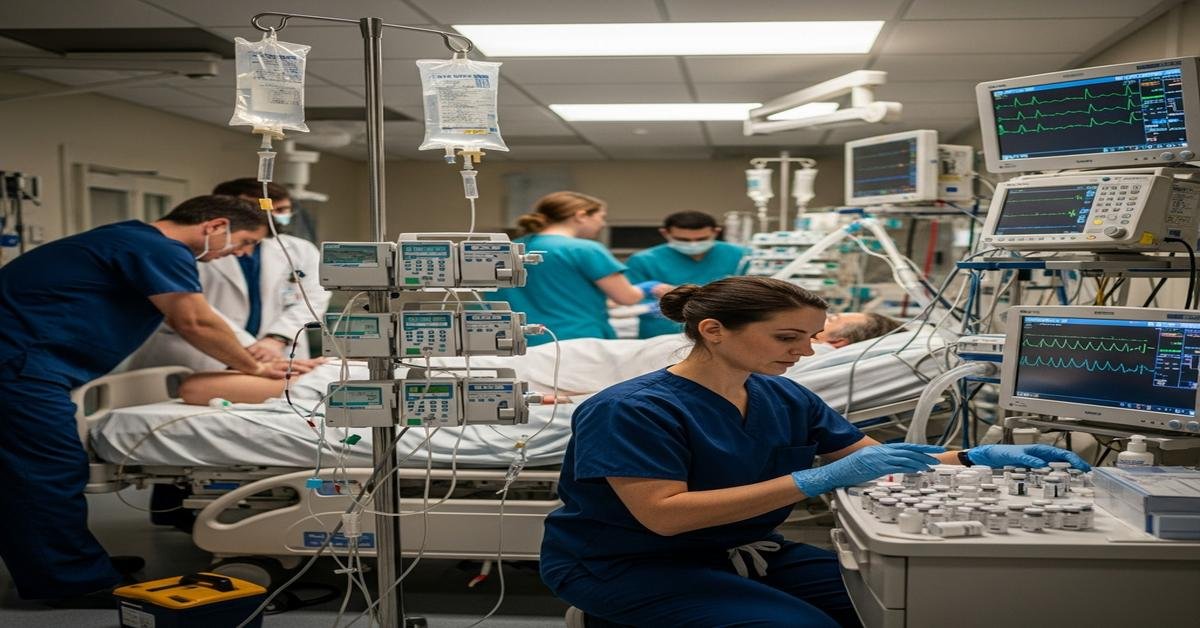
In a crashing patient, seconds count and medications can save or sink the resuscitation. A critical care pharmacist brings drug expertise to the bedside—choosing the right agent, dose, route, and sequence—while preventing errors under pressure. This article explains what pharmacists do in a Code Blue, how we think about vasopressors, sedation, neuromuscular blockade, and advanced life support, and why those choices matter for survival and brain recovery.
The pharmacist’s role in a Code Blue
Pharmacists improve resuscitation by removing uncertainty around drugs. We prepare, double-check, and time medications so the team can focus on high‑quality CPR and defibrillation.
- Before the code: Stock standardized drug kits (epinephrine, amiodarone, magnesium, calcium, sodium bicarbonate), premix high‑risk infusions (norepinephrine, vasopressin), and label lines. Standardization prevents dosing mistakes when stress is high.
- During the code:
- Recommend drugs based on rhythm and suspected cause (Hs and Ts). This keeps treatment aligned with evidence, not habit.
- Prepare push meds rapidly and call out doses and times (“Epinephrine 1 mg given at 14:03”). Timing matters because CPR drugs follow 3–5 minute cycles.
- Mix and start infusions as soon as ROSC is near (pressors, antiarrhythmics, sedation). Early stabilization prevents rearrest.
- Check renal/hepatic function and interactions in real time. For example, if the patient uses QT‑prolonging drugs, amiodarone may need close telemetry; if they’re on beta‑blockers, pressor choice may shift.
- Manage compatibility and line access. Avoid Y‑siting catecholamines with sodium bicarbonate; alkaline solutions inactivate them.
- After ROSC: Guide hemodynamics (MAP targets, choice of pressor/inotrope), start analgesia and sedation for ventilator synchrony, advise on temperature control (avoid fever), and plan for underlying cause (e.g., hyperkalemia protocol, PE fibrinolysis).
ACLS drug essentials: what to give and why
Defibrillation and compressions save lives; drugs support them. Use medications to treat reversible causes and stabilize the rhythm.
- Epinephrine (cardiac arrest): 1 mg IV/IO every 3–5 minutes for any nonperfusing rhythm. It raises aortic diastolic pressure via alpha‑1 effects, improving coronary perfusion pressure and the chance of ROSC. Give early in PEA/asystole; give after the first shock in VF/pVT to avoid delaying defibrillation.
- Amiodarone (refractory VF/pVT): 300 mg IV push, then 150 mg if needed. It suppresses ventricular arrhythmias that resist defibrillation. After ROSC, typical infusion is 1 mg/min for 6 hours, then 0.5 mg/min for 18 hours if ongoing arrhythmia risk. Use a filter; dilute in D5W. Watch for hypotension.
- Lidocaine (alternative to amiodarone): 1–1.5 mg/kg IV, then 0.5–0.75 mg/kg q5–10 min to max 3 mg/kg. Follow with 1–4 mg/min infusion. Useful if amiodarone is unavailable or poorly tolerated.
- Magnesium sulfate (torsades de pointes): 2 g IV push. It stabilizes repolarization in polymorphic VT due to prolonged QT.
- Calcium chloride/gluconate (hyperkalemia, calcium‑channel blocker overdose, severe hypocalcemia): Calcium stabilizes the cardiac membrane and can restore a perfusing rhythm. Typical doses: Calcium chloride 1 g IV (central line) or calcium gluconate 3 g IV (peripheral).
- Sodium bicarbonate: Not routine. Consider 50 mEq IV push for severe hyperkalemia, tricyclic antidepressant overdose, known severe acidosis, or prolonged arrest with good ventilation. It can worsen intracellular acidosis if used indiscriminately.
- Suspected pulmonary embolism arrest: Fibrinolysis may be life‑saving. Many centers use alteplase 50 mg IV bolus during CPR, with ongoing compressions for 60–90 minutes. Follow local protocol.
In PEA/asystole, focus on the Hs and Ts (hypovolemia, hypoxia, hydrogen ion/acidosis, hypo-/hyperkalemia, hypothermia, tension pneumothorax, tamponade, toxins, thrombosis pulmonary/coronary). Pharmacists rapidly assemble electrolyte therapies or antidotes because correcting the cause is what restores circulation.
Vasopressors and inotropes: choosing and titrating under stress
Pressors buy time by restoring perfusion pressure; they do not fix inadequate volume or a failing pump. Always assess fluid responsiveness first, then target the physiology.
- Norepinephrine (first‑line in septic and undifferentiated vasodilatory shock): Mixed alpha/beta effects raise MAP with less tachycardia than dopamine. Start 0.02–0.05 mcg/kg/min, titrate every 1–3 minutes to MAP ≥65 mmHg (often 65–75), typical range 0.02–0.5 mcg/kg/min. Watch for digital/mesenteric ischemia at high doses.
- Vasopressin (add‑on in septic shock): 0.03 units/min (fixed dose). Restores depleted endogenous vasopressin and can reduce norepinephrine requirements. Minimal effect on heart rate. Avoid higher doses unless protocolized—risk of ischemia.
- Epinephrine (refractory shock or anaphylaxis): Strong beta and alpha activity. Start 0.02–0.2 mcg/kg/min. Raises lactate by stimulating glycolysis; don’t misread this as worsening shock without context.
- Phenylephrine (pure alpha‑1): Useful if tachyarrhythmias make beta stimulation risky (e.g., atrial fibrillation with RVR). Typical 0.2–3 mcg/kg/min. Can reduce stroke volume; avoid if pump failure is dominant.
- Dopamine: Higher arrhythmia risk without outcome benefit in shock. Reserve for special cases (e.g., bradycardia where pacing is not available).
- Dobutamine (inotrope): For low cardiac output states (cardiogenic shock, post‑arrest myocardial stunning), especially when MAP is adequate or supported with norepinephrine. Start 2–5 mcg/kg/min, titrate to 20. May drop MAP due to vasodilation—pair with a pressor.
- Milrinone (inodilator): Helpful in right ventricular failure or pulmonary hypertension. Infuse 0.125–0.5 mcg/kg/min without bolus in hypotension; reduce dose in renal dysfunction. Can worsen hypotension.
Lines, mixing, and safety: Use a central line when possible; catecholamines can injure tissue if extravasated. If a peripheral line is unavoidable, use a large, proximal vein and check frequently. For extravasation, stop the infusion, aspirate, and infiltrate phentolamine 5–10 mg in 10 mL NS around the site; nitroglycerin paste is a backup. Avoid mixing catecholamines with sodium bicarbonate or other alkaline solutions; prepare in NS or D5W using standardized concentrations. Label lines clearly—misconnections during a code are a common hazard.
Push‑dose pressors (peri‑intubation or peri‑arrest hypotension): Use only with institutional protocols and trained staff. Typical examples: phenylephrine 50–200 mcg IV q1–2 min or epinephrine 5–20 mcg IV q1–2 min using a properly diluted solution. They bridge to an infusion but can overshoot BP or cause arrhythmias if misdosed.
Sedation and analgesia: comfort, safety, and extubation readiness
Sedation is not just comfort—it prevents self‑harm (pulling a tube), improves ventilator synchrony, and reduces oxygen demand. Over‑sedation, however, prolongs ventilation and delirium. Aim for light sedation unless deeper sedation is clinically required.
- Assess and set targets: Use RASS with a goal of -1 to 0 for most; deeper levels for ARDS paralysis, elevated ICP, or severe agitation. Reassess at least hourly during titration.
- Analgesia‑first strategy: Treat pain before anxiety.
- Fentanyl 25–100 mcg IV bolus; infusion 25–200 mcg/hr. Fast onset, histamine‑sparing. Accumulates with prolonged use.
- Hydromorphone 0.2–0.6 mg IV bolus; infusion 0.5–3 mg/hr. Useful when fentanyl tachyphylaxis occurs.
- Add non‑opioids (e.g., acetaminophen) to reduce opioid needs. Start a bowel regimen early to prevent ileus.
- Sedatives:
- Propofol start 5–10 mcg/kg/min, titrate to 5–50 mcg/kg/min. Rapid on/off aids daily awakening. Watch for hypotension; monitor triglycerides every 2–3 days and watch for Propofol Infusion Syndrome with high doses or prolonged use (rhabdomyolysis, lactic acidosis, cardiac failure).
- Dexmedetomidine 0.2–1.4 mcg/kg/hr. Promotes arousable sedation and may reduce delirium. Avoid loading dose; can cause bradycardia and hypotension.
- Midazolam bolus 1–5 mg IV, infusion 1–5+ mg/hr. Use for seizures or severe hemodynamic instability where propofol is not tolerated. Accumulates in renal/hepatic dysfunction; increases delirium risk with prolonged use.
- Daily SAT and SBT: Hold sedation daily if safe, assess for spontaneous breathing. This shortens ventilator days and ICU stay.
- Delirium prevention: Use CAM‑ICU screening. Prioritize sleep hygiene, day–night cues, early mobility, and hearing/vision aids. Reserve antipsychotics for dangerous agitation; monitor QT if combined with amiodarone or fluoroquinolones.
- Post‑arrest temperature control: Prevent fever (≤37.5°C). Routine deep hypothermia is no longer standard; sedation and analgesia help with shiver control.
Neuromuscular blockade: when and how
Paralytics improve intubating conditions, ventilator synchrony, and severe ARDS management. They remove muscle tone, not consciousness—deep analgesia and sedation must precede and continue throughout.
- Rapid sequence intubation (RSI):
- Rocuronium 1.2 mg/kg IV (ideal body weight) for fast onset; duration 45–60 minutes. Good when succinylcholine is contraindicated.
- Succinylcholine 1–1.5 mg/kg IV for the quickest onset; avoid in hyperkalemia, neuromuscular disease, major burns/crush injuries >48 hours, rhabdomyolysis, or pseudocholinesterase deficiency.
- ICU paralysis (e.g., severe ARDS, proning): Cisatracurium bolus 0.1–0.2 mg/kg, infusion 1–3 mcg/kg/min. Organ‑independent metabolism makes it safer in multi‑organ failure. Monitor with train‑of‑four (goal 1–2/4 twitches). Provide eye lubrication and DVT prophylaxis; minimize concurrent steroids to reduce weakness risk.
Putting it together: practical scenarios
- Shockable arrest (VF): Defibrillate → CPR. After the first shock, give epinephrine 1 mg. If VF persists after two shocks, give amiodarone 300 mg, then 150 mg if still refractory. Pharmacist times epinephrine q3–5 min, prepares amiodarone with a filter, and readies a norepinephrine infusion for immediate ROSC support.
- Septic shock with MAP 50 and lactate 6: Start norepinephrine 0.05 mcg/kg/min, titrate every 2 minutes to MAP ≥65. If dose escalates quickly or mottling persists, add vasopressin 0.03 units/min. If cardiac index is low or ScvO2 remains low, add dobutamine 2–5 mcg/kg/min. Pharmacist checks for atrial fibrillation risk, arrhythmias, and line compatibilities, and advises against sodium bicarbonate unless specific indications exist.
- Peri‑intubation hypotension: Pre‑load with balanced crystalloids if fluid responsive; have a norepinephrine infusion primed. If immediate BP support is needed, give phenylephrine 100 mcg IV and start norepinephrine. Post‑tube, start fentanyl and propofol carefully to maintain MAP targets.
- Hyperkalemic PEA: Give calcium (chloride centrally or gluconate peripherally), insulin 10 units IV with 25 g dextrose, and albuterol nebulization; consider sodium bicarbonate if acidotic. Pharmacist prepares meds back‑to‑back and prompts repeat potassium checks in 30–60 minutes.
Safety pearls and common pitfalls
- Weight‑based dosing: Use ideal or adjusted body weight where appropriate (e.g., rocuronium, sedatives). Document the weight used.
- Standard concentrations: Reduce math at the bedside and simplify titration. Post the titration ranges on pumps.
- Avoid incompatible Y‑sites: Do not co‑infuse catecholamines with sodium bicarbonate; separate lines for amiodarone when possible.
- Label lines and syringes clearly: In codes, misidentification causes dangerous boluses. Color coding and tall‑man lettering help.
- Monitor for toxicity: Triglycerides with propofol, QT with amiodarone/antipsychotics, lactate trends with epinephrine, ischemia with high‑dose pressors.
- Never paralyze without sedation: Check and document deep sedation and analgesia before and during neuromuscular blockade.
- Local policy first: Doses, concentrations, and push‑dose pressor use vary by institution. Follow your protocol to reduce variability and error.
The pharmacist’s value in the ICU is speed plus precision—getting the right drug to the right place at the right time, and preventing the errors that injure patients when seconds are short. When medication strategy aligns with physiology—pressors for pressure, inotropes for flow, analgesia before sedation, and targeted therapy for causes—teams resuscitate more effectively and patients have a better chance at meaningful recovery.

