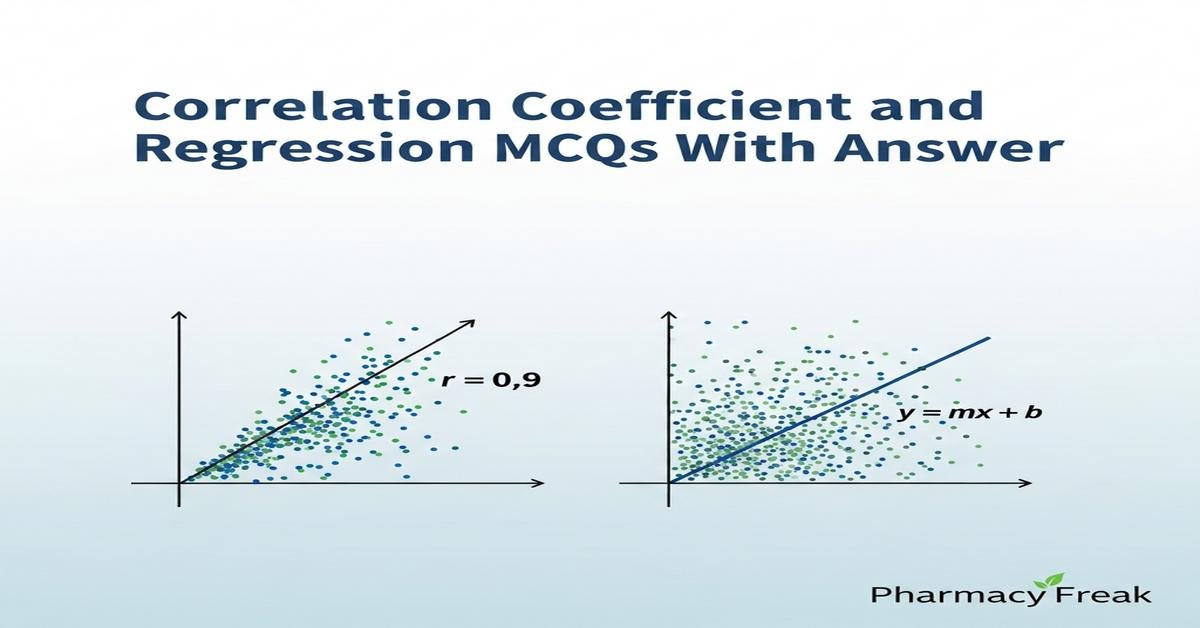
Introduction: This set of multiple-choice questions on correlation coefficients and regression is tailored for M.Pharm students preparing for exams in Research Methodology & Biostatistics. The quiz emphasizes conceptual understanding and practical interpretation of Pearson and Spearman correlations, regression line parameters, assumptions of least squares, coefficient of determination, residual analysis, and issues such as multicollinearity, measurement error, transformation, and inference. Questions progress from foundational definitions to nuances encountered when analyzing pharmaceutical research data, helping you deepen analytical skills needed for clinical studies, pharmacoepidemiology, and experimental design. Use these MCQs to test knowledge, identify weak areas, and reinforce application of statistical principles in drug research.
Q1. Which of the following correctly states the possible range for the Pearson correlation coefficient between two continuous variables?
- -1 to +1
- 0 to +1
- -∞ to +∞
- -0.5 to +0.5
Correct Answer: -1 to +1
Q2. For ordinal data or nonparametric relationships, which correlation measure is most appropriate?
- Pearson correlation
- Spearman rank correlation
- Point-biserial correlation
- Phi coefficient
Correct Answer: Spearman rank correlation
Q3. The coefficient of determination (R²) in a simple linear regression quantifies which of the following?
- The slope of the regression line
- The proportion of variance in the dependent variable explained by the independent variable
- The average value of residuals
- The correlation between predictors
Correct Answer: The proportion of variance in the dependent variable explained by the independent variable
Q4. In the simple linear regression model Y = β0 + β1X + ε, the slope β1 represents:
- The predicted value of Y when X = 0
- The change in X for a one-unit change in Y
- The change in Y for a one-unit change in X
- The square of the correlation coefficient
Correct Answer: The change in Y for a one-unit change in X
Q5. The ordinary least squares (OLS) method estimates regression coefficients by minimizing which quantity?
- The sum of raw residuals (Σεi)
- The sum of absolute residuals (Σ|εi|)
- The sum of squared residuals (Σεi²)
- The maximum residual
Correct Answer: The sum of squared residuals (Σεi²)
Q6. If a dataset exhibits a strong curved (nonlinear) relationship, which statement is correct regarding the Pearson correlation?
- Pearson correlation will always detect the strong nonlinear relationship
- Pearson correlation may be close to zero despite a strong nonlinear association
- Pearson correlation becomes negative for nonlinear relationships
- Pearson correlation equals R² in nonlinear cases
Correct Answer: Pearson correlation may be close to zero despite a strong nonlinear association
Q7. Which analysis estimates the correlation between two variables while holding a third variable constant?
- Partial correlation
- Spearman correlation
- Point-biserial correlation
- Canonical correlation
Correct Answer: Partial correlation
Q8. Multicollinearity among independent variables in regression primarily leads to which problem?
- Biased residuals with non-zero mean
- Inflated standard errors and unstable coefficient estimates
- Guaranteed improvement in predictive accuracy
- Reduction in R² to zero
Correct Answer: Inflated standard errors and unstable coefficient estimates
Q9. The standard error of estimate in regression is best described as:
- The standard deviation of the independent variable
- The average of squared residuals
- The standard deviation of the residuals around the regression line
- The slope of the fitted line
Correct Answer: The standard deviation of the residuals around the regression line
Q10. The intercept (β0) in a simple linear regression model represents:
- The change in Y per unit change in X
- The predicted value of Y when X = 0
- The correlation between X and Y
- The error term variance
Correct Answer: The predicted value of Y when X = 0
Q11. The test statistic for testing the significance of Pearson correlation r uses which distribution and degrees of freedom?
- t-distribution with n degrees of freedom
- t-distribution with n − 2 degrees of freedom
- z-distribution with n − 2 degrees of freedom
- F-distribution with 1 and n − 1 degrees of freedom
Correct Answer: t-distribution with n − 2 degrees of freedom
Q12. Covariance between two variables indicates:
- The standardized strength of association independent of units
- The direction of association and magnitude dependent on units
- The causal effect of X on Y
- The proportion of variance explained
Correct Answer: The direction of association and magnitude dependent on units
Q13. If the Pearson correlation coefficient r = 0.80, what is the coefficient of determination (R²)?
- 0.20
- 0.64
- 0.80
- 1.25
Correct Answer: 0.64
Q14. Which factor most affects the p-value when testing whether an observed correlation differs from zero?
- The sample size
- The units of measurement
- The mean of variables
- The number of decimal places reported
Correct Answer: The sample size
Q15. Which of the following is NOT an assumption required for valid inference in simple linear regression?
- Linearity between X and expected Y
- Homoscedasticity (constant variance) of residuals
- Normality of the predictor X
- Independence of residuals
Correct Answer: Normality of the predictor X
Q16. In a log–log regression (both Y and X log-transformed), the estimated slope coefficient is interpreted as:
- The absolute change in Y for a unit change in X
- The percent change in Y for a one percent change in X (elasticity)
- The change in log Y for a unit change in X (non-percent)
- The correlation between log X and log Y
Correct Answer: The percent change in Y for a one percent change in X (elasticity)
Q17. Which correlation measure is generally more robust to outliers in the data?
- Pearson correlation
- Spearman rank correlation
- Covariance
- Product-moment correlation of raw scores
Correct Answer: Spearman rank correlation
Q18. Standardized regression coefficients (beta weights) indicate:
- Change in the dependent variable in original units per one-unit change in predictor
- Change in standard deviation units of the dependent variable per one standard deviation change in predictor
- The p-value of the predictor
- The unstandardized slope multiplied by sample size
Correct Answer: Change in standard deviation units of the dependent variable per one standard deviation change in predictor
Q19. Measurement error in the independent variable typically biases the OLS slope estimate in what direction?
- Biases the slope away from zero (inflation)
- No bias is introduced by measurement error
- Biases the slope toward zero (attenuation)
- Makes the slope exactly zero
Correct Answer: Biases the slope toward zero (attenuation)
Q20. In multiple regression, which statistic adjusts R² to account for the number of predictors and sample size?
- Adjusted R²
- Residual standard error
- F-statistic
- Durbin-Watson statistic
Correct Answer: Adjusted R²

