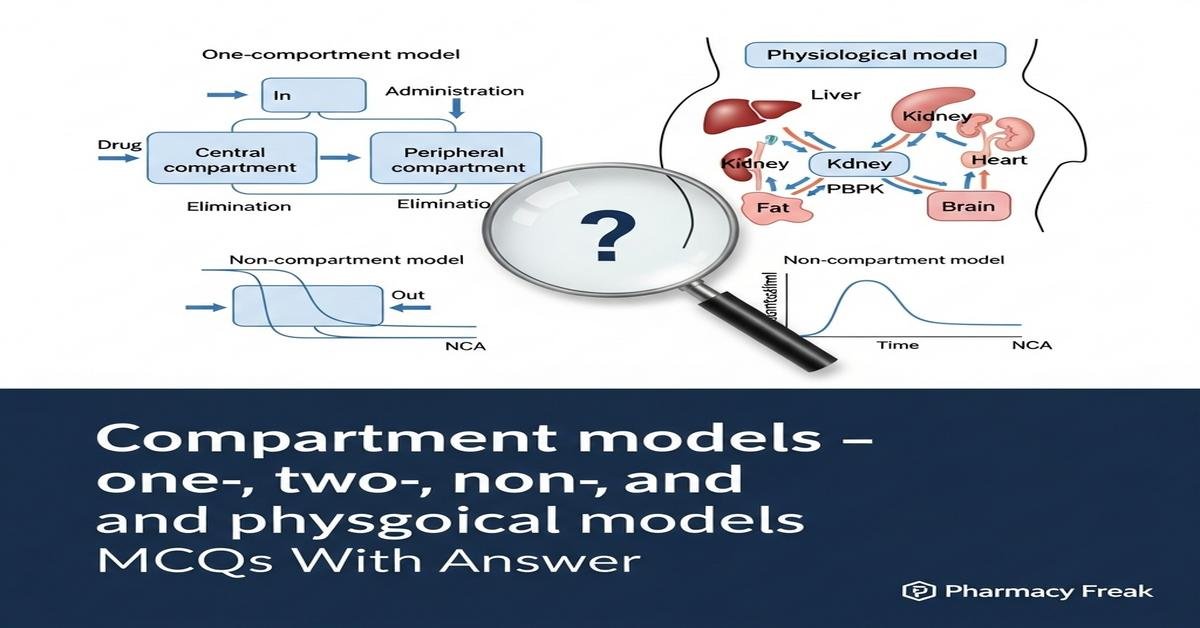
Compartment models — one-compartment, two-compartment, non-compartmental and physiological (PBPK) models — are essential pharmacokinetic tools for B. Pharm students. These models describe absorption, distribution, metabolism and elimination (ADME) and predict plasma concentration–time profiles after IV bolus, oral dosing, infusion or multiple dosing. Key concepts include volume of distribution, clearance, elimination rate constant, half-life, micro- and macro-constants (k12, k21, alpha, beta), AUC, MRT and bioavailability. Learning model assumptions, parameter estimation, curve-fitting and when to apply non-compartmental analysis versus physiological modelling deepens understanding for drug development, dose optimization and therapeutic monitoring. Clear examples and practice problems will help you apply these concepts to real pharmacokinetic data. Now let’s test your knowledge with 30 MCQs on this topic.
Q1. What is the primary assumption of a one-compartment pharmacokinetic model?
- The drug distributes instantaneously and uniformly throughout the body
- The drug is confined to the plasma only
- There are two kinetically distinct distribution phases
- The drug follows saturable (nonlinear) elimination
Correct Answer: The drug distributes instantaneously and uniformly throughout the body
Q2. In a two-compartment model after an IV bolus, the initial rapid decline phase is called:
- Elimination phase
- Absorption phase
- Distribution phase (alpha phase)
- Steady-state phase
Correct Answer: Distribution phase (alpha phase)
Q3. Which parameter represents the volume in which the drug would need to be uniformly distributed to account for the observed plasma concentration?
- Clearance
- Volume of distribution (Vd)
- Elimination rate constant (ke)
- Bioavailability (F)
Correct Answer: Volume of distribution (Vd)
Q4. Clearance (CL) is best defined as:
- The fraction of drug eliminated per unit time
- Theoretical volume of plasma cleared of drug per unit time
- Time required to reduce drug concentration by half
- The extent of drug absorption after oral dosing
Correct Answer: Theoretical volume of plasma cleared of drug per unit time
Q5. Non-compartmental analysis (NCA) primarily relies on which metric to estimate systemic exposure?
- Half-life
- Area under the concentration–time curve (AUC)
- Volume of distribution
- Micro-rate constants
Correct Answer: Area under the concentration–time curve (AUC)
Q6. In a one-compartment IV bolus model, the plasma concentration-time profile is described by:
- Mono-exponential decline
- Biexponential decline
- Linear increase followed by plateau
- Sigmoidal curve due to saturation
Correct Answer: Mono-exponential decline
Q7. Which method estimates fraction absorbed into the systemic circulation from oral data using a one-compartment model?
- Loo–Riegelman method
- Wagner–Nelson method
- Nonlinear mixed-effects method
- Well-stirred physiologic model
Correct Answer: Wagner–Nelson method
Q8. Micro-constants in a two-compartment model typically include:
- Alpha and beta only
- k12, k21 and k10
- Vd and CL
- AUC and MRT
Correct Answer: k12, k21 and k10
Q9. Macro-constants (alpha, beta) are related to micro-constants by:
- Direct equality; alpha = k12
- Algebraic combinations derived from micro-constants
- They represent clearance and volume respectively
- They are only used in non-compartmental analysis
Correct Answer: Algebraic combinations derived from micro-constants
Q10. Flip-flop kinetics occurs when:
- Elimination is faster than absorption
- Absorption is slower than elimination, so absorption rate determines terminal slope
- Distribution is instantaneous
- Clearance becomes concentration-dependent
Correct Answer: Absorption is slower than elimination, so absorption rate determines terminal slope
Q11. Which of the following is a primary advantage of physiological (PBPK) models over empirical compartment models?
- They require fewer parameters
- They use anatomically and physiologically realistic compartments and can predict tissue concentrations
- They always fit sparse clinical data better
- They eliminate the need for clearance estimates
Correct Answer: They use anatomically and physiologically realistic compartments and can predict tissue concentrations
Q12. Mean residence time (MRT) in NCA is calculated as:
- AUC/AUMC
- AUMC/AUC
- Half-life × 0.693
- Vd / CL
Correct Answer: AUMC/AUC
Q13. For IV infusion at steady state, Css (steady-state concentration) equals:
- Infusion rate / Clearance
- Vd × Clearance
- Infusion rate × Vd
- Half-life / Clearance
Correct Answer: Infusion rate / Clearance
Q14. Which approach is commonly used to separate distribution and elimination phases in two-compartment kinetic analysis?
- Non-compartmental trapezoidal method
- Curve-stripping or biexponential curve fitting
- One-point clearance estimate
- Direct measurement of tissue concentrations only
Correct Answer: Curve-stripping or biexponential curve fitting
Q15. Loading dose (LD) to rapidly achieve target concentration is calculated by:
- Target concentration × Clearance
- Target concentration × Volume of distribution / Bioavailability
- Target concentration / Half-life
- Clearance × Half-life / Vd
Correct Answer: Target concentration × Volume of distribution / Bioavailability
Q16. In NCA, the terminal elimination rate constant (λz) is derived from:
- Initial rising limb of the concentration curve
- Terminal linear portion of the log concentration–time plot
- Maximum concentration (Cmax) only
- Volume of distribution data
Correct Answer: Terminal linear portion of the log concentration–time plot
Q17. Which statement about volume of distribution (Vd) is true?
- A large Vd always indicates slow elimination
- Vd indicates the extent of drug distribution between plasma and tissues
- Vd and clearance are numerically identical
- Vd can be measured directly from tissue biopsies only
Correct Answer: Vd indicates the extent of drug distribution between plasma and tissues
Q18. The Loo–Riegelman method is specifically used to:
- Estimate AUC using the trapezoidal rule
- Determine fraction absorbed for one-compartment oral drugs
- Estimate absorption profile and distribution for two-compartment oral models
- Calculate clearance from oral data without IV reference
Correct Answer: Estimate absorption profile and distribution for two-compartment oral models
Q19. Which condition makes non-compartmental analysis preferable to compartmental modeling?
- When mechanistic tissue predictions are needed
- When data are sparse and model-independent exposure metrics (AUC, MRT) suffice
- When micro-rate constants must be estimated
- When drug distribution is known to be multi-compartmental and complex
Correct Answer: When data are sparse and model-independent exposure metrics (AUC, MRT) suffice
Q20. In a linear pharmacokinetic system, doubling the dose will:
- More than double AUC due to saturation
- Exactly double AUC and Cmax (proportionality)
- Reduce the half-life
- Change clearance nonlinearly
Correct Answer: Exactly double AUC and Cmax (proportionality)
Q21. Which parameter is used to assess the extent of systemic absorption of an oral dose compared to IV?
- MRT
- Bioavailability (F)
- Half-life
- Volume of distribution
Correct Answer: Bioavailability (F)
Q22. The well-stirred liver model in PBPK commonly predicts hepatic clearance using which inputs?
- Hepatic blood flow, fraction unbound, and intrinsic clearance
- Molecular weight and pKa only
- Cardiac output and renal clearance only
- Plasma protein binding alone
Correct Answer: Hepatic blood flow, fraction unbound, and intrinsic clearance
Q23. Accumulation ratio at steady state for linear kinetics depends primarily on:
- Half-life and dosing interval
- Bioavailability only
- Volume of distribution only
- Route of administration only
Correct Answer: Half-life and dosing interval
Q24. Which is a limitation of simple compartment models?
- They can predict tissue-specific concentrations accurately for all drugs
- They ignore physiological heterogeneity and may oversimplify distribution mechanisms
- They always require PBPK inputs
- They cannot be fitted to plasma data
Correct Answer: They ignore physiological heterogeneity and may oversimplify distribution mechanisms
Q25. An observed biexponential decline after IV bolus indicates:
- Instantaneous equilibrium between all tissues and plasma
- Presence of at least two kinetically distinct compartments
- That non-compartmental analysis is invalid
- Absorption-limited elimination
Correct Answer: Presence of at least two kinetically distinct compartments
Q26. Which technique estimates the terminal half-life from sparse clinical samples without model fitting?
- Non-compartmental terminal slope estimation (λz)
- Full physiologic PBPK simulation
- Direct micro-rate constant measurement
- Loo–Riegelman deconvolution
Correct Answer: Non-compartmental terminal slope estimation (λz)
Q27. If clearance increases while Vd remains constant, what happens to half-life?
- Half-life increases
- Half-life decreases
- Half-life remains unchanged
- Half-life becomes infinite
Correct Answer: Half-life decreases
Q28. In compartment modelling, identifiability problems arise when:
- All parameters are independently estimable from available data
- Different parameter sets produce indistinguishable concentration–time profiles
- Data are rich with many sampling points
- Only IV data are used
Correct Answer: Different parameter sets produce indistinguishable concentration–time profiles
Q29. The trapezoidal rule in NCA is used to:
- Estimate AUC by summing areas of trapezoids under concentration–time curve
- Calculate micro-rate constants directly
- Determine tissue partition coefficients
- Fit biexponential curves
Correct Answer: Estimate AUC by summing areas of trapezoids under concentration–time curve
Q30. Which scenario strongly favors using a PBPK model over empirical compartment models?
- When only a single plasma concentration is available
- When predicting drug–drug interactions, pediatric dosing and tissue exposures using physiological parameters
- When a simple one-compartment profile fits the data perfectly
- When non-compartmental AUC is the only required output
Correct Answer: When predicting drug–drug interactions, pediatric dosing and tissue exposures using physiological parameters

