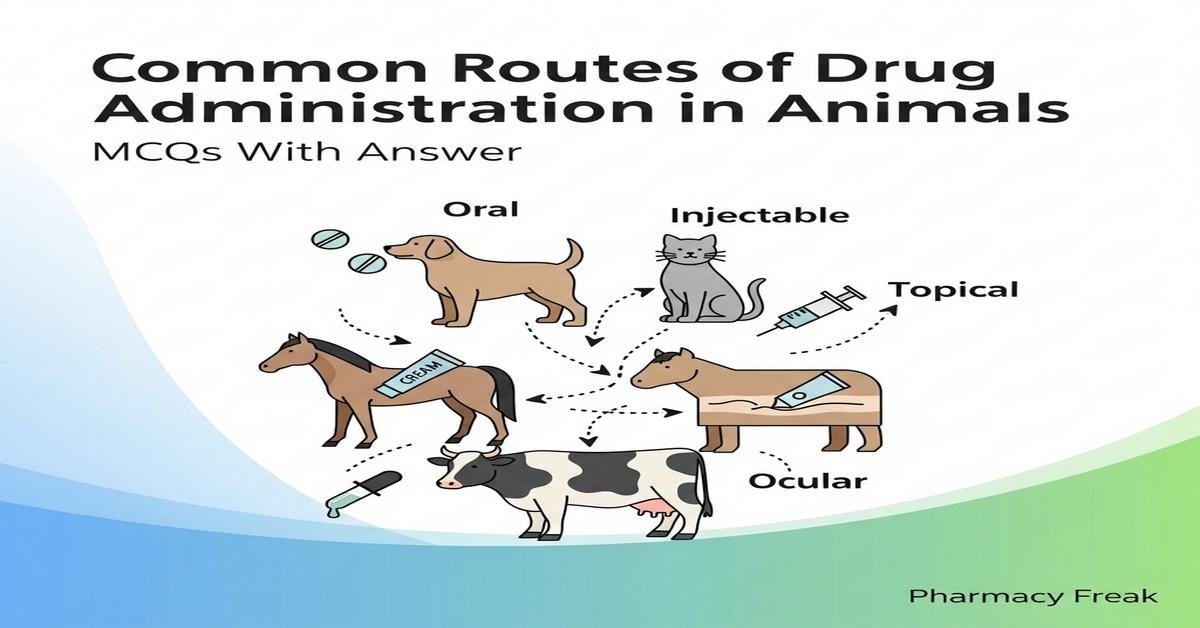
Introduction: Understanding common routes of drug administration in animals is essential for B.Pharm students studying veterinary pharmacology, dosage forms, and pharmacokinetics. This topic covers oral, parenteral (intravenous, intramuscular, subcutaneous), topical, inhalational, rectal, intraocular, intranasal, and intraperitoneal routes, with emphasis on bioavailability, first‑pass effect, absorption rates, and formulation considerations. Knowledge of species differences, site selection, aseptic technique, and risks such as tissue irritation or embolism informs safe, effective dosing. Mastery helps in choosing appropriate delivery for therapeutic goals, onset time, and drug stability. Now let’s test your knowledge with 30 MCQs on this topic.
Q1. Which route of administration gives the most rapid systemic drug effect in animals?
- Oral administration
- Intramuscular injection
- Intravenous injection
- Subcutaneous injection
Correct Answer: Intravenous injection
Q2. Which factor most directly reduces bioavailability of orally administered drugs in animals?
- High lipid solubility
- First‑pass hepatic metabolism
- Large molecular size
- Parenteral formulation
Correct Answer: First‑pass hepatic metabolism
Q3. For a dehydrated ruminant needing rapid fluid and electrolyte replacement, which route is preferred?
- Oral bolus
- Intraperitoneal injection
- Intravenous infusion
- Topical application
Correct Answer: Intravenous infusion
Q4. Which route is most appropriate for administering vaccines that require depot effect in animals?
- Intravenous
- Intramuscular
- Inhalation
- Ocular
Correct Answer: Intramuscular
Q5. Subcutaneous injections are preferred over intramuscular in small mammals primarily because:
- They provide a faster onset of action
- They avoid first‑pass metabolism
- They are less painful and easier to administer
- They always give higher bioavailability
Correct Answer: They are less painful and easier to administer
Q6. Which topical route is best for delivering medication to the respiratory tract of animals?
- Transdermal patch
- Inhalation/aerosolization
- Topical ophthalmic
- Rectal suppository
Correct Answer: Inhalation/aerosolization
Q7. Which statement about intraperitoneal administration in veterinary practice is correct?
- It is the fastest route for drug delivery to the brain
- It is commonly used for large food animals
- It allows absorption via peritoneal capillaries into systemic circulation
- It bypasses all hepatic metabolism
Correct Answer: It allows absorption via peritoneal capillaries into systemic circulation
Q8. Which route is most affected by pH and gastric emptying time in animals?
- Intravenous
- Topical dermal
- Oral
- Intranasal
Correct Answer: Oral
Q9. Which route is most suitable for local analgesia of a limb in a dog?
- Transdermal patch on the contralateral limb
- Intravenous bolus
- Regional nerve block (peripheral injection)
- Oral tablet
Correct Answer: Regional nerve block (peripheral injection)
Q10. Which of the following is a major risk specific to intraarterial injections in animals?
- Slow onset of action
- Reduced systemic absorption
- Tissue ischemia and embolism
- Increased first‑pass effect
Correct Answer: Tissue ischemia and embolism
Q11. Transdermal patches rely primarily on which property to enhance drug absorption through skin?
- Hydrophilicity of the drug
- High molecular weight
- Lipophilicity and permeation enhancers
- Gastric dissolution
Correct Answer: Lipophilicity and permeation enhancers
Q12. Which route bypasses the skin barrier and delivers drug directly into subcutaneous tissue?
- Topical cream
- Intranasal spray
- Subcutaneous injection
- Oral syrup
Correct Answer: Subcutaneous injection
Q13. For ocular infections in animals, which route gives highest local concentration with minimal systemic exposure?
- Systemic oral antibiotic
- Topical ophthalmic drops
- Intramuscular injection
- Transdermal patch near the eye
Correct Answer: Topical ophthalmic drops
Q14. Which characteristic of a drug formulation is most important for safe intramuscular injection?
- Particle size and sterility
- Color of the solution
- Presence of sugar
- Gastroresistant coating
Correct Answer: Particle size and sterility
Q15. Which route is commonly used to administer activated charcoal for toxin binding in large animals?
- Intravenous
- Oral via stomach tube
- Intraperitoneal
- Topical dermal
Correct Answer: Oral via stomach tube
Q16. What is a primary advantage of intranasal vaccination in some animal species?
- Avoids mucosal immunity
- Stimulates local mucosal and systemic immunity rapidly
- Requires sterile injections
- Always gives higher systemic bioavailability than IV
Correct Answer: Stimulates local mucosal and systemic immunity rapidly
Q17. Which route should be avoided for irritating or hypertonic solutions to prevent tissue necrosis?
- Intravenous peripheral vein
- Intramuscular
- Subcutaneous
- Topical
Correct Answer: Subcutaneous
Q18. Which parameter best quantifies the fraction of an administered dose reaching systemic circulation intact?
- Half‑life
- Volume of distribution
- Bioavailability
- Clearance
Correct Answer: Bioavailability
Q19. A veterinarian chooses intramuscular over intravenous injection because:
- IM provides immediate plasma peak higher than IV
- IM reduces the need for venous access and provides depot action
- IM eliminates absorption variability
- IM always causes less pain than SC
Correct Answer: IM reduces the need for venous access and provides depot action
Q20. When using inhalational anesthetics in animals, which factor most affects uptake from the lungs?
- Skin permeability
- Pulmonary blood flow and solubility of the anesthetic
- Gastric emptying
- Rectal motility
Correct Answer: Pulmonary blood flow and solubility of the anesthetic
Q21. Which formulation consideration is critical for ocular drops to avoid corneal irritation in animals?
- Appropriate pH and isotonicity
- Use of preservative‑free oral excipient
- High viscosity for oral administration
- Enteric coating
Correct Answer: Appropriate pH and isotonicity
Q22. Which route is preferred for long‑term continuous drug delivery in small animals using an implanted device?
- Transdermal patch replaced daily
- Subcutaneous implantable pump or osmotic minipump
- Oral bolus tablets
- Topical ointment
Correct Answer: Subcutaneous implantable pump or osmotic minipump
Q23. Which of the following is a contraindication for intramuscular injection in ruminants?
- Need for vaccine depot
- Meat residue concerns and abscess formation risk
- Administration of isotonic saline
- Emergency fluid resuscitation
Correct Answer: Meat residue concerns and abscess formation risk
Q24. Which route is most suitable when immediate, localized anti‑inflammatory effect is required in a joint?
- Intravenous bolus
- Intra‑articular injection
- Oral slow‑release tablet
- Topical skin cream on the limb
Correct Answer: Intra‑articular injection
Q25. Which property of a drug increases likelihood of absorption through nasal mucosa in animals?
- Very high molecular weight
- Low membrane permeability
- Moderate lipophilicity and small molecular size
- Enteric coating
Correct Answer: Moderate lipophilicity and small molecular size
Q26. When preparing a sterile intramuscular injection, which practice is essential to minimize infection risk?
- Reusing needles between animals
- Warming the entire bottle of drug repeatedly
- Aseptic technique: sterile needle, clean skin, single‑use syringes
- Applying topical antibiotic to the injection site afterwards always
Correct Answer: Aseptic technique: sterile needle, clean skin, single‑use syringes
Q27. Which route would be least affected by alterations in gastrointestinal flora or motility?
- Oral tablet
- Rectal suppository
- Parenteral injection
- Oral suspension
Correct Answer: Parenteral injection
Q28. Depot formulations for long‑acting therapy in animals are most commonly administered via which route?
- Intravenous infusion
- Topical spray
- Intramuscular or subcutaneous injection
- Ophthalmic drops
Correct Answer: Intramuscular or subcutaneous injection
Q29. Which consideration is most important when converting a drug dose from IV to oral route in animals?
- Assuming identical bioavailability
- Adjusting for oral bioavailability and first‑pass loss
- Doubling the volume only
- Changing the drug’s mechanism of action
Correct Answer: Adjusting for oral bioavailability and first‑pass loss
Q30. Which statement about intramuscular injection sites in horses is correct?
- Caudal cervical triangle is a commonly used safe IM site
- Gluteal muscles are always preferred due to safety
- Small gauge insulin syringes are ideal for large volumes
- Any site is acceptable if aseptic technique is ignored
Correct Answer: Caudal cervical triangle is a commonly used safe IM site

