Introduction
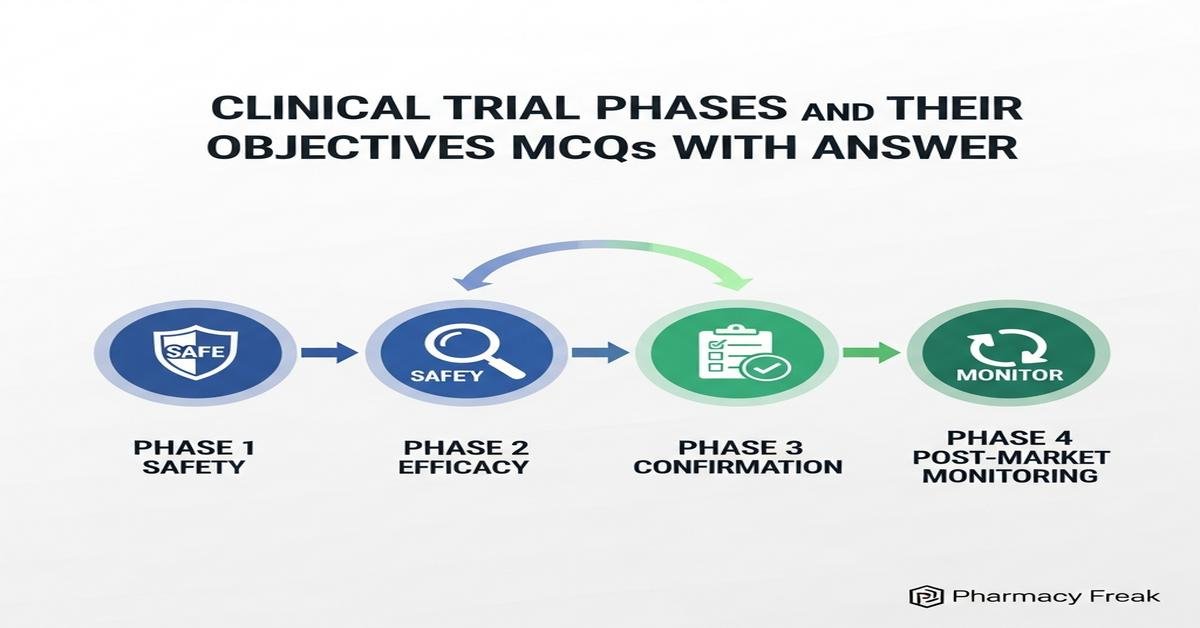
This quiz set on Clinical trial phases and their objectives is tailored for M.Pharm students studying Clinical Research (MPP 104T). It summarizes the distinct aims, study designs, and regulatory roles of Phase 0 through Phase IV trials, including dose-escalation strategies, pharmacokinetic/pharmacodynamic assessments, proof-of-concept evaluations, pivotal confirmatory trials, and post-marketing surveillance. Each question targets key concepts you must master for exams and practical research activities — such as determining maximum tolerated dose, use of surrogate endpoints, adaptive designs, and the role of safety monitoring committees. Practice these MCQs to reinforce conceptual clarity and improve application of trial-phase principles in drug development.
Q1. Which primary objective best describes a typical Phase I clinical trial?
- To confirm clinical efficacy and compare with standard therapy
- To assess safety, tolerability, pharmacokinetics and pharmacodynamics in humans
- To monitor long-term safety after marketing approval
- To evaluate cost-effectiveness in real-world settings
Correct Answer: To assess safety, tolerability, pharmacokinetics and pharmacodynamics in humans
Q2. What is the main objective of a Phase II clinical trial?
- To collect large-scale safety data for regulatory submission
- To generate preclinical toxicology profiles in animals
- To provide preliminary evidence of efficacy and to perform dose-ranging in patients
- To perform post-marketing pharmacovigilance
Correct Answer: To provide preliminary evidence of efficacy and to perform dose-ranging in patients
Q3. The primary goal of Phase III trials is to:
- Explore pharmacokinetic variability in healthy volunteers
- Confirm efficacy and safety in large patient populations for regulatory approval
- Test microdosing concepts in humans
- Conduct observational assessments in routine clinical practice
Correct Answer: Confirm efficacy and safety in large patient populations for regulatory approval
Q4. Which statement best describes the objective of Phase IV studies?
- To establish maximum tolerated dose (MTD) in healthy volunteers
- To evaluate first‑in‑human pharmacology at microdoses
- To monitor long-term safety, rare adverse events, and additional indications after approval
- To perform controlled dose-escalation in a small cohort
Correct Answer: To monitor long-term safety, rare adverse events, and additional indications after approval
Q5. Phase 0 (microdosing) studies are primarily used to:
- Gather preliminary human pharmacokinetic and target-engagement data using sub-therapeutic doses
- Confirm long-term safety in large populations
- Replace Phase II efficacy trials
- Perform large-scale randomized comparisons
Correct Answer: Gather preliminary human pharmacokinetic and target-engagement data using sub-therapeutic doses
Q6. Determination of Maximum Tolerated Dose (MTD) and Dose‑Limiting Toxicities (DLTs) is most characteristic of which phase?
- Phase IV
- Phase III
- Phase I
- Phase IIb
Correct Answer: Phase I
Q7. What is the purpose of an adaptive seamless Phase II/III design?
- To delay interim analyses until trial completion
- To combine exploratory and confirmatory stages allowing preplanned adaptations to speed development
- To exclude any safety monitoring committee oversight
- To restrict enrollment to healthy volunteers only
Correct Answer: To combine exploratory and confirmatory stages allowing preplanned adaptations to speed development
Q8. A randomized, double-blind, placebo-controlled multicenter study intended for regulatory submission is typically classified as:
- Phase I
- Phase IIa exploratory study
- Phase III pivotal trial
- Phase 0 microdosing study
Correct Answer: Phase III pivotal trial
Q9. Bioequivalence (BE) studies for generic drug approval are usually conducted in which phase classification?
- Phase IV post-marketing surveillance
- Phase IIb dose-response study
- Phase I (healthy volunteer pharmacokinetic study)
- Phase III large-scale efficacy trial
Correct Answer: Phase I (healthy volunteer pharmacokinetic study)
Q10. In early oncology development, expansion cohorts following a dose-escalation are used to:
- Provide definitive evidence for regulatory approval
- Assess long-term safety in thousands of patients
- Obtain preliminary efficacy signals and further safety data at selected doses
- Replace preclinical animal testing requirements
Correct Answer: Obtain preliminary efficacy signals and further safety data at selected doses
Q11. Which type of endpoint is most commonly used in Phase II trials to detect an early efficacy signal?
- Population-level post-marketing utilization metrics
- Proof-of-concept clinical or surrogate endpoints
- Large mortality endpoints requiring long follow-up
- Pharmacovigilance spontaneous reports
Correct Answer: Proof-of-concept clinical or surrogate endpoints
Q12. Informed consent of trial participants is required during which phases of clinical research?
- Only in Phase III and IV
- Only during interventional phases (Phase I–III)
- Throughout all human subject research phases whenever participants are enrolled
- Only for Phase I studies involving healthy volunteers
Correct Answer: Throughout all human subject research phases whenever participants are enrolled
Q13. Before initiating first-in-human clinical trials, sponsors generally must submit which application to regulatory authorities?
- New Drug Application (NDA)
- Investigational New Drug (IND) or Clinical Trial Application (CTA)
- Marketing Authorization Application (MAA)
- Periodic Safety Update Report (PSUR)
Correct Answer: Investigational New Drug (IND) or Clinical Trial Application (CTA)
Q14. What is the primary role of an independent Data Monitoring Committee (DMC or DSMB)?
- To conduct all trial statistical analyses for publication
- To design the trial protocol and write informed consent
- To periodically review accumulating safety and efficacy data and recommend continuation, modification, or stopping
- To manage drug supply and logistics
Correct Answer: To periodically review accumulating safety and efficacy data and recommend continuation, modification, or stopping
Q15. How does sample size typically change across Phase I to Phase III trials?
- It remains constant across all phases
- It decreases from Phase I to Phase III
- It increases progressively, with the largest sample size in Phase III
- Phase II always has the largest sample size
Correct Answer: It increases progressively, with the largest sample size in Phase III
Q16. The difference between Phase IIa and Phase IIb studies is that Phase IIa usually focuses on:
- Confirmatory comparisons against active comparators
- Large-scale safety surveillance
- Early proof-of-concept and preliminary dosing while Phase IIb focuses on dose-response and selection
- Post-marketing risk management
Correct Answer: Early proof-of-concept and preliminary dosing while Phase IIb focuses on dose-response and selection
Q17. Surrogate endpoints (biomarkers) are commonly employed in which phase to accelerate decision-making?
- Phase IV exclusively
- Phase II exploratory trials
- Phase 0 microdosing studies
- Neither Phase I nor II; only Phase III uses surrogates
Correct Answer: Phase II exploratory trials
Q18. Which statement distinguishes confirmatory from exploratory clinical trials?
- Exploratory trials are intended to provide definitive hypothesis testing for regulatory approval
- Confirmatory trials generate hypotheses and explore mechanisms of action
- Confirmatory trials rigorously test predefined hypotheses for approval; exploratory trials generate hypotheses and signal detection
- There is no difference; the terms are interchangeable
Correct Answer: Confirmatory trials rigorously test predefined hypotheses for approval; exploratory trials generate hypotheses and signal detection
Q19. A serious but very rare adverse drug reaction is most likely to be detected in which phase?
- Phase I
- Phase II
- Phase III
- Phase IV post-marketing surveillance
Correct Answer: Phase IV post-marketing surveillance
Q20. What is the primary objective of pilot or feasibility studies conducted before a pivotal Phase III trial?
- To replace the need for a Phase III randomized trial
- To assess feasibility of procedures, recruitment, outcome measures, and optimize trial design
- To conduct post-approval labeling changes
- To evaluate marketing strategies for product launch
Correct Answer: To assess feasibility of procedures, recruitment, outcome measures, and optimize trial design

