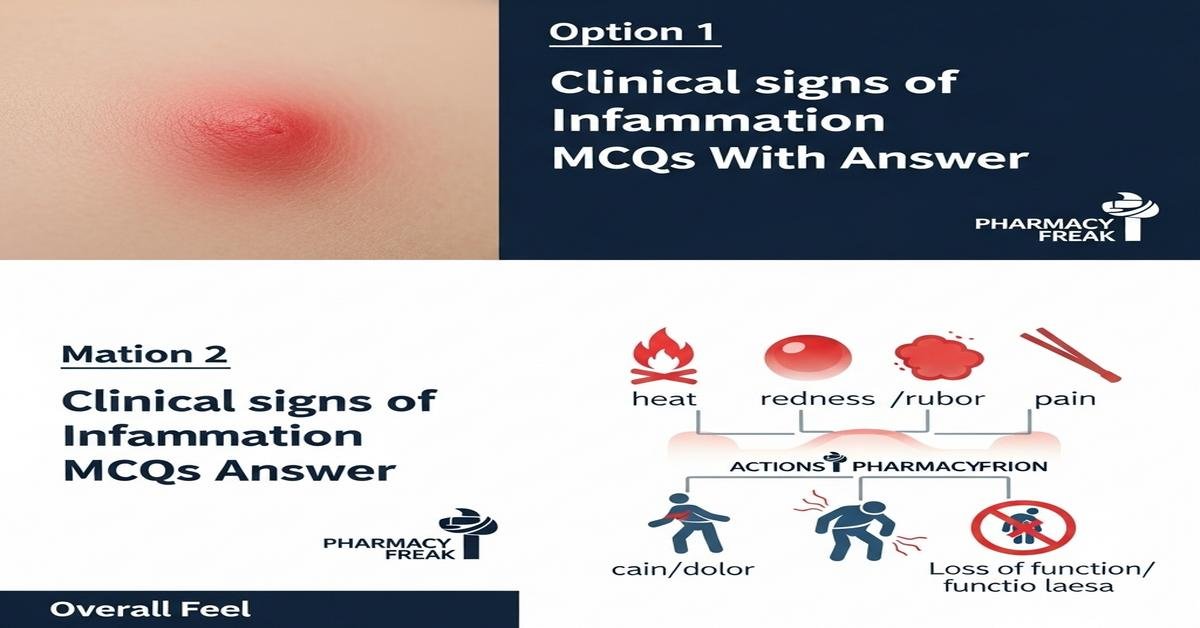
Clinical signs of inflammation MCQs With Answer
Understanding the clinical signs of inflammation is essential for B. Pharm students preparing for pharmacology and pathology exams. This concise guide covers key inflammation signs—rubor, calor, tumor, dolor and functio laesa—along with vascular and cellular mechanisms, mediators like histamine, prostaglandins and cytokines, systemic markers such as fever, leukocytosis, ESR and CRP, and pharmacological interventions. These MCQs are crafted to deepen your pathophysiology knowledge, reinforce drug-action links, and sharpen diagnostic reasoning relevant to pharmaceutical practice. Ideal for exam prep and revision, the questions emphasize both acute and chronic inflammation concepts for practical application. Now let’s test your knowledge with 50 MCQs on this topic.
Q1. Which of the following is not a classical cardinal sign of inflammation?
- Rubor (redness)
- Calor (heat)
- Diaphoresis (sweating)
- Dolor (pain)
Correct Answer: Diaphoresis (sweating)
Q2. Rubor during inflammation is primarily due to which vascular event?
- Increased blood viscosity
- Vasodilation of arterioles
- Thrombosis in capillaries
- Reduced cardiac output
Correct Answer: Vasodilation of arterioles
Q3. Which mediator is most directly responsible for increased vascular permeability in acute inflammation?
- Interleukin-10
- Histamine
- Albumin
- Acetylcholine
Correct Answer: Histamine
Q4. Chemotaxis in acute inflammation refers to:
- Random movement of red blood cells
- Directed migration of leukocytes toward a chemical gradient
- Contraction of smooth muscle
- Vasodilation of capillaries
Correct Answer: Directed migration of leukocytes toward a chemical gradient
Q5. Which cell type is the predominant first responder in acute inflammation?
- Lymphocytes
- Macrophages
- Neutrophils
- Plasma cells
Correct Answer: Neutrophils
Q6. Dolor (pain) in inflammation is mainly mediated by which substances?
- Prostaglandins and bradykinin
- Urea and creatinine
- Insulin and glucagon
- Ceruloplasmin and ferritin
Correct Answer: Prostaglandins and bradykinin
Q7. Tumor (swelling) observed in inflammation is primarily due to:
- Increased lymphatic drainage
- Accumulation of extracellular fluid from increased vascular permeability
- Muscle hypertrophy
- Bone deposition
Correct Answer: Accumulation of extracellular fluid from increased vascular permeability
Q8. Which acute phase protein is most commonly measured as a sensitive marker of inflammation?
- Albumin
- C-reactive protein (CRP)
- Transferrin
- Fibrinogen degradation products
Correct Answer: C-reactive protein (CRP)
Q9. ESR (erythrocyte sedimentation rate) increases in inflammation due to:
- Decreased plasma fibrinogen
- Altered red cell shape causing slower sedimentation
- Increased plasma fibrinogen causing rouleaux formation
- Increased leukocyte adhesion to endothelium
Correct Answer: Increased plasma fibrinogen causing rouleaux formation
Q10. Which complement component fragment is most important in chemotaxis of neutrophils?
- C1q
- C3b
- C5a
- C9
Correct Answer: C5a
Q11. Diapedesis refers to:
- Formation of new blood vessels
- Transmigration of leukocytes through the endothelium
- Programmed cell death of neutrophils
- Synthesis of acute phase proteins
Correct Answer: Transmigration of leukocytes through the endothelium
Q12. Which prostaglandin is primarily involved in fever generation during inflammation?
- PGD2
- PGE2
- PGI2 (prostacyclin)
- Thromboxane A2
Correct Answer: PGE2
Q13. Margination in inflammation describes:
- Peripheral movement of leukocytes along vessel walls
- Central aggregation of platelets
- Migration of fibroblasts into wound
- Deposition of collagen in tissues
Correct Answer: Peripheral movement of leukocytes along vessel walls
Q14. Which adhesion molecule is critical for firm adhesion of leukocytes to endothelium?
- E-selectin
- P-selectin
- Integrins (e.g., LFA-1)
- Fibrinogen
Correct Answer: Integrins (e.g., LFA-1)
Q15. Chronic inflammation is characterized by which predominant cell type?
- Neutrophils
- Mononuclear cells (macrophages and lymphocytes)
- Platelets
- Basophils
Correct Answer: Mononuclear cells (macrophages and lymphocytes)
Q16. Which mediator is primarily released by mast cells and causes immediate vasodilation and increased permeability?
- Interleukin-6
- Histamine
- Interferon-gamma
- Transforming growth factor-beta
Correct Answer: Histamine
Q17. Which enzyme family generates leukotrienes that contribute to increased vascular permeability and bronchoconstriction?
- Cyclooxygenases (COX)
- Lipoxygenases (5-LOX)
- Proteases
- Kinases
Correct Answer: Lipoxygenases (5-LOX)
Q18. The classical signs of inflammation were originally described by which historical figure?
- Rudolf Virchow
- Antoni van Leeuwenhoek
- Aulus Cornelius Celsus
- William Harvey
Correct Answer: Aulus Cornelius Celsus
Q19. Which systemic sign of inflammation is mediated by endogenous pyrogens acting on the hypothalamus?
- Anemia
- Fever
- Weight gain
- Hypotension
Correct Answer: Fever
Q20. Which laboratory finding is most characteristic of acute bacterial infection and inflammation?
- Lymphopenia
- Neutrophilic leukocytosis with left shift
- Decreased CRP
- Hypoglycemia
Correct Answer: Neutrophilic leukocytosis with left shift
Q21. Which cytokine is a major inducer of acute phase protein production by the liver?
- Interleukin-1 (IL-1)
- Interleukin-10 (IL-10)
- Interleukin-4 (IL-4)
- Interferon-alpha
Correct Answer: Interleukin-1 (IL-1)
Q22. Which of the following describes “functio laesa” in inflammation?
- Loss of function
- Increased energy production
- Enhanced blood flow
- Improved tissue repair
Correct Answer: Loss of function
Q23. Pus formation in an acute bacterial abscess primarily consists of:
- Fibrin and hyaline membranes
- Dead neutrophils, necrotic tissue and bacteria
- Lymphocytes and plasma cells
- Bone fragments and cartilage
Correct Answer: Dead neutrophils, necrotic tissue and bacteria
Q24. Which drug class reduces inflammation by inhibiting cyclooxygenase enzymes?
- Beta-blockers
- NSAIDs (nonsteroidal anti-inflammatory drugs)
- ACE inhibitors
- Proton pump inhibitors
Correct Answer: NSAIDs (nonsteroidal anti-inflammatory drugs)
Q25. Corticosteroids exert anti-inflammatory effects mainly by:
- Blocking beta-adrenergic receptors
- Inhibiting phospholipase A2 and reducing prostaglandin/leukotriene synthesis
- Activating COX-2 enzyme
- Increasing histamine release
Correct Answer: Inhibiting phospholipase A2 and reducing prostaglandin/leukotriene synthesis
Q26. Rolling of leukocytes along endothelium is mediated primarily by which molecules?
- Integrins
- Selectins
- Immunoglobulins
- Complement proteins
Correct Answer: Selectins
Q27. Which mediator amplifies inflammation and causes vasodilation, increased permeability, and pain and is targeted by many antihistamine drugs?
- Bacterial endotoxin
- Histamine
- Insulin
- Serotonin exclusively
Correct Answer: Histamine
Q28. In chronic inflammation, tissue repair is commonly associated with:
- Necrosis without fibrosis
- Granulation tissue and fibrosis
- Immediate resolution without scarring
- Purely neutrophilic infiltration
Correct Answer: Granulation tissue and fibrosis
Q29. Which laboratory marker correlates best with acute inflammatory activity rather than chronic inflammation?
- ESR measured over months
- C-reactive protein (CRP) levels
- Hemoglobin concentration
- Serum albumin
Correct Answer: C-reactive protein (CRP) levels
Q30. Bradykinin contributes to inflammation by causing:
- Inhibition of platelet aggregation
- Vasodilation, increased permeability and pain
- Direct bacterial killing
- Fibroblast apoptosis
Correct Answer: Vasodilation, increased permeability and pain
Q31. Which histological feature indicates chronic inflammation?
- Predominant neutrophil infiltration
- Lymphocytes, plasma cells and macrophages with tissue destruction
- Endothelial necrosis only
- Fibrinoid necrosis exclusively
Correct Answer: Lymphocytes, plasma cells and macrophages with tissue destruction
Q32. Which mediator is produced by macrophages and has pyrogenic and pro-inflammatory properties?
- Interleukin-1 (IL-1)
- Adiponectin
- Albumin
- Erythropoietin
Correct Answer: Interleukin-1 (IL-1)
Q33. What is the primary outcome when an acute inflammatory response successfully eliminates an injurious agent?
- Chronic inflammation with fibrosis
- Resolution with restoration of normal tissue architecture
- Immediate malignant transformation
- Permanent necrosis of entire organ
Correct Answer: Resolution with restoration of normal tissue architecture
Q34. In the context of inflammation, prostacyclin (PGI2) mainly causes:
- Platelet aggregation and vasoconstriction
- Vasodilation and inhibition of platelet aggregation
- Stimulation of neutrophil degranulation
- Direct bacterial lysis
Correct Answer: Vasodilation and inhibition of platelet aggregation
Q35. Which sign indicates inflammation of deep tissues causing functional impairment?
- Rubor only
- Functio laesa (loss of function)
- Sweating
- Increased appetite
Correct Answer: Functio laesa (loss of function)
Q36. Which cell-surface receptor on macrophages recognizes bacterial lipopolysaccharide (LPS)?
- Insulin receptor
- Toll-like receptor 4 (TLR4)
- Beta-adrenergic receptor
- Nicotinic acetylcholine receptor
Correct Answer: Toll-like receptor 4 (TLR4)
Q37. Reactive oxygen species (ROS) produced by neutrophils during the respiratory burst serve to:
- Synthesize collagen
- Kill phagocytosed microbes
- Reduce vascular permeability
- Inhibit chemotaxis
Correct Answer: Kill phagocytosed microbes
Q38. Which of the following best distinguishes acute from chronic inflammation?
- Presence of fever in chronic but not acute inflammation
- Dominant cell type: neutrophils in acute, mononuclear cells in chronic
- Only chronic inflammation shows vasodilation
- Acute inflammation always leads to scarring
Correct Answer: Dominant cell type: neutrophils in acute, mononuclear cells in chronic
Q39. Which medication is most appropriate to rapidly reduce histamine-mediated pruritus and wheal formation?
- NSAIDs
- Antihistamines (H1 blockers)
- Beta-blockers
- ACE inhibitors
Correct Answer: Antihistamines (H1 blockers)
Q40. Which vascular change is responsible for heat (calor) felt in inflamed tissue?
- Vasoconstriction of capillaries
- Increased blood flow due to arteriolar vasodilation
- Decreased metabolic activity
- Thrombosis of venules
Correct Answer: Increased blood flow due to arteriolar vasodilation
Q41. Which mediator promotes fibroblast proliferation and collagen synthesis during healing and fibrosis?
- Transforming growth factor-beta (TGF-β)
- Histamine
- C5a
- Bradykinin
Correct Answer: Transforming growth factor-beta (TGF-β)
Q42. Serum amyloid A (SAA) is an acute phase protein that can lead to which long-term complication if chronically elevated?
- Renal amyloidosis
- Hepatic steatosis
- Peripheral neuropathy
- Hypothyroidism
Correct Answer: Renal amyloidosis
Q43. Which diagnostic feature on microscopy indicates coagulative necrosis often seen with ischemic injury rather than typical acute inflammation?
- Preserved tissue architecture with loss of nuclei
- Extensive neutrophil infiltration with liquefactive changes
- Granulation tissue formation
- Lymphoid follicle development
Correct Answer: Preserved tissue architecture with loss of nuclei
Q44. Which drug inhibits leukotriene synthesis by blocking 5-lipoxygenase and is used in inflammatory conditions?
- Aspirin
- Zileuton
- Ibuprofen
- Prednisone
Correct Answer: Zileuton
Q45. Which of the following best describes a transudate rather than an exudate in inflammation?
- High protein content and cellular debris
- Low protein content and low specific gravity due to hydrostatic imbalance
- Contains bacteria and pus
- Enriched in fibrin and inflammatory cells
Correct Answer: Low protein content and low specific gravity due to hydrostatic imbalance
Q46. Which receptor-ligand interaction is essential for neutrophil firm adhesion to endothelium before transmigration?
- E-selectin binding to glycoprotein ligands
- Integrin (LFA-1) binding to ICAM-1 on endothelium
- Antibody binding to complement
- T-cell receptor binding to MHC
Correct Answer: Integrin (LFA-1) binding to ICAM-1 on endothelium
Q47. In an inflammatory response, which mediator directly activates the coagulation cascade and contributes to fibrin deposition?
- IL-10
- Tissue factor (TF) expressed by activated endothelium and macrophages
- Adiponectin
- Glucagon
Correct Answer: Tissue factor (TF) expressed by activated endothelium and macrophages
Q48. Which pharmacological agent is contraindicated in patients with peptic ulcer disease when managing inflammation?
- Acetaminophen (paracetamol)
- Nonsteroidal anti-inflammatory drugs (NSAIDs)
- Corticosteroids at low dose for short term
- Topical emollients
Correct Answer: Nonsteroidal anti-inflammatory drugs (NSAIDs)
Q49. Which pattern of inflammation is characterized by accumulation of neutrophils and often leads to tissue liquefaction?
- Granulomatous inflammation
- Suppurative (purulent) inflammation
- Serous inflammation
- Fibrous inflammation
Correct Answer: Suppurative (purulent) inflammation
Q50. Granuloma formation in chronic inflammation typically involves which specialized cell derived from macrophages?
- Osteoclasts
- Multinucleated giant cells
- Neutrophil extracellular traps
- Eosinophilic hyaline bodies
Correct Answer: Multinucleated giant cells

