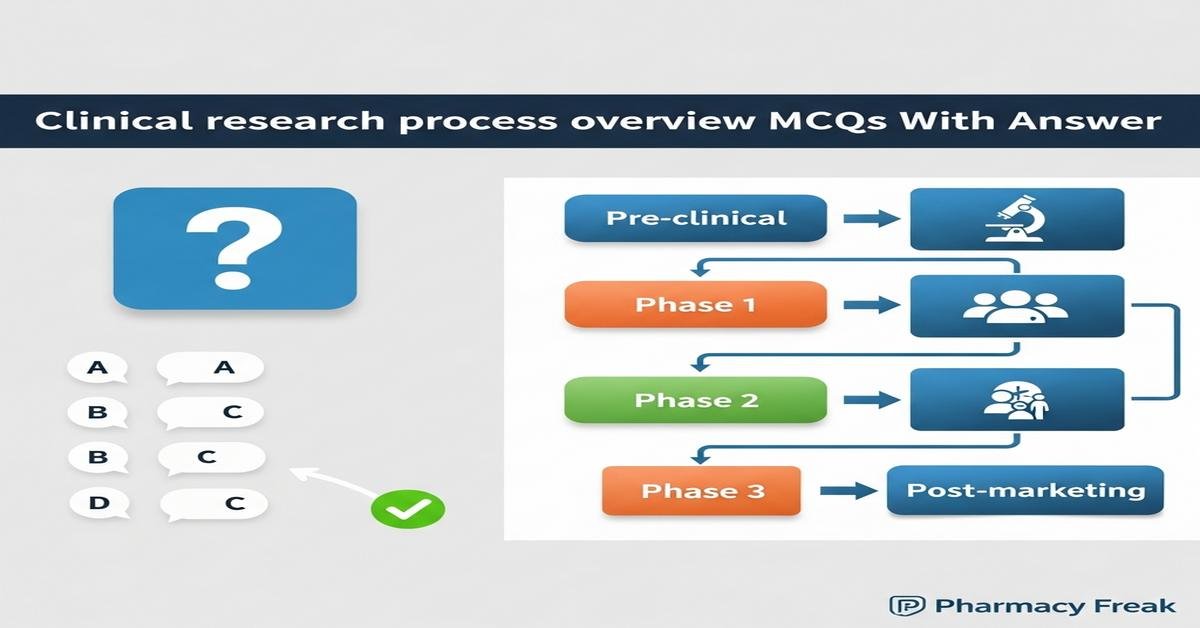
This quiz compilation on “Clinical research process overview MCQs With Answer” is tailored for M.Pharm students studying Product Development and Technology Transfer. It succinctly covers key concepts across the clinical development continuum: trial phases, regulatory submissions, ethics and informed consent, GCP principles, monitoring and safety reporting, randomization and blinding, statistical considerations, role of CROs/DSMBs, investigational medicinal product (IMP) handling, and technology transfer issues such as manufacturing, labeling, stability and supply chain for trials. Each MCQ is designed to test conceptual understanding and practical application, helping students prepare for exams and future roles in clinical research, quality assurance, and regulatory affairs.
Q1. Which activity is typically completed immediately before submitting an Investigational New Drug (IND) or Clinical Trial Application (CTA)?
- Phase I human trials
- Preclinical toxicology and pharmacology studies
- Marketing authorization application
- Post-marketing surveillance
Correct Answer: Preclinical toxicology and pharmacology studies
Q2. Which phase of clinical trials primarily assesses safety and pharmacokinetics in healthy volunteers?
- Phase IV
- Phase II
- Phase I
- Phase III
Correct Answer: Phase I
Q3. Under ICH-GCP, who has primary responsibility for ensuring that informed consent is obtained from trial participants?
- Regulatory authority
- Principal Investigator
- Sponsor
- Contract Research Organization (CRO)
Correct Answer: Principal Investigator
Q4. What is the main purpose of a Data Safety Monitoring Board (DSMB) in a clinical trial?
- To manage trial finances
- To independently monitor participant safety and efficacy data
- To recruit study participants
- To prepare the final regulatory submission
Correct Answer: To independently monitor participant safety and efficacy data
Q5. Which document is considered the definitive record of all essential trial documentation and regulatory correspondence?
- Investigator Brochure
- Trial Master File (TMF)
- Clinical Study Report (CSR)
- Case Report Form (CRF)
Correct Answer: Trial Master File (TMF)
Q6. In randomized controlled trials, what is the main advantage of blinding?
- To increase sample size
- To reduce allocation bias and observer-expectancy effects
- To eliminate the need for consent
- To speed regulatory approval
Correct Answer: To reduce allocation bias and observer-expectancy effects
Q7. Which regulatory submission is required in many jurisdictions before first human exposure to an IMP?
- New Drug Application (NDA)
- Clinical Study Report (CSR)
- Investigational New Drug (IND) or Clinical Trial Application (CTA)
- Marketing Authorization Renewal
Correct Answer: Investigational New Drug (IND) or Clinical Trial Application (CTA)
Q8. What is the key objective of Phase II clinical trials?
- Confirm long-term safety in the general population
- Evaluate efficacy and dose-response in patients
- Conduct post-marketing surveillance
- Assess manufacturing scale-up
Correct Answer: Evaluate efficacy and dose-response in patients
Q9. Which term describes a secondary measure used in trials that may predict clinical benefit but is not itself a direct measure of patient survival or function?
- Primary endpoint
- Exploratory endpoint
- Surrogate endpoint
- Composite endpoint
Correct Answer: Surrogate endpoint
Q10. Which process ensures that the investigational product manufactured for a trial meets predefined quality and release criteria?
- Pharmacovigilance
- Lot release and quality control testing
- Clinical monitoring
- Ethics committee review
Correct Answer: Lot release and quality control testing
Q11. What is the primary role of a Contract Research Organization (CRO) in clinical trials?
- To grant marketing authorization
- To manufacture the investigational product
- To provide outsourced operational services such as monitoring, data management, and trial logistics
- To adjudicate regulatory inspections
Correct Answer: To provide outsourced operational services such as monitoring, data management, and trial logistics
Q12. Which regulatory guidance provides international standards for Good Clinical Practice?
- ISO 9001
- ICH E6 (R2) Good Clinical Practice
- ICH Q7
- WHO GMP Annex 13
Correct Answer: ICH E6 (R2) Good Clinical Practice
Q13. What is the correct immediate action when a serious unexpected adverse reaction (SUSAR) occurs in a trial subject?
- Ignore until study end
- Report promptly to regulatory authority and ethics committee per local requirements
- Only record in the TMF
- Publish in a journal
Correct Answer: Report promptly to regulatory authority and ethics committee per local requirements
Q14. In sample size calculation, which factor primarily determines the number of subjects required to detect a treatment effect?
- Sponsor’s budget
- Expected effect size and variability
- Number of study sites
- Investigator preference
Correct Answer: Expected effect size and variability
Q15. Which document defines the detailed procedures, responsibilities and conduct of a single clinical study?
- Investigator Brochure
- Clinical Study Protocol
- Quality Management Plan
- Batch Manufacturing Record
Correct Answer: Clinical Study Protocol
Q16. During technology transfer for an IMP, which activity is critical to ensure consistent product quality across sites?
- Changing the formulation without validation
- Qualification and validation of manufacturing process and analytical methods
- Reducing stability testing to save time
- Outsourcing regulatory submissions only
Correct Answer: Qualification and validation of manufacturing process and analytical methods
Q17. What is the primary difference between monitoring and auditing in clinical research?
- Monitoring is retrospective; auditing is real-time
- Monitoring is routine oversight during conduct; auditing is an independent evaluation of compliance
- Monitoring issues are not documented; audits are confidential
- There is no difference
Correct Answer: Monitoring is routine oversight during conduct; auditing is an independent evaluation of compliance
Q18. Which element is essential in the labeling of investigational medicinal products for clinical trials?
- Marketing claims
- Storage conditions, protocol number, and trial-specific identification
- Physician’s personal notes
- Final brand packaging for commercial sale
Correct Answer: Storage conditions, protocol number, and trial-specific identification
Q19. Which statistical principle helps prevent selection bias by ensuring predictable assignment ratios are preserved?
- Intention-to-treat analysis
- Block randomization
- Crossover design
- Per-protocol analysis
Correct Answer: Block randomization
Q20. In clinical trial quality management, what is the primary purpose of a corrective and preventive action (CAPA) system?
- To document patient recruitment numbers only
- To identify root causes of quality issues and implement measures to prevent recurrence
- To finalize the clinical study report
- To increase enrollment targets
Correct Answer: To identify root causes of quality issues and implement measures to prevent recurrence

