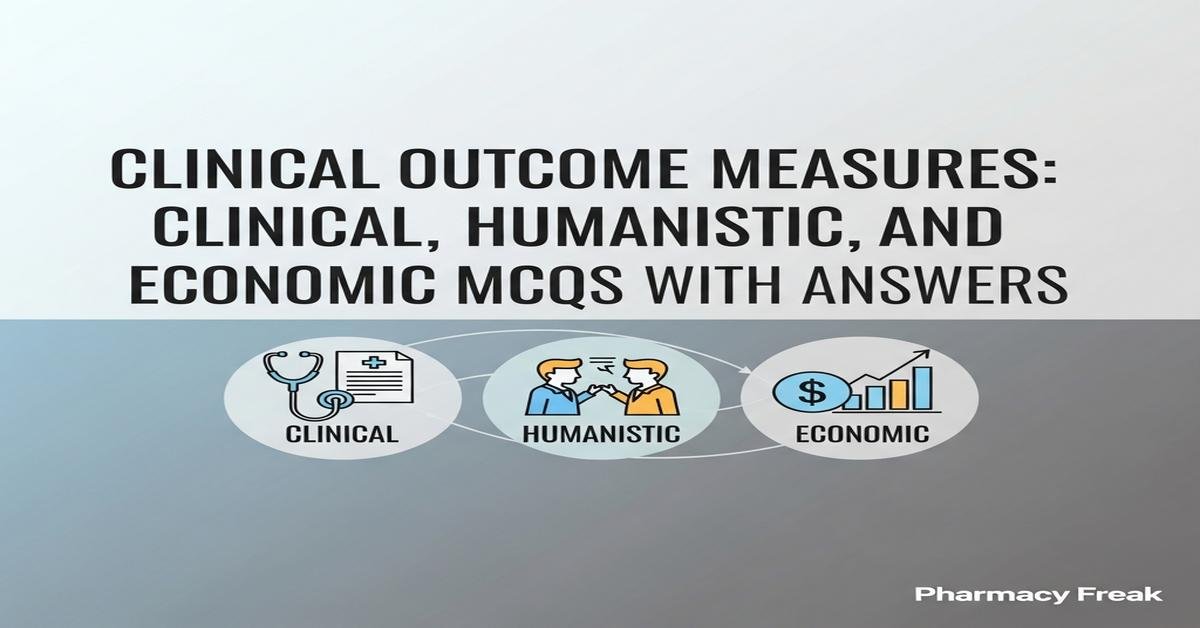
Clinical outcome measures: clinical, humanistic and economic MCQs With Answer
This collection of MCQs is designed for M.Pharm students preparing for Clinical Research (MPP 104T). It focuses on clinical, humanistic and economic outcome measures used in trials and health technology assessment. Questions emphasize principles and applications: types of outcomes, patient-reported outcomes (PROs), health-related quality of life (HRQoL) instruments, utility measures, cost-effectiveness concepts (QALY, ICER), psychometric properties (validity, reliability, responsiveness), minimal clinically important difference (MCID), and economic evaluation perspectives. The set deepens conceptual understanding and practical interpretation so students can critically appraise study outcomes, select appropriate measures, and interpret economic results in clinical research and pharmacy practice.
Q1. Which of the following best defines a “patient-reported outcome” (PRO)?
- A clinical measurement recorded by the physician during a visit
- A laboratory biomarker used as a surrogate endpoint
- An outcome reported directly by the patient about their health status without interpretation by clinicians
- An economic metric describing healthcare costs
Correct Answer: An outcome reported directly by the patient about their health status without interpretation by clinicians
Q2. Which instrument is primarily a health utility measure used for cost-utility analysis?
- SF-36 Health Survey
- EQ-5D
- Beck Depression Inventory
- Visual Analogue Scale for pain (single item)
Correct Answer: EQ-5D
Q3. In economic evaluations, the Incremental Cost-Effectiveness Ratio (ICER) is calculated as:
- Difference in costs divided by difference in effectiveness between two interventions
- Total cost of intervention divided by life years gained
- Difference in effectiveness divided by the total population
- Cost of intervention minus the willingness-to-pay threshold
Correct Answer: Difference in costs divided by difference in effectiveness between two interventions
Q4. Which psychometric property assesses whether a measurement instrument yields consistent results under unchanged conditions?
- Content validity
- Responsiveness
- Reliability
- Criterion validity
Correct Answer: Reliability
Q5. Minimal clinically important difference (MCID) is best described as:
- The smallest statistically significant change in a score
- The smallest change in an outcome perceived as beneficial by patients that would mandate a change in management
- The average change observed in a randomized trial
- A change required to achieve a cost-saving
Correct Answer: The smallest change in an outcome perceived as beneficial by patients that would mandate a change in management
Q6. Which of the following is a disease-specific patient-reported outcome measure example?
- EuroQol EQ-5D
- SF-12 Health Survey
- Asthma Control Questionnaire (ACQ)
- Generic utility index
Correct Answer: Asthma Control Questionnaire (ACQ)
Q7. Responsiveness of an instrument refers to:
- Whether it measures what it intends to measure
- Ability to detect clinically important changes over time
- Degree of correlation with another instrument at a single time point
- How simple it is to administer
Correct Answer: Ability to detect clinically important changes over time
Q8. In cost-utility analysis, QALY stands for:
- Quality-Adjusted Life Year
- Quantified Annual Life Yield
- Quality Assessment of Life Year
- Quarterly Adjusted Living Year
Correct Answer: Quality-Adjusted Life Year
Q9. Which approach to estimating MCID uses an external standard (anchor) to interpret score changes?
- Distribution-based method
- Anchor-based method
- Reliability-based method
- Factor analysis method
Correct Answer: Anchor-based method
Q10. A surrogate endpoint is best described as:
- A patient-important outcome such as mortality or symptom relief
- An indirect measure expected to predict a clinical benefit but not itself a direct measure of how a patient feels, functions, or survives
- An economic outcome expressing costs per patient
- A measure of study process adherence
Correct Answer: An indirect measure expected to predict a clinical benefit but not itself a direct measure of how a patient feels, functions, or survives
Q11. Which perspective in economic evaluations includes only direct medical costs borne by the healthcare system?
- Societal perspective
- Patient perspective
- Healthcare payer perspective
- Provider perspective including productivity losses
Correct Answer: Healthcare payer perspective
Q12. Floor and ceiling effects in patient-reported outcome instruments can limit:
- Internal consistency reliability
- Ability to detect deterioration or improvement at distribution extremes
- Content validity across cultures
- Cost estimates in economic models
Correct Answer: Ability to detect deterioration or improvement at distribution extremes
Q13. Which of the following is a generic health-related quality of life (HRQoL) instrument often used for population comparisons?
- Karnofsky Performance Status
- EQ-5D
- WOMAC (Western Ontario and McMaster Universities Arthritis Index)
- Pain Catastrophizing Scale
Correct Answer: EQ-5D
Q14. Mapping in health economics refers to:
- Geographical distribution of disease burden
- Converting disease-specific PRO scores to generic utility values for QALY calculation
- Plotting ICERs on a cost-effectiveness plane
- Creating patient flow diagrams for clinical trials
Correct Answer: Converting disease-specific PRO scores to generic utility values for QALY calculation
Q15. Which statistical method is commonly used to evaluate internal consistency of a multi-item questionnaire?
- Kaplan-Meier analysis
- Cronbach’s alpha
- Logistic regression
- Pearson correlation for two independent samples
Correct Answer: Cronbach’s alpha
Q16. In sensitivity analysis for economic models, one-way sensitivity analysis explores:
- Simultaneous variation of all parameters within plausible ranges
- Variation of a single parameter at a time to assess its impact on outcomes
- Changes in clinical trial sample size
- The impact of different measurement instruments on psychometric properties
Correct Answer: Variation of a single parameter at a time to assess its impact on outcomes
Q17. Which property indicates that an outcome measure correlates well with a gold-standard measure?
- Construct validity
- Criterion validity
- Test-retest reliability
- Responsiveness
Correct Answer: Criterion validity
Q18. Willingness-to-pay threshold in cost-effectiveness analysis is used to:
- Determine statistical significance of clinical outcomes
- Judge whether an ICER represents good value for money by comparing cost per QALY gained to a societal threshold
- Estimate the direct medical costs of an intervention
- Calculate the discount rate for future costs
Correct Answer: Judge whether an ICER represents good value for money by comparing cost per QALY gained to a societal threshold
Q19. Which outcome type specifically captures productivity losses and informal care costs in economic evaluations?
- Clinical outcomes
- Humanistic outcomes
- Indirect costs
- Direct non-medical costs
Correct Answer: Indirect costs
Q20. When validating a translated PRO instrument for a new language/culture, which process is essential?
- Simple literal translation by a single translator
- Forward-backward translation, cognitive debriefing, and psychometric testing
- Replacing items with culturally different concepts without testing
- Using the original scoring thresholds without revalidation
Correct Answer: Forward-backward translation, cognitive debriefing, and psychometric testing

