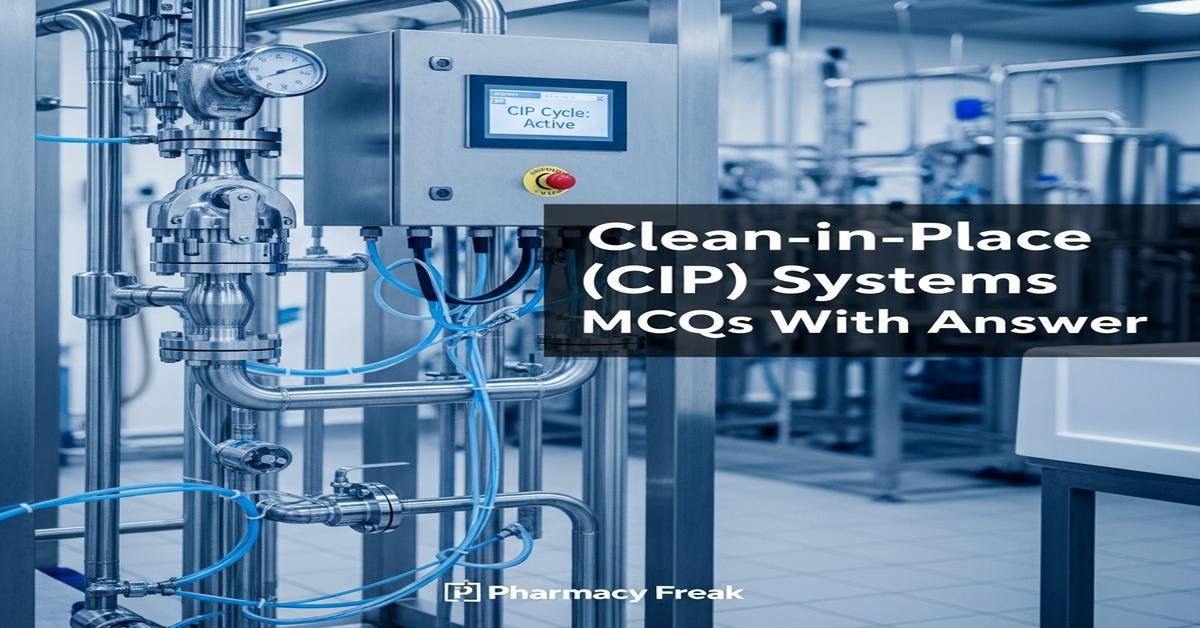
Introduction: Clean-in-place (CIP) systems are essential in pharmaceutical manufacturing for automated, reproducible removal of product residues and microbial contaminants from process equipment without disassembly. This blog provides M.Pharm students with focused multiple-choice questions and answers to deepen understanding of CIP design, critical process parameters (time, temperature, flow, chemical concentration), cleaning agents, validation approaches, sampling strategies, and monitoring methods. Emphasis is placed on practical considerations such as turbulent flow, material compatibility, sensor usage (conductivity/TOC/ORP), and regulatory expectations for cleaning validation (IQ/OQ/PQ). These MCQs are crafted to reinforce decision-making skills needed for designing, validating, and troubleshooting GMP-compliant CIP operations.
Q1. What is the primary purpose of a Clean-in-place (CIP) system in pharmaceutical manufacturing?
- To sterilize personnel before entering the production area
- To remove product residues, soils and microbial contamination from process equipment without disassembly
- To package finished products under aseptic conditions
- To cool the product during processing
Correct Answer: To remove product residues, soils and microbial contamination from process equipment without disassembly
Q2. Which of the following parameters is considered one of the “critical cleaning variables” in CIP validation?
- Color of the cleaning tank
- Flow velocity in the pipes
- Brand of the detergent supplier
- Operator shoe size
Correct Answer: Flow velocity in the pipes
Q3. Which sequence represents a typical CIP cycle for removing both organic and inorganic soils?
- Acid wash → Caustic wash → Pre-rinse → Final rinse
- Pre-rinse → Caustic (alkaline) wash → Acid wash → Final rinse
- Final rinse → Caustic wash → Pre-rinse → Acid wash
- Caustic wash → Sterilization → Packaging
Correct Answer: Pre-rinse → Caustic (alkaline) wash → Acid wash → Final rinse
Q4. Which monitoring technique provides a rapid, real-time indication that an alkaline cleaning solution has been removed during final rinse?
- Visual inspection only
- Conductivity measurement
- Manual pH paper test of surface swabs
- Endotoxin assay
Correct Answer: Conductivity measurement
Q5. In cleaning validation, what is the difference between swab sampling and rinse sampling?
- Swab sampling measures airborne particles; rinse sampling measures microbial counts
- Swab sampling targets specific surface residues; rinse sampling evaluates residuals from internal surfaces via collected rinse waters
- Swab sampling is only for final products; rinse sampling is only for personnel
- There is no difference; both are identical methods
Correct Answer: Swab sampling targets specific surface residues; rinse sampling evaluates residuals from internal surfaces via collected rinse waters
Q6. Which cleaning agent class is most effective for removing proteinaceous residues in pharmaceutical equipment?
- Nonionic surfactants alone
- Alkaline (caustic) solutions often combined with surfactants
- Organic solvents only
- Dilute hydrochloric acid at room temperature
Correct Answer: Alkaline (caustic) solutions often combined with surfactants
Q7. What is the primary reason for maintaining turbulent flow (rather than laminar) during CIP circulation?
- Turbulence reduces power consumption
- Turbulent flow enhances shear forces and mass transfer to dislodge soils
- Turbulent flow increases foaming to aid cleaning
- Turbulent flow prevents corrosion entirely
Correct Answer: Turbulent flow enhances shear forces and mass transfer to dislodge soils
Q8. Which sensor is commonly used during CIP to verify the presence and concentration of oxidizing sanitizers such as hypochlorite?
- Thermocouple
- Oxidation-reduction potential (ORP) sensor
- pH electrode only
- Ultrasonic flow meter
Correct Answer: Oxidation-reduction potential (ORP) sensor
Q9. During cleaning validation, what is the purpose of performing a worst-case or bracketing approach?
- To reduce validation paperwork by testing only one equipment item
- To identify and validate the most difficult-to-clean product or location, thereby ensuring broader applicability
- To exclude heavily soiled areas from validation
- To validate only at ambient temperature
Correct Answer: To identify and validate the most difficult-to-clean product or location, thereby ensuring broader applicability
Q10. Which of the following is a typical revalidation trigger for a CIP process?
- Minor change in shift pattern for operators
- Change in formulation or cleaning chemistry that may affect soil removal
- Replacement of light bulbs in the utility room
- Changing the brand of bottled water in the cafeteria
Correct Answer: Change in formulation or cleaning chemistry that may affect soil removal
Q11. What role does Temperature play in a CIP process?
- Temperature has no effect on cleaning efficacy
- Higher temperatures generally enhance solubility and reaction rates, improving cleaning efficacy for many soils
- Lower temperatures always improve detergent performance
- Temperature determines the final product color only
Correct Answer: Higher temperatures generally enhance solubility and reaction rates, improving cleaning efficacy for many soils
Q12. Which design feature helps prevent recontamination of cleaned equipment in a closed-loop CIP system?
- Using only gravity feed without control valves
- Incorporating return loops with proper check valves and automated valve sequencing
- Leaving tanks open to atmosphere during final rinse
- Routing rinse water back into product storage
Correct Answer: Incorporating return loops with proper check valves and automated valve sequencing
Q13. Which analytical parameter is commonly used as a non-specific indicator of organic residues remaining after cleaning?
- Total Organic Carbon (TOC)
- Gram staining
- Particle size distribution
- Total dissolved solids (TDS) only
Correct Answer: Total Organic Carbon (TOC)
Q14. When validating a CIP cycle, what is typically evaluated during the Performance Qualification (PQ)?
- Theoretical designs of the CIP skid
- Demonstration that the CIP cycle consistently achieves predefined acceptance criteria under normal operating conditions
- Factory acceptance test for electrical motor efficiency
- Only installation of piping supports
Correct Answer: Demonstration that the CIP cycle consistently achieves predefined acceptance criteria under normal operating conditions
Q15. Why is material compatibility an important consideration when selecting cleaning agents for CIP?
- Because cleaning agents determine the production schedule
- Because some chemicals can corrode or damage process materials leading to particulate or ion release
- Because compatibility affects the color of finished tablets
- Material compatibility is irrelevant for stainless steel
Correct Answer: Because some chemicals can corrode or damage process materials leading to particulate or ion release
Q16. Which sampling location is generally considered worst-case for verifying internal surface cleanliness of a tank fitted with spray devices?
- Directly under the spray ball outlet
- At dead-leg or low-flow areas furthest from spray heads
- On the outer jacket of the tank
- At the manway hatch where access is easiest
Correct Answer: At dead-leg or low-flow areas furthest from spray heads
Q17. What is the primary advantage of automated CIP systems versus manual cleaning?
- Automated CIP always uses less water than manual cleaning
- Automated CIP provides reproducibility, traceability, and reduced risk of operator error
- Manual cleaning cannot achieve sterility ever
- Automated CIP eliminates need for validation
Correct Answer: Automated CIP provides reproducibility, traceability, and reduced risk of operator error
Q18. Which of the following is a common method to control foaming during CIP when surfactants are used?
- Increase detergent concentration without limits
- Add antifoam agents and/or optimize spray patterns and flow rates
- Operate at the lowest possible temperature to reduce foam
- Turn off circulation pumps intermittently to build foam
Correct Answer: Add antifoam agents and/or optimize spray patterns and flow rates
Q19. For microbial control, what is typically included at the end of a CIP cycle for aseptic systems?
- Only a cold water rinse
- A final sanitization step (e.g., hot water flush or chemical sanitizer) followed by sterile or filtered air purge as appropriate
- Filling with product immediately without drying
- Application of powder disinfectant into the product line
Correct Answer: A final sanitization step (e.g., hot water flush or chemical sanitizer) followed by sterile or filtered air purge as appropriate
Q20. Which documentation elements are essential for a robust CIP validation dossier?
- Only vendor brochures and a risk assessment
- Cleaning procedure, validation protocol (IQ/OQ/PQ), sampling/analytical methods, acceptance criteria, and results
- Only photographs of the CIP skid
- Only operator training records without test data
Correct Answer: Cleaning procedure, validation protocol (IQ/OQ/PQ), sampling/analytical methods, acceptance criteria, and results

