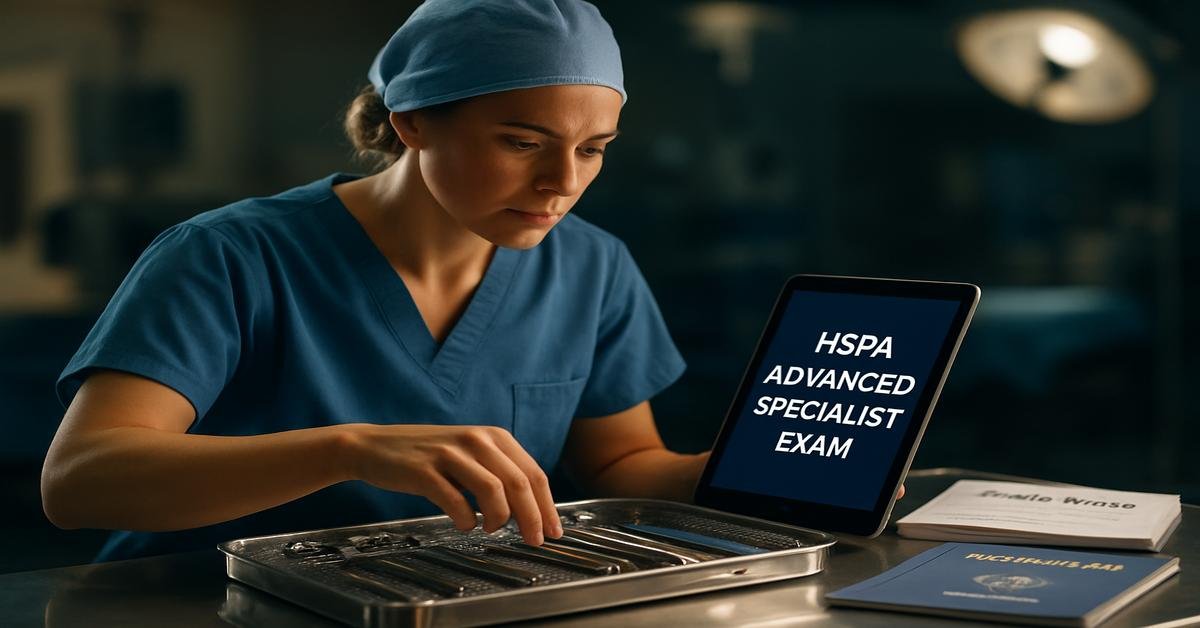
The Certified Instrument Specialist, or CIS, credential is for sterile processing professionals who want to show deep knowledge of surgical instruments. It goes beyond basic handling and cleaning. It proves that you understand how instruments are built, how they function in the operating room, and what it takes to inspect, test, assemble, and protect them correctly. That matters because a missed crack, a dull scissor, or a badly assembled device can delay surgery or put a patient at risk. If you are preparing for the HSPA Advanced Specialist exam, the goal is not just to memorize facts. You need to think like an instrument specialist. You need to connect design, use, care, and patient safety into one clear workflow.
What the CIS credential actually proves
The CIS credential is an advanced certification from HSPA for people who work closely with surgical instrumentation. It tells employers and coworkers that you understand more than the standard steps of decontamination and sterilization. You know the details that affect function and safety.
That includes things like:
- Instrument identification by name, category, and surgical use
- Inspection for wear, corrosion, cracks, loose parts, and alignment issues
- Testing of cutting edges, ratchets, jaws, insulation, suction, and other functional parts
- Assembly of sets based on use, weight, protection, and sterilization needs
- Care methods that match the instrument material and design
- Communication with the OR, repair vendors, and sterile processing staff
This is why the credential carries weight. Surgical instruments are not just metal items in a tray. They are precision tools. Each one has a job. If it fails during a case, the surgical team loses time and the patient may face added risk.
Why instrument specialization matters in real work
Many people assume instruments are simple because they are used every day. In reality, instruments fail in subtle ways. A box lock may look clean but hide bioburden. A needle holder may close but still fail to grip properly. A laparoscopic instrument may pass a quick visual check yet have damaged insulation that creates a burn risk.
An instrument specialist helps prevent these failures before they reach the operating room. That means:
- Fewer surgical delays because sets are complete and instruments work as expected
- Lower repair costs because damage is caught early
- Better surgeon satisfaction because the right tools are available and functional
- Better patient safety because damaged or contaminated devices are kept out of use
For example, a dull curette may seem like a minor problem. It is not. A surgeon using a dull instrument may need more force, which can reduce control and extend the procedure. A specialist understands that instrument condition affects the entire case, not just the tray count.
What the HSPA Advanced Specialist exam usually expects you to know
The CIS exam tests applied knowledge. It is not only about definitions. It expects you to understand how instruments are categorized, used, inspected, and maintained.
Common knowledge areas include:
- Surgical instrument families, such as cutting, grasping, clamping, retracting, dilating, suctioning, and suturing instruments
- Anatomy of instruments, including tips, jaws, shanks, rings, ratchets, box locks, lumens, and insulation
- Material science, such as stainless steel, tungsten carbide inserts, passivation, and corrosion causes
- Inspection methods using magnification, lighted inspection, test materials, and function checks
- Specialty instrumentation for areas like orthopedics, neurosurgery, eye surgery, laparoscopic surgery, robotic systems, and microsurgery
- Set assembly principles including count accuracy, organization, protection, and compatibility with sterilization methods
- Care and handling standards for transport, cleaning, lubrication, testing, repair, and storage
If you study only names, you will struggle. The exam often rewards reasoning. For instance, if a hinged instrument has staining, rough movement, and a stiff box lock, you need to think through possible causes. Was it inadequate cleaning? Mineral deposits? Missing lubricant? Early corrosion? The exam is built around this kind of practical thinking.
Build your study plan around understanding, not memorizing
The best CIS preparation starts with structure. Break the content into groups and learn each group in a practical way.
A useful study plan looks like this:
- Week 1: Instrument basics — categories, names, and anatomy
- Week 2: Inspection and testing — what defects look like and how to identify them
- Week 3: Specialty instruments — ortho, lap, eye, micro, and powered devices
- Week 4: Assembly and packaging — tray logic, weight, placement, and protection
- Week 5: Repairs and quality assurance — what to remove from service and how to document issues
- Week 6: Review and practice questions — focus on weak areas and test reasoning
Why does this work better than random reading? Because the exam covers a system. You need to see how each part connects. If you know what a Kerrison does in surgery, you are more likely to remember how to inspect its footplate and why damage matters. Use matters.
Learn instruments by function, not just by name
One of the fastest ways to improve is to group instruments by what they do. This makes them easier to remember and easier to compare.
For example:
- Cutting instruments: scissors, osteotomes, curettes, chisels. Study edge sharpness, alignment, and tip condition.
- Grasping and holding instruments: forceps, Allis, Babcock, Kocher, needle holders. Study jaw alignment, teeth condition, and grip quality.
- Clamping and occluding instruments: Kelly, Crile, mosquito, Rochester. Study ratchet action, jaw approximation, and box lock wear.
- Retracting and exposing instruments: Army-Navy, Richardson, Weitlaner, Gelpi. Study integrity, tension, and tip condition.
- Probing and dilating instruments: sounds, dilators, probes. Study straightness, surface damage, and sizing.
- Suction instruments: Frazier, Poole, Yankauer. Study patency, tip damage, and lumen cleanliness.
This helps because the exam may give you a clinical or functional clue instead of a simple name recall question. If you understand the job of the instrument, you can reason your way to the answer.
Focus hard on inspection, because that is where specialists stand out
Inspection is one of the biggest differences between basic processing and advanced instrument specialization. Anyone can look at a tray. A specialist knows what to look for and why it matters.
When inspecting, pay attention to:
- Cleanliness: no soil, debris, retained moisture, tape residue, or deposits
- Surface condition: no pitting, rust, staining, scratches, or flaking
- Alignment: tips should meet correctly, jaws should close evenly, shafts should be straight
- Movement: hinges and joints should open and close smoothly without sticking or wobbling
- Sharpness: cutting tools should perform as designed, not drag or fold test material
- Insulation and coatings: no cracks, chips, peeling, or burn marks
- Lumens and channels: clear, dry, and undamaged
Take scissors as a simple example. A good inspection is not just “they look fine.” You check the blades under light. You test them with approved material. You watch for tip closure, blade ride, and smooth motion. If the blades are shiny in the wrong spots, that may show wear. If one blade folds the test material instead of cutting it, the scissors are not ready for use.
Know common damage patterns and what causes them
The exam may ask you to identify not only a defect, but also the likely cause. This matters because prevention is part of instrument care.
Common examples include:
- Rust or reddish discoloration: often linked to poor water quality, chemical exposure, or breakdown of the passive layer
- Pitting: usually more serious than staining; can trap soil and weaken the metal
- Cracked insulation: often caused by use wear, impact, harsh handling, or repeated processing
- Misalignment: may result from dropping, incorrect use, or poor repair
- Stiff box locks: can come from retained soil, mineral buildup, or lack of proper instrument milk where allowed by IFU
- Dull edges: caused by normal use, improper testing, or instrument-to-instrument damage in trays
Understanding cause helps you answer questions more accurately. It also helps in real work. If a tray keeps coming back with scratched insulation or bent tips, the problem may be in transport, tray arrangement, or point-of-use handling, not just in decontam.
Do not treat specialty instruments as a minor topic
Specialty instruments can feel overwhelming because there are many types, and some are used in procedures you may not see every day. Still, this is where advanced knowledge shows.
Pay extra attention to:
- Laparoscopic instruments: disassembly, lumen cleaning, insulation testing, port and handle function
- Orthopedic instruments: heavy sets, cutting surfaces, depth markings, alignment, and powered equipment attachments
- Microsurgical instruments: delicate tips, fine jaws, protective handling, and magnified inspection
- Eye instruments: very fine construction, strict cleaning detail, and tip protection
- Powered surgical instruments: battery systems, attachments, lubrication rules, and manufacturer-specific handling
Why is this area important? Because errors with specialty devices are costly. Some are expensive to replace. Others can fail in ways that are hard to spot without careful training. A tiny bend in a micro tip or small insulation break in a laparoscopic instrument can create major problems in surgery.
Use the operating room context to remember details
If you can, study with the clinical purpose in mind. Instruments make more sense when you know how they are used.
For example:
- A Babcock is designed to hold delicate tissue, so its jaws should preserve tissue rather than crush it.
- A Kocher has teeth because it is meant for firmer tissue or fascia, so damaged teeth directly affect grip.
- A needle holder must secure a suture needle under pressure, so jaw inserts and alignment matter more than simple appearance.
- A Frazier suction is used in precise surgical fields, so a blocked lumen or damaged stylet area affects accuracy.
This approach improves memory because it replaces isolated facts with purpose. Purpose is easier to remember under exam pressure.
Practice questions the right way
Practice questions help, but only if you review them deeply. Do not just count your score. Ask why each answer is right or wrong.
After each question, review:
- What clue in the question pointed to the answer?
- Was this a recall question or a reasoning question?
- Did I miss a key term like jaws, lumen, insert, insulation, or ratchet?
- Do I understand the real-world risk behind the answer?
For example, if a question asks which defect requires immediate removal from service, do not stop at the correct choice. Think about why. A cracked insulated instrument is not just “damaged.” It may transfer unintended energy during surgery. Once you connect defect to risk, the answer becomes easier to remember.
Test-day strategies that actually help
By exam day, your goal is to stay calm and read carefully. Many missed questions happen because people rush through familiar words and miss the important detail.
Useful strategies include:
- Read the last line first so you know what the question is really asking
- Watch for qualifiers like first, best, most likely, and immediate
- Eliminate unsafe answers first if several options seem possible
- Use function to reason when you do not remember a term exactly
- Do not overthink clear instrument care principles
If you are stuck, ask yourself what protects the patient and preserves device function. That principle often points you in the right direction.
How to become better at the job while studying for the exam
The best exam preparation often happens at work. Every tray is a study session if you use it well.
Try these habits:
- Pick one tray a day and identify every instrument in it
- Compare similar instruments, such as Kelly vs. Crile or Allis vs. Babcock, and note the design differences
- Ask why an instrument is arranged a certain way in the set
- Review repair reports to learn the most common failures in your facility
- Observe patterns in damaged sets, missing items, and frequent OR complaints
This matters because the CIS exam is built on real-world judgment. The more you connect daily work to instrument science, the easier the test becomes.
Final thoughts
Passing the HSPA CIS exam is about mastering surgical tools in a practical, patient-focused way. Learn what instruments do. Learn how they fail. Learn how to inspect them with purpose. Learn how proper assembly and handling affect surgery. If you study from that mindset, the content becomes more logical and much easier to retain.
The CIS credential is not just another line on a résumé. It reflects a higher level of responsibility. Instrument specialists protect the quality of the surgical field before the case even begins. That is why the work matters, and that is why the exam expects depth. Study for understanding, not just recall, and you will be in a strong position to pass.

