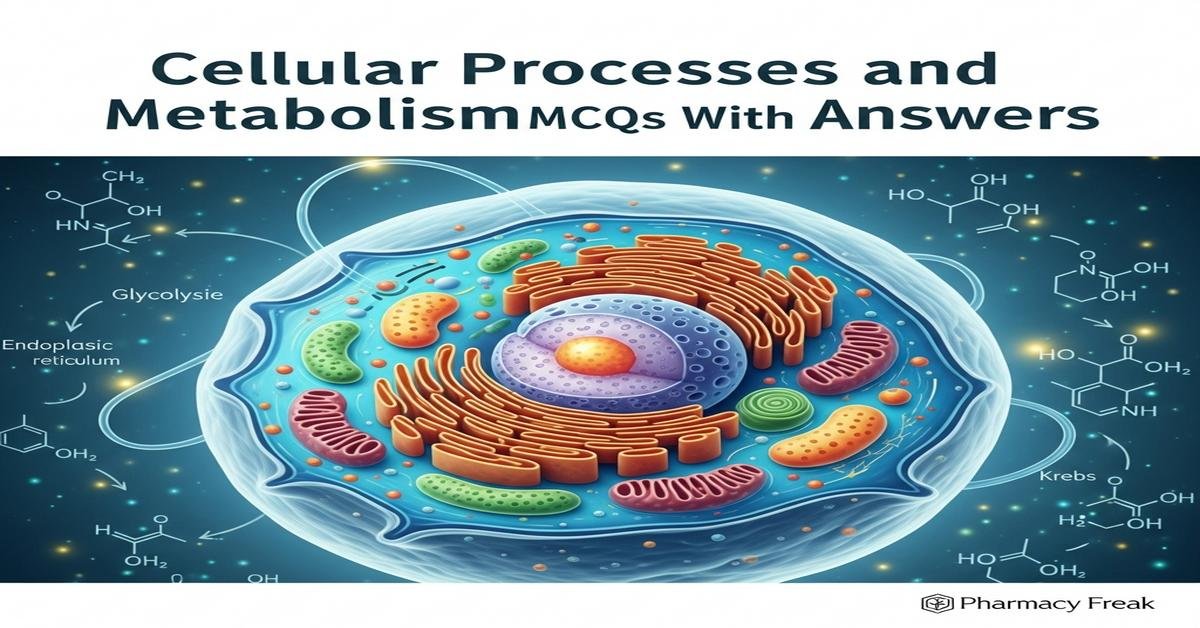
Cellular processes and metabolism form the biochemical foundation of pharmacology, encompassing pathways like glycolysis, the tricarboxylic acid (TCA) cycle, oxidative phosphorylation and the pentose phosphate pathway. This concise review highlights bioenergetics, ATP synthesis, enzyme regulation, redox cofactors (NAD+/NADP+, FAD), anabolic vs. catabolic reactions, and transport across membranes—key concepts for B. Pharm students preparing for exams and drug action studies. Understanding metabolic control points, enzyme kinetics and metabolic integration helps predict drug effects and toxicities. Clinical relevance includes metabolic enzyme targets, mitochondrial dysfunction and reactive oxygen species. Now let’s test your knowledge with 30 MCQs on this topic.
Q1. Which step of glycolysis directly produces ATP by substrate-level phosphorylation?
- Hexokinase reaction
- Phosphofructokinase-1 reaction
- 1,3-Bisphosphoglycerate to 3-phosphoglycerate (phosphoglycerate kinase)
- Pyruvate kinase converting phosphoenolpyruvate to pyruvate
Correct Answer: 1,3-Bisphosphoglycerate to 3-phosphoglycerate (phosphoglycerate kinase)
Q2. Which coenzyme primarily accepts electrons in catabolic reactions to form NADH?
- NADP+
- FAD
- NAD+
- Coenzyme A
Correct Answer: NAD+
Q3. The main site of oxidative phosphorylation in eukaryotic cells is:
- Golgi apparatus
- Mitochondrial inner membrane
- Rough endoplasmic reticulum
- Cytosol
Correct Answer: Mitochondrial inner membrane
Q4. Which enzyme is the rate-limiting control point of the TCA cycle?
- Isocitrate dehydrogenase
- Citrate synthase
- Alpha-ketoglutarate dehydrogenase
- Succinyl-CoA synthetase
Correct Answer: Isocitrate dehydrogenase
Q5. Uncouplers of oxidative phosphorylation increase:
- ATP synthesis yield per oxygen molecule
- Proton gradient across inner mitochondrial membrane
- Oxygen consumption without ATP synthesis
- Complex IV activity exclusively
Correct Answer: Oxygen consumption without ATP synthesis
Q6. Which reaction regenerates NAD+ under anaerobic glycolysis in muscle?
- Lactate dehydrogenase converting pyruvate to lactate
- Pyruvate carboxylase converting pyruvate to oxaloacetate
- Pantothenate kinase reaction
- Pyruvate dehydrogenase producing acetyl-CoA
Correct Answer: Lactate dehydrogenase converting pyruvate to lactate
Q7. The primary function of the pentose phosphate pathway is to produce:
- ATP for muscle contraction
- NADPH and ribose-5-phosphate
- Acetyl-CoA for TCA cycle
- FADH2 for oxidative phosphorylation
Correct Answer: NADPH and ribose-5-phosphate
Q8. Which enzyme converts pyruvate into acetyl-CoA and is inhibited by phosphorylation?
- Pyruvate carboxylase
- Lactate dehydrogenase
- Pyruvate dehydrogenase complex
- Pyruvate kinase
Correct Answer: Pyruvate dehydrogenase complex
Q9. In enzyme kinetics, Km represents:
- The maximum velocity of the enzyme
- The substrate concentration at half Vmax
- The turnover number (kcat)
- The inhibitor constant
Correct Answer: The substrate concentration at half Vmax
Q10. Which molecule is an allosteric activator of phosphofructokinase-1 (PFK-1) in glycolysis?
- Citrate
- ATP
- Fructose-2,6-bisphosphate
- Alanine
Correct Answer: Fructose-2,6-bisphosphate
Q11. Beta-oxidation of fatty acids occurs primarily in:
- Cytosol
- Mitochondrial matrix
- Peroxisomes exclusively
- Endoplasmic reticulum lumen
Correct Answer: Mitochondrial matrix
Q12. Which carrier transports long-chain fatty acids into mitochondria for oxidation?
- Acyl carrier protein
- Carnitine shuttle (carnitine palmitoyltransferase system)
- Fatty acid binding protein in cytosol
- ATP-binding cassette transporter
Correct Answer: Carnitine shuttle (carnitine palmitoyltransferase system)
Q13. The net ATP yield from complete aerobic oxidation of one molecule of glucose is approximately:
- 2 ATP
- 10 ATP
- 30–32 ATP
- 100 ATP
Correct Answer: 30–32 ATP
Q14. Which enzyme detoxifies superoxide radicals by converting them to hydrogen peroxide?
- Catalase
- Glutathione peroxidase
- Superoxide dismutase (SOD)
- Peroxiredoxin
Correct Answer: Superoxide dismutase (SOD)
Q15. Gluconeogenesis primarily occurs in the liver and requires which unique enzyme to bypass pyruvate kinase?
- Pyruvate kinase
- Pyruvate carboxylase and PEP carboxykinase
- Hexokinase
- Glyceraldehyde-3-phosphate dehydrogenase
Correct Answer: Pyruvate carboxylase and PEP carboxykinase
Q16. Which pathway provides precursors for nucleotide synthesis and reduces oxidative stress by generating NADPH?
- Glycolysis
- Pentose phosphate pathway
- TCA cycle
- Beta-oxidation
Correct Answer: Pentose phosphate pathway
Q17. Competitive enzyme inhibitors primarily affect which kinetic parameter?
- Decrease Vmax, Km unchanged
- Increase Vmax, Km decreased
- Increase Km, Vmax unchanged
- Neither Km nor Vmax affected
Correct Answer: Increase Km, Vmax unchanged
Q18. Anaplerotic reactions are important because they:
- Degrade amino acids exclusively
- Replenish TCA cycle intermediates
- Convert glucose to glycogen
- Produce ATP by substrate-level phosphorylation only
Correct Answer: Replenish TCA cycle intermediates
Q19. Which hormone activates glycogen phosphorylase in liver via cAMP-dependent phosphorylation?
- Insulin
- Glucagon
- Thyroxine
- Growth hormone
Correct Answer: Glucagon
Q20. The primary electron donor to complex I of the electron transport chain is:
- FADH2
- Ubiquinol (reduced CoQ)
- NADH
- Cytochrome c
Correct Answer: NADH
Q21. Which of the following is a glucogenic amino acid (can be converted to glucose)?
- Leucine
- Lysine
- Alanine
- Isoleucine (only ketogenic)
Correct Answer: Alanine
Q22. Allosteric inhibition of phosphofructokinase-1 by ATP exemplifies:
- Feed-forward activation
- Negative feedback by product inhibition
- Competitive inhibition at active site
- Irreversible enzyme inactivation
Correct Answer: Negative feedback by product inhibition
Q23. The urea cycle primarily functions to:
- Synthesize essential amino acids
- Detoxify ammonia by converting it to urea
- Generate ketone bodies
- Oxidize fatty acids
Correct Answer: Detoxify ammonia by converting it to urea
Q24. Which molecule directly drives the rotation of ATP synthase to make ATP?
- Electrical potential alone across the membrane
- Proton motive force (proton gradient and membrane potential)
- ATP/ADP ratio in cytosol
- FADH2 concentration
Correct Answer: Proton motive force (proton gradient and membrane potential)
Q25. Noncompetitive inhibitors affect enzyme activity by:
- Competing with substrate for the active site
- Binding to an allosteric site and reducing Vmax
- Increasing Vmax
- Only affecting Km but not Vmax
Correct Answer: Binding to an allosteric site and reducing Vmax
Q26. Which metabolic state activates AMP-activated protein kinase (AMPK)?
- High ATP / low AMP levels
- Low AMP / high ATP levels
- High AMP / low ATP levels indicating energy stress
- High insulin signaling only
Correct Answer: High AMP / low ATP levels indicating energy stress
Q27. Which enzyme distinguishes hepatic glucokinase from muscle hexokinase?
- Glucokinase has lower Km for glucose than hexokinase
- Glucokinase is inhibited by glucose-6-phosphate; hexokinase is not
- Glucokinase has higher Km and is not inhibited by glucose-6-phosphate
- Both enzymes are identical in regulation and kinetics
Correct Answer: Glucokinase has higher Km and is not inhibited by glucose-6-phosphate
Q28. Which enzyme produces glycerol-3-phosphate for triglyceride synthesis from dihydroxyacetone phosphate?
- Glycerol kinase
- Glycerol-3-phosphate dehydrogenase
- Acyl-CoA synthetase
- Hormone-sensitive lipase
Correct Answer: Glycerol-3-phosphate dehydrogenase
Q29. During prolonged fasting, the liver increases production of:
- Glycogen exclusively
- Ketone bodies from acetyl-CoA
- Insulin to store glucose
- Fatty acids by de novo lipogenesis
Correct Answer: Ketone bodies from acetyl-CoA
Q30. Which antioxidant system uses glutathione to reduce hydrogen peroxide to water?
- Superoxide dismutase system
- Catalase alone
- Glutathione peroxidase with reduced glutathione (GSH)
- Peroxisomal beta-oxidation
Correct Answer: Glutathione peroxidase with reduced glutathione (GSH)

