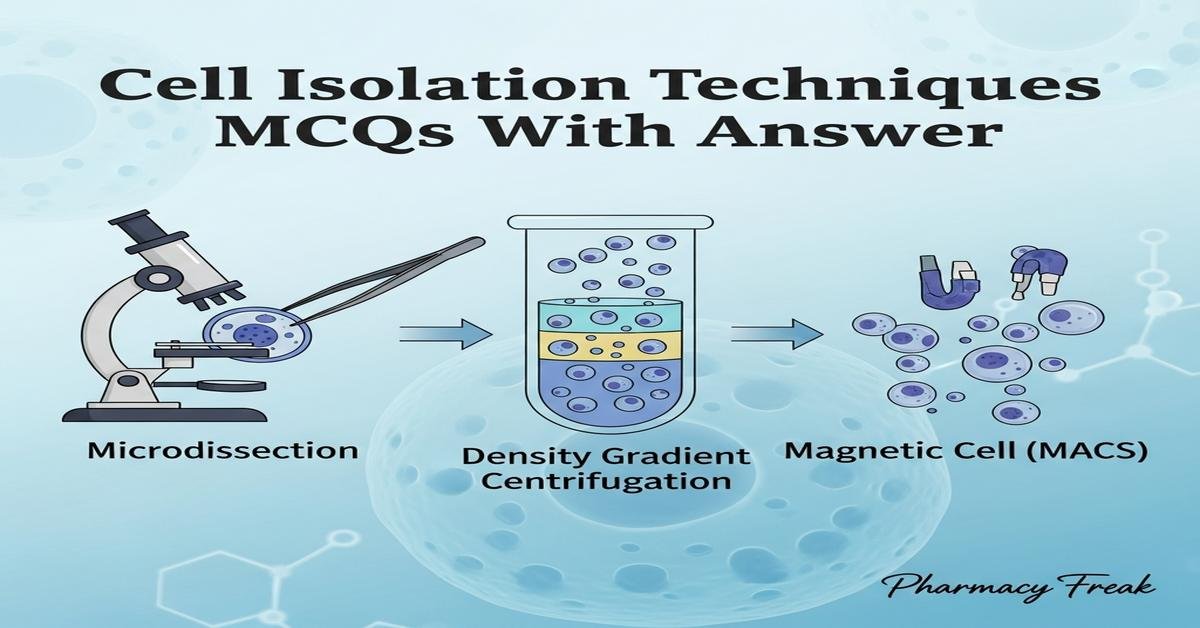
Introduction: Cell isolation techniques MCQs With Answer is designed for M.Pharm students preparing for Modern Bio-Analytical Techniques (MPA 202T). This collection focuses on core principles, common reagents, instruments, and troubleshooting strategies used to separate and purify cells from tissues, blood, and cultures. Questions emphasize practical considerations — enzymatic versus mechanical dissociation, density gradient centrifugation, magnetic and fluorescence-based sorting, single-cell isolation methods, viability assessment, and sample handling to preserve cell function. Each MCQ includes plausible distractors and concise answers to reinforce conceptual understanding, help in exam preparation, and improve lab decision-making when designing cell isolation workflows.
Q1. Which enzyme is most commonly used to dissociate adherent mammalian cell cultures by cleaving proteins that mediate cell-substrate and cell-cell adhesion?
- Collagenase
- Trypsin-EDTA
- DNase I
- Lysozyme
Correct Answer: Trypsin-EDTA
Q2. Which density gradient medium is classically used to isolate peripheral blood mononuclear cells (PBMCs) based on buoyant density around 1.077 g/mL?
- Percoll
- Sucrose
- Ficoll-Paque
- Cesium chloride
Correct Answer: Ficoll-Paque
Q3. What is the primary mechanism by which EDTA facilitates cell detachment during isolation?
- Proteolytic cleavage of extracellular matrix proteins
- Chelation of divalent cations disrupting calcium-dependent adhesion molecules
- Digestion of DNA in viscous samples
- Breaking hydrogen bonds in membrane proteins
Correct Answer: Chelation of divalent cations disrupting calcium-dependent adhesion molecules
Q4. Which technique uses antibody-conjugated magnetic beads to enrich a specific cell population in bulk with high speed and simplicity?
- Flow cytometry
- MACS (magnetic-activated cell sorting)
- Laser capture microdissection
- Density gradient centrifugation
Correct Answer: MACS (magnetic-activated cell sorting)
Q5. In fluorescence-activated cell sorting (FACS), what distinguishes it from analytical flow cytometry?
- FACS measures cell size only
- FACS sorts and physically separates cells based on fluorescence and light scattering
- FACS uses magnetic beads rather than fluorescence
- FACS cannot detect multiple fluorophores
Correct Answer: FACS sorts and physically separates cells based on fluorescence and light scattering
Q6. Which reagent is most appropriate to reduce sample viscosity caused by extracellular DNA following tissue dissociation?
- Collagenase
- Trypsin
- DNase I
- EDTA
Correct Answer: DNase I
Q7. When isolating hepatocytes from liver tissue, which enzymatic approach is commonly used to preserve viability while liberating cells from extracellular matrix?
- High concentration trypsin treatment
- Collagenase perfusion
- Lysozyme incubation
- Simple mechanical homogenization without enzymes
Correct Answer: Collagenase perfusion
Q8. Which factor most directly affects the resolution of cell separation in density gradient centrifugation?
- Type of fluorescent dye used
- Gradient medium density and centrifugal force/time
- Presence of magnetic beads
- Ambient room temperature alone
Correct Answer: Gradient medium density and centrifugal force/time
Q9. Trypan blue exclusion assay measures which property of a cell suspension?
- Metabolic activity of live cells
- Membrane integrity to distinguish live and dead cells
- DNA content for cell cycle analysis
- Surface antigen expression
Correct Answer: Membrane integrity to distinguish live and dead cells
Q10. Which physical method is least likely to preserve surface antigens and cell viability for downstream immunophenotyping?
- Gentle enzymatic dissociation with Accutase
- Manual mincing and gentle pipetting
- High shear mechanical homogenization
- Laser capture microdissection
Correct Answer: High shear mechanical homogenization
Q11. What is the principal advantage of Percoll over fixed-density media for certain cell separations?
- Percoll creates an adjustable, continuous density gradient suitable for separating cells with similar densities
- Percoll permanently binds to cell membranes increasing yield
- Percoll is fluorescent and aids detection in flow cytometry
- Percoll lyses erythrocytes selectively
Correct Answer: Percoll creates an adjustable, continuous density gradient suitable for separating cells with similar densities
Q12. Laser capture microdissection (LCM) is particularly valuable when you need to:
- Sort millions of live cells by surface markers at high throughput
- Isolate specific cells or regions from fixed tissue sections with microscopic precision
- Perform density gradient separation of blood components
- Lyse cells for bulk RNA extraction only
Correct Answer: Isolate specific cells or regions from fixed tissue sections with microscopic precision
Q13. Which of the following best describes a trade-off commonly encountered in cell isolation procedures?
- Higher purity always yields higher cell viability
- Maximizing yield often reduces purity or increases cell stress, affecting function
- Longer enzymatic digestion uniformly improves both viability and purity
- Using no reagents guarantees best downstream molecular integrity
Correct Answer: Maximizing yield often reduces purity or increases cell stress, affecting function
Q14. For removing red blood cells from whole blood prior to leukocyte isolation, which method is commonly used?
- Ammonium chloride (ACK) lysis buffer
- Trypan blue staining
- Percoll gradient to remove leukocytes
- DNase I treatment
Correct Answer: Ammonium chloride (ACK) lysis buffer
Q15. Which single-cell isolation approach pairs directly with high-throughput single-cell RNA-seq by encapsulating cells with barcoded beads?
- MACS bulk enrichment
- Droplet microfluidics (e.g., 10x Genomics)
- Density gradient centrifugation
- Trypsinization of adherent cells
Correct Answer: Droplet microfluidics (e.g., 10x Genomics)
Q16. During cryopreservation of primary cells, which agent is typically included to protect cells from ice-crystal injury?
- EDTA
- Dimethyl sulfoxide (DMSO)
- Trypsin
- Ficoll
Correct Answer: Dimethyl sulfoxide (DMSO)
Q17. Which measure is most important to prevent cross-contamination and maintain sterility during cell isolation from tissues?
- Using fluorescent antibodies throughout
- Aseptic technique with sterile instruments, consumables, and laminar flow hood
- Performing all steps at room temperature to save time
- Omitting wash steps to avoid losing cells
Correct Answer: Aseptic technique with sterile instruments, consumables, and laminar flow hood
Q18. Differential adhesion exploits which biological property to enrich for specific cell types?
- Differences in buoyant density between cells
- Differences in how quickly cell types adhere to culture surfaces
- Unique magnetic susceptibility of certain cells
- Unique fluorescence emission spectra of live cells
Correct Answer: Differences in how quickly cell types adhere to culture surfaces
Q19. What is a common practical reason to pass dissociated cell suspensions through a 40–70 µm filter before downstream assays?
- To label cells with fluorescent dyes
- To remove clumps and undigested tissue fragments that can clog instruments
- To magnetic-sort the cells simultaneously
- To measure cell metabolic rate
Correct Answer: To remove clumps and undigested tissue fragments that can clog instruments
Q20. When planning immunomagnetic enrichment of rare cells, which strategy increases specificity of capture?
- Using a cocktail of antibodies against multiple unique surface markers of the target cells
- Reducing antibody concentration to minimize binding
- Skipping washes after binding to preserve yield
- Using only size-based filtration
Correct Answer: Using a cocktail of antibodies against multiple unique surface markers of the target cells

