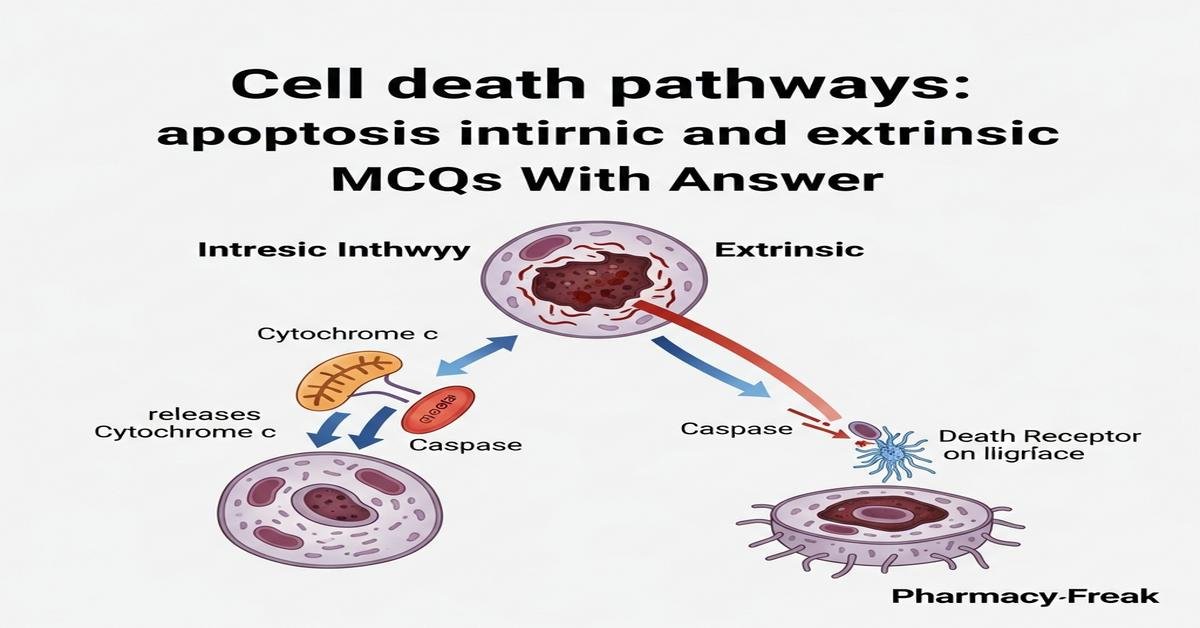
Introduction: Cell death pathways: apoptosis intrinsic and extrinsic MCQs With Answer is designed for M.Pharm students to deepen understanding of regulated cell death mechanisms critical to pharmacology and therapeutics. This short guide focuses on the intrinsic (mitochondria-mediated) and extrinsic (death receptor-mediated) apoptotic pathways, covering key molecules such as Bcl-2 family proteins, cytochrome c, Apaf-1, caspases, IAPs, SMAC/DIABLO and cross-talk mediators like Bid. Questions emphasize molecular events, pharmacological modulators, experimental assays, and clinical relevance including drug resistance and targeted agents (e.g., BH3 mimetics). These MCQs aim to test conceptual depth and application-level knowledge for advanced coursework and exam preparation.
Q1. What is a hallmark morphological change characteristic of apoptosis?
- Cell swelling and plasma membrane rupture
- Cell shrinkage and chromatin condensation
- Large-scale inflammation with neutrophil infiltration
- Uncontrolled necrosis-like lysis
Correct Answer: Cell shrinkage and chromatin condensation
Q2. Which event primarily initiates the intrinsic (mitochondrial) apoptotic pathway?
- Activation of Fas receptor by FasL
- Release of cytochrome c from mitochondria
- Proteasomal degradation of p53
- Binding of TRAIL to DR4/DR5
Correct Answer: Release of cytochrome c from mitochondria
Q3. Which receptor is a prototypic death receptor mediating the extrinsic apoptotic pathway?
- EGFR (Epidermal growth factor receptor)
- Fas (CD95)
- TGF-β receptor
- β-adrenergic receptor
Correct Answer: Fas (CD95)
Q4. Which protein oligomerizes with cytochrome c to form the apoptosome?
- Apaf-1
- Bax
- XIAP
- FLIP
Correct Answer: Apaf-1
Q5. Which caspase is the primary initiator in the intrinsic apoptotic pathway?
- Caspase-1
- Caspase-8
- Caspase-9
- Caspase-3
Correct Answer: Caspase-9
Q6. Which caspase is predominantly activated early in the extrinsic (death receptor) pathway?
- Caspase-6
- Caspase-8
- Caspase-9
- Caspase-12
Correct Answer: Caspase-8
Q7. Which BH3-only protein is cleaved by caspase-8 to link extrinsic and intrinsic apoptosis?
- BAD
- Bid
- Bcl-2
- Bak
Correct Answer: Bid
Q8. Which of the following is an anti-apoptotic member of the Bcl-2 family?
- Bax
- Bak
- Bcl-2
- Bim
Correct Answer: Bcl-2
Q9. Which proteins are the essential pro-apoptotic effectors that form pores in the mitochondrial outer membrane?
- Bcl-2 and Bcl-xL
- Bax and Bak
- XIAP and cIAP1
- Apaf-1 and cytochrome c
Correct Answer: Bax and Bak
Q10. Which of the following is an example of a BH3-only pro-apoptotic protein?
- XIAP
- Bid
- Bcl-xL
- FLIP
Correct Answer: Bid
Q11. What is the primary function of inhibitor of apoptosis proteins (IAPs) such as XIAP?
- Promote cytochrome c release
- Inhibit caspase activity
- Activate death receptors
- Form the apoptosome
Correct Answer: Inhibit caspase activity
Q12. What is the role of SMAC/DIABLO in apoptosis regulation?
- Stabilize mitochondrial membrane potential
- Antagonize IAPs to promote caspase activation
- Activate Bcl-2 to prevent apoptosis
- Directly cleave caspase-3
Correct Answer: Antagonize IAPs to promote caspase activation
Q13. Which laboratory assay directly detects DNA fragmentation characteristic of apoptosis?
- MTT assay
- TUNEL assay
- ELISA for cytokines
- Gram staining
Correct Answer: TUNEL assay
Q14. Annexin V staining is used to detect which early apoptotic event?
- Loss of mitochondrial DNA
- Externalization of phosphatidylserine
- Nuclear envelope breakdown
- Proteasome activation
Correct Answer: Externalization of phosphatidylserine
Q15. Which fluorescent dye is commonly used to assess mitochondrial membrane potential in apoptosis studies?
- DAPI
- JC-1
- FITC-annexin
- Propidium iodide
Correct Answer: JC-1
Q16. Which therapeutic agent is a BH3 mimetic that selectively inhibits Bcl-2 and is used clinically?
- z-VAD-fmk
- Venetoclax
- Staurosporine
- TNF-α
Correct Answer: Venetoclax
Q17. Which compound is a commonly used pan-caspase inhibitor in experimental studies?
- z-VAD-fmk
- SMAC mimetic
- Cyclosporin A
- Paclitaxel
Correct Answer: z-VAD-fmk
Q18. TRAIL induces apoptosis primarily by binding to which class of receptors?
- Toll-like receptors
- Death receptors (DR4/DR5)
- G-protein coupled receptors
- Receptor tyrosine kinases
Correct Answer: Death receptors (DR4/DR5)
Q19. How does the tumor suppressor p53 promote apoptosis following severe DNA damage?
- By upregulating anti-apoptotic Bcl-2 expression
- By increasing transcription of pro-apoptotic genes such as PUMA and Bax
- By directly activating caspase-3 in the cytosol
- By stabilizing mitochondrial membrane potential
Correct Answer: By increasing transcription of pro-apoptotic genes such as PUMA and Bax
Q20. Which statement best distinguishes apoptosis from necroptosis?
- Apoptosis is inflammatory and depends on RIPK3/MLKL; necroptosis is caspase-dependent and non-inflammatory
- Apoptosis is caspase-dependent and generally non-inflammatory; necroptosis is RIPK3/MLKL-dependent and pro-inflammatory
- Both processes are identical and interchangeable in cells
- Necroptosis always requires mitochondrial cytochrome c release, apoptosis does not
Correct Answer: Apoptosis is caspase-dependent and generally non-inflammatory; necroptosis is RIPK3/MLKL-dependent and pro-inflammatory

