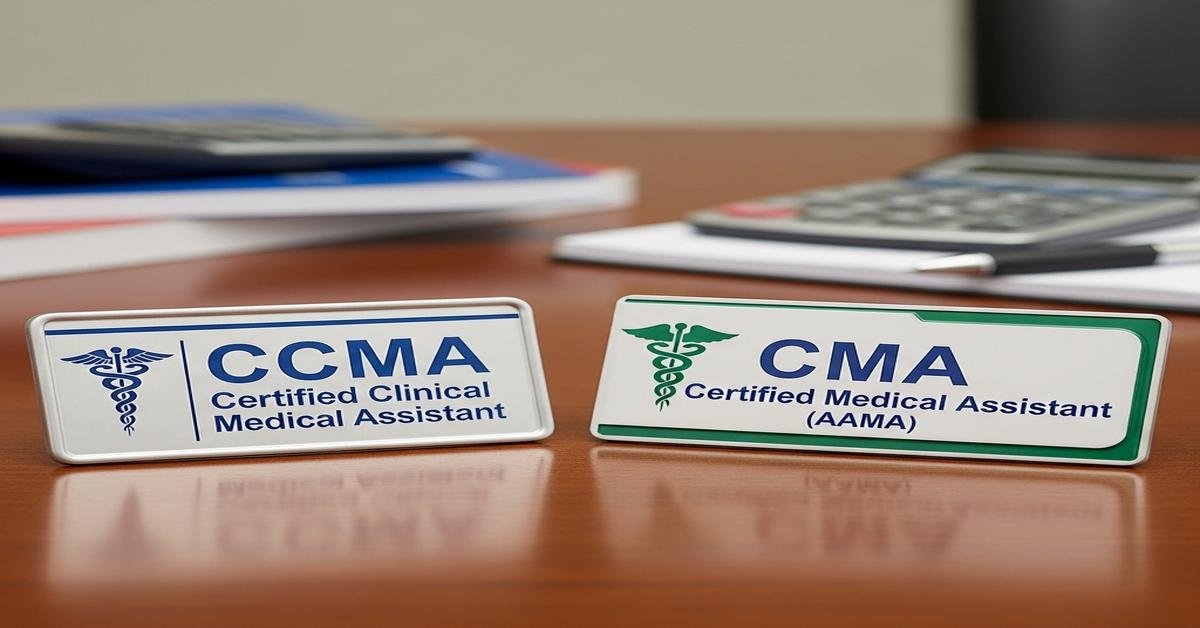
Medical assisting is one of the fastest ways to enter patient care. Two credentials lead most job postings in 2026: the CCMA (Certified Clinical Medical Assistant) and the CMA (AAMA) (Certified Medical Assistant). Both verify that you can room patients, take vitals, give injections where allowed, and manage front-desk workflows. But they are not identical. Their pathways, exams, costs, and how employers see them differ in useful ways. This guide breaks down the details so you can choose the credential that fits your timeline, budget, and career goals.
What CCMA and CMA Actually Mean
CCMA is awarded by the National Healthcareer Association (NHA). It focuses on clinical skills used in outpatient settings. The CCMA is widely available to graduates of short medical assistant programs and to many working MAs who meet experience criteria. It is known for flexible eligibility.
CMA (AAMA) is awarded by the American Association of Medical Assistants. Eligibility requires graduation from a postsecondary medical assisting program accredited by CAAHEP or ABHES. This accreditation standard gives employers a predictable baseline for anatomy, pharmacology, administrative training, and supervised clinical practice.
- Overlap: Both are national credentials for outpatient care. You will see both in job listings for clinics, family practice, and specialty offices.
- Key difference: CMA requires graduating from an accredited MA program; CCMA offers multiple pathways and is more accessible to on-the-job-trained MAs.
Eligibility and Pathways
CCMA (NHA)
- Training: Typically open to candidates who completed a medical assistant program. Many employers and schools bundle the exam with graduation.
- Work experience route: NHA has historically allowed candidates with recent MA work experience to sit for the exam. This matters if you learned on the job and want to validate your skills without returning to school.
- Timeline: Because there is no requirement to graduate from a CAAHEP/ABHES-accredited program, the CCMA can be faster to obtain for working MAs.
Why this matters: If you are already in a clinic or finishing a non-accredited program, the CCMA path is usually simpler and quicker.
CMA (AAMA)
- Training: Requires completion of a medical assisting program accredited by CAAHEP or ABHES.
- Externship: Accredited programs include supervised hands-on hours, which employers like because they reduce onboarding risk.
- Timeline: Typical programs run 9–24 months. That is longer, but it often includes more structured clinical time and exam preparation built into the curriculum.
Why this matters: Employers know exactly what CMA graduates were taught and how they were evaluated. That clarity can influence hiring in hospital-owned networks and specialties with higher liability.
Exam Structure and Difficulty
What both exams test
- Patient care: vitals, patient history, positioning, specimen collection, and basic procedures.
- Clinical support: medication administration, EKG basics, injection techniques, sterilization and infection control.
- Administrative functions: scheduling, EHR documentation, billing basics, insurance types, privacy (HIPAA) and consent.
- Professional behavior and safety: communication, scope-of-practice boundaries, OSHA, and emergency response basics.
How they differ
- Prerequisite rigor: The CMA’s accredited-program requirement front-loads anatomy, pharmacology, and clinical reasoning. That often translates into a denser exam experience.
- Question style: Both use multiple-choice items. CMA questions often feel more scenario-driven and integration-heavy. CCMA questions frequently focus on practical, task-oriented decision-making. This aligns with each exam’s purpose.
- Scope breadth: The CMA typically expects a deeper administrative and clinical base because the underlying programs are standardized. The CCMA leans into common outpatient workflows and hands-on competencies.
- Pass-rate trends (big picture): Over the past several years, the CMA has tended to report lower pass rates than the CCMA. That suggests a steeper curve for first-time testers. The exact numbers move year to year; always check each organization’s current handbook if you want specifics.
- Length and volume: Expect each exam to take several hours and involve well over a hundred questions. Both include unscored items being tested for future use. The test-day experience requires stamina and careful time management.
Bottom line on difficulty: Most candidates perceive the CMA as more challenging because of the depth expected from accredited programs and the way the questions integrate knowledge. The CCMA is no “easy” test—its practical focus trips up people who rush or skip fundamentals—but many testers find it more approachable on the first attempt.
Cost in 2026: Exams, Prep, and Renewal
Exam fees (typical ranges; your cost may vary by membership, school bundle, or retake policy):
- CCMA (NHA): Commonly in the low-to-mid $100s. Some schools include the exam in tuition; standalone registration and retakes add cost.
- CMA (AAMA): Often tiered by membership and graduate status. Recent graduates of accredited programs with AAMA membership usually pay less than nonmembers or out-of-window testers. The total still tends to fall in the low-to-mid $100s for most candidates.
Why the ranges: Both bodies adjust fees periodically. Schools, workforce programs, or employers may subsidize costs. Retakes and rescheduling carry their own fees.
Preparation costs
- Official practice tests and study guides: usually modest and worth it for blueprint alignment.
- Third-party review courses: available online; cost varies widely. Pick one that maps to the current exam blueprint and offers many timed questions.
- Free options: instructor notes, EHR demos, anatomy flashcards, and procedural checklists from your program can be enough if used well.
Renewal and continuing education
- CCMA: Renewal occurs every two years and requires continuing education plus a renewal fee. The CE load is small but more frequent. This keeps you current on changing office practices and safety rules.
- CMA: Renewal occurs every five years through continuing education across required content categories or by re-examination. The CE total is higher but spread over a longer period, which matches the broader curriculum foundation.
Practical view: The CCMA has more frequent but lighter renewals; the CMA has less frequent but heavier renewals. Many employers reimburse CE and renewal fees, especially for full-time staff, because certification supports quality metrics and payer requirements.
Hiring Preferences and Market Perception in 2026
National hiring patterns
- Most outpatient clinics accept either CCMA or CMA. Employers care most about proven reliability, vaccination status, and recent hands-on experience.
- Large hospital-owned networks and specialty practices often prefer CMA. The accredited-program requirement makes onboarding predictable and supports risk management. This is common in cardiology, orthopedics, GI, and multi-specialty groups.
- Primary care and urgent care frequently hire CCMA or CMA. For roles heavy on rooming, phlebotomy, injections, and EKGs, both credentials meet needs. Fit and scheduling flexibility can outweigh the letters.
State and payer realities
- Scope of practice varies by state. Injections, medication administration, and CLIA-waived testing often require documented training. Certification helps verify training. Some employers prefer CMA because accreditation makes documentation simpler; others are comfortable with CCMA plus in-house competency checklists.
- Liability and insurer policies can nudge employers toward credentials with strong educational baselines. This is one reason CMA preferences persist in certain regions.
Salary and advancement
- Experience usually outweighs the specific credential after your first year. Strong references, proven reliability, and EHR proficiency move pay faster than the letters alone.
- Small pay premiums for CMA appear in some markets because of the accredited training and perceived breadth. In other markets, there is no difference. Cross-training (EKG, phlebotomy, telephone triage) and bilingual skills often matter more.
What hiring managers actually check
- Attendance and evaluations from your externship or last job.
- Immunization and background check readiness to start quickly.
- Communication skills: how you handle difficult conversations, triage calls, and interruptions.
- Safety habits: hand hygiene, sharps handling, and documentation accuracy.
- Coachability: how fast you learn clinic-specific workflows and EHR templates.
Which One Fits Your Goals?
- You need a credential fast to qualify for a job posting: CCMA is usually faster if you already have MA experience or are finishing a non-accredited program.
- You want hospital-owned specialty clinics and a long runway for advancement: CMA is often the better bet because many large systems prefer or require it for certain roles.
- You completed a CAAHEP/ABHES-accredited program: Taking the CMA leverages the curriculum you already finished and may open more doors in competitive markets.
- You learned on the job and want recognition without going back to school: CCMA validates your skills and can raise your market value quickly.
- You plan to stack credentials: Some MAs earn CCMA first, then complete an accredited program later and sit for the CMA. This strategy keeps income flowing while you upskill.
Study and Scheduling Tips That Work for Both Exams
- Map the blueprint to a calendar. Break the content areas into weekly goals. Leave the final two weeks for practice tests and weak-area repair.
- Practice like it’s test day. Use timed blocks. Aim to answer, flag, and move. Both exams reward disciplined pacing more than perfection on any single question.
- Master core clinical math. Doses, conversions, and injection angles are reliable points. Errors here are preventable with short, daily drills.
- Drill documentation language. Practice crafting concise, legible EHR notes with correct abbreviations and normal ranges. Many scenario questions hinge on chart clarity.
- Review safety and privacy rules. OSHA, sharps, exposure protocols, and HIPAA are frequent test targets because they drive real-world risk.
- Do hands-on refreshers. Vitals, EKG lead placement basics, PPE don/doff, and specimen handling should be automatic. Muscle memory reduces test anxiety.
- Plan your logistics early. Confirm your ID, testing window, accommodations (if needed), and route to the test center. Stress steals points you already earned.
FAQs in 2026
- Is one credential “better”? Not universally. CMA is often preferred in larger systems because of the accredited-program requirement. CCMA is widely accepted and faster to obtain for many candidates. The “better” choice depends on your local market and goals.
- Are the exams interchangeable for licensure? Most states do not license medical assistants the way they license nurses. Employers set standards. Check local employer norms and any state-specific rules around injections or medication administration.
- Can I switch later? Yes. Many MAs start with CCMA, then complete an accredited program and earn the CMA. Your experience will still count.
- Do I need both? Usually no. One recognized credential plus strong performance is enough. Some candidates keep both for flexibility during job searches.
- What if my certification lapses? Both organizations have recertification and reinstatement processes. Expect to complete CE, pay a fee, or re-test depending on how long it has been.
Clear Comparison: Difficulty, Cost, Hiring Preference
- Difficulty: CMA is generally considered tougher due to accredited-program depth and integrated questions. CCMA is rigorous but more practical in focus.
- Cost: Both exams land in a similar overall cost band for most candidates. CCMA may be cheaper upfront if bundled with school fees; CMA can be less expensive for AAMA members or recent accredited graduates. Renewal differs: CCMA is lighter but every two years; CMA is heavier but every five.
- Hiring preference: Many employers accept either. Hospital-owned networks and certain specialties often prefer CMA; urgent care and primary care commonly hire CCMA or CMA. Experience and references usually trump the credential within a year.
Practical Scenarios to Decide
- Career-changer with a new baby, needs income soon: Finish your short MA program or leverage current clinic experience and take the CCMA. Build hours and references. Consider an accredited program later if you want hospital roles.
- Recent high school grad with time and financial aid: Enroll in a CAAHEP/ABHES-accredited MA program and target the CMA. You get a stronger foundation and broad employer acceptance.
- Front-desk staff moving into clinical: Ask your manager about CCMA support. Many clinics will sponsor your exam if you commit to cross-training.
- MA aiming for specialty (cardiology, ortho, GI) in a hospital network: Plan for the CMA. The accredited-program credential aligns with typical preferences in these settings.
Bottom Line
If you need speed and flexibility, the CCMA is usually the most direct route. If you want the widest acceptance in hospital-owned systems and a deeper academic base, the CMA is often the better long-term play. In both cases, your daily habits—showing up, documenting cleanly, protecting patient safety, and learning fast—are what employers reward. Pick the path that gets you working, keep your CE current, and build skill depth. By 2026, the strongest medical assistants are the ones who treat certification as a starting line, not the finish.

