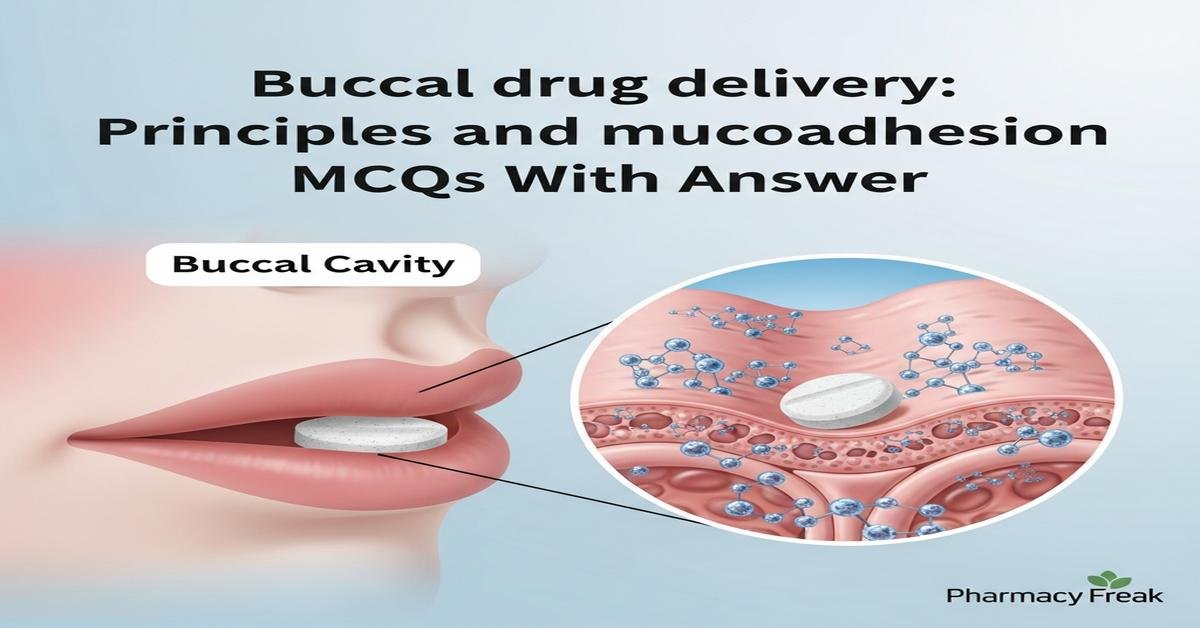
Buccal drug delivery: principles and mucoadhesion MCQs With Answer
Buccal drug delivery offers a valuable alternative to conventional oral administration by enabling pre-gastric absorption and partial avoidance of first-pass metabolism. For M. Pharm students, understanding the underlying principles—oral mucosal anatomy, permeability pathways, formulation strategies, and mucoadhesion mechanisms—is essential for designing effective buccal systems. This quiz focuses on mucoadhesive theory, polymer selection, permeation enhancement, device design, and safety evaluation. You will encounter questions on interfacial theories of adhesion, mucus chemistry, saliva dynamics, and analytical methods used to assess mucoadhesion and permeability. Use these MCQs to reinforce core concepts, test decision-making on formulation choices, and align your knowledge with current best practices in buccal films, patches, tablets, and gels.
Q1. The primary pharmacokinetic advantage of buccal drug delivery is:
- Partial avoidance of first-pass metabolism and gastric degradation
- Guaranteed rapid onset for all types of drugs
- Enabling sustained release with a single swallow
- Increasing drug solubility irrespective of physicochemical properties
Correct Answer: Partial avoidance of first-pass metabolism and gastric degradation
Q2. Which permeability ranking across oral mucosa is most accurate?
- Sublingual > Buccal > Palatal
- Buccal > Sublingual > Palatal
- Palatal > Buccal > Sublingual
- Buccal > Palatal > Sublingual
Correct Answer: Sublingual > Buccal > Palatal
Q3. In the consolidation stage of mucoadhesion, the dominant events are:
- Polymer dissolution and crystallization
- Polymer chain interpenetration and formation of hydrogen and van der Waals bonds
- Electrostatic repulsion and dehydration
- Enzymatic crosslinking of mucin
Correct Answer: Polymer chain interpenetration and formation of hydrogen and van der Waals bonds
Q4. The net negative charge of mucus responsible for electrostatic interactions primarily arises from:
- Phosphate and nitrate residues
- Sialic acid and sulfate groups on mucins
- Carboxylate groups on collagen
- Hydroxyl groups on cellulose
Correct Answer: Sialic acid and sulfate groups on mucins
Q5. Which polymer shows strong pH-dependent mucoadhesion due to ionizable carboxyl groups?
- Polyvinylpyrrolidone (PVP)
- Hydroxypropyl methylcellulose (HPMC)
- Carbopol (crosslinked polyacrylic acid)
- Polyethylene glycol (PEG)
Correct Answer: Carbopol (crosslinked polyacrylic acid)
Q6. Which cationic polymer is widely used to enhance buccal permeation by transiently opening tight junctions?
- Chitosan
- Sodium alginate
- PVP K30
- Eudragit L100
Correct Answer: Chitosan
Q7. The main purpose of an impermeable backing layer in a buccal patch is to:
- Prevent polymer hydration
- Increase drug crystallinity
- Provide unidirectional drug flux toward the mucosa and limit drug loss to saliva
- Reduce drug loading requirements
Correct Answer: Provide unidirectional drug flux toward the mucosa and limit drug loss to saliva
Q8. Which physiological factor most strongly decreases buccal residence time of dosage forms?
- Salivary flow rate and turnover
- Gingival crevicular fluid composition
- Capillary density in lamina propria
- Oral temperature variability
Correct Answer: Salivary flow rate and turnover
Q9. Which statement about metabolic barriers in the buccal mucosa is most accurate?
- Buccal mucosa has high CYP450 activity comparable to intestine
- Buccal mucosa lacks any enzymes that degrade peptides
- Buccal mucosa exhibits lower CYP450 than intestine but contains peptidases that can degrade peptide drugs
- Only salivary amylase affects drug stability at the buccal surface
Correct Answer: Buccal mucosa exhibits lower CYP450 than intestine but contains peptidases that can degrade peptide drugs
Q10. Which permeation enhancer is correctly matched with its primary mechanism?
- Sodium deoxycholate – bile salt that disrupts lipid packing to increase membrane fluidity
- EDTA – non-chelating surfactant that inserts into membranes
- Poloxamer 407 – tight junction opener via calcium chelation
- Oleic acid – forms covalent bonds with mucins
Correct Answer: Sodium deoxycholate – bile salt that disrupts lipid packing to increase membrane fluidity
Q11. For a weak base with pKa 8.5 intended for buccal delivery, increasing salivary pH from 6.0 to 7.4 will most likely:
- Decrease unionized fraction and reduce transcellular permeation
- Increase unionized fraction and potentially enhance transcellular permeation
- Have no effect on ionization or permeation
- Irreversibly bind the drug to mucin
Correct Answer: Increase unionized fraction and potentially enhance transcellular permeation
Q12. Which laboratory method is most appropriate to quantify mucoadhesive strength of a buccal film?
- Franz diffusion cell permeation test
- UV–Vis spectroscopy
- Texture analyzer tensile detachment test (peak detachment force/work of adhesion)
- Rotating basket dissolution apparatus
Correct Answer: Texture analyzer tensile detachment test (peak detachment force/work of adhesion)
Q13. Thiolated polymers (thiomers) enhance buccal mucoadhesion primarily by:
- Forming covalent disulfide bonds with cysteine-rich domains of mucus glycoproteins
- Crosslinking with calcium ions in saliva
- Electrostatic complexation with anionic drugs
- Increasing drug crystallinity
Correct Answer: Forming covalent disulfide bonds with cysteine-rich domains of mucus glycoproteins
Q14. How does excessive crosslinking of a mucoadhesive polymer typically affect adhesion?
- It always maximizes adhesion by preventing erosion
- It has no impact on adhesion
- It generally lowers adhesion by reducing swelling and chain interpenetration
- It converts hydrogen bonding into covalent bonding
Correct Answer: It generally lowers adhesion by reducing swelling and chain interpenetration
Q15. Which drug profile is most suitable for systemic buccal delivery?
- Potent drug (dose ≤ 2 mg), moderate lipophilicity (logP 1–3), significant first-pass metabolism
- High dose (≥ 500 mg), very hydrophilic, poor permeability, stable in GI tract
- Strongly irritant, highly bitter, requires gastric activation
- Extremely lipophilic (logP > 6), very low solubility, no first-pass metabolism
Correct Answer: Potent drug (dose ≤ 2 mg), moderate lipophilicity (logP 1–3), significant first-pass metabolism
Q16. Compared with buccal tablets, mucoadhesive films typically offer:
- Lower surface area and slower hydration
- Greater surface area, faster hydration, and improved patient comfort
- No difference in residence time
- Higher risk of dose dumping during use
Correct Answer: Greater surface area, faster hydration, and improved patient comfort
Q17. Regarding transport pathways across buccal epithelium, which is most accurate?
- Lipophilic drugs favor paracellular transport through tight junctions
- Hydrophilic macromolecules are limited by tight junctions; transient opening can enhance their permeation
- All peptides readily cross transcellularly without enhancers
- Buccal epithelium is more permeable than intestinal epithelium for all drugs
Correct Answer: Hydrophilic macromolecules are limited by tight junctions; transient opening can enhance their permeation
Q18. Typical target residence time for a buccal mucoadhesive patch in clinical use is:
- 15–30 minutes
- 4–8 hours
- 24–48 hours
- 72 hours
Correct Answer: 4–8 hours
Q19. During safety evaluation of buccal permeation enhancers in vitro, a rapid, reversible decrease in which parameter indicates transient barrier opening?
- Viscosity of the donor solution
- Transmembrane electrical resistance (TEER) across epithelial models
- Osmolarity of acceptor medium
- Partition coefficient (logP) of the drug
Correct Answer: Transmembrane electrical resistance (TEER) across epithelial models
Q20. The wetting/spreading theory of mucoadhesion primarily relates mucoadhesive performance to:
- Electron transfer and double layer formation at the interface
- Detachment force required to fracture a cohesive polymer network
- Contact angle and spreading coefficient of the polymer on the mucosal surface
- Covalent bond formation between drug and mucin
Correct Answer: Contact angle and spreading coefficient of the polymer on the mucosal surface


I am a Registered Pharmacist under the Pharmacy Act, 1948, and the founder of PharmacyFreak.com. I hold a Bachelor of Pharmacy degree from Rungta College of Pharmaceutical Science and Research. With a strong academic foundation and practical knowledge, I am committed to providing accurate, easy-to-understand content to support pharmacy students and professionals. My aim is to make complex pharmaceutical concepts accessible and useful for real-world application.
Mail- Sachin@pharmacyfreak.com