Introduction
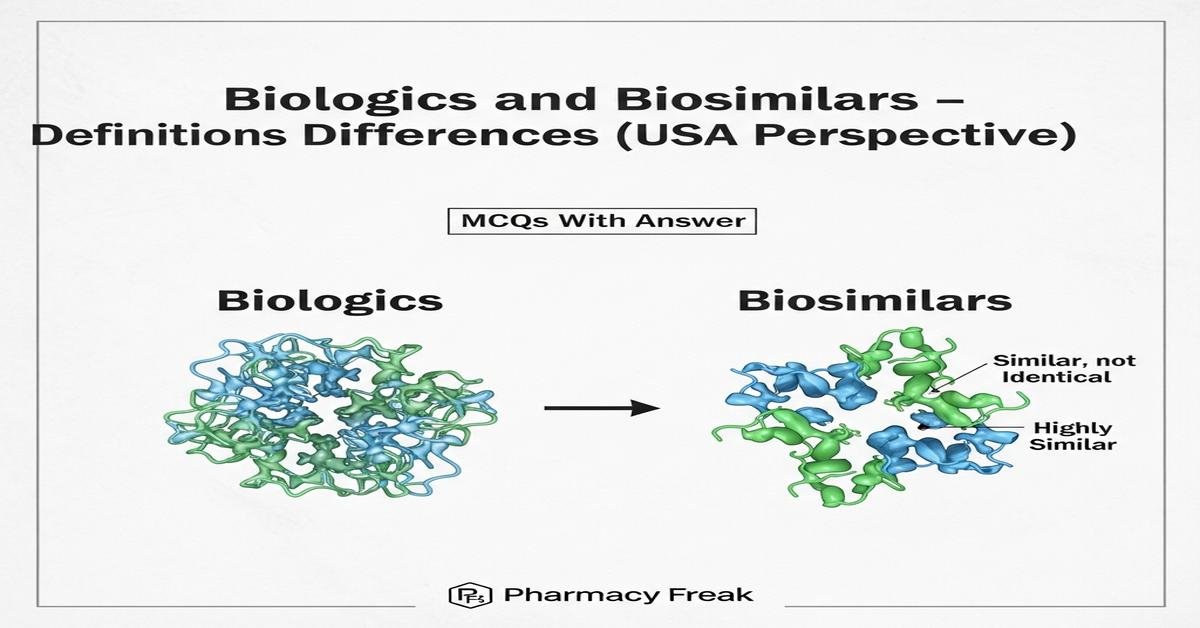
This quiz set focuses on biologics and biosimilars from a USA regulatory perspective, tailored for M.Pharm students studying Regulatory Aspects of Herbal and Biologicals. It explains key definitions, pathways, and differences between original biologic products and biosimilar or interchangeable products under US law, emphasising the Biologics Price Competition and Innovation Act (BPCIA), 351(a) and 351(k) pathways, Purple Book references, interchangeability criteria, extrapolation of indications, immunogenicity concerns, and post-marketing requirements. The questions probe analytical, clinical, and regulatory concepts students must master to evaluate approval strategies, naming, substitution rules, and patent/policy interactions affecting development and market entry in the United States.
Q1. What is the regulatory pathway established by the Biologics Price Competition and Innovation Act (BPCIA) for approval of biosimilars in the USA?
- Section 505(b)(2) New Drug pathway
- 351(a) Biologics License Application (BLA)
- 351(k) Biosimilar biological product application
- ANDA generic drug pathway
Correct Answer: 351(k) Biosimilar biological product application
Q2. Under US regulation, which statement best defines a ‘biosimilar’?
- A biologic that is identical in amino acid sequence and post‑translational modifications to the reference product
- A biologic that is highly similar to a reference product notwithstanding minor differences in clinically inactive components
- A generic chemically synthesized small molecule equivalent to a branded drug
- A biosimilar that automatically substitutes for any biological product at pharmacy level
Correct Answer: A biologic that is highly similar to a reference product notwithstanding minor differences in clinically inactive components
Q3. What additional designation, beyond biosimilarity, must a product obtain to be automatically substitutable at the pharmacy level in many states?
- Biologic license under 351(a)
- Therapeutic equivalence designation
- Interchangeability designation
- Fast track designation
Correct Answer: Interchangeability designation
Q4. Which of the following is a key regulatory requirement that distinguishes an interchangeable biosimilar from a biosimilar in the USA?
- Demonstration of identical primary amino acid sequence
- Additional switching studies showing no increased risk in efficacy or safety when alternating with reference product
- No requirement for immunogenicity data
- Approval under 505(j) pathway
Correct Answer: Additional switching studies showing no increased risk in efficacy or safety when alternating with reference product
Q5. The FDA Purple Book primarily provides information on:
- Approved small molecule generics and their Orange Book ratings
- Licensed biological products, including biosimilars and interchangeable biological products
- Clinical trial registries for biologics
- FDA guidance documents unrelated to approvals
Correct Answer: Licensed biological products, including biosimilars and interchangeable biological products
Q6. Which statutory section governs reference product exclusivity for biologics in the USA?
- Section 505(c) of the FD&C Act
- Section 351(k) of the PHS Act
- Section 351(a) of the PHS Act with 12 years of exclusivity for reference products
- Section 505(j) of the FD&C Act
Correct Answer: Section 351(a) of the PHS Act with 12 years of exclusivity for reference products
Q7. Extrapolation of indications for a biosimilar is permitted by the FDA when:
- The biosimilar developer conducts full randomized controlled trials for each indication
- Mechanisms of action, pharmacokinetics, and immunogenicity justify that similarity across indications
- The reference product has no active patents
- The biosimilar has a different mechanism of action but same target molecule
Correct Answer: Mechanisms of action, pharmacokinetics, and immunogenicity justify that similarity across indications
Q8. Which naming convention does the FDA currently recommend for non-interchangeable biosimilars?
- Use the same nonproprietary name as the reference product with no suffix
- Assign a unique nonproprietary name with a four-letter lowercase, meaningless suffix
- Use brand-name only with no nonproprietary name
- Numbered suffix corresponding to the approval order
Correct Answer: Assign a unique nonproprietary name with a four-letter lowercase, meaningless suffix
Q9. Which of the following best describes the ‘patent dance’ associated with biosimilars under US law?
- A mandatory exchange of patent lists and litigation steps set out in the BPCIA between the biosimilar applicant and reference product sponsor
- An expedited FDA review timeline for patents
- State-level substitution laws for interchangeable products
- International patent harmonization for biologics
Correct Answer: A mandatory exchange of patent lists and litigation steps set out in the BPCIA between the biosimilar applicant and reference product sponsor
Q10. In the context of US regulation, what is the primary difference between a comparability exercise (for a post‑approval manufacturing change) and a biosimilarity assessment?
- Comparability addresses changes to the same manufacturer’s product; biosimilarity compares products from different manufacturers
- Comparability requires full clinical trials; biosimilarity never requires clinical data
- Comparability is only an analytical assessment; biosimilarity is only a clinical assessment
- There is no regulatory distinction between the two
Correct Answer: Comparability addresses changes to the same manufacturer’s product; biosimilarity compares products from different manufacturers
Q11. Which type of analytical data is most critical for establishing structural and functional similarity between a biosimilar and its reference product?
- High‑resolution mass spectrometry and orthogonal functional assays
- Simple HPLC retention time only
- Only clinical trial endpoints
- Single immunoassay for total protein concentration
Correct Answer: High‑resolution mass spectrometry and orthogonal functional assays
Q12. Which immunogenicity concern is particularly important when assessing biosimilars compared to their reference products?
- Potential for formation of anti‑drug antibodies leading to loss of efficacy or cross‑reactivity with endogenous proteins
- Risk of small molecule drug‑drug interactions
- Likelihood of immediate hypersensitivity identical to any generic drug
- None; immunogenicity is not relevant for biologics
Correct Answer: Potential for formation of anti‑drug antibodies leading to loss of efficacy or cross‑reactivity with endogenous proteins
Q13. Which regulatory document outlines the FDA’s scientific considerations in demonstrating biosimilarity?
- Orange Book
- Biosimilars User Fee Act only
- FDA Guidance for Industry: Scientific Considerations in Demonstrating Biosimilarity to a Reference Product
- ICH Q7A only
Correct Answer: FDA Guidance for Industry: Scientific Considerations in Demonstrating Biosimilarity to a Reference Product
Q14. Post‑marketing pharmacovigilance for biosimilars is important because:
- The analytical comparability package eliminates the need for any post‑approval monitoring
- Rare adverse events or immunogenicity may only become apparent in larger real‑world populations
- Biosimilars are guaranteed to have identical safety profiles to reference products
- Interchangeability ensures no additional monitoring is necessary
Correct Answer: Rare adverse events or immunogenicity may only become apparent in larger real‑world populations
Q15. Which of the following is true about interchangeability designation and state pharmacy substitution laws?
- Interchangeability by FDA automatically mandates substitution in all states
- Interchangeability designation facilitates substitution, but state laws determine substitution practices and recordkeeping
- FDA prohibits any substitution regardless of state law
- State laws are irrelevant once the FDA grants biosimilarity
Correct Answer: Interchangeability designation facilitates substitution, but state laws determine substitution practices and recordkeeping
Q16. The reference product for a biosimilar application in the USA must be:
- An internationally sourced product never licensed in the US
- The US-licensed reference product or a foreign licensed product with bridging data to the US reference
- Any product with the same INN irrespective of approval status
- A biosimilar previously approved in Europe only
Correct Answer: The US-licensed reference product or a foreign licensed product with bridging data to the US reference
Q17. Which of the following clinical study designs is commonly required to support interchangeability?
- Single‑dose pharmacokinetic study only with no switching
- Multiple‑switching design comparing alternating exposures between biosimilar and reference product
- Open label uncontrolled observational study
- Animal toxicology study only
Correct Answer: Multiple‑switching design comparing alternating exposures between biosimilar and reference product
Q18. Which regulatory concept allows a biosimilar to rely in part on the FDA’s previous findings of safety and effectiveness for the reference product?
- New Drug Application reliance
- Exclusivity waiver
- The abbreviated 351(k) pathway relying on reference product licensure data
- ANDA referencing
Correct Answer: The abbreviated 351(k) pathway relying on reference product licensure data
Q19. Which factor is NOT typically a focus when assessing manufacturing comparability for biosimilar development?
- Glycosylation profile and other critical quality attributes
- Process‑related impurities and removal strategies
- Exact matching of proprietary cell line used by reference manufacturer
- Aggregate content and product stability
Correct Answer: Exact matching of proprietary cell line used by reference manufacturer
Q20. Why might a biosimilar sponsor perform a ‘totality of evidence’ approach during development?
- To replace the need for any analytical comparability studies entirely
- To integrate analytical, nonclinical, and clinical data to justify biosimilarity without unnecessary duplication of large clinical trials
- To only meet patent requirements
- Because FDA requires only clinical data for approval
Correct Answer: To integrate analytical, nonclinical, and clinical data to justify biosimilarity without unnecessary duplication of large clinical trials


I am a Registered Pharmacist under the Pharmacy Act, 1948, and the founder of PharmacyFreak.com. I hold a Bachelor of Pharmacy degree from Rungta College of Pharmaceutical Science and Research. With a strong academic foundation and practical knowledge, I am committed to providing accurate, easy-to-understand content to support pharmacy students and professionals. My aim is to make complex pharmaceutical concepts accessible and useful for real-world application.
Mail- Sachin@pharmacyfreak.com