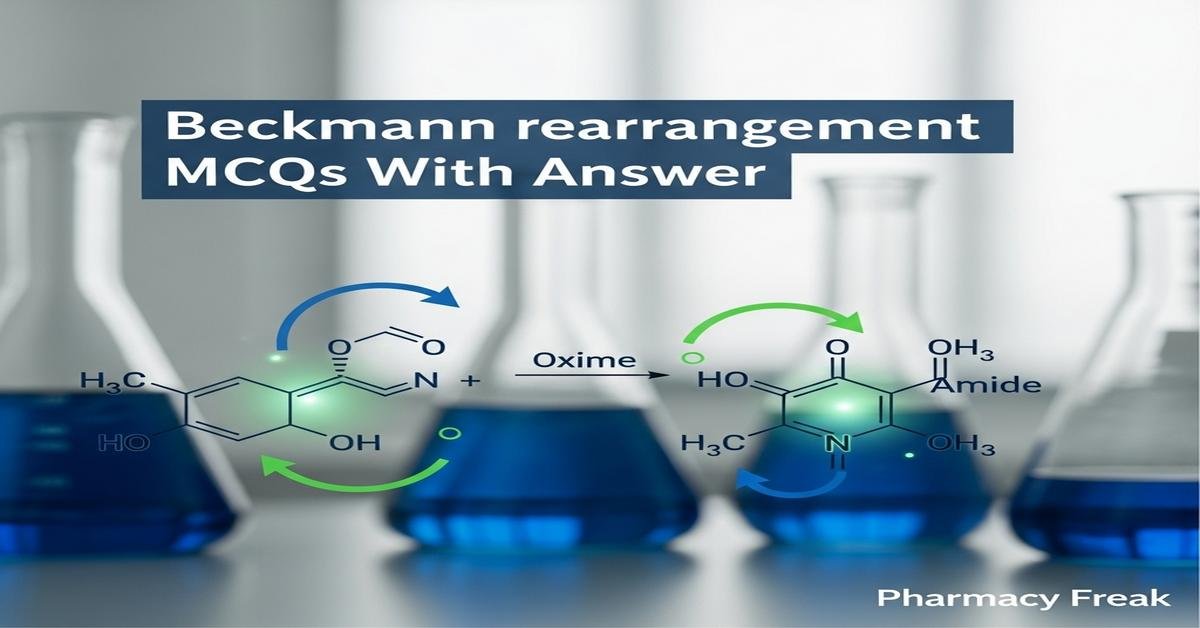
Beckmann rearrangement MCQs With Answer is an essential set for B.Pharm students preparing for organic chemistry exams and pharmacy competitive tests. This concise introduction reviews the Beckmann rearrangement, focusing on ketoxime conversion to amides, the role of acid catalysis, the nitrilium ion intermediate, migratory aptitude, stereochemical (anti) requirements, and industrial applications such as conversion of cyclohexanone oxime to ε-caprolactam for nylon-6. These points reinforce mechanism understanding, reagent choice (H2SO4, PPA, BF3, p-TsOH), and synthetic scope relevant to pharmaceutical synthesis. Now let’s test your knowledge with 50 MCQs on this topic.
Q1. What is the primary product of a Beckmann rearrangement of a ketoxime?
- An ester
- An amide
- A carboxylic acid
- A nitrile
Correct Answer: An amide
Q2. Which intermediate is most commonly invoked in the mechanism of the Beckmann rearrangement?
- Carbocation
- Carbanion
- Nitrilium ion
- Radical
Correct Answer: Nitrilium ion
Q3. In the Beckmann rearrangement, which group migrates from carbon to nitrogen?
- The group syn to the oxime OH
- The group anti to the oxime OH
- Always the larger group
- Always the smaller group
Correct Answer: The group anti to the oxime OH
Q4. Which of the following acids is commonly used to catalyze the Beckmann rearrangement?
- Acetic acid
- Hydrochloric acid (HCl)
- Polyphosphoric acid (PPA)
- Formic acid
Correct Answer: Polyphosphoric acid (PPA)
Q5. The Beckmann rearrangement of cyclohexanone oxime gives which important industrial product?
- Caprolactone
- ε-Caprolactam
- Sebacic acid
- Adipic acid
Correct Answer: ε-Caprolactam
Q6. Which stereochemical feature of the oxime determines regiochemistry in Beckmann rearrangement?
- Cis/trans around C=C double bond
- Orientation (anti/syn) of substituents about C=N–OH
- Configuration at adjacent stereocenters
- Conformation of remote alkyl chains
Correct Answer: Orientation (anti/syn) of substituents about C=N–OH
Q7. In an unsymmetrical ketoxime, which substituent usually migrates preferentially?
- The nucleophilic substituent
- The substituent anti to OH and with higher migratory aptitude
- The smallest substituent
- The substituent syn to OH
Correct Answer: The substituent anti to OH and with higher migratory aptitude
Q8. Which of the following best describes migratory aptitude commonly observed in Beckmann rearrangement?
- Methyl > tertiary alkyl > aryl
- Aryl > tertiary alkyl > secondary alkyl > primary alkyl
- Primary alkyl > secondary alkyl > tertiary alkyl > aryl
- All groups migrate equally
Correct Answer: Aryl > tertiary alkyl > secondary alkyl > primary alkyl
Q9. Which condition favors formation of lactams in a Beckmann rearrangement?
- Using acyclic ketoximes only
- Presence of a suitable ring size in cyclic ketoximes
- Very low temperature
- Absence of acid catalyst
Correct Answer: Presence of a suitable ring size in cyclic ketoximes
Q10. Which step follows formation of the nitrilium ion in the Beckmann mechanism?
- Beta-elimination to form alkene
- Hydrolysis to give an amide
- Radical recombination
- Direct reduction to amine
Correct Answer: Hydrolysis to give an amide
Q11. Which reagent is often used as a Lewis acid promoter for Beckmann rearrangement?
- Borane (BH3)
- Boron trifluoride (BF3·OEt2)
- Sodium hydroxide
- Lithium aluminum hydride (LiAlH4)
Correct Answer: Boron trifluoride (BF3·OEt2)
Q12. The anti-periplanar requirement in Beckmann rearrangement is important because it:
- Stabilizes the radical intermediate
- Lowers activation energy for migration to nitrogen
- Prevents protonation of the oxime
- Promotes formation of nitrile directly
Correct Answer: Lowers activation energy for migration to nitrogen
Q13. Which transformation is commonly mistaken for the Beckmann rearrangement but actually involves simple dehydration of aldoximes?
- Pinacol rearrangement
- Conversion of aldoximes to nitriles
- Wagner-Meerwein rearrangement
- Baeyer-Villiger oxidation
Correct Answer: Conversion of aldoximes to nitriles
Q14. What is the role of protonation in the Beckmann rearrangement?
- Directly generates the final amide
- Activates the oxime OH as a better leaving group
- Removes water from the reaction
- Forms a free radical intermediate
Correct Answer: Activates the oxime OH as a better leaving group
Q15. Beckmann rearrangement is most commonly applied to which starting material in pharmaceutical synthesis?
- Alcohols
- Amines
- Ketoximes
- Carboxylic acids
Correct Answer: Ketoximes
Q16. Which product results from Beckmann rearrangement of benzophenone oxime under acidic conditions?
- Benzamide
- Diphenylamine
- Benzoic acid
- Formanilide
Correct Answer: Benzamide
Q17. In industrial caprolactam production, Beckmann rearrangement is followed by which type of downstream processing?
- Hydrogenation to give cyclohexanone
- Polymerization to nylon precursors
- Oxidation to adipic acid
- Direct esterification
Correct Answer: Polymerization to nylon precursors
Q18. Which experimental observation supports the nitrilium ion mechanism in Beckmann rearrangement?
- Isolation of stable radicals
- Trapping of nitrilium intermediates by nucleophiles
- Detection of carbanions by NMR
- Formation of alkenes as major products
Correct Answer: Trapping of nitrilium intermediates by nucleophiles
Q19. A Beckmann rearrangement that yields ring contraction/expansion typically involves:
- Intermolecular rearrangement with external nucleophiles
- Cyclic ketoximes undergoing intramolecular migration
- Formation of epoxides first
- Base-catalyzed cleavage
Correct Answer: Cyclic ketoximes undergoing intramolecular migration
Q20. Which side reaction can occur under harsh acidic Beckmann conditions?
- Hydrogenation of unsaturated bonds
- Beckmann fragmentation leading to cleavage products
- Formation of stable oxaziridines
- Alkene metathesis
Correct Answer: Beckmann fragmentation leading to cleavage products
Q21. Which analytical method is most useful to monitor formation of amide product in Beckmann rearrangement?
- UV-visible spectroscopy only
- Infrared (IR) spectroscopy showing C=O amide band
- Polarimetry
- Optical microscopy
Correct Answer: Infrared (IR) spectroscopy showing C=O amide band
Q22. Which structural feature of an oxime favors Beckmann rearrangement to give a lactam rather than an acyclic amide?
- Presence of an adjacent ester group
- A cyclic backbone allowing intramolecular capture of nitrilium
- Very bulky substituents preventing migration
- Terminal alkyne functionality
Correct Answer: A cyclic backbone allowing intramolecular capture of nitrilium
Q23. During Beckmann rearrangement, what is the fate of the original oxime hydroxyl group?
- Remains attached to final amide
- Is eliminated as water after protonation
- Becomes a chloride
- Is converted to an alcohol on carbon
Correct Answer: Is eliminated as water after protonation
Q24. In mixed-substituent ketoximes, controlling the oxime geometry (E/Z) can influence:
- The solvent polarity only
- The regiochemical outcome of migration
- The molecular weight of product
- The need for an acid catalyst
Correct Answer: The regiochemical outcome of migration
Q25. Which reagent pair can be used to convert an oxime to an O-sulfonyl derivative to promote Beckmann rearrangement?
- Tosyl chloride (TsCl) and base
- Hydrogen gas and Pd/C
- Sodium borohydride and ethanol
- Nitric acid and sulfuric acid
Correct Answer: Tosyl chloride (TsCl) and base
Q26. The Beckmann rearrangement is mechanistically most similar to which of the following rearrangements?
- Baeyer-Villiger oxidation (via Criegee intermediate)
- Wagner-Meerwein rearrangement (carbocation migration)
- Claisen rearrangement (pericyclic)
- Meerwein-Ponndorf-Verley reduction
Correct Answer: Wagner-Meerwein rearrangement (carbocation migration)
Q27. Which experimental modification can invert the regiochemical outcome in a Beckmann rearrangement of an unsymmetrical ketoxime?
- Changing acid strength or using different activating groups to alter conformation
- Running reaction under inert atmosphere only
- Using an excess of water
- Lowering the temperature below -78 °C
Correct Answer: Changing acid strength or using different activating groups to alter conformation
Q28. Beckmann fragmentation is favored when the migrating group can form:
- A very stable carbocation or resonance-stabilized fragment after cleavage
- A highly strained ring
- An unreactive alkane
- A primary alcohol
Correct Answer: A very stable carbocation or resonance-stabilized fragment after cleavage
Q29. Which solvent property generally aids Beckmann rearrangement?
- Strongly basic solvent
- Polar, non-nucleophilic solvent that stabilizes ionic intermediates
- Nonpolar hydrocarbon solvent only
- Water as the sole solvent
Correct Answer: Polar, non-nucleophilic solvent that stabilizes ionic intermediates
Q30. For mechanistic studies, which isotopic labeling experiment can confirm migration of a specific group in Beckmann rearrangement?
- 13C labeling of the migrating carbon
- Deuterium labeling at remote methyl groups
- 18O labeling of solvent water only
- 14C labeling of nitrogen
Correct Answer: 13C labeling of the migrating carbon
Q31. Which functional group on an oxime substrate would most likely inhibit Beckmann rearrangement under standard acidic conditions?
- An electron-withdrawing nitro group adjacent to migrating carbon
- An electron-donating methoxy group on the aromatic ring
- A tertiary alcohol remote from the oxime
- An N-Boc protected amine on the same molecule
Correct Answer: An electron-withdrawing nitro group adjacent to migrating carbon
Q32. The industrial Beckmann rearrangement of cyclohexanone oxime requires control of which hazardous byproduct?
- Excess ammonia gas
- Hydrogen cyanide (HCN) or related nitrogen-containing volatiles
- Chlorine gas
- Methane emissions
Correct Answer: Hydrogen cyanide (HCN) or related nitrogen-containing volatiles
Q33. Which spectroscopic change indicates conversion of an oxime to an amide?
- Loss of OH stretch and appearance of amide C=O band in IR
- New strong O–H stretch in IR
- Disappearance of aromatic signals in 1H NMR
- Appearance of a triplet at 0 ppm in 1H NMR
Correct Answer: Loss of OH stretch and appearance of amide C=O band in IR
Q34. In designing a synthetic route, why might a medicinal chemist choose Beckmann rearrangement?
- To convert a carboxylic acid directly to an alcohol
- To obtain regioselective amide formation from ketones via oximes
- To perform stereospecific hydrogenation
- To oxidize alcohols to aldehydes
Correct Answer: To obtain regioselective amide formation from ketones via oximes
Q35. Which of the following is NOT a typical step in the Beckmann rearrangement sequence?
- Protonation of oxime OH
- Migration of anti substituent to nitrogen
- Formation of nitrilium intermediate
- Radical chain propagation
Correct Answer: Radical chain propagation
Q36. Which property of a migrating group increases its migratory aptitude in Beckmann rearrangement?
- High electronegativity
- Ability to stabilize positive charge in transition state
- High steric hindrance only
- Very low polarizability
Correct Answer: Ability to stabilize positive charge in transition state
Q37. Which reagent would most likely convert an oxime into an activated leaving group for rearrangement?
- Sodium chloride
- p-Toluenesulfonyl chloride (TsCl)
- Sodium bicarbonate
- Hexane
Correct Answer: p-Toluenesulfonyl chloride (TsCl)
Q38. In the Beckmann rearrangement, the nitrilium ion is best described as:
- A neutral nitrogen species
- A positively charged species with triple-bond character to nitrogen
- A stable anion
- A radical cation
Correct Answer: A positively charged species with triple-bond character to nitrogen
Q39. Which structural outcome indicates a Beckmann fragmentation rather than normal rearrangement?
- Formation of a single amide product corresponding to intact carbon skeleton
- Cleavage of carbon–carbon bond yielding nitrile plus carbocation-derived fragment
- Direct formation of an alcohol
- Retention of oxime functionality
Correct Answer: Cleavage of carbon–carbon bond yielding nitrile plus carbocation-derived fragment
Q40. Compared to direct amide formation from carboxylic acids, one advantage of Beckmann rearrangement is:
- It always gives higher yields without optimization
- It converts ketones to amides allowing different connectivity and regioselectivity
- It requires no activation or catalysts
- It avoids formation of any byproducts
Correct Answer: It converts ketones to amides allowing different connectivity and regioselectivity
Q41. Which type of oxime geometry is often denoted as “anti” or “syn” relative to the OH group?
- E/Z notation across C=C
- Configuration about the C=N bond (E/Z or syn/anti orientation)
- Axial/equatorial in cyclohexane only
- cis/trans about a single bond elsewhere
Correct Answer: Configuration about the C=N bond (E/Z or syn/anti orientation)
Q42. Which precaution is important when performing Beckmann rearrangement on scale in a lab?
- Avoiding strongly basic workup
- Controlling exotherm and managing acidic waste streams
- Keeping reaction open to air at high temperature
- Using excess peroxide
Correct Answer: Controlling exotherm and managing acidic waste streams
Q43. In regioselective synthesis, converting a ketone to its oxime before Beckmann rearrangement can allow:
- Direct formation of alcohols
- Control over which carbon migrates to form the amide
- Prevention of any functional group transformations
- Formation of symmetrical ketones only
Correct Answer: Control over which carbon migrates to form the amide
Q44. Which classical reagent combination was historically used for Beckmann rearrangements in early literature?
- Concentrated sulfuric acid or oleum
- Lithium aluminum hydride
- Potassium permanganate
- Sodium borohydride
Correct Answer: Concentrated sulfuric acid or oleum
Q45. For an aromatic ketoxime, which substituent on the aromatic ring tends to increase migration of the aryl group?
- Strong electron-withdrawing groups on aryl ring
- Electron-donating substituents that stabilize positive charge
- Very bulky alkyl groups far from reaction center
- Terminal alkyne substituents only
Correct Answer: Electron-donating substituents that stabilize positive charge
Q46. Which downstream conversion of a Beckmann product is commonly relevant in medicinal chemistry?
- Reduction of the amide to an amine
- Oxidative cleavage of aromatic rings
- Direct polymerization to polyethylene
- Decarboxylation to form alkenes
Correct Answer: Reduction of the amide to an amine
Q47. Which experimental observation would argue against a concerted pericyclic mechanism for Beckmann rearrangement?
- Evidence for discrete ionic nitrilium intermediates via trapping
- Retention of stereochemistry at migrating center only
- No solvent effect observed
- Reaction occurring in absence of acid
Correct Answer: Evidence for discrete ionic nitrilium intermediates via trapping
Q48. Which of the following best describes the major electronic requirement for a group to migrate in the Beckmann rearrangement?
- It must be highly electronegative
- It should be able to stabilize positive charge in transition state (electron-rich or resonance-stabilized)
- It must be a primary alkyl only
- It must contain a free radical center
Correct Answer: It should be able to stabilize positive charge in transition state (electron-rich or resonance-stabilized)
Q49. When converting a ketone to an amide via Beckmann in a synthetic route, which step is essential before the rearrangement?
- Oxidation of ketone to acid
- Formation of the corresponding oxime
- Hydrogenation of ketone
- Formation of a Grignard reagent
Correct Answer: Formation of the corresponding oxime
Q50. Why is understanding Beckmann rearrangement important for B.Pharm students?
- It is only historically interesting with no modern relevance
- It underpins strategies for amide and lactam synthesis crucial in drug and polymer chemistry
- It describes polymerization of ethylene
- It only applies to inorganic chemistry
Correct Answer: It underpins strategies for amide and lactam synthesis crucial in drug and polymer chemistry


I am a Registered Pharmacist under the Pharmacy Act, 1948, and the founder of PharmacyFreak.com. I hold a Bachelor of Pharmacy degree from Rungta College of Pharmaceutical Science and Research. With a strong academic foundation and practical knowledge, I am committed to providing accurate, easy-to-understand content to support pharmacy students and professionals. My aim is to make complex pharmaceutical concepts accessible and useful for real-world application.
Mail- Sachin@pharmacyfreak.com