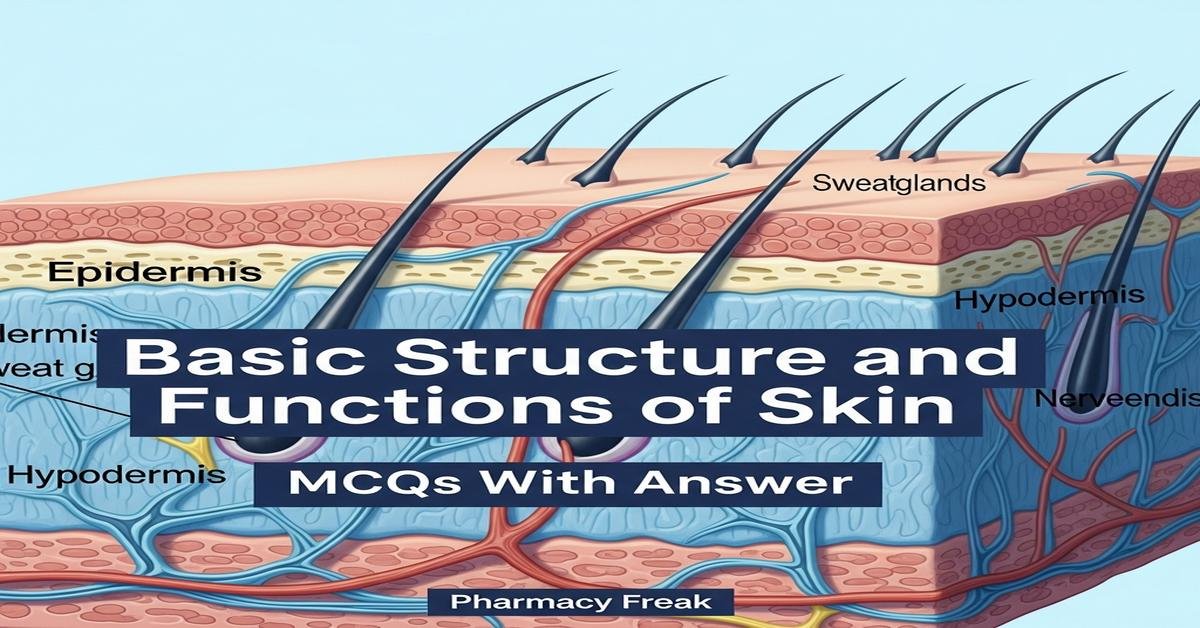
Introduction: The topic “Basic structure and functions of skin MCQs With Answer” gives B. Pharm students a focused review of skin anatomy, histology, physiology, and pharmacological relevance. Key areas include the epidermis (keratinocytes, melanocytes, Langerhans), dermis (collagen, vasculature, adnexa), hypodermis, stratum corneum barrier, lipid composition (ceramides, cholesterol), thermoregulation, immune defense, wound healing, and factors affecting transdermal drug absorption. Understanding these concepts is essential for formulation design, topical therapy, and transdermal delivery systems. This set emphasizes clinical and pharmaceutical applications to build exam readiness and practical insight. Now let’s test your knowledge with 30 MCQs on this topic.
Q1. Which epidermal layer is primarily responsible for the barrier function of skin and is rich in flattened anucleate corneocytes?
- Stratum basale
- Stratum spinosum
- Stratum granulosum
- Stratum corneum
Correct Answer: Stratum corneum
Q2. Which cell type in the epidermis synthesizes melanin and originates from the neural crest?
- Langerhans cell
- Merkel cell
- Melanocyte
- Keratinocyte
Correct Answer: Melanocyte
Q3. Which dermal layer contains loose connective tissue, capillary loops, and is responsible for nutrient exchange with the avascular epidermis?
- Reticular dermis
- Papillary dermis
- Hypodermis
- Subcutaneous fascia
Correct Answer: Papillary dermis
Q4. What is the main structural protein of corneocytes that contributes to mechanical strength of the epidermis?
- Elastin
- Loricrin/filaggrin-associated keratin
- Collagen type I
- Fibronectin
Correct Answer: Loricrin/filaggrin-associated keratin
Q5. Which lipid classes are major components of the stratum corneum intercellular matrix important for barrier integrity?
- Sphingomyelins, triglycerides, phosphatidylcholine
- Ceramides, cholesterol, free fatty acids
- Glycosaminoglycans, proteoglycans, hyaluronan
- Phospholipids, cholesterol esters, sterols
Correct Answer: Ceramides, cholesterol, free fatty acids
Q6. Which junctional structure attaches basal keratinocytes to the basement membrane?
- Desmosome
- Tight junction
- Hemidesmosome
- Gap junction
Correct Answer: Hemidesmosome
Q7. Which epidermal cells function as antigen-presenting cells and are abundant in the stratum spinosum?
- Melanocytes
- Langerhans cells
- Merkel cells
- Fibroblasts
Correct Answer: Langerhans cells
Q8. Which gland secretes sebum via holocrine secretion and is associated with hair follicles?
- Eccrine sweat gland
- Apocrine sweat gland
- Sebaceous gland
- Meibomian gland
Correct Answer: Sebaceous gland
Q9. Which property best predicts transdermal drug absorption through intact skin?
- High molecular weight (>1000 Da)
- High hydrophilicity (very low logP)
- Moderate lipophilicity and MW < 500 Da
- Strong ionization at skin pH
Correct Answer: Moderate lipophilicity and MW < 500 Da
Q10. Which vitamin is synthesized in the skin from 7-dehydrocholesterol upon UVB exposure?
- Vitamin A
- Vitamin C
- Vitamin D3 (cholecalciferol)
- Vitamin K
Correct Answer: Vitamin D3 (cholecalciferol)
Q11. Which layer is present only in thick skin (palms and soles) and lies between stratum granulosum and stratum corneum?
- Stratum basale
- Stratum lucidum
- Stratum spinosum
- Stratum germinativum
Correct Answer: Stratum lucidum
Q12. Which nerve fibers predominantly mediate sweating from eccrine glands?
- Adrenergic sympathetic fibers
- Cholinergic sympathetic fibers
- Parasympathetic fibers
- Sensory C-fibers
Correct Answer: Cholinergic sympathetic fibers
Q13. Which collagen type is most abundant in the dermis and provides tensile strength?
- Collagen type I
- Collagen type II
- Collagen type IV
- Collagen type III
Correct Answer: Collagen type I
Q14. What is transepidermal water loss (TEWL) a measure of?
- Rate of epidermal cell division
- Non-evaporative water content of dermis
- Passive water loss through the epidermis
- Sweat rate from eccrine glands
Correct Answer: Passive water loss through the epidermis
Q15. Which protein is important for aggregation of keratin filaments and formation of the cornified envelope?
- Filaggrin
- Elastase
- Keratinase
- Collagenase
Correct Answer: Filaggrin
Q16. During wound healing, which phase is characterized by fibroblast proliferation and granulation tissue formation?
- Hemostasis
- Inflammation
- Proliferation
- Remodeling
Correct Answer: Proliferation
Q17. Which structure in hair follicles is the active proliferative zone responsible for hair growth?
- Hair shaft
- Hair bulb/matrix
- Infundibulum
- Arrector pili muscle
Correct Answer: Hair bulb/matrix
Q18. Which change in skin physiology increases with aging and affects topical drug absorption?
- Increased epidermal turnover
- Thicker stratum corneum uniformity
- Reduced skin hydration and thinner dermis
- Increased sebum production
Correct Answer: Reduced skin hydration and thinner dermis
Q19. Which immune mediator is produced by keratinocytes and contributes to local inflammation after injury?
- Insulin
- Interleukin-1 (IL-1)
- Collagen type II
- Melatonin
Correct Answer: Interleukin-1 (IL-1)
Q20. Which of the following best describes apocrine sweat glands?
- Widely distributed, regulate body temperature via watery sweat
- Located in axillae and perineum, produce viscous secretions after puberty
- Holocrine glands producing lipid-rich sebum
- Major source of vitamin D synthesis
Correct Answer: Located in axillae and perineum, produce viscous secretions after puberty
Q21. Which enzyme in the skin participates in drug metabolism by oxidation and is part of phase I reactions?
- CYP450 monooxygenases
- Glucuronosyltransferase (UGT)
- Sulfotransferase (SULT)
- Glutathione S-transferase (GST)
Correct Answer: CYP450 monooxygenases
Q22. Which statement about melanosome transfer is correct?
- Melanosomes are synthesized by keratinocytes and transferred to melanocytes
- Melanosomes are transferred from melanocytes to keratinocytes via dendrites
- Melanosomes are only present in the dermis
- Melanosome transfer is independent of UV exposure
Correct Answer: Melanosomes are transferred from melanocytes to keratinocytes via dendrites
Q23. Which epidermal receptor cell is involved in light touch sensation and is associated with slowly adapting mechanoreception?
- Merkel cell
- Meissner corpuscle
- Pacinian corpuscle
- Ruffini ending
Correct Answer: Merkel cell
Q24. Which factor most increases percutaneous absorption of a topical drug?
- Decreased skin temperature
- Increased molecular size
- Enhanced skin hydration and occlusion
- Intact, non-inflamed skin
Correct Answer: Enhanced skin hydration and occlusion
Q25. Which component of the basement membrane zone is important for dermal-epidermal adhesion and is targeted in some blistering diseases?
- Type I collagen
- Laminin and type IV collagen
- Elastin fibers
- Keratin filaments
Correct Answer: Laminin and type IV collagen
Q26. Which cell marker is commonly used to identify Langerhans cells in the epidermis?
- CD3
- CD1a
- CD20
- CD31
Correct Answer: CD1a
Q27. Which statement about the hypodermis (subcutaneous tissue) is correct?
- It is primarily composed of dense irregular connective tissue with many capillaries
- It contains adipose tissue that provides thermal insulation and a drug depot
- It contains the epidermal appendages like hair follicles and sweat glands
- It is avascular and contains only collagen type IV
Correct Answer: It contains adipose tissue that provides thermal insulation and a drug depot
Q28. Which molecule in the stratum granulosum participates in the formation of the cornified envelope and is visible as keratohyalin granules?
- Keratin 14
- Loricrin and profilaggrin/filaggrin
- Elastin
- Collagen type III
Correct Answer: Loricrin and profilaggrin/filaggrin
Q29. Which physiological role of skin helps regulate body temperature by increasing blood flow and sweating?
- Barrier function
- Thermoregulation
- Vitamin D activation
- Pigmentation
Correct Answer: Thermoregulation
Q30. Which measurement is commonly used to evaluate skin barrier integrity in research and formulation studies?
- Transcutaneous oxygen tension
- Transepidermal water loss (TEWL)
- Skin electrical resistance only
- Melanin index
Correct Answer: Transepidermal water loss (TEWL)

