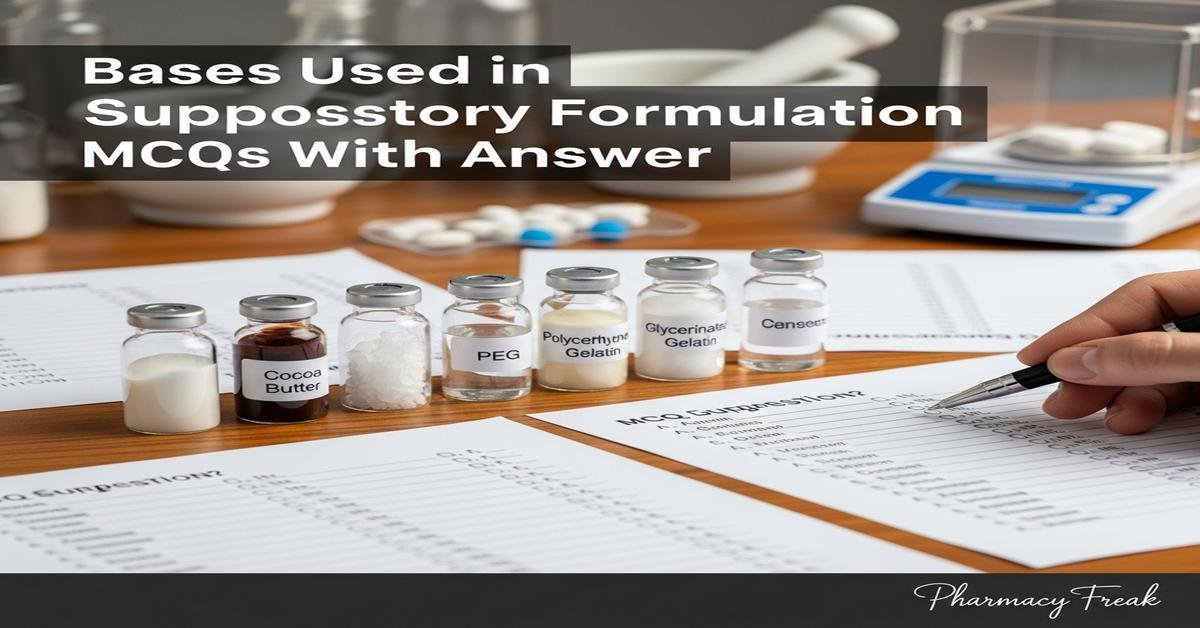
Suppository bases used in formulation determine drug release, stability, compatibility, and patient acceptability. B. Pharm students must master base classification — fatty (cocoa butter, theobroma oil), synthetic triglycerides (Witepsol, Suppocire), water-soluble bases (polyethylene glycol, glycerinated gelatin), and surfactant/emulsifying bases — plus physicochemical properties like melting point, polymorphism, hydrophilic‑lipophilic balance, density factor, and displacement value. Understanding preparation methods (molding, compression, fusion), release mechanisms (melt, dissolve, water‑exchange), and quality tests (disintegration, dissolution, content uniformity, microbial limits) is essential for safe, effective suppository design. Clinical considerations include mucosal irritation, local/systemic delivery and storage. Now let’s test your knowledge with 30 MCQs on this topic.
Q1. Which of the following is a classical fatty (oleaginous) suppository base?
- Cocoa butter (theobroma oil)
- Polyethylene glycol
- Glycerinated gelatin
- Poloxamer 407
Correct Answer: Cocoa butter (theobroma oil)
Q2. Which base type is most suitable for water-soluble drugs requiring rapid dissolution in rectal fluids?
- Fatty bases like cocoa butter
- Water-soluble bases like polyethylene glycol (PEG)
- Synthetic triglyceride bases
- Oleaginous bases with high melting point
Correct Answer: Water-soluble bases like polyethylene glycol (PEG)
Q3. Polymorphism of cocoa butter affects suppository performance by changing which property?
- Viscosity at room temperature
- Melting point and melting behavior
- Color stability only
- Microbial resistance
Correct Answer: Melting point and melting behavior
Q4. The displacement value (or factor) in suppository formulation is used to:
- Measure drug solubility in the base
- Calculate the volume of base displaced by the drug during moulding
- Determine the melting point of the base
- Assess microbial contamination
Correct Answer: Calculate the volume of base displaced by the drug during moulding
Q5. Which method is commonly used to prepare suppositories by melting the base, incorporating drug, and pouring into moulds?
- Compression method
- Fusion (molding) method
- Spray drying method
- Lyophilization
Correct Answer: Fusion (molding) method
Q6. A hydrophobic drug incorporated into a fatty base will typically show which release behavior?
- Immediate rapid release by dissolution
- Slow release due to poor partition into aqueous rectal fluids
- Complete chemical degradation in the base
- No effect—release is independent of base lipophilicity
Correct Answer: Slow release due to poor partition into aqueous rectal fluids
Q7. Which water-soluble base can cause irritation when used for rectal suppositories at high glycerin content?
- Polyethylene glycol (PEG)
- Glycerinated gelatin
- Witepsol
- Theobroma oil
Correct Answer: Glycerinated gelatin
Q8. For a drug incompatible with PEG, which alternative base would be preferable?
- Cocoa butter
- High molecular weight PEG blend
- Glycerinated gelatin without modification
- Poloxamer 407 in aqueous solution
Correct Answer: Cocoa butter
Q9. Which property of a suppository base is most critical to ensure it does not soften or melt at storage temperatures?
- Hydrophilicity
- Melting point well above ambient storage temperature
- Density factor equal to water
- High hygroscopicity
Correct Answer: Melting point well above ambient storage temperature
Q10. The density factor is needed to calculate:
- Microbial load per suppository
- The amount of base required to fill a mould of known volume when drug is present
- The dissolution rate of the drug
- The osmotic pressure of the suppository
Correct Answer: The amount of base required to fill a mould of known volume when drug is present
Q11. Which surfactant or emulsifying agent is commonly used to enhance release from fatty bases?
- Span 80 (sorbitan monooleate)
- Waxes like beeswax
- Stearic acid only
- Magnesium stearate
Correct Answer: Span 80 (sorbitan monooleate)
Q12. Compression moulding of suppositories is mainly used when:
- The base must remain molten during filling
- The drug or base is heat-sensitive and cannot be melted
- Large batches are needed rapidly
- Polymorphism must be induced
Correct Answer: The drug or base is heat-sensitive and cannot be melted
Q13. Which test is part of pharmacopeial quality control for suppositories to assess release characteristics?
- Disintegration and dissolution testing
- Tap density alone
- Melting point by capillary tube only
- pH of melted base
Correct Answer: Disintegration and dissolution testing
Q14. Polyethylene glycol (PEG) bases are preferred for which advantage compared to fatty bases?
- Higher risk of polymorphism
- Water solubility allowing predictable dissolution and reduced leakage
- Lower melting point for broad climates
- Stronger oily odor masking
Correct Answer: Water solubility allowing predictable dissolution and reduced leakage
Q15. Which phenomenon is most associated with storage of cocoa butter in warm climates?
- Hydrolysis to glycerol
- Polymorphic transition resulting in graininess or oil leakage
- Complete evaporation of theobroma oil
- Spontaneous sterilization
Correct Answer: Polymorphic transition resulting in graininess or oil leakage
Q16. Glycerinated gelatin bases are especially useful for which route or application?
- Vaginal suppositories requiring bioadhesion and water uptake
- Rectal rapid systemic delivery of lipophilic drugs
- Urethral oily formulations
- Parenteral injections
Correct Answer: Vaginal suppositories requiring bioadhesion and water uptake
Q17. A drug with high partition coefficient (very lipophilic) is expected to:
- Preferentially remain in a fatty base and show slow systemic absorption
- Dissolve rapidly in aqueous rectal fluids regardless of base
- Be chemically unstable in oleaginous bases always
- Convert into hydrophilic form on storage
Correct Answer: Preferentially remain in a fatty base and show slow systemic absorption
Q18. Which of the following is a synthetic triglyceride base used to avoid polymorphism seen in cocoa butter?
- Suppocire or Witepsol
- Glycerinated gelatin
- Polyethylene glycol 4000 alone
- Beeswax
Correct Answer: Suppocire or Witepsol
Q19. For evaluation of content uniformity in suppositories, sampling should ensure:
- Each suppository contains identical mass regardless of drug content
- Drug content per unit falls within pharmacopeial limits for the stated dose
- Only the average of a batch meets specification
- Viscosity of melted base is consistent only
Correct Answer: Drug content per unit falls within pharmacopeial limits for the stated dose
Q20. Which additive can be used to reduce fragility and improve mechanical strength of PEG suppositories?
- High proportions of low molecular weight PEG only
- Plasticizers like glycerol or propylene glycol
- Excess surfactant to solubilize the drug
- Beeswax to increase melting point
Correct Answer: Plasticizers like glycerol or propylene glycol
Q21. In formulation calculations, if a drug displaces part of the base, the required correction is made using:
- pKa value of the drug
- Displacement value (or density factor)
- Melting point of the drug
- UV absorbance only
Correct Answer: Displacement value (or density factor)
Q22. Which storage precaution is most appropriate for suppositories with cocoa butter base?
- Store at elevated temperatures to maintain softness
- Store in a cool place away from direct heat to prevent melting and polymorphic changes
- Expose to sunlight for sterilization
- Keep in humid environment to avoid drying
Correct Answer: Store in a cool place away from direct heat to prevent melting and polymorphic changes
Q23. Which in vitro test helps predict in vivo release of drug from suppositories that melt at body temperature?
- Friability test only
- Dissolution testing using appropriate medium and temperature
- Viscosity of the melted base
- pH indicator strip assessment
Correct Answer: Dissolution testing using appropriate medium and temperature
Q24. Which statement about poloxamer (Pluronic) bases is correct?
- They are purely lipophilic and insoluble in water
- They are thermoreversible gels that can solubilize hydrophilic drugs
- They always increase mucosal irritation
- They are identical to cocoa butter in polymorphism
Correct Answer: They are thermoreversible gels that can solubilize hydrophilic drugs
Q25. When compounding a suppository with a volatile odor drug, which base characteristic helps mask odor?
- High water solubility
- Fatty/oily base that retains volatile components
- Low melting point below room temperature
- Use of glycerinated gelatin only
Correct Answer: Fatty/oily base that retains volatile components
Q26. Which factor most influences local irritation potential of a suppository formulation?
- Only the melting point of the base
- pH, osmolarity, concentration of irritant excipients and preservatives
- Density factor of the base
- Color of the suppository
Correct Answer: pH, osmolarity, concentration of irritant excipients and preservatives
Q27. A suppository formulation shows oil leakage and softening after storage; the most likely cause is:
- Drug chemical degradation only
- Polymorphic transition or melting due to inadequate storage temperature
- Excessive microbial growth producing gas
- Incomplete mixing of active with base causing hardening
Correct Answer: Polymorphic transition or melting due to inadequate storage temperature
Q28. Which advantage do PEG bases offer for systemic drug delivery via rectum?
- Formation of an oily reservoir for slow partitioning only
- Predictable dissolution and limited first-pass hepatic metabolism for some drugs
- Guaranteed avoidance of mucosal irritation always
- Complete protection from enzymatic degradation
Correct Answer: Predictable dissolution and limited first-pass hepatic metabolism for some drugs
Q29. During scale-up of suppository production, which parameter is critical to maintain consistency between lab and production batches?
- Only the color of moulds
- Temperature control during melting, cooling rate, and mould filling accuracy
- Amount of ambient light in the production area
- Use of different mould shapes without recalculation
Correct Answer: Temperature control during melting, cooling rate, and mould filling accuracy
Q30. Which consideration is most important when selecting a base for a drug with chemical instability in aqueous media?
- Choose a water-soluble base that dissolves rapidly
- Prefer a non-aqueous (fatty) base to limit water exposure and hydrolysis
- Always include preservatives regardless of base
- Use glycerinated gelatin with high water content
Correct Answer: Prefer a non-aqueous (fatty) base to limit water exposure and hydrolysis

