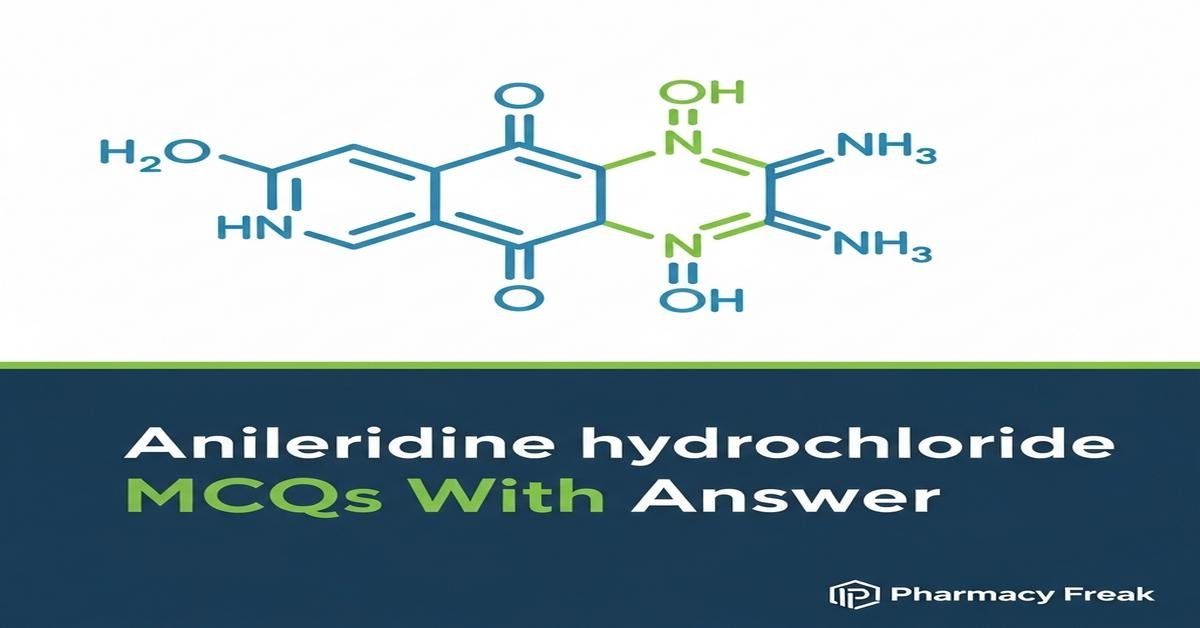
Anileridine hydrochloride MCQs With Answer is an essential revision resource tailored for B. Pharm students studying opioid analgesics and narcotic pharmacotherapy. This concise, Student-friendly post highlights Anileridine hydrochloride classification, mechanism of action as a mu-opioid agonist, pharmacokinetics, common adverse effects, drug interactions, formulation considerations, and analytical assay methods. These focused MCQs emphasize clinical relevance, dosage concerns, stability of the hydrochloride salt, regulatory status, and overdose management. Ideal for exam preparation and practical understanding, the set reinforces key learning outcomes in pharmacology, medicinal chemistry, and pharmacy practice. Now let’s test your knowledge with 50 MCQs on this topic.
Q1. What class of drug does Anileridine belong to?
- Nonsteroidal anti-inflammatory agent
- Opioid analgesic
- Anticonvulsant
- Local anesthetic
Correct Answer: Opioid analgesic
Q2. The hydrochloride salt of Anileridine is used primarily to:
- Decrease potency
- Improve water solubility for formulation
- Enhance lipid solubility for CNS penetration
- Convert it into a prodrug
Correct Answer: Improve water solubility for formulation
Q3. The primary receptor target responsible for Anileridine’s analgesic effect is:
- NMDA receptor
- Alpha-2 adrenergic receptor
- Mu-opioid receptor
- GABA-A receptor
Correct Answer: Mu-opioid receptor
Q4. A common adverse effect of Anileridine is:
- Hyperreflexia
- Respiratory depression
- Hypoglycemia
- Photosensitivity
Correct Answer: Respiratory depression
Q5. Which antidote is indicated for Anileridine overdose?
- Atropine
- Naloxone
- Flumazenil
- N-acetylcysteine
Correct Answer: Naloxone
Q6. Compared to meperidine (pethidine), Anileridine is generally considered to be:
- Structurally identical
- Less potent and shorter acting
- An analog with comparable opioid activity
- An opioid antagonist
Correct Answer: An analog with comparable opioid activity
Q7. Major metabolic pathways for Anileridine include:
- Ester hydrolysis and hepatic N-dealkylation
- Renal glucuronidation only
- Direct exhalation unchanged
- Photodegradation in skin
Correct Answer: Ester hydrolysis and hepatic N-dealkylation
Q8. In formulating Anileridine hydrochloride injections, a key consideration is:
- Maintaining alkaline pH for stability
- Preventing light exposure and controlling pH
- Adding proteolytic enzymes
- Using ethanol as sole diluent for stability
Correct Answer: Preventing light exposure and controlling pH
Q9. Which analytical technique is commonly used for assay and purity testing of Anileridine hydrochloride?
- Thin-layer chromatography only
- High-performance liquid chromatography (HPLC)
- Paper chromatography
- Flame photometry
Correct Answer: High-performance liquid chromatography (HPLC)
Q10. An important contraindication to Anileridine use is:
- History of migraine
- Severe respiratory depression
- Mild seasonal allergies
- Well-controlled hypertension
Correct Answer: Severe respiratory depression
Q11. Which adverse effect is characteristic of opioid use including Anileridine?
- Diarrhea
- Mydriasis
- Constipation
- Hypersalivation
Correct Answer: Constipation
Q12. Anileridine’s analgesic action is primarily due to:
- Blocking voltage-gated sodium channels
- Inhibiting prostaglandin synthesis
- Activating mu-opioid receptors and reducing nociceptive transmission
- Increasing GABAergic inhibition in muscle
Correct Answer: Activating mu-opioid receptors and reducing nociceptive transmission
Q13. A pharmacokinetic property that B. Pharm students should monitor with Anileridine is:
- High urinary excretion of unchanged drug without metabolism
- Extensive hepatic metabolism and renal excretion of metabolites
- Complete absorption without first-pass effect
- Exclusively biliary excretion of parent drug
Correct Answer: Extensive hepatic metabolism and renal excretion of metabolites
Q14. When counseling patients, pharmacists should warn about which interaction with Anileridine?
- Increased effect with stimulants like amphetamines
- Enhanced sedation with benzodiazepines and alcohol
- Reduced analgesia with NSAIDs
- No interactions are known
Correct Answer: Enhanced sedation with benzodiazepines and alcohol
Q15. For stability, Anileridine hydrochloride injections should be stored:
- Open to light at room temperature
- In tightly closed containers, protected from light
- Frozen at -20°C
- At very high humidity
Correct Answer: In tightly closed containers, protected from light
Q16. Which of the following is a relevant quality control test for Anileridine hydrochloride tablets?
- Moisture sorption only
- Dissolution testing, assay, and content uniformity
- Viscosity measurement
- pH of saliva
Correct Answer: Dissolution testing, assay, and content uniformity
Q17. Regulatory status of Anileridine in many countries is best described as:
- Over-the-counter analgesic
- Controlled substance requiring prescription
- Dietary supplement
- Herbal remedy
Correct Answer: Controlled substance requiring prescription
Q18. A key structural difference between Anileridine and meperidine family members is:
- Addition of aniline-like moiety in some analogs
- Complete absence of an ester group
- Presence of a steroid nucleus
- Replacement of nitrogen with oxygen in the core
Correct Answer: Addition of aniline-like moiety in some analogs
Q19. Which laboratory parameter is most important to monitor in a patient receiving repeated doses of Anileridine?
- Serum cholesterol
- Liver function tests and renal function
- Serum sodium only
- Thyroid-stimulating hormone
Correct Answer: Liver function tests and renal function
Q20. In pharmaceutical analysis, UV spectrophotometry for Anileridine hydrochloride is useful for:
- Estimating melting point
- Simple assay when sample is free of interfering substances
- Measuring viscosity of solution
- Determining microbial contamination
Correct Answer: Simple assay when sample is free of interfering substances
Q21. Anileridine produces miosis primarily by:
- Sympathetic stimulation of iris dilator muscle
- Central stimulation of parasympathetic pathways
- Blockade of cholinesterase
- Direct inhibition of ocular muscles
Correct Answer: Central stimulation of parasympathetic pathways
Q22. Which patient population requires dose adjustment or caution with Anileridine?
- Patients with stable angina only
- Pregnant women, elderly, and those with renal/hepatic impairment
- Young healthy adults with no comorbidity
- Patients with controlled hyperlipidemia
Correct Answer: Pregnant women, elderly, and those with renal/hepatic impairment
Q23. Combining Anileridine with monoamine oxidase inhibitors (MAOIs) can cause:
- Reduced analgesic efficacy without side effects
- Severe interactions, including serotoninergic or hypertensive crises
- Immediate renal failure
- No clinically significant interaction
Correct Answer: Severe interactions, including serotoninergic or hypertensive crises
Q24. Which formulation strategy can be used to mask bitter taste in oral Anileridine formulations?
- Use of sugar-free water only
- Enteric coating or taste-masking coatings and flavors
- Freeze-drying the tablet surface
- Adding strong alkali to the formulation
Correct Answer: Enteric coating or taste-masking coatings and flavors
Q25. In overdose, early signs of opioid toxicity with Anileridine include:
- Hypertension and tachycardia
- Respiratory depression, pinpoint pupils, and reduced consciousness
- Excessive salivation and diarrhea
- Skin blistering and rash
Correct Answer: Respiratory depression, pinpoint pupils, and reduced consciousness
Q26. Which excipient property is particularly important in injectable formulations of Anileridine hydrochloride?
- High particulate load
- Sterility and isotonicity of the vehicle
- High bacterial growth potential
- Presence of strong oxidizers
Correct Answer: Sterility and isotonicity of the vehicle
Q27. When developing an HPLC method for Anileridine, a suitable detector often used is:
- Refractive index detector for low sensitivity
- UV-visible detector at characteristic wavelength
- Atomic absorption detector
- Flame ionization detector
Correct Answer: UV-visible detector at characteristic wavelength
Q28. Tolerance to Anileridine refers to:
- Reduced adverse effects with continued use only
- Progressive loss of analgesic effect requiring higher doses
- Immediate allergic reaction
- Inability to absorb the drug orally
Correct Answer: Progressive loss of analgesic effect requiring higher doses
Q29. Physical dependence on Anileridine is best described as:
- Psychological desire without withdrawal symptoms
- Physiological adaptation with withdrawal on abrupt cessation
- Complete immunity to opioid effects
- Development of tolerance to antibiotics
Correct Answer: Physiological adaptation with withdrawal on abrupt cessation
Q30. Which storage condition would most likely accelerate degradation of Anileridine hydrochloride?
- Cool, dark, dry storage
- Exposure to heat, moisture, and light
- Refrigeration at recommended temperature
- Sealed container with desiccant
Correct Answer: Exposure to heat, moisture, and light
Q31. Which pharmacodynamic effect is NOT typically caused by Anileridine?
- Analgesia
- Respiratory stimulation
- Sedation
- Euphoria
Correct Answer: Respiratory stimulation
Q32. A key counseling point for patients prescribed Anileridine is to avoid:
- Driving or operating heavy machinery until effects are known
- Taking vitamin supplements
- Sleeping more than 8 hours
- Wearing sunglasses
Correct Answer: Driving or operating heavy machinery until effects are known
Q33. In formulation chemistry, converting Anileridine to its hydrochloride salt primarily affects which property?
- Color of the compound only
- Water solubility and crystalline form
- Radioactivity
- Its potency at mu receptors directly
Correct Answer: Water solubility and crystalline form
Q34. Which of the following is an appropriate method to assess content uniformity of Anileridine tablets?
- Weighing tablets only
- Assay of individual tablets by validated analytical method
- Measuring tablet diameter
- Color comparison by eye
Correct Answer: Assay of individual tablets by validated analytical method
Q35. When handling Anileridine in a compounding pharmacy, pharmacists should:
- Use PPE and follow controlled substance handling regulations
- Mix it openly on the counter without precautions
- Assume it is non-hazardous and use bare hands
- Store it with food products for convenience
Correct Answer: Use PPE and follow controlled substance handling regulations
Q36. An important adverse neurologic effect associated with some pethidine-like opioids that pharmacists should monitor is:
- Seizures due to neurotoxic metabolites in susceptible patients
- Development of multiple sclerosis
- Rapid neuroregeneration
- Peripheral neuropathy due to vitamin overdose
Correct Answer: Seizures due to neurotoxic metabolites in susceptible patients
Q37. Which regulatory document is essential when dispensing Anileridine hydrochloride preparations?
- Material safety data sheet (MSDS) and controlled substance prescription records
- Food safety certificate
- Pesticide registration
- Cosmetic ingredient list
Correct Answer: Material safety data sheet (MSDS) and controlled substance prescription records
Q38. For a stability study of Anileridine hydrochloride tablets, accelerated conditions typically include:
- Low humidity and low temperature only
- High temperature and high relative humidity
- Complete darkness and freezing
- Continuous shaking at room temperature
Correct Answer: High temperature and high relative humidity
Q39. Which factor can influence the bioavailability of oral Anileridine?
- First-pass hepatic metabolism
- Its radioactivity level
- Ambient noise during administration
- Tablet color
Correct Answer: First-pass hepatic metabolism
Q40. In toxicology screening after suspected Anileridine misuse, clinicians commonly evaluate:
- Serum opioid levels and clinical signs of opioid toxicity
- Only blood glucose
- Electrolytes for immediate diagnosis
- Urine for fungal elements
Correct Answer: Serum opioid levels and clinical signs of opioid toxicity
Q41. Which pharmacological effect of Anileridine contributes to post-operative nausea and vomiting?
- Peripheral vasodilation
- Central chemoreceptor trigger zone stimulation
- Inhibition of vestibular function only
- Increased gastric motility
Correct Answer: Central chemoreceptor trigger zone stimulation
Q42. When designing a patient information leaflet for Anileridine, which point is essential?
- It can be stopped abruptly without issues
- Potential for dependence and need for careful tapering
- It cures all types of chronic pain permanently
- No need to inform other healthcare providers
Correct Answer: Potential for dependence and need for careful tapering
Q43. Which chromatographic mobile phase consideration is important for HPLC of Anileridine?
- Nonpolar solvents only with no buffer
- Appropriate organic solvent and buffer to achieve retention and peak shape
- Use of pure water only
- Use of molten salts as mobile phase
Correct Answer: Appropriate organic solvent and buffer to achieve retention and peak shape
Q44. In clinical pharmacology, the ceiling effect for respiratory depression with Anileridine is:
- Nonexistent; respiratory depression increases with dose
- Very pronounced and prevents overdose
- Dependent only on route of administration
- Guaranteed to peak at low doses
Correct Answer: Nonexistent; respiratory depression increases with dose
Q45. Which metabolic enzyme system is most likely involved in the biotransformation of Anileridine?
- CYP450 hepatic enzymes
- Renal brush border enzymes only
- Pancreatic lipase exclusively
- Skin esterases only
Correct Answer: CYP450 hepatic enzymes
Q46. Which formulation would be least appropriate for an opioid like Anileridine?
- Immediate-release oral tablets for acute pain
- Controlled-release forms for chronic pain with careful monitoring
- Inhalation aerosol intended for recreational use
- Parenteral injection for perioperative analgesia
Correct Answer: Inhalation aerosol intended for recreational use
Q47. For long-term therapy considerations, pharmacists should implement:
- No monitoring at all
- Regular review, risk assessment for abuse, and pain management evaluation
- Automatic dose increases every month
- Encouragement to combine with alcohol
Correct Answer: Regular review, risk assessment for abuse, and pain management evaluation
Q48. Which statement about the hydrochloride salt form of an opioid is correct?
- Salt formation always makes the drug inactive
- Hydrochloride salts typically increase aqueous solubility and ease of formulation
- Hydrochloride salts prevent metabolism by the liver
- Salt forms are only used for topical products
Correct Answer: Hydrochloride salts typically increase aqueous solubility and ease of formulation
Q49. A pharmaceutical stability-indicating method for Anileridine must be able to:
- Differentiate the parent drug from its degradation products
- Only measure pH changes
- Quantify microbial contamination only
- Measure tablet hardness exclusively
Correct Answer: Differentiate the parent drug from its degradation products
Q50. When preparing MCQs for B. Pharm exams on Anileridine hydrochloride, the best approach to test deep understanding is to focus on:
- Memorization of brand names only
- Mechanism of action, pharmacokinetics, formulation, safety, and analytical methods
- Counting the number of letters in the drug name
- Advertising slogans of pharmaceutical companies
Correct Answer: Mechanism of action, pharmacokinetics, formulation, safety, and analytical methods


