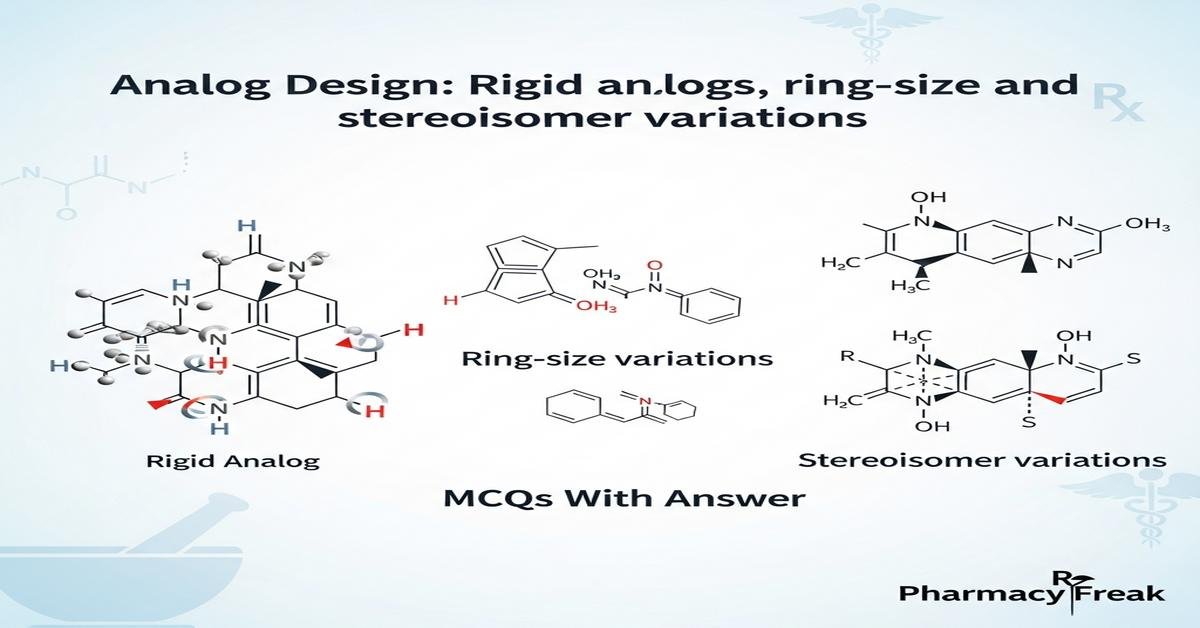
Introduction: Analog Design: Rigid analogs, ring-size and stereoisomer variations explores how deliberate structural modifications—rigidification, ring-size changes and stereochemical alterations—affect drug-receptor interactions, pharmacokinetics and metabolic fate. For M.Pharm students, understanding these strategies is essential for rational lead optimization: locking bioactive conformations can increase potency and selectivity, while ring-size manipulation tunes geometry and strain for improved binding. Stereoisomerism governs enantiospecific activity, safety and ADME properties. This quiz set tests conceptual and applied knowledge of conformational restriction, synthetic approaches to rigid analogs, stereochemical outcomes, and analytical methods for stereoisomer resolution, preparing students for advanced medicinal chemistry challenges in drug design and SAR interpretation.
Q1. Which of the following best describes the primary purpose of designing a rigid analog of a flexible lead compound?
- To reduce synthetic complexity by removing stereocenters
- To lock the molecule into a conformation that favors target binding
- To increase the number of rotatable bonds for enhanced solubility
- To create a more metabolically labile scaffold
Correct Answer: To lock the molecule into a conformation that favors target binding
Q2. Conformational restriction often improves binding affinity primarily by which thermodynamic effect?
- Increasing entropic penalty upon binding
- Decreasing entropic penalty upon binding
- Increasing desolvation energy unfavorably
- Creating irreversible covalent bonds with the target
Correct Answer: Decreasing entropic penalty upon binding
Q3. Which structural modification is a common method to rigidify a molecule without adding polar functionality?
- Introduction of an intramolecular hydrogen-bond donor
- Formation of a covalent bridge (cyclization) between two remote atoms
- Adding a tertiary amine side chain
- Adding a polyethylene glycol (PEG) linker
Correct Answer: Formation of a covalent bridge (cyclization) between two remote atoms
Q4. Changing ring size from a six-membered to a five-membered ring in an analog is most likely to affect which property first?
- pKa of distal functional groups
- Preferred bond angles and overall geometry at the binding site
- Ability to form covalent adducts with protein residues
- Number of hydrogen bond donors
Correct Answer: Preferred bond angles and overall geometry at the binding site
Q5. Which is true about rigid analogs that mimic the bioactive conformation of a ligand?
- They always increase aqueous solubility
- They necessarily eliminate all metabolic liabilities
- They can improve selectivity by reducing off-target conformations
- They always decrease molecular weight
Correct Answer: They can improve selectivity by reducing off-target conformations
Q6. Introduction of an aromatic ring to replace an aliphatic chain (aromatic rigidification) primarily changes which interaction with the target?
- Hydrogen-bond donation capacity only
- Pi–pi or CH–pi interactions and planarity
- Ability to chelate metal ions
- Net formal charge at physiological pH
Correct Answer: Pi–pi or CH–pi interactions and planarity
Q7. Which stereochemical term describes two stereoisomers that are non-superimposable mirror images?
- Conformers
- Enantiomers
- Epimers
- Atropisomers
Correct Answer: Enantiomers
Q8. Diastereomers differ from enantiomers in that diastereomers:
- Are always mirror images
- Have identical physical properties in achiral environments
- Are stereoisomers that are not mirror images and often have different physical properties
- Are only relevant for conformational isomerism
Correct Answer: Are stereoisomers that are not mirror images and often have different physical properties
Q9. Epimerization at a single stereocenter near a pharmacophore can cause:
- No change in activity because stereochemistry is irrelevant
- Significant changes in potency or selectivity due to altered spatial orientation
- Only changes in solubility, never in receptor binding
- Conversion to a racemate automatically
Correct Answer: Significant changes in potency or selectivity due to altered spatial orientation
Q10. Atropisomerism is most relevant for which type of medicinal chemistry problem?
- Conformationally flexible small aliphatic molecules with no steric hindrance
- Chiral centers created by sp3 stereocenters only
- Restricted rotation around a single bond leading to isolable stereoisomers
- Molecules that rapidly interconvert at room temperature without biological relevance
Correct Answer: Restricted rotation around a single bond leading to isolable stereoisomers
Q11. Which experimental method is commonly used to separate enantiomers for biological testing?
- Achiral reversed-phase HPLC
- Chiral chromatography (e.g., chiral HPLC)
- Mass spectrometry without chiral selector
- Thin-layer chromatography on silica gel without chiral modifier
Correct Answer: Chiral chromatography (e.g., chiral HPLC)
Q12. When converting a flexible lead into a rigid analog to reduce off-target binding, which of the following is a potential risk?
- Elimination of the bioactive conformation entirely
- Guaranteed elimination of all metabolic pathways
- Instant improvement in aqueous solubility
- No change in pharmacokinetics
Correct Answer: Elimination of the bioactive conformation entirely
Q13. Which computational descriptor is most useful to quantify the degree of conformational flexibility that rigidification aims to reduce?
- LogP
- Number of rotatable bonds and conformational energy range
- pKa
- Optical rotation ([α]D)
Correct Answer: Number of rotatable bonds and conformational energy range
Q14. Decreasing ring size from seven to five members often increases ring strain. This can lead to:
- Enhanced chemical stability under all conditions
- Altered reactivity, potentially faster metabolic or chemical degradation
- Loss of stereogenic centers automatically
- Complete loss of binding affinity in all targets
Correct Answer: Altered reactivity, potentially faster metabolic or chemical degradation
Q15. Which strategy is commonly used to enforce a gauche or synperiplanar conformation in analog design?
- Introducing a bulky group far from the torsion angle of interest
- Using a small-ring constraint or intramolecular hydrogen bond
- Removing all heteroatoms from the molecule
- Converting sp3 centers to sp2 hybridized centers everywhere
Correct Answer: Using a small-ring constraint or intramolecular hydrogen bond
Q16. In stereoisomer-selective pharmacology, why might one enantiomer be a toxicant while the other is therapeutic?
- Toxicity is independent of stereochemistry
- Enantiomers interact differently with chiral biological targets or metabolic enzymes
- Only racemates can be toxic, not single enantiomers
- Enantiomers have identical ADME profiles always
Correct Answer: Enantiomers interact differently with chiral biological targets or metabolic enzymes
Q17. Which synthetic approach is frequently used to obtain a single stereoisomer for lead optimization?
- Classical non-selective radical halogenation
- Asymmetric synthesis using chiral catalysts or auxiliaries
- Thermal racemization followed by achiral purification
- Random mutagenesis of the target protein
Correct Answer: Asymmetric synthesis using chiral catalysts or auxiliaries
Q18. Bioisosteric replacement aimed at rigidification would most likely substitute which pair?
- Replace an aromatic ring with a flexible alkyl chain
- Replace an amide with a heterocycle that mimics geometry but locks conformation
- Replace a sp2 carbon with a water molecule
- Replace a stereocenter with a proton
Correct Answer: Replace an amide with a heterocycle that mimics geometry but locks conformation
Q19. Which of the following best explains why rigid analogs can improve selectivity over related receptor subtypes?
- Rigid analogs are always smaller and diffuse better
- Rigid analogs present pharmacophoric groups in a precise 3D arrangement matching one subtype better than others
- Rigid analogs cannot cross membranes and thus act only locally
- Rigid analogs universally increase basicity and bind only to acidic pockets
Correct Answer: Rigid analogs present pharmacophoric groups in a precise 3D arrangement matching one subtype better than others
Q20. In structure-activity relationship (SAR) exploration, introducing ring fusion or bridgeheads is mainly used to:
- Eliminate chirality completely
- Lock relative stereochemistry and reduce conformational freedom to probe orientation effects
- Increase the number of rotatable bonds to enhance flexibility
- Ensure the molecule becomes achiral and more lipophilic
Correct Answer: Lock relative stereochemistry and reduce conformational freedom to probe orientation effects

