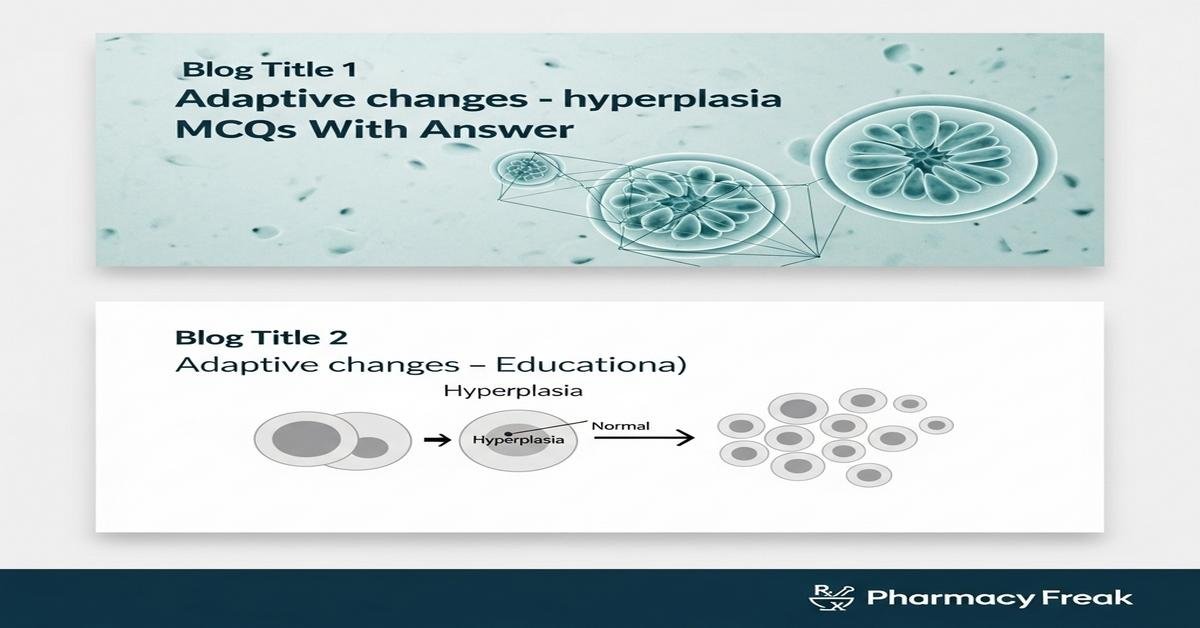
Adaptive changes – hyperplasia are fundamental concepts for B.Pharm students, linking cellular biology, pathology, and pharmacology. This concise introduction explains how cells increase in number through controlled proliferation in response to stimuli — physiological (compensatory or hormonal) or pathological (excessive growth-factor signaling, chronic irritation). Key terms include compensatory hyperplasia, hormonal hyperplasia, growth factors, cyclins, and neoplastic risk. Understanding mechanisms and drug interactions (e.g., estrogens, androgens, growth factor modulators) helps predict therapeutic effects and adverse reactions. Mastery of histological features and clinical examples (BPH, endometrial hyperplasia, liver regeneration) is essential for rational drug therapy and safety. Now let’s test your knowledge with 50 MCQs on this topic.
Q1. What best defines hyperplasia as an adaptive change?
- Increase in cell size without change in cell number
- Increase in cell number due to enhanced cell proliferation
- Replacement of one differentiated cell type by another
- Uncontrolled clonal expansion with invasion
Correct Answer: Increase in cell number due to enhanced cell proliferation
Q2. Which of the following is a physiological example of hyperplasia?
- Liver cirrhosis after chronic alcohol use
- Benign prostatic hyperplasia
- Bone marrow expansion after hemorrhage
- Squamous metaplasia in smokers
Correct Answer: Bone marrow expansion after hemorrhage
Q3. Hormonal hyperplasia is classically exemplified by which condition?
- Endometrial hyperplasia during estrogen stimulation
- Renal hyperplasia due to hypoxia
- Cardiac hypertrophy in hypertension
- Alveolar hyperplasia after pneumonia
Correct Answer: Endometrial hyperplasia during estrogen stimulation
Q4. Compensatory hyperplasia is best demonstrated by:
- Lymphoid hyperplasia in chronic infection
- Regeneration of the liver after partial hepatectomy
- Metaplasia of bronchial epithelium
- Fibrosis after chronic inflammation
Correct Answer: Regeneration of the liver after partial hepatectomy
Q5. Which molecular regulators are directly involved in cell cycle progression during hyperplasia?
- Collagenases and elastases
- Cyclins and cyclin-dependent kinases (CDKs)
- Acetylcholinesterase and butyrylcholinesterase
- Hemoglobin and myoglobin
Correct Answer: Cyclins and cyclin-dependent kinases (CDKs)
Q6. Persistent pathological hyperplasia may increase the risk of which outcome?
- Acute ischemia
- Neoplastic transformation
- Immediate apoptosis of all cells
- Complete tissue regeneration without scarring
Correct Answer: Neoplastic transformation
Q7. Benign prostatic hyperplasia (BPH) primarily affects which tissue compartment?
- Prostatic stroma only
- Prostatic glandular epithelium and stroma
- Urethral mucosa exclusively
- Prostatic capsule only
Correct Answer: Prostatic glandular epithelium and stroma
Q8. Which growth factor family is most implicated in epithelial hyperplasia?
- Transforming growth factor-beta (TGF-β) as a universal mitogen
- Epidermal growth factor (EGF) family
- Interleukin-10 family
- Hemoglobin-related peptides
Correct Answer: Epidermal growth factor (EGF) family
Q9. In pharmacology, excess estrogen therapy can cause which type of adaptive change?
- Muscle hypertrophy
- Endometrial hyperplasia
- Neuronal apoptosis
- Fatty metamorphosis
Correct Answer: Endometrial hyperplasia
Q10. Histologically, hyperplasia is distinguished from neoplasia by which feature?
- Uniform cellular hyperchromasia and pleomorphism in hyperplasia
- Organized architecture and proportional increase in cell types in hyperplasia
- Invasion of surrounding tissues in hyperplasia
- Monoclonal origin always in hyperplasia
Correct Answer: Organized architecture and proportional increase in cell types in hyperplasia
Q11. Which signaling pathway is commonly activated to promote proliferation in hyperplasia?
- Wnt/β-catenin pathway
- GABAergic inhibitory pathway
- Urea cycle enzymes
- Renin-angiotensin-aldosterone system only in kidneys
Correct Answer: Wnt/β-catenin pathway
Q12. Which laboratory marker may reflect increased cellular proliferation associated with hyperplasia?
- Decreased serum albumin
- Elevated Ki-67 (MIB-1) proliferation index
- Low C-reactive protein
- Increased creatinine clearance
Correct Answer: Elevated Ki-67 (MIB-1) proliferation index
Q13. Which of the following drugs is used to reduce hyperplasia in BPH by blocking androgen action?
- Propranolol
- Finasteride (5α-reductase inhibitor)
- Omeprazole
- Amlodipine
Correct Answer: Finasteride (5α-reductase inhibitor)
Q14. Cellular hyperplasia requires which process that differs from hypertrophy?
- Increased synthesis of contractile proteins without mitosis
- Cell division (mitosis) leading to increased cell number
- Accumulation of intracellular lipids
- Replacement of one cell type by another
Correct Answer: Cell division (mitosis) leading to increased cell number
Q15. Which factor typically inhibits proliferation and may limit hyperplasia?
- Transforming growth factor-beta (TGF-β) in many contexts
- Epidermal growth factor (EGF)
- Platelet-derived growth factor (PDGF)
- Fibroblast growth factor (FGF)
Correct Answer: Transforming growth factor-beta (TGF-β) in many contexts
Q16. Which clinical test helps evaluate endometrial hyperplasia risk in a patient on unopposed estrogen?
- Serum PSA level
- Transvaginal ultrasound and endometrial biopsy
- Chest X-ray
- Creatine kinase measurement
Correct Answer: Transvaginal ultrasound and endometrial biopsy
Q17. Which of these conditions is an example of pathological hyperplasia driven by chronic irritation?
- Callus formation on the foot
- Dysplastic change in cervical epithelium
- Squamous hyperplasia of the larynx from tobacco smoke
- Myocardial infarction scar
Correct Answer: Squamous hyperplasia of the larynx from tobacco smoke
Q18. In wound healing, fibroblast hyperplasia contributes primarily to:
- Immediate hemostasis
- Extracellular matrix deposition and scar formation
- Neuronal regeneration
- Adipose tissue necrosis
Correct Answer: Extracellular matrix deposition and scar formation
Q19. Growth factors that act as mitogens typically bind to which receptor type to induce hyperplasia?
- G-protein-coupled receptors exclusively
- Receptor tyrosine kinases (RTKs)
- Intracellular nuclear receptors only
- Ionotropic ligand-gated channels
Correct Answer: Receptor tyrosine kinases (RTKs)
Q20. Which histologic finding supports a diagnosis of simple hyperplasia rather than atypical hyperplasia in endometrium?
- Marked cellular atypia and loss of polarity
- Increased gland-to-stroma ratio with preserved architecture
- Invasive growth into myometrium
- Monoclonal cellular proliferation with genetic mutations
Correct Answer: Increased gland-to-stroma ratio with preserved architecture
Q21. Which statement correctly contrasts hyperplasia and hypertrophy?
- Hyperplasia increases size; hypertrophy increases number
- Hyperplasia increases cell number; hypertrophy increases cell size
- Both always involve increased cell number only
- Hypertrophy is always pathological while hyperplasia is always physiological
Correct Answer: Hyperplasia increases cell number; hypertrophy increases cell size
Q22. A common drug-induced hyperplasia involves gingival overgrowth; which medication is known for this effect?
- Phenytoin
- Metformin
- Ibuprofen
- Warfarin
Correct Answer: Phenytoin
Q23. Which cellular process is essential for hyperplasia but not for hypertrophy?
- Protein synthesis
- Mitosis (cell division)
- Increased energy metabolism
- Enhanced substrate uptake
Correct Answer: Mitosis (cell division)
Q24. Which prostate medication reduces stromal proliferation by antagonizing α1-adrenergic receptors?
- Tamsulosin
- Finasteride
- Spironolactone
- Sildenafil
Correct Answer: Tamsulosin
Q25. Hyperplasia of which organ is central to compensated enlargement after partial removal?
- Brain
- Liver
- Lens of the eye
- Cartilage
Correct Answer: Liver
Q26. The transition from sustained hyperplasia to neoplasia often involves which genetic change?
- Reversible epigenetic marks only
- Accumulation of mutations in oncogenes and tumor suppressor genes
- Immediate telomere lengthening without mutation
- Loss of all growth factor receptors
Correct Answer: Accumulation of mutations in oncogenes and tumor suppressor genes
Q27. In endocrine hyperplasia, target tissue enlargement occurs due to:
- Direct infection of the target tissue
- Excessive hormonal stimulation from endocrine glands
- Reduced blood supply to the target tissue
- Deposition of amyloid proteins
Correct Answer: Excessive hormonal stimulation from endocrine glands
Q28. Which cell-cycle checkpoint proteins, when dysregulated, may lead to unchecked hyperplasia?
- Actin and myosin
- p53 and Rb
- Hemoglobin and myoglobin
- Albumin and transferrin
Correct Answer: p53 and Rb
Q29. Which imaging modality is most useful for assessing glandular hyperplasia of the prostate?
- Electrocardiogram (ECG)
- Transrectal ultrasound (TRUS)
- DEXA scan
- Fluoroscopy of the chest
Correct Answer: Transrectal ultrasound (TRUS)
Q30. Which of the following is NOT a mechanism driving hyperplasia?
- Increased local production of growth factors
- Enhanced stem cell activation in tissue
- Complete absence of mitogenic signals
- Hormonal stimulation
Correct Answer: Complete absence of mitogenic signals
Q31. Which pathology term describes increased number of cells with abnormal architecture and pleomorphism?
- Simple hyperplasia
- Atypical hyperplasia (dysplasia in some contexts)
- Hypertrophy
- Apoptosis
Correct Answer: Atypical hyperplasia (dysplasia in some contexts)
Q32. Pharmacological inhibition of which enzyme reduces DHT-mediated prostatic hyperplasia?
- Aromatase
- 5α-reductase
- Cyclooxygenase-2 (COX-2)
- Angiotensin-converting enzyme (ACE)
Correct Answer: 5α-reductase
Q33. In thyroid hyperplasia (goiter) due to iodine deficiency, the primary stimulus is:
- Excess T3/T4 production
- Elevated TSH from reduced thyroid hormone synthesis
- Autoimmune destruction of follicles
- Increased calcitonin secretion
Correct Answer: Elevated TSH from reduced thyroid hormone synthesis
Q34. Which cell population typically provides progenitors for hyperplastic response in many tissues?
- Mature neurons
- Resident stem/progenitor cells
- Red blood cells
- Mature adipocytes that cannot divide
Correct Answer: Resident stem/progenitor cells
Q35. Which cytokine is mainly associated with inflammatory responses but can indirectly influence hyperplasia?
- Interleukin-1 (IL-1)
- Insulin
- Growth hormone only
- Collagen type I
Correct Answer: Interleukin-1 (IL-1)
Q36. A drug that blocks EGFR signaling would most likely reduce which process?
- Neuronal synaptic transmission
- Epithelial cell hyperplasia
- Renal filtration rate
- Platelet aggregation
Correct Answer: Epithelial cell hyperplasia
Q37. Which morphological feature suggests hyperplasia rather than neoplasia on light microscopy?
- Polyclonal proliferation and preservation of normal architecture
- Marked cellular atypia and anisokaryosis
- Invasive growth breaking basement membrane
- Monoclonal expansion with stromal desmoplasia
Correct Answer: Polyclonal proliferation and preservation of normal architecture
Q38. Which pharmacologic class is commonly used to relieve symptoms of BPH by relaxing smooth muscle?
- Calcium channel blockers
- α1-adrenergic blockers
- Proton pump inhibitors
- Statins
Correct Answer: α1-adrenergic blockers
Q39. Which gene alteration is typically early in progression from hyperplasia to carcinoma in many tissues?
- Activation of oncogenes (e.g., RAS)
- Loss of hemoglobin synthesis
- Mutation of collagen genes only
- Complete loss of mitochondrial DNA
Correct Answer: Activation of oncogenes (e.g., RAS)
Q40. In pharmacotherapy, modulation of which pathway might reduce pathologic hyperplasia driven by inflammation?
- Inhibition of COX-2 and proinflammatory mediators
- Activation of renin secretion
- Stimulation of adipogenesis
- Enhancement of collagen deposition
Correct Answer: Inhibition of COX-2 and proinflammatory mediators
Q41. Endometrial hyperplasia due to chronic anovulation is most likely caused by:
- Continuous progesterone exposure
- Unopposed estrogen stimulation
- Low circulating estrogen levels
- Excess thyroid hormone
Correct Answer: Unopposed estrogen stimulation
Q42. Which laboratory method assesses clonality in a hyperplastic lesion?
- Serum electrolyte panel
- Analysis of X-chromosome inactivation patterns or molecular clonality assays
- Complete red blood cell count only
- Urinalysis
Correct Answer: Analysis of X-chromosome inactivation patterns or molecular clonality assays
Q43. A pharmacological agent that blocks estrogen receptors would most likely have what effect on estrogen-driven hyperplasia?
- Exacerbate hyperplasia
- Reduce or reverse hyperplasia
- Cause immediate necrosis of tissue
- No effect because receptors are irrelevant
Correct Answer: Reduce or reverse hyperplasia
Q44. Which cellular feature is increased in hyperplasia visible on histology?
- Number of mitotic figures
- Extracellular mineral deposition only
- Number of apoptotic bodies exclusively
- Vacuolation without proliferation
Correct Answer: Number of mitotic figures
Q45. Which mechanism explains compensatory hyperplasia in the kidney after unilateral nephrectomy?
- Hyperplasia of epithelial cells and hypertrophy to increase function
- Immediate generation of new nephrons
- Apoptosis of remaining renal cells
- Conversion of cartilage to renal tissue
Correct Answer: Hyperplasia of epithelial cells and hypertrophy to increase function
Q46. Metaplasia differs from hyperplasia in that metaplasia involves:
- Increase in the number of the same cell type
- Replacement of one differentiated cell type by another
- Uncontrolled proliferation with invasion
- Immediate cell lysis
Correct Answer: Replacement of one differentiated cell type by another
Q47. Which clinical finding is commonly associated with BPH due to urethral compression?
- Polyuria with nocturia
- Hemoptysis
- Cachexia
- Increased visual acuity
Correct Answer: Polyuria with nocturia
Q48. Which experimental marker is used to study proliferation in hyperplastic tissue studies?
- TUNEL assay exclusively for proliferation
- BrdU or Ki-67 labeling to mark proliferating cells
- Masson’s trichrome to stain lipids
- Gram stain for bacterial identification
Correct Answer: BrdU or Ki-67 labeling to mark proliferating cells
Q49. Chronic stimulation leading to glandular hyperplasia in the stomach (e.g., due to H. pylori) primarily affects which cells?
- Pneumocytes
- Gastric mucosal epithelial cells and glands
- Skeletal myocytes
- Glial cells
Correct Answer: Gastric mucosal epithelial cells and glands
Q50. For a B.Pharm student, understanding hyperplasia is important because:
- It has no relevance to pharmacotherapy or adverse effects
- It helps predict drug actions, adverse reactions, and therapeutic targets linked to cell proliferation
- It only concerns surgical techniques
- It replaces the need to learn pharmacokinetics
Correct Answer: It helps predict drug actions, adverse reactions, and therapeutic targets linked to cell proliferation

