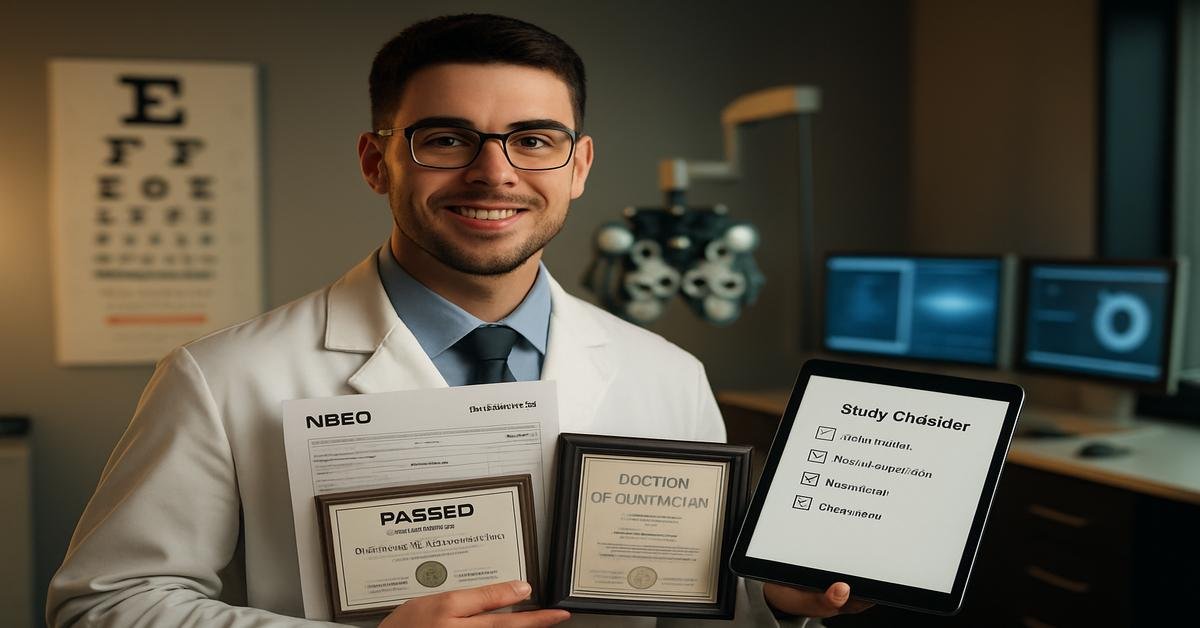
Becoming an optometrist in 2026 is a long process, but it is very manageable when you break it into clear steps. The two biggest milestones are passing the NBEO exams and meeting your state licensing rules. That is where many students feel stuck. There are several exams, each with a different purpose, and licensing rules can vary by state. The good news is that the path is predictable. If you understand what happens at each stage, you can plan better, study smarter, and avoid delays that cost time and money. This guide walks through the process from optometry school to full doctor licensure, with a practical focus on what you need to do and why it matters.
What the optometry career path looks like in 2026
In the United States, the standard path to becoming a licensed optometrist has four main parts:
- Complete the required college coursework and get admitted to an accredited optometry program.
- Graduate from optometry school with your OD degree.
- Pass the NBEO exams, which test knowledge, clinical judgment, and practical skills.
- Apply for state licensure and meet any extra state-specific requirements.
That sounds simple on paper, but each step has details that matter. For example, passing the NBEO is not just about intelligence. It is also about timing, exam strategy, clinical exposure, and understanding how state boards review your application. Students who struggle often do not fail because they are weak overall. They fail because they underestimate the structure of the process.
Know what the NBEO is really testing
The National Board of Examiners in Optometry, or NBEO, runs the main licensing exams used by state boards. These exams are designed to answer one basic question: Can this person practice safely as an entry-level optometrist?
That means the exams do not only test whether you can memorize facts. They test whether you can use those facts in a clinical setting. You need to recognize patterns, choose the next best step, and avoid unsafe decisions.
In practical terms, the NBEO process usually includes these major components:
- Applied Basic Science, often called Part I — covers core sciences that support optometric care.
- Patient Assessment and Management, often called Part II — focuses on clinical thinking, diagnosis, and treatment planning.
- Clinical Skills examination — evaluates hands-on or applied clinical performance.
The exact names, formats, and administration details can change over time, so students in 2026 should confirm current requirements early. That matters because exam changes can affect how you prepare. A student using an old study plan may spend too much time on low-value material and not enough time practicing the kind of reasoning the current exam expects.
Step 1: Build your foundation before the boards are close
The best NBEO prep starts long before your first dedicated study block. Strong students often assume they can catch up later. That is risky. Board performance is usually built during your first years of optometry school, not in the final few weeks before the exam.
Here is why. Part I depends heavily on your understanding of systems, mechanisms, and relationships. If you learn ocular anatomy, physiology, pharmacology, and disease as isolated facts, recall becomes fragile. Under exam pressure, disconnected facts are easy to forget. But if you understand why something happens, you can reason through unfamiliar questions.
For example, if you truly understand aqueous humor dynamics, you are better prepared to answer glaucoma questions even when the wording is unfamiliar. If you only memorized a list of drug names, you may freeze when a question asks you to apply those drugs to a patient with a complicating condition.
Good early preparation includes:
- Reviewing class material weekly instead of cramming before course exams.
- Making concept maps that connect disease mechanisms, findings, and treatment.
- Using active recall, such as self-quizzing from memory.
- Practicing case-based thinking even in basic science courses.
This approach takes more effort at first, but it reduces re-learning later. That is a major advantage when board season overlaps with clinic, school responsibilities, and life stress.
Step 2: Make a realistic NBEO study plan
A study plan should match the way the exam works, not the way you wish you studied. Many students make a beautiful schedule that collapses in one week because it ignores clinic hours, fatigue, and weak areas.
A practical plan has three parts:
- Content review to refresh and organize what you know.
- Question-based learning to train test reasoning.
- Timed practice to improve endurance and pacing.
Start by figuring out your baseline. Take a diagnostic test or complete a mixed set of board-style questions under timed conditions. Do not use tutor mode at first. You need an honest picture of where you are. Some students discover they are weaker in optics than expected. Others realize they know diseases fairly well but lose points on basic science integration.
Then divide topics into three groups:
- Strong — you mostly need maintenance and practice.
- Moderate — you understand the basics but need repetition.
- Weak — you need full review and repeated testing.
This matters because equal study time for every subject is usually inefficient. If neuro-ophthalmic pathways are a weak point, they deserve more time than a topic you already answer correctly at a high rate.
A simple weekly structure might look like this:
- 4 to 5 days of focused topic review with questions built into each session.
- 1 mixed review day to test retention across subjects.
- 1 lighter day for catch-up, flash review, or rest.
Rest is not laziness. It protects performance. Burnout reduces retention, concentration, and test-day stamina.
Step 3: Study for Part I by understanding systems, not just lists
Applied Basic Science is often the first major board hurdle. Students sometimes approach it like a giant memorization contest. That is a mistake. The exam rewards integrated thinking.
When you review, ask questions like:
- What is the normal process?
- What breaks down in disease?
- What symptoms and signs follow from that breakdown?
- What treatment changes the mechanism?
That sequence helps your memory because it creates a logical chain. For instance, in retinal disease, do not stop at appearance and diagnosis. Connect pathology to visual symptoms, imaging findings, risk factors, and management.
Another smart strategy is to study overlapping topics together. Pharmacology, ocular disease, and systemic disease often interact. If you separate them too strictly, you miss the way board questions are built. A question may test side effects, contraindications, and disease mechanism all at once.
Step 4: Prepare for Part II like a clinician
Part II usually feels more familiar to students with strong clinical exposure because it focuses on patient assessment and management. But this can create false confidence. Seeing patients in clinic is not the same as answering board questions well.
In clinic, you can ask follow-up questions, gather extra data, and discuss uncertainty with preceptors. On an exam, you have limited information and must choose the best answer from the options given.
To prepare well, practice structured case analysis:
- Identify the chief problem before looking at answer choices.
- Pull out the key findings that narrow the diagnosis.
- Rule out dangerous alternatives even if they are less likely.
- Choose the next best action, not just a technically possible one.
This “next best action” mindset matters a lot. Board questions often reward safe, appropriate sequencing. A student may know the final diagnosis but still miss the question by choosing a step that is premature, too aggressive, or not indicated yet.
For example, if a patient presents with sudden visual symptoms and signs that suggest urgent retinal pathology, the correct choice may focus on immediate referral or urgent management rather than a more complete but delayed workup.
Step 5: Treat the clinical skills exam as performance training
Students often make one of two mistakes with the clinical skills portion. They either assume their clinic experience is enough, or they become so anxious about the format that they overcomplicate every task.
The right approach is performance training. Clinical skill testing is about consistency, sequence, patient communication, and avoiding errors under pressure. You need to show that you can perform core procedures in a safe and organized way.
That means your practice should include:
- Repeating exam procedures in the correct order until the sequence feels natural.
- Speaking clearly and professionally as you would with a real patient.
- Practicing with time pressure so you do not rush the wrong parts.
- Getting feedback from faculty or peers who will actually correct technique.
Video review can help. Many students do not notice habits that cost points, such as poor positioning, incomplete instructions, or skipping a transition step. Small errors add up.
Step 6: Avoid common reasons students fail or delay licensure
Most licensing delays are preventable. The usual problems are not mysterious. They come from poor planning, missed paperwork, or weak strategy.
Common problems include:
- Starting board prep too late and trying to relearn everything in a short period.
- Using only passive review, such as rereading notes without testing yourself.
- Ignoring weak subjects because they feel uncomfortable.
- Failing to verify state requirements early in the final year of school.
- Delaying exam registration and getting poor test dates or locations.
- Underestimating paperwork timelines for transcripts, score reporting, and background checks.
One practical example: a student may pass all board exams but still cannot start work on time because the state board is waiting on a transcript, jurisprudence exam, or documentation of clinical training. This is frustrating because it has nothing to do with clinical ability. It is an administrative problem, but it affects your income and job start date.
Step 7: Understand state licensing requirements early
Passing the NBEO does not automatically give you a license. Licensure is granted by individual states. Every state board sets its own rules within the larger framework of national exams and professional standards.
In many states, your application may include:
- Proof of graduation from an accredited optometry program.
- NBEO score reports.
- Background check or fingerprinting.
- Jurisprudence exam on state laws and regulations.
- Application fees and supporting documents.
The jurisprudence requirement is especially important because students often treat it as minor. It is not. State law governs what you can do in practice, how you prescribe, what records you must keep, and what conduct can trigger disciplinary action. A state board wants proof that you understand the legal boundaries of practice, not just the medical side.
If you know where you want to practice, check that state’s board requirements months in advance. If you are deciding between states, compare them early. This helps you avoid last-minute surprises.
Step 8: Plan your first job around your license timeline
Many new graduates focus on finding a job and assume the license will fall into place. It should be the other way around. Your license timeline affects when you can legally work, bill, prescribe, and start earning at full capacity.
When talking with employers, be clear about:
- Your expected exam dates.
- When your scores should be available.
- When you will submit your state application.
- Whether the state board has slow processing periods.
This is not just administrative detail. It affects trust. Employers are more comfortable hiring a new graduate who understands the licensing process and communicates clearly about timing.
What makes a strong candidate in the 2026 optometry job market
By 2026, employers are still looking for the same core traits, but they are paying closer attention to readiness. A new doctor needs more than a license. Practices want someone who can move from student to safe, efficient provider.
Traits that matter include:
- Strong clinical judgment and appropriate referral habits.
- Good patient communication, especially for education and treatment adherence.
- Professional reliability with documentation and follow-through.
- Comfort with routine care and medical optometry, depending on the setting.
This is another reason the NBEO matters. It does not just stand between you and your license. It pushes you to organize your knowledge in the way real practice requires. The exam process can feel stressful and bureaucratic, but it also forces a useful transition from student learning to doctor-level decision making.
A final step-by-step checklist
If you want a simple roadmap, use this sequence:
- During optometry school: build strong basic science understanding and keep reviewing core concepts.
- Before board season: take a diagnostic test and identify weak areas.
- For Part I: study systems deeply and use active recall plus timed questions.
- For Part II: practice case-based reasoning and focus on the next best clinical action.
- For clinical skills: rehearse procedures, communication, and timing under realistic conditions.
- Before graduation: confirm the exact requirements of the state where you want to practice.
- After passing exams: submit your licensure application quickly and track every required document.
- Before accepting a job start date: make sure your licensing timeline is realistic.
The path to becoming a licensed optometrist in 2026 is demanding, but it is not confusing once you understand the order of events and the reason behind each one. Pass the NBEO by studying for understanding, not just recall. Approach the clinical exam like a performance skill, not an afterthought. And treat state licensure as a serious project with deadlines and documents, not just a final formality. If you do those things well, you put yourself in a strong position to move from student to practicing doctor without unnecessary setbacks.

