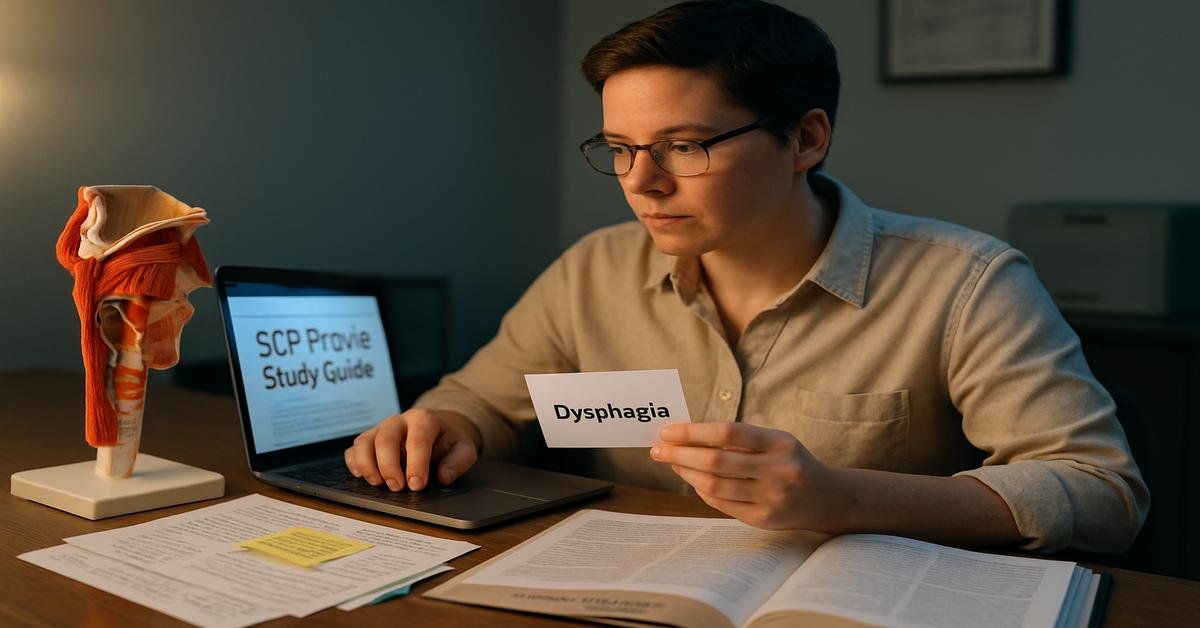
The SLP Praxis covers a wide range of knowledge, but not all topics carry the same weight when you are studying under time pressure. Two areas that often deserve extra attention are dysphagia and language disorders. They show up in direct content questions, case-based questions, and clinical decision-making scenarios. They also test whether you can connect anatomy, development, assessment, and treatment in a practical way. This study guide focuses on the high-yield points you are most likely to need. The goal is not to memorize isolated facts. It is to help you understand the patterns behind the questions so you can reason through them on test day.
Dysphagia: what the Praxis wants you to know
Dysphagia questions usually test three things: whether you understand normal swallowing, whether you can identify where the breakdown is happening, and whether you know what assessment or management step makes sense next. If you know those three layers, many questions become easier.
Swallowing is typically divided into four stages:
- Oral preparatory stage: food is chewed and formed into a bolus.
- Oral transit stage: the tongue moves the bolus posteriorly.
- Pharyngeal stage: the swallow is triggered, the airway is protected, and the bolus moves through the pharynx.
- Esophageal stage: the bolus enters the esophagus and moves toward the stomach.
A common Praxis move is to describe a symptom and ask you to identify the affected stage. For example, poor mastication, pocketing, or reduced bolus control usually point to an oral stage issue. Coughing during meals, wet vocal quality, or delayed swallow trigger usually point to a pharyngeal stage issue. Complaints of food “sticking” lower down or regurgitation after the swallow may suggest an esophageal problem, which often calls for medical referral rather than primary SLP treatment.
High-yield anatomy and physiology for swallowing
You do not need to become an anatomist to pass the Praxis, but you do need the core functions. Questions often depend on knowing why a structure matters.
- Lips and cheeks: keep food in the mouth. Weakness can cause anterior spillage or pocketing.
- Tongue: shapes, holds, and propels the bolus. Reduced tongue strength or coordination affects oral transit.
- Velum: closes off the nasal cavity. Poor closure can lead to nasal regurgitation.
- Larynx: protects the airway during the swallow.
- Epiglottis: helps deflect material away from the airway, though airway protection depends on several coordinated actions, not just the epiglottis alone.
- Upper esophageal sphincter: opens to allow the bolus into the esophagus. Reduced opening can leave residue in the pyriform sinuses.
Know the airway protection sequence at a basic level: vocal folds adduct, the larynx elevates, and structures move to protect the airway as the bolus passes. If a question mentions reduced laryngeal elevation, think about the consequences: poorer airway protection and reduced UES opening.
Signs, symptoms, and what they suggest
The exam often gives you clinical signs and asks for the best interpretation. Learn to connect symptoms to likely physiology.
- Coughing or choking during meals: possible aspiration or penetration.
- Wet, gurgly vocal quality after swallowing: possible pharyngeal residue or airway invasion.
- Multiple swallows per bite or sip: possible residue or reduced clearance.
- Drooling or poor oral containment: oral motor weakness or reduced sensation.
- Delayed swallow initiation: increased risk that material enters the pharynx before the airway is protected.
- Silent aspiration: aspiration with no cough response. This matters because bedside observation alone can miss it.
That last point is especially important. The Praxis may ask why an instrumental assessment is needed. A key reason is that aspiration can be silent. If the patient looks fairly stable but has recurrent pneumonia, weight loss, or unexplained respiratory issues, bedside signs may not tell the whole story.
Dysphagia assessment: bedside versus instrumental
You should know what each assessment method can and cannot do. This is a favorite test area.
Clinical bedside evaluation helps the SLP review history, cranial nerve function, oral mechanism, secretion management, alertness, positioning, and overt signs during trial swallows. It is useful, but it does not directly visualize the swallow.
Videofluoroscopic swallow study (VFSS), also called modified barium swallow study, gives a moving X-ray view of the oral, pharyngeal, and part of the esophageal stages. It helps identify aspiration, timing problems, residue, and the effect of strategies.
Fiberoptic endoscopic evaluation of swallowing (FEES) uses an endoscope passed transnasally to visualize pharyngeal and laryngeal structures. It is useful for secretion management, anatomy, fatigue effects, and repeated observations over a meal. It does not show the oral stage the way VFSS does, and there is a moment of white-out during the actual swallow.
On the Praxis, if the question asks which procedure best evaluates physiology across swallowing stages and tests compensatory techniques in real time, VFSS is often the answer. If it asks about direct visualization of laryngeal structures, secretion status, or repeated bedside use, FEES is often the better choice.
Dysphagia management: compensatory versus rehabilitative
This distinction matters. Praxis questions may ask you to choose an intervention and justify it.
Compensatory strategies aim to improve swallowing safety right away, without changing the underlying physiology. Examples include:
- Postural changes such as chin tuck or head turn
- Diet texture modification
- Small bites and sips
- Pacing and supervised feeding
These are useful when immediate safety is the priority. For example, a head turn may redirect the bolus away from a weaker side of the pharynx.
Rehabilitative strategies aim to improve the underlying swallowing function over time. Examples may include exercises for strength, range of motion, or timing, depending on the specific deficit.
The key test skill is matching the technique to the problem. Do not choose an exercise just because it sounds familiar. Ask: what physiology is impaired, and does this treatment target that impairment?
Medical conditions commonly linked to dysphagia
The Praxis often embeds dysphagia in medical cases. You should recognize common patterns.
- Stroke: may cause oral or pharyngeal dysphagia, delayed swallow, unilateral weakness, reduced sensation, or aspiration risk.
- Parkinson’s disease: may involve reduced movement amplitude, delayed swallow, poor bolus control, and residue.
- Traumatic brain injury: may include dysphagia along with cognitive issues that affect safety and compliance.
- Head and neck cancer: swallowing can be affected by surgery, radiation, fibrosis, pain, and structural changes.
- Dementia: swallowing issues may combine physiologic changes with reduced attention, recognition, and self-feeding ability.
Case questions often test functional reasoning. A patient with mild physiologic impairment but severe cognitive deficits may still be unsafe because they cannot follow precautions. The best answer is often the one that considers both swallowing and cognition.
Language disorders: the high-yield framework
Language disorder questions usually fall into one of three groups: developmental language disorders in children, acquired language disorders such as aphasia, and distinctions between language difference and language disorder. The exam expects you to know normal language development, common error patterns, assessment logic, and core treatment principles.
Start with the main language domains:
- Phonology: sound system rules
- Morphology: word parts such as plurals and tense markers
- Syntax: sentence structure
- Semantics: word and sentence meaning
- Pragmatics: social use of language
Many Praxis questions describe a child’s errors and ask what domain is affected. If a child says “He walk yesterday,” that points to morphology. If a child uses very short, poorly organized sentences, syntax is involved too. If the child has trouble using language appropriately in conversation, think pragmatics.
Developmental language disorders: what to memorize and what to understand
You should know broad developmental milestones, but understanding the sequence matters more than memorizing exact months for every skill. In general, children move from single words to two-word combinations, then to longer sentences with increasing grammar, vocabulary, and narrative ability.
High-yield patterns include:
- Late talkers: limited expressive vocabulary early on, though not all will have persistent disorder.
- Specific weaknesses in morphology and syntax: often show up in omitted grammatical markers, short utterances, and difficulty with complex sentences.
- Vocabulary and word retrieval problems: may affect both comprehension and expression.
- Narrative weakness: trouble telling organized stories with clear sequence and key details.
The Praxis may test whether you can identify red flags. A child who has poor comprehension, limited gestures, weak social interaction, and very slow language growth raises more concern than a child with mild expressive delay alone.
Assessment of language disorders in children
Good test questions do not reward blind reliance on a single standardized score. They reward clinical judgment.
A complete language evaluation often includes:
- Case history and caregiver interview
- Hearing status review
- Standardized testing when appropriate
- Language sample analysis
- Observation across settings
- Dynamic assessment when needed
Language sample analysis is especially high yield because it shows how the child uses language in a more natural context. It can reveal sentence length, grammatical forms, vocabulary variety, narrative skill, and pragmatic patterns that a formal test may miss.
Dynamic assessment matters when the test wants you to separate disorder from difference or limited prior exposure. If a bilingual child performs poorly on a standard English test, that alone does not prove a disorder. The better question is whether the child can learn language forms with support, and whether errors appear across both languages in ways that suggest true impairment.
Language difference versus disorder
This is one of the most important and most misunderstood Praxis areas. A language difference is not a disorder. Dialect features or second-language influence should not be treated as deficits.
For example, if a child uses a nonmainstream dialect feature that is rule-governed within their speech community, that is a difference. It becomes a disorder concern only if the child shows difficulty learning and using language within the rules of their own language system, or if weaknesses appear across languages and contexts.
Questions in this area often include a tempting but wrong answer that labels cultural or linguistic variation as impairment. Be careful. The best answer usually includes culturally responsive assessment and multiple data sources.
Aphasia and acquired language disorders
Adult language questions often center on aphasia. You should know the broad profiles of classic aphasia types, but more importantly, understand the dimensions being tested: fluency, auditory comprehension, repetition, naming, and awareness of errors.
- Broca’s aphasia: typically nonfluent speech, relatively better comprehension, impaired repetition.
- Wernicke’s aphasia: fluent but often empty or paraphasic speech, poorer comprehension, impaired repetition.
- Conduction aphasia: relatively fluent speech and better comprehension, but repetition is notably impaired.
- Global aphasia: severe impairment across language modalities.
- Anomic aphasia: word-finding difficulty is a major feature, with relatively preserved fluent speech and comprehension.
If the Praxis gives you a case, do not jump to a label too fast. Read for the pattern. A patient with fluent speech full of semantic substitutions and poor auditory comprehension does not have Broca’s aphasia just because naming is impaired. Naming is often impaired in many aphasia types.
Treatment principles for language disorders
The exam may ask for the best treatment goal or approach. Strong answers are functional, measurable, and tied to the person’s actual deficits.
For children, therapy often targets skills that support communication in school and daily life, such as:
- Understanding and using grammatical markers
- Expanding sentence structure
- Building vocabulary depth, not just word lists
- Improving story retell and narrative organization
- Supporting classroom language demands
For adults with aphasia, goals often focus on functional communication, caregiver training, and participation. A good treatment plan does not stop at impairment drills. It asks what the patient needs to do: order food, communicate with family, manage appointments, or return to parts of work or community life.
The “why” matters here. A treatment goal is stronger when it connects language skills to real participation. Praxis questions often reward this functional logic.
How to study these topics efficiently for the Praxis
Do not study dysphagia and language disorders as disconnected fact lists. Build simple decision frameworks.
For dysphagia, practice this sequence:
- What stage seems impaired?
- What signs point to that stage?
- What assessment would best confirm it?
- What management option matches the physiology and the patient’s overall status?
For language disorders, use this sequence:
- What language domain is affected?
- Is this developmental or acquired?
- Could this be language difference rather than disorder?
- What assessment data would clarify the picture?
- What treatment goal is both specific and functional?
Case-based practice is especially useful because the Praxis rarely asks only for textbook definitions. It wants you to make a clinical decision with limited but meaningful information.
Final review points to keep in mind
- Dysphagia: know swallowing stages, common symptoms, bedside versus instrumental assessment, and the difference between compensatory and rehabilitative strategies.
- Silent aspiration: remember that absence of coughing does not mean the swallow is safe.
- Language disorders: know the core language domains and how deficits show up in real speech and comprehension.
- Assessment: do not rely on a single test score when language samples, dynamic assessment, or cultural-linguistic context matter.
- Aphasia: focus on fluency, comprehension, repetition, and naming patterns.
- Best answers: are usually the ones that are clinically logical, patient-centered, and tied to actual function.
If you study these areas with a clinical mindset, not just a memorization mindset, you will be in a stronger position on exam day. The Praxis rewards understanding. When you know why a symptom occurs, why one test is more useful than another, and why a treatment fits a specific deficit, you can handle unfamiliar questions with much more confidence.

