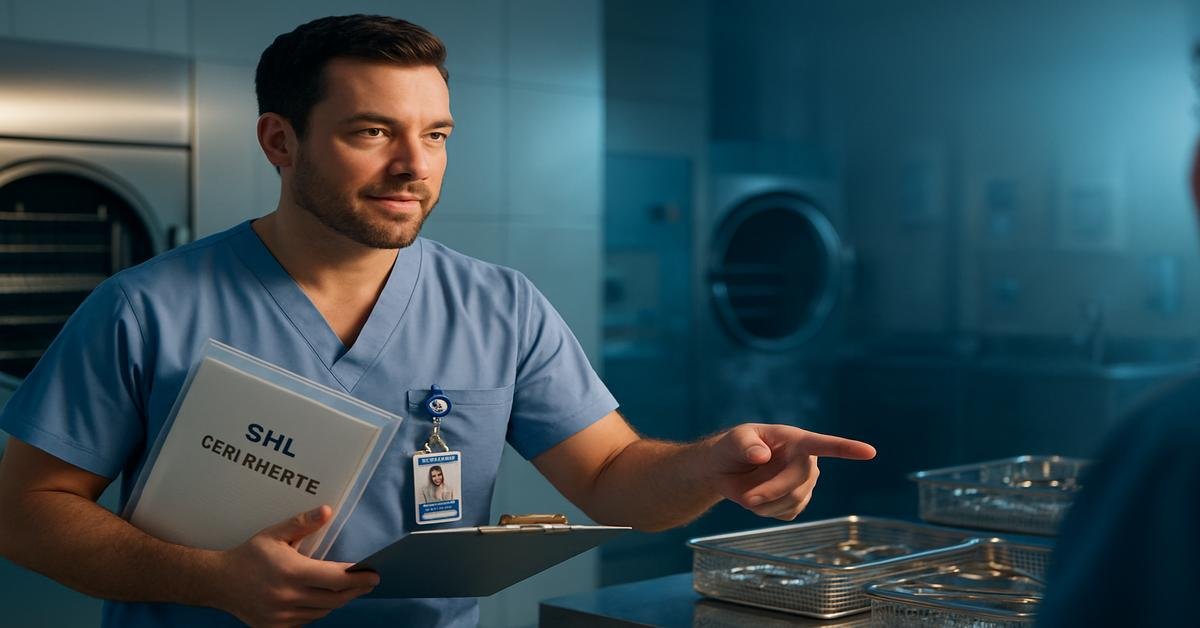
Sterile processing is one of the most important support functions in a hospital, even though patients rarely see it. When instruments are not cleaned, assembled, sterilized, stored, and delivered correctly, surgery slows down, infection risk rises, and clinical teams lose trust. That is why hospitals need more than skilled technicians. They need leaders who understand workflow, quality systems, staffing, compliance, and communication across departments. For many people in sterile processing, the CHL certification can help bridge that gap. It shows readiness for leadership and can support the move into supervisory, manager, and director-level roles.
What sterile processing management really involves
People outside the field sometimes think sterile processing management is mainly about making sure trays are ready on time. That is part of it, but the role is much broader. A supervisor or director is responsible for the full system, not just the daily output.
That system usually includes:
- Decontamination workflow so used devices are handled safely and cleaned according to manufacturer instructions
- Assembly and inspection standards so trays are complete, functional, and consistent
- Sterilization process control including load configuration, monitoring, documentation, and release
- Inventory and instrument availability so operating rooms, clinics, and procedural areas have what they need when they need it
- Staffing and training so technicians are competent, cross-trained, and supported
- Regulatory and accreditation readiness so the department can meet survey expectations and internal quality goals
- Collaboration with surgery, infection prevention, risk management, and materials management
In practice, management means balancing patient safety, productivity, and people. A good manager cannot focus on speed alone. Fast tray turnaround means little if errors increase. At the same time, perfect technical standards on paper do not help much if the operating room is constantly delayed because communication and scheduling are poor. Leadership in sterile processing is about building a reliable process that works under pressure.
Why hospitals look for formal leadership credentials
Hospitals do not promote people into leadership just because they are strong technicians. Technical ability matters, but management roles require a different skill set. A senior technician may be excellent at identifying damaged instruments or troubleshooting washer failures, yet still need development in budgeting, staff coaching, policy writing, or performance improvement.
This is where certifications matter. They help employers see that a candidate has studied the broader responsibilities of leadership. A formal credential does not replace experience, but it does show structure. It shows the person has invested time in learning how departments are managed, how quality is measured, and how healthcare systems operate.
For hospital hiring managers, that matters for a simple reason: leadership mistakes in sterile processing affect many departments at once. A weak decision about instrument standardization can frustrate surgeons. Poor staff training can create inspection failures. Incomplete documentation can become a compliance issue. Because the impact spreads quickly, employers often prefer leaders who have both hands-on experience and recognized management education.
What the CHL certification signals to employers
The CHL certification is often seen as a leadership-focused credential. In a hiring or promotion context, it can signal that the candidate is moving beyond task-level competence and toward department-level thinking.
That matters because hospitals want leaders who can answer questions like these:
- How do we reduce tray errors without slowing production?
- How do we train new staff consistently across all shifts?
- How do we prepare for an accreditation survey?
- How do we measure productivity in a fair way?
- How do we work with the operating room when case volume changes suddenly?
- How do we justify new equipment or additional staff?
A leadership certification helps show that the candidate has been exposed to those questions. It suggests they understand that sterile processing is not only a technical department. It is also an operational and strategic department.
That distinction is important. Hospitals increasingly expect sterile processing leaders to contribute to broader goals such as patient safety, cost control, service line growth, and standardization. A director may need to explain why instrument repair costs are rising, why peel pack usage is inconsistent, or why delayed case starts are linked to tray completeness issues. Someone with a leadership credential is often better positioned to speak that language.
How CHL can support the move into a supervisory role
The first step up is often a lead technician or supervisor role. This is where many sterile processing professionals discover that leadership is less about authority and more about consistency.
A supervisor usually handles practical responsibilities such as:
- Assigning staff by area and shift
- Monitoring work quality in decontam, prep and pack, and sterilization
- Coaching technicians on errors and process steps
- Helping manage urgent requests from the operating room
- Tracking productivity, tray turnaround, and missing instruments
- Supporting orientation and competency checks
CHL can help at this stage because it gives structure to what could otherwise be a difficult transition. A technician is used to doing the work. A supervisor must also direct the work, explain expectations, and correct problems fairly. That shift can be uncomfortable. Many new supervisors struggle when they have to coach former peers, document performance issues, or defend policy decisions they did not create.
Leadership preparation helps because it teaches that management decisions should be based on standards, risk, and process—not personal preference. For example, if one technician skips a step during inspection to save time, the supervisor needs to explain not only that the shortcut is wrong, but why it creates patient risk and process instability. A certification rooted in leadership concepts helps make those conversations clearer and more credible.
How CHL can strengthen a manager or director candidacy
Director and manager roles require a wider view. At that level, a leader is not just overseeing shift operations. They are shaping the department’s direction.
Typical responsibilities may include:
- Budget planning for staffing, supplies, repairs, capital equipment, and service contracts
- Policy and procedure oversight to keep department practices aligned with current standards and manufacturer instructions
- Quality improvement using data to reduce errors, delays, wet loads, missing instruments, and rework
- Survey readiness for internal audits and outside inspections
- Interdepartmental leadership with surgery, endoscopy, infection prevention, and supply chain
- Staff development including career ladders, succession planning, and certification support
CHL can strengthen a candidacy here because it supports the case that the person understands management as a discipline. Hospitals often look for leaders who can connect sterile processing outcomes to hospital-wide performance. A tray error is not only a tray error. It can become an OR delay, surgeon dissatisfaction, overtime cost, and possible patient safety event. A manager or director must see the chain of impact.
That is one reason leadership credentials can carry weight. They suggest the candidate can think in systems. In an interview, that often shows up in stronger answers. Instead of saying, “I would remind the staff to be more careful,” a stronger candidate might say, “I would review where errors are occurring, compare shifts, audit work instructions, verify competency, and check whether tray design or case cart timing is contributing to rework.” That answer sounds different because it reflects management thinking.
Certification alone is not enough
It is important to be realistic. CHL can help open doors, but it does not automatically qualify someone for a director job. Hospitals usually want a combination of certification, experience, communication ability, and leadership results.
In most cases, employers still want to see evidence such as:
- Experience leading people, even informally
- A record of improving quality or workflow
- Good working relationships with the OR and other departments
- Comfort with audits, reports, and documentation
- Professional judgment under pressure
This matters because management is visible. A technician can be highly effective while working independently. A supervisor or director works in a more exposed way. Their decisions affect staffing, morale, turnaround time, compliance, and physician trust. Hospitals need proof that a candidate can lead in real conditions, not just pass an exam.
So the strongest career path is usually this: build deep technical credibility, gain experience solving daily operational problems, earn leadership education such as CHL, and then show measurable impact.
What measurable impact looks like in sterile processing leadership
If you want CHL to lead to higher-level hospital roles, it helps to pair it with outcomes that employers value. That means being able to point to real improvements you helped create.
Useful examples include:
- Reducing tray assembly errors through revised checklists and staff retraining
- Improving on-time case support by reorganizing workflow and priority communication
- Lowering instrument repair costs by improving handling and inspection practices
- Strengthening orientation for new hires so competency is reached faster and more consistently
- Preparing the department for a successful audit or accreditation survey
- Helping standardize trays with OR leadership to reduce missing items and unnecessary duplicates
These examples matter because they show leadership in action. Hospitals promote people who make systems better. Certification supports that story, but results prove it.
For example, imagine two candidates applying for a manager role. Both have technical experience. One says, “I earned CHL and want to grow.” The other says, “I earned CHL, led a tray error reduction project, updated our shift handoff process, and worked with the OR to cut urgent add-on delays.” The second candidate is much easier to hire because the hospital can already picture them functioning in the role.
How CHL helps with credibility across departments
Sterile processing leaders do not work in isolation. Much of the job involves influence. Directors and supervisors must work with people who may not fully understand sterile processing complexity, including surgeons, perioperative leaders, infection prevention staff, and executives.
That is where leadership credentials can help in a subtle but important way. They can improve credibility in cross-department conversations.
For instance, when discussing why a loaner tray cannot be rushed through without proper processing steps, the issue is not only technical accuracy. It is also professional authority. A leader with recognized credentials may be better positioned to explain the risk, defend the standard, and hold the line when pressure builds.
The same is true in budget discussions. If a director is asking for new sterilizers, more tracking technology, or additional educator support, they need to speak in operational terms. They must explain the effect on safety, throughput, labor efficiency, and service continuity. Leadership education can improve that communication because it pushes people to think beyond the department bench and into the larger hospital picture.
Best ways to use CHL as a career step, not just a resume line
To get the most value from CHL, it helps to treat it as part of a larger career strategy.
Practical steps include:
- Ask for leadership tasks now. Volunteer to help with audits, orientation, policy review, or process improvement projects.
- Track your results. Keep records of error reduction, training work, committee participation, and workflow improvements.
- Learn the business side. Pay attention to staffing plans, repair spending, case volume, and supply usage. Directors are expected to understand these numbers.
- Build communication skills. Practice writing clear emails, presenting data, and explaining sterile processing concerns to non-SPD leaders.
- Develop a reputation for reliability. Hospitals promote people who stay calm, follow standards, and solve problems without drama.
These steps matter because promotions often happen before a formal posting appears. Senior leaders usually already know who they trust. If your certification is paired with visible leadership behavior, you are more likely to be seen as ready when an opening comes up.
What hospitals want in sterile processing directors and supervisors now
Hospital expectations have changed. Sterile processing leaders today are expected to be stronger in data, quality systems, staff development, and cross-functional communication than in the past. The department is no longer viewed as only a back-room service area. It is recognized as a patient safety and operational control point.
That shift creates opportunity. Professionals who earn CHL and pair it with real leadership performance may be well positioned for advancement because hospitals need people who can manage complexity. Instrument inventories are larger. device instructions are more detailed. surgery schedules are tighter. survey expectations are higher. Staff retention is harder. All of that increases the value of skilled leaders.
In other words, hospitals are not just looking for someone who knows sterile processing. They are looking for someone who can lead sterile processing through change, pressure, and accountability.
Final thought
CHL certification can be a meaningful step toward supervisory and director roles in hospitals because it signals leadership intent and management knowledge. It shows that a sterile processing professional is preparing for responsibilities beyond the technical workflow. But the credential has the most value when it is backed by strong experience, measurable improvements, and the ability to lead people well.
For professionals who want to move up, that is the real path: master the work, learn to improve the system, earn leadership credibility, and show that you can protect both safety and operations at the same time. In sterile processing management, that combination is what turns a capable technician into a trusted hospital leader.

