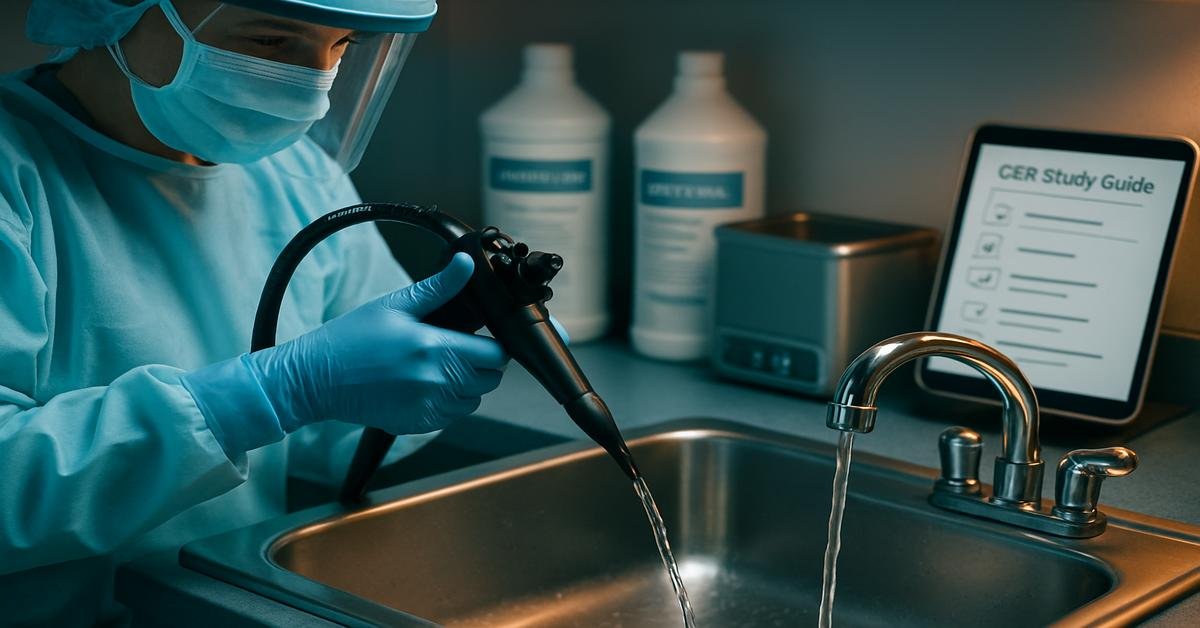
Preparing for the CER exam means learning much more than a list of steps. You need to understand why each step in endoscope decontamination matters, what can go wrong, and how safety protocols protect both patients and staff. Flexible endoscopes are complex devices with long, narrow channels, delicate materials, and many surfaces that can trap soil and microbes. That is why reprocessing failures can lead to infections, equipment damage, failed inspections, and serious patient harm. This study guide focuses on the high-yield topics you are most likely to see on the exam and in real practice.
Why flexible endoscope decontamination is a high-risk process
Flexible endoscopes are harder to clean than many other medical devices because they are heat-sensitive and have internal channels that cannot be seen directly during routine cleaning. Blood, mucus, tissue, and biofilm can remain inside if the process is rushed or incomplete. Once soil dries, it becomes much harder to remove. If microbes remain after cleaning, high-level disinfection may not work as intended because disinfectants cannot reliably penetrate organic debris.
This is one of the most tested ideas on the CER exam: cleaning is the foundation of disinfection. High-level disinfection is not a substitute for good cleaning. If a scope is poorly cleaned, the next steps are weakened from the start.
Another reason this topic matters is patient-to-patient risk. Flexible endoscopes contact mucous membranes, and some enter sterile body sites when used with accessories. Even when the scope itself is classified as a semi-critical device, its contamination can still transmit serious pathogens if reprocessing fails. The exam often tests your understanding that the device design, intended use, and level of patient contact all affect the required level of reprocessing.
Spaulding classification and what it means in practice
The Spaulding classification system is a core concept. It connects device use to the minimum level of reprocessing required.
- Critical items: enter sterile tissue or the vascular system. These must be sterile.
- Semi-critical items: contact mucous membranes or non-intact skin. These require at least high-level disinfection.
- Non-critical items: contact intact skin only. These usually require low-level disinfection or cleaning.
Most flexible endoscopes are treated as semi-critical devices and require meticulous cleaning followed by high-level disinfection, unless the manufacturer and use case require sterilization. The exam may also test related accessories. For example, some accessories used through the scope channel may be single-use, while reusable critical accessories require sterilization. Do not assume all parts of the procedure are handled the same way.
The key point is this: reprocessing decisions are based on risk of infection from how the device is used, not just on what the device is called.
Point-of-use pre-cleaning: the first high-yield step
Point-of-use treatment begins immediately after the procedure. This step is often underestimated, but it has a major effect on all later steps. The goal is to prevent bioburden from drying on or inside the scope.
Common actions include:
- Wiping the exterior of the insertion tube with the approved solution
- Suctioning detergent or water through channels according to instructions for use
- Flushing air and water channels as directed
- Removing detachable parts for separate reprocessing if required
- Transporting the scope in a way that prevents environmental contamination
Why this matters: dried soil sticks to internal channel walls and creates a surface where microbes can survive. Early pre-cleaning reduces the microbial load and makes manual cleaning more effective. On the exam, if you see a question asking which step best prevents soil from becoming difficult to remove, point-of-use pre-cleaning is often the answer.
Leak testing: protecting the device and the process
Leak testing checks the scope for damage before immersion and manual cleaning. If the scope has a leak and is immersed, fluids can enter internal spaces not meant to be exposed. This can damage the scope and create hidden contamination that is difficult or impossible to remove.
There are two broad reasons leak testing is so important:
- Patient safety: a damaged scope may not be fully reprocessable.
- Equipment protection: catching damage early can prevent more costly internal damage.
If a leak is detected, the scope should be removed from service and handled according to facility policy and manufacturer instructions. A common exam trap is to continue processing after a failed leak test. That is unsafe. A failed leak test changes the next action: do not proceed as if the scope is intact.
Manual cleaning: the most critical step in the whole cycle
Manual cleaning removes visible soil and much of the microbial contamination before high-level disinfection or sterilization. This step is often considered the most important part of reprocessing because disinfectants cannot reliably work through residual debris.
Strong manual cleaning includes:
- Using the correct detergent at the correct dilution and temperature
- Following the device manufacturer’s instructions for all channels and components
- Brushing every accessible channel with the correct size brush
- Flushing channels thoroughly
- Cleaning detachable valves, caps, and other removable parts separately
- Inspecting the scope and components during the process
The “why” here is simple: internal channels are narrow and can trap proteins, fat, and mucus. Brushing creates friction that loosens debris from surfaces. Flushing moves loosened soil out of the channels. If the brush is the wrong size, it may glide through without contacting the channel wall. If channels are skipped, contamination remains hidden.
A high-yield exam idea is that manual cleaning must be complete even when an automated endoscope reprocessor is used later. The AER does not replace proper manual cleaning.
Visual inspection, borescopes, and cleaning verification
Inspection is no longer just a quick look at the outside of the scope. Modern practice places strong emphasis on identifying retained soil, damage, and moisture. Visual inspection includes the exterior, distal end, connectors, removable parts, and anything else accessible. Magnification and adequate lighting help because tiny cracks or debris can be missed with the naked eye.
Borescopes are used to inspect internal channels more directly. They can reveal retained debris, scratches, peeling surfaces, or fluid that ordinary external inspection will never show. On an exam, if you are asked what supports quality assurance beyond routine visual checks, borescope inspection and cleaning verification testing are strong answers.
Cleaning verification tests may check for substances such as protein, hemoglobin, or ATP, depending on facility practice and test design. These tests do not replace full reprocessing steps, but they help confirm whether cleaning was effective. The reason they matter is that invisible contamination can still interfere with high-level disinfection.
High-level disinfection and when sterilization may be needed
After cleaning, many flexible endoscopes undergo high-level disinfection. High-level disinfection destroys vegetative bacteria, mycobacteria, fungi, and many viruses, though it may not kill large numbers of bacterial spores. For semi-critical flexible endoscopes, this is often the minimum acceptable level when supported by the manufacturer’s instructions for use.
To be effective, high-level disinfection depends on:
- Correct chemical concentration
- Correct temperature
- Correct contact time
- Full channel and surface exposure to the disinfectant
- Prior thorough cleaning
This is another exam favorite: if one parameter is missed, the process may not be valid. For example, shortening contact time because the department is busy is not a minor error. It can mean the scope has not reached the required disinfection level.
Sterilization may be required for certain devices, accessories, or specific manufacturer instructions. Always tie the answer back to device use and manufacturer guidance. The CER exam often rewards the answer that follows instructions for use over guesswork or habit.
Automated endoscope reprocessors: benefits and limits
Automated endoscope reprocessors bring consistency. They standardize exposure time, fluid flow, and process steps. They also reduce some direct chemical handling by staff. But they are not magic machines. They only work correctly if the scope is properly cleaned, correctly connected, and compatible with the machine and the process chemistry.
Common high-yield points about AERs include:
- All channels must be connected correctly for effective flow.
- The AER must be used according to both the endoscope and AER manufacturer instructions.
- Routine maintenance, testing, and documentation are part of safe use.
- Using an AER does not eliminate the need for staff competency.
A common real-world problem is incorrect channel hookup. If the disinfectant or rinse water does not flow through a channel, that channel has not been properly processed. The exam may present this as a setup error and ask what the biggest risk is. The answer is incomplete reprocessing.
Rinsing, drying, and storage: where many hidden failures happen
After high-level disinfection, the scope must be rinsed as directed to remove chemical residue. Residual disinfectant can injure patients, especially on delicate mucosal surfaces. Then comes drying, which is one of the most important and commonly missed steps.
Moisture supports microbial growth. Even a properly disinfected scope can become unsafe if water remains in channels during storage. That is why forced air drying and alcohol flushing, when specified, are important parts of the process. Drying is not cosmetic. It is a microbiological control step.
For storage, scopes are usually hung vertically in a clean, well-ventilated cabinet, with detachable parts managed according to policy and manufacturer instructions. Proper storage protects the scope from recontamination and helps residual moisture drain away. High-yield exam logic: if storage conditions allow moisture retention or environmental contamination, the safety of the scope is reduced even if earlier steps were done correctly.
Transport, workflow, and separation of clean and dirty areas
Safe reprocessing depends on physical workflow as much as technical skill. Dirty scopes should move through decontamination in one direction, from contaminated handling to cleaning, disinfection, drying, and clean storage. Clean and dirty items should not cross paths. This reduces the chance of recontamination.
Transport also matters. Used scopes should be transported in closed, labeled containers that protect staff and the environment from exposure. Clean scopes should be moved in a way that preserves cleanliness. If the exam asks about department design or best practice, think about contamination control through one-way workflow and separation of clean and dirty functions.
Personal protective equipment and staff safety protocols
Flexible endoscope reprocessing exposes staff to blood, body fluids, splashes, aerosols, and strong chemicals. PPE is not optional. It is a control measure for predictable hazards.
Common PPE includes:
- Gloves appropriate to the task
- Fluid-resistant gown
- Face protection such as mask and eye protection or face shield
- Respiratory protection if required by the chemical hazard assessment
The “why” is straightforward. Brushing channels and flushing fluids can create splashes. Chemical disinfectants can irritate the skin, eyes, and respiratory tract. Staff need protection not only during dirty handling, but throughout the stages where exposure is possible.
Safety protocols also include ventilation, chemical monitoring, spill response, and access to safety data information. If a question asks how to reduce staff chemical exposure, the best answer is usually a combination of engineering controls, proper PPE, and adherence to safe handling procedures.
Documentation, traceability, and quality assurance
Good documentation is a patient safety tool. It supports traceability, quality review, and response to possible exposure events. Typical records may include:
- Patient and procedure identification
- Scope identifier or serial number
- Date and time of reprocessing
- Operator identification
- Disinfectant test results and process parameters
- Maintenance and repair history
Why this matters: if there is a suspected reprocessing failure, traceability helps identify which patients and which devices may be involved. It also helps reveal patterns, such as repeat failures with the same scope, skipped steps, or staff training gaps.
Quality assurance also includes competency assessment, audits, preventive maintenance, environmental monitoring as required, and review of policy compliance. The CER exam often tests the idea that a strong reprocessing program is not just about individual tasks. It is a system with checks built in.
Common exam traps and how to think through them
Many CER questions are designed to see whether you understand priorities. A few patterns come up often:
- Visible soil after cleaning: the item is not ready for high-level disinfection. It must be re-cleaned.
- Failed leak test: remove the scope from service and follow policy. Do not continue routine immersion processing.
- Missing or unclear instructions for use: do not guess. Follow facility policy for obtaining correct guidance.
- Incorrect chemical concentration or expired solution: the process may be invalid.
- Wet scope in storage: think risk of microbial growth and compromised storage conditions.
- Skipped brushing because an AER will be used: this is incorrect. Manual cleaning still matters.
A helpful exam strategy is to ask yourself three questions:
- What step best removes or reduces soil?
- What step best prevents damage or recontamination?
- What action most closely follows manufacturer instructions and patient safety principles?
These questions often lead you to the right answer even when the wording is tricky.
What to memorize versus what to truly understand
For CER prep, some details need memorization, such as device categories, major process steps, and the role of PPE and documentation. But the deeper learning comes from understanding cause and effect.
- If soil remains, disinfection is weaker.
- If moisture remains, microbes may grow.
- If channels are not connected, the process is incomplete.
- If a scope is damaged, it may not be safely reprocessed.
- If documentation is poor, exposure events are harder to investigate.
When you study with this logic, the material becomes easier to remember because it stops being a list and becomes a safety system.
Flexible endoscope decontamination is one of the most important topics on the CER exam because it combines microbiology, device design, workflow, human factors, and patient safety. Focus on the sequence of care: pre-clean promptly, leak test correctly, clean thoroughly, inspect carefully, disinfect or sterilize as required, dry completely, store safely, and document everything. If you understand why each step exists, you will be better prepared not only for the test, but for real decisions in the reprocessing department.

