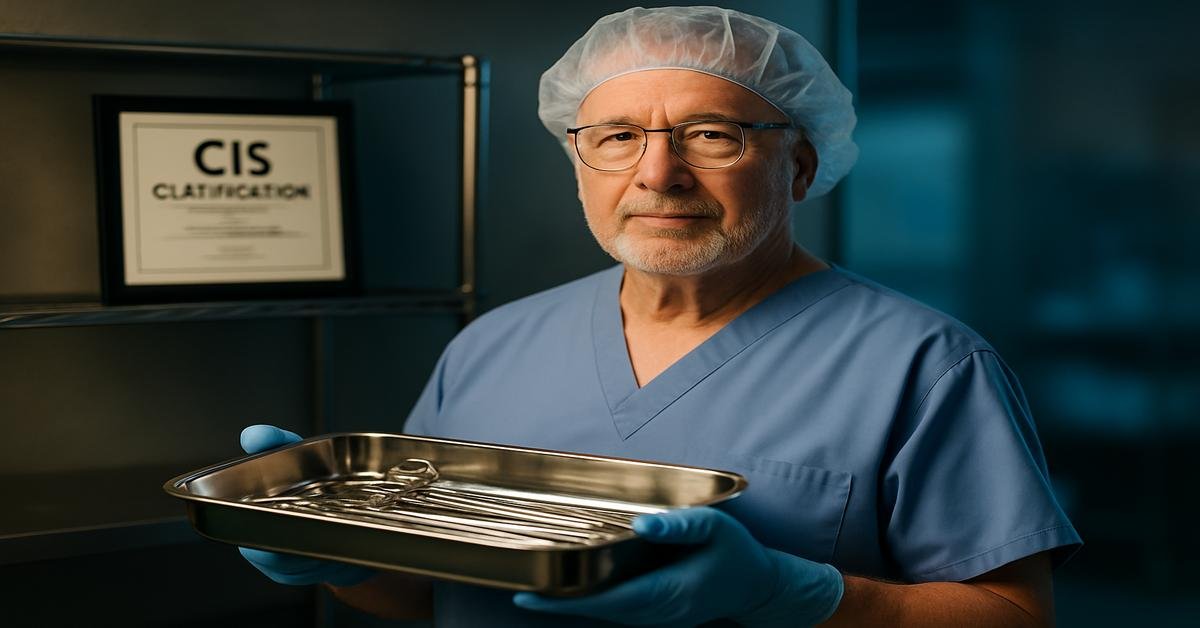
In sterile processing, experience matters. But when someone wants to move into a senior role focused on surgical instruments, experience alone is often not enough. That is where the Certified Instrument Specialist, or CIS, credential becomes important. It shows that a technician understands instruments at a deeper level: how they are designed, how they are used in surgery, how they should be cleaned and inspected, and what can go wrong if they are mishandled. For people building a surgical instrument career, CIS certification is not just another line on a resume. It is proof of specialized knowledge that supports patient safety, stronger team performance, and career growth into more advanced sterile processing positions.
What CIS certification means in sterile processing
The CIS credential is a specialized certification for sterile processing professionals who work closely with surgical instruments. While a general sterile processing certification shows broad knowledge of decontamination, preparation, sterilization, and distribution, CIS goes further into instrument-specific knowledge.
This matters because surgical instruments are not simple tools. They come in thousands of designs. Many look similar but function differently. A clamp, forceps, elevator, retractor, or laparoscopic instrument may have very specific handling, testing, and assembly needs. Senior sterile processing staff are often expected to know these differences without guesswork.
A CIS-certified professional is usually expected to understand areas such as:
- Instrument identification and correct naming
- Instrument function during surgical procedures
- Inspection and testing for wear, alignment, sharpness, and damage
- Proper cleaning methods for complex devices
- Assembly of surgical sets with attention to count sheets and surgeon preference
- Care of specialty instruments, including microsurgical, orthopedic, robotic, and laparoscopic devices
That depth of knowledge becomes essential as technicians move into lead, educator, quality, instrument coordinator, or advanced tray assembly roles.
Why senior sterile processing roles demand more than basic technical skill
Entry-level sterile processing work often focuses on following established steps correctly. Senior roles require something different. They require judgment.
A senior technician is not just expected to clean and assemble. They are expected to spot a problem before it reaches the operating room. They may need to recognize that a Kerrison is dull, that a laparoscopic insulation layer is compromised, or that a loaner tray is missing a specialty item the count sheet failed to flag. These are not small issues. They can delay surgery, frustrate surgeons and OR staff, increase costs, and in some cases put patients at risk.
This is why CIS certification carries weight. It tells employers that the person has studied the instrument side of sterile processing in a focused way. It suggests they can think beyond routine steps and understand how instruments perform in real clinical use.
For example, two scissors may both appear clean. But a senior instrument specialist should also ask:
- Do the blades meet correctly?
- Is there a gap, nick, or looseness at the joint?
- Does the scissor cut the test material cleanly from tip to heel?
- Is there staining, pitting, or corrosion that could affect performance?
That level of assessment is what separates basic processing from advanced instrument management.
Patient safety is the strongest reason CIS matters
It is easy to talk about certification in terms of career growth, but the strongest reason it matters is patient safety. Surgical instruments that are damaged, assembled incorrectly, or not properly inspected can affect the outcome of a procedure.
Consider a few practical examples:
- A cracked insulation on a laparoscopic instrument can create a burn risk during minimally invasive surgery.
- A dull rongeur or scissor can make tissue handling less precise and increase surgeon frustration during a critical step.
- A misassembled powered instrument can fail in the middle of a case.
- A retained bioburden issue in a complex hinged instrument can create a serious infection control concern.
Senior sterile processing staff are often the last line of defense before the instrument reaches the OR. That is why specialized instrument knowledge is not optional in higher-level roles. CIS certification supports that responsibility by validating that the person understands how to inspect and manage instruments carefully, not just process them quickly.
In many departments, speed matters because of case volume. But speed without instrument knowledge can create expensive and dangerous errors. The CIS credential helps reinforce a standard: quality first, because poor instrument quality eventually slows everything down anyway.
CIS certification helps build credibility with the operating room
One of the biggest challenges in sterile processing is earning trust across departments. OR teams depend on sterile processing, but they do not always see the work behind the scenes. When issues happen in the operating room, the pressure is immediate. Cases are delayed. Surgeons are waiting. Staff want answers quickly.
In that environment, credibility matters.
A senior sterile processing professional with CIS certification often has stronger standing when discussing instrument issues with surgical staff, vendors, service teams, and managers. The credential does not replace good communication or real experience, but it supports both. It signals that the person has formal knowledge of instruments, not just informal familiarity.
This can help in situations such as:
- Explaining why an instrument should be repaired or removed from service
- Reviewing tray errors and identifying root causes
- Helping revise count sheets that no longer match actual set needs
- Supporting in-service training on instrument handling and care
- Working with the OR on missing items, damaged devices, or specialty set standardization
When a senior technician can clearly explain why a problem happened and how to prevent it, they become more valuable to the whole surgical team. CIS certification helps strengthen that role.
It supports advancement into leadership and specialty positions
Not every experienced technician wants to become a manager. Many want to stay close to technical work while moving into higher-level responsibility. CIS certification is especially useful for that path.
It can support advancement into roles such as:
- Lead sterile processing technician
- Instrument coordinator
- Surgical tray specialist
- SPD educator or preceptor
- Quality or audit-focused technician
- Service line specialist for orthopedic, neuro, cardiac, robotic, or ophthalmic instruments
Why does this matter? Because senior roles often require more than seniority. Employers want people who can solve technical problems, train others, reduce errors, and manage complex inventory. A general certification shows foundation-level competence. CIS shows specialization.
For a hiring manager, that difference can be practical. If two candidates have similar years of experience, but one has taken the extra step to earn CIS certification, that candidate may appear more prepared for instrument-heavy responsibilities.
The same applies internally. Departments often need someone to take ownership of difficult areas: loaner instrumentation, specialty service line sets, damaged item tracking, or count sheet cleanup. CIS-certified staff are often natural candidates because they have already committed to deeper study.
The certification sharpens the way professionals think about instruments
One underrated benefit of CIS certification is how it changes a technician’s mindset. Studying for the exam forces people to move beyond pattern recognition.
Many technicians learn instruments by repetition. They know what belongs in a tray because they have assembled it many times. That kind of learning is useful, but it has limits. It can break down when trays are updated, when a new surgeon arrives, when a specialty set appears, or when a damaged instrument looks almost normal at first glance.
CIS preparation pushes professionals to understand:
- How instruments are categorized
- How design affects cleaning and function
- How surgical use affects wear patterns
- How to identify subtle but important defects
- Why handling, testing, and storage methods matter
This creates a more analytical approach. Instead of thinking, “This looks about right,” the technician starts thinking, “Does this instrument function the way it is supposed to, and what evidence do I have?”
That shift is important in senior roles. Leaders and specialists need to make consistent decisions, not guesses based on habit.
CIS certification can reduce costly instrument and tray problems
Hospitals spend large amounts of money on surgical instruments. Some specialty devices cost hundreds or thousands of dollars each. A department that mishandles, misidentifies, or poorly inspects instruments can create major waste.
Common costly problems include:
- Unnecessary repairs caused by poor handling or incorrect cleaning
- Premature replacement because damage was not caught early
- Case delays from missing or incorrect tray contents
- Duplicate purchases because inventory tracking is weak
- Loaner tray problems due to rushed or incomplete processing
Senior professionals with CIS certification are often better prepared to help control these issues. They understand instrument care in a way that supports both safety and cost control.
For example, a certified instrument specialist may recognize that a repeated repair issue is not random damage but a handling problem during transport or washer loading. Or they may notice that a tray is consistently overbuilt with rarely used items that increase inspection time and replacement cost without helping the surgical team. These are the kinds of observations that improve department performance over time.
It strengthens training and mentoring inside the department
Senior sterile processing staff are often informal teachers, even if training is not their official title. New technicians ask them questions. Other shifts depend on their judgment. Managers rely on them to reinforce standards.
This is another reason CIS certification matters. You cannot teach instrument care well if your own knowledge is incomplete.
A senior technician with CIS-level knowledge can help newer staff understand not just what to do, but why they are doing it. That improves retention and consistency.
For instance, instead of saying, “Always open box locks in the washer,” they can explain that closed box locks prevent proper water and detergent contact in hidden areas, making cleaning less effective. Instead of simply rejecting a damaged clamp, they can explain how jaw misalignment affects tissue grasping during a case.
That kind of teaching builds a stronger department. It creates fewer repeated mistakes because people understand the reason behind the standard.
Experience still matters, but certification validates and organizes it
It is important to be realistic. CIS certification does not magically make someone an expert. A person can pass an exam and still need hands-on growth. At the same time, many excellent senior technicians already have strong instrument knowledge before they ever sit for the test.
So why get certified?
Because certification validates that knowledge in a formal, recognized way. It also helps organize experience into a stronger framework. People who have learned on the job often discover during CIS study that they know many answers already, but they now understand the broader system behind those answers.
That matters when they want to move up, apply elsewhere, or contribute at a higher level in their current department. A manager can observe strong performance, but a certification gives that performance a credentialed standard.
In competitive job markets, formal validation helps. In internal promotion decisions, it can help too. It shows initiative, discipline, and commitment to the specialty.
Who should consider CIS certification
CIS certification is especially valuable for sterile processing professionals who:
- Work heavily with surgical set assembly and instrument inspection
- Want to move into lead or specialist roles
- Support complex service lines such as ortho, neuro, robotics, or ophthalmology
- Help train other technicians
- Work with vendors, repairs, loaners, or count sheet management
- Want stronger credibility in instrument-focused positions
It is particularly useful for people who feel stuck between frontline technical work and leadership. It offers a way to grow professionally without leaving the technical side of sterile processing behind.
Why CIS is essential, not optional, for many senior instrument-focused roles
Not every senior sterile processing job requires CIS certification on paper. But in practice, many instrument-focused roles benefit from the exact knowledge the credential is meant to measure. That is why it has become increasingly important.
If a role includes responsibility for specialty instrumentation, tray quality, cross-department problem-solving, training, or instrument standards, then CIS is more than a nice extra. It directly matches the work.
Calling it “essential” is not about making certification sound prestigious. It is about matching responsibility to knowledge. Senior roles involve higher stakes. The person handling those duties should have a reliable foundation in instrument science, function, and care. CIS certification helps show that foundation is there.
For professionals serious about a surgical instrument career, the message is simple: broad sterile processing knowledge gets you into the field, but specialized instrument knowledge helps you advance in it.
In the end, CIS certification matters because surgical instruments matter. They affect case flow, surgeon performance, department costs, and most importantly, patient safety. Senior sterile processing professionals carry more responsibility for those outcomes. The CIS credential helps prove they are ready for that responsibility. It does not replace experience, but it strengthens it, sharpens it, and makes it easier for employers and teams to trust it.

