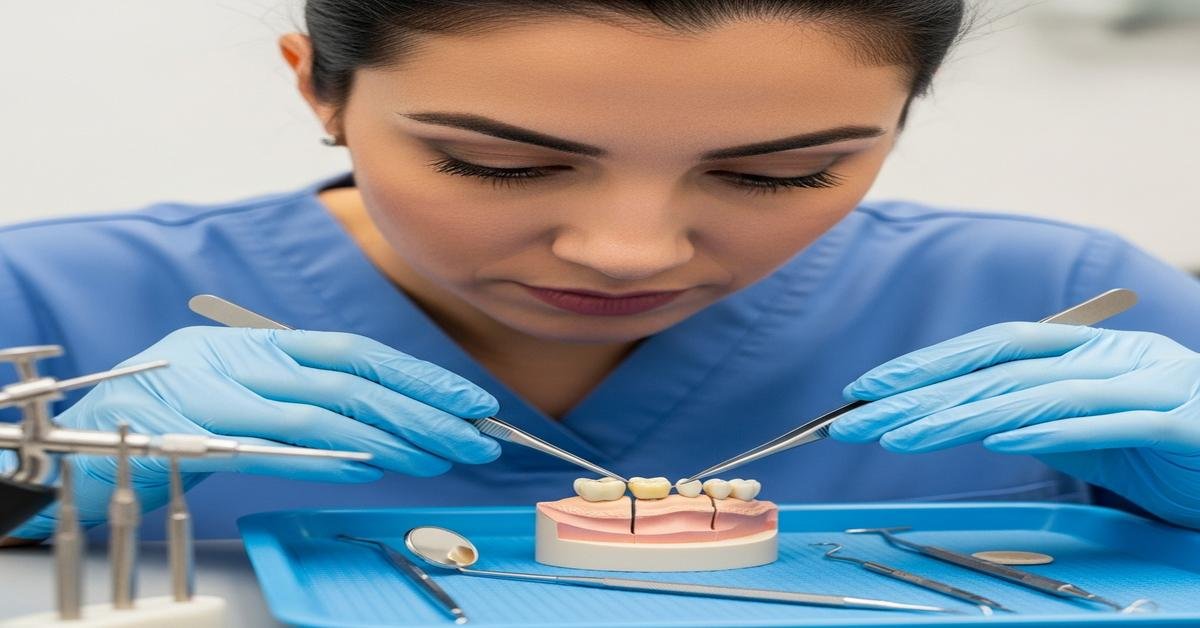
Restorative assistants are the engine of efficient dentistry. If you’re aiming for the CRFDA credential or your state’s advanced functions board, you’ll be judged on what you do with your hands, how you think under pressure, and whether your results look, function, and last like a dentist’s. This guide shows you exactly what examiners look for with fillings and crowns—and how to study, practice, and pass with confidence.
What the advanced functions exam really tests
These exams are not trivia contests. They test whether you can deliver predictable clinical outcomes safely and legally. Expect evaluation in four buckets:
- Clinical execution: Isolation, tissue management, matrices/wedges, material handling, contacts, contours, occlusion.
- Provisional crowns and impressions: Fabrication, fit, margins, occlusion, reline, cement cleanup, hemostasis, impression accuracy.
- Judgment and sequencing: Step order, when to stop, when to fix, and when to ask for help.
- Safety, infection control, and documentation: PPE, sharps, disinfecting, label/lot tracking, notes within your legal scope.
Why this matters: Great hands can be undone by poor isolation. Perfect anatomy fails if the contact is open. Examiners score outcomes, but they also watch how you get there.
Know your rules and your blueprint
Scope of practice varies by state or province. Some allow you to place and finish composites and amalgams; most allow provisionals and impressions. Confirm permitted functions, supervision level, and the exact exam blueprint. Studying outside your scope wastes time and risks errors on test day.
Core science you must own
- Adhesion: Etch cleans and creates micro-porosity. Primer wets collagen. Adhesive bonds resin to tooth. Over-dry dentin collapses collagen; over-wet dilutes primer. Follow the bottle’s timing—examiners watch.
- Curing: Light angle, distance, and time control shrinkage and depth. Keep the tip clean, perpendicular, and as close as possible. Two-millimeter increments are safer than one big bulk.
- Polymerization stress: High “C-factor” boxes pull on walls. Use wedges, rings, and oblique increments to reduce gap formation.
- Amalgam condensation: Pressure reduces voids and improves margins. Carving recreates anatomy and guides occlusion.
- Tissue and moisture control: Dry field equals reliable bonds and impressions. Rubber dam is gold standard; if not allowed, combine cotton, retraction cord, and suction with discipline.
Mastering Class II composites
Class II composites are the most failed exam task—usually for contacts and overhangs. Here’s how to avoid that.
- Matrix choice: Sectional systems with rings more reliably create tight contacts than Tofflemire for composites. Use Tofflemire mainly with amalgam or when axial walls are missing and you need broader support.
- Wedge with intent: The wedge seals the gingival margin and slightly separates teeth. Choose a size that blanches the papilla gently. If you see flash at the box floor, your wedge isn’t sealing.
- Band contour: Burnish the band against the adjacent tooth at the contact area. You’re “pre-building” the contact before placing resin.
- Adhesive protocol: Total-etch? Etch enamel longer (15–30s), dentin shorter (10–15s). Self-etch? Add selective enamel etch to improve enamel bond. Air-thin adhesive to avoid pooling, then cure fully.
- Increment strategy: Start by sealing the proximal box with a thin flowable or warmed composite. Build the proximal wall first, cure, then fill the rest in small oblique increments. This locks in the contact and reduces gap formation.
- Cure control: Hold the light stable. Cure from different angles, including buccal and lingual, especially for deeper boxes.
- Remove matrix early: After building the proximal wall, remove the ring and band to finish without trapping flash or nicking adjacent tooth.
- Refine anatomy last: Use a small condenser or plastic instrument to sculpt grooves before final cure. Then finish with fine diamonds, carbide finishing burs, and discs, keeping the contact intact.
Why this works: A tight contact and sealed gingival margin depend more on your matrix-wedge-contour than on the composite itself. Get those right first.
Amalgam skills that still matter
Even if your clinic uses mostly composite, some boards still test amalgam Class II. The keys are condensation, margins, and anatomy.
- Matrix and wedge: Tofflemire with a firm wedge for a dense proximal contact. Burnish the band before packing.
- Condense decisively: Immediate, firm, overlapping condensation eliminates voids and brings mercury to the surface for removal.
- Carve to tooth: Carve against supported margins while the amalgam is still carveable. Recreate triangular ridges and fossae to guide occlusion.
- Check contacts and occlusion: Use floss to confirm a “snap” contact. Mark high spots with articulating paper and refine carefully.
- Mercury hygiene: Use HVE, trap/amalgamator protocols, and proper disposal. Examiners notice safety as much as anatomy.
Finishing, polishing, and occlusion
- Sequence matters: Gross contour with coarse instruments; refine with fine; polish last. Jumping grits leaves scratches that stain and plaque-accumulate.
- Protect the contact: Use finishing strips lightly. Over-thinning breaks contacts and causes food impaction—an automatic deduction.
- Occlusion: Dry teeth, have the patient tap and glide. High spots appear darker and broader on articulating paper. Adjust the restoration, not opposing enamel. Recheck after each minor adjustment.
Why this matters: A beautiful restoration that is high in occlusion will hurt, crack, or debond. Function trumps cosmetics on the score sheet.
Provisional crowns that stay on
You’ll be scored on fit, margins, contact, contour, occlusion, and cleanliness. Bis-acryl temps are common on exams because they’re predictable.
- Before prep: Take a silicone putty or alginate matrix of the unprepped tooth. This gives you a template.
- After prep: Dry the tooth, apply light lubricant to the matrix, fill with bis-acryl, seat fully, and hold steady. Do not rock—rocking distorts margins.
- Timing: Remove at a rubbery set to avoid locking in. Trim gross excess with scissors or a bur away from the margin.
- Reline if needed: If margins are open, spot-etch the temp internally, apply adhesive (if material allows), and reline with fresh bis-acryl in the marginal area. Seat, set, trim again.
- Contacts and occlusion: Add flowable or bis-acryl to open contacts; adjust anatomy with burs and polishers. Aim for light centric marks and no heavy excursive marks.
- Cementation: Use non-eugenol temporary cement unless told otherwise. Thin, even layer, seat with finger pressure, hold until initial set, then clean thoroughly with an explorer and floss.
Why this works: Provisionals fail from poor margins, weak contacts, or high occlusion. Precise trimming and selective relining fix all three.
Hemostasis, retraction, and impressions
Strong impressions begin with dry, visible margins. Examiners look for tissue respect and clear sulcular capture.
- Hemostasis agents: Aluminum chloride controls mild bleeding with minimal staining. Ferric sulfate controls heavier bleeding but can darken tissue. Avoid epi in cardiac or sensitive patients.
- Cord choices: Single-cord for shallow margins, double-cord for deeper sulci. Pack gently with a cord packer angled toward the tooth, not the attachment. Leave the bottom cord in place if using the double-cord technique and remove the top just before the impression.
- Retraction paste: Good when cord isn’t allowed or tissue is fragile. Keep the field dry and wait the full working time.
- VPS/PVS technique: Dry the prep, syringe light body around the margin while keeping the tip in material to avoid bubbles, then seat the tray loaded with heavy body in a single motion.
- Evaluate: Look for continuous, sharp margin detail with no pulls or voids. If you can’t see a 360-degree margin, you don’t have a pass.
Infection control and safety the examiner notices
- Room setup: Barriers on touch points; sterile or disinfected packs; date and lot tracking for materials when required.
- PPE discipline: Donning/doffing sequence, eyewear for patient and provider (especially when curing), HVE when aerosolizing.
- Sharps and burs: Immediate disposal of single-use blades and needles; burs stored safely when not in use.
- Field management: Saliva control without cross-contamination; clean hand vs. dirty hand concept.
- Turnover: Wipe-discard-wipe method with correct contact time. Examiners time you, even if silently.
Documentation and communication
- Chart exactly what you did: Materials, shade, lot numbers if required, anesthesia by provider, isolation method, any complications, post-op instructions given.
- Use closed-loop communication: Repeat critical instructions from the dentist, confirm before acting, and speak up if you see a safety risk.
- Stay in your lane: Do not diagnose or consent beyond your scope. Knowing when to defer earns points for professionalism.
Six-week study plan that works
- Week 1: Blueprint + basics: Confirm scope and exam tasks. Review adhesive steps, matrix systems, provisional materials. Build checklists for each procedure you’ll be tested on.
- Week 2: Isolation and matrices: Practice rubber dam placement and alternatives. Rehearse sectional matrices and wedges until contacts are consistently tight on typodonts.
- Week 3: Class II composites: Daily reps on building proximal walls first. Photograph results. Floss every contact and record snap/no-snap.
- Week 4: Amalgam and finishing: Condensation drills, carving anatomy, polishing sequences. Time each step to build speed without rushing.
- Week 5: Provisionals and impressions: Make and reline bis-acryl temps. Practice cord packing on a model with fake bleeding (use red disclosing solution). Evaluate impression detail critically.
- Week 6: Mock exams: Full start-to-finish simulations with setup, PPE, documentation, and cleanup. Have a mentor score you against the rubric.
Daily, spend 10 minutes on instrument and material names. Examiners sometimes ask you to name what you’re using and why. Clear answers show understanding, not memorization.
Day-of-exam strategy
- Set the room like a recipe: Lay out only what you need in order of use. Clutter breeds mistakes.
- Call your steps: Quietly say what you’re doing and why. It shows intent and helps you stick to sequence.
- Chase dryness: Every critical step—bonding, seating provisionals, impressions—requires a dry field. Stop and re-control moisture if needed.
- Measure twice, cut once: Before removing a matrix or seating a temp, pause to recheck the detail that matters (band adaptation, margin clearance).
- Own minor errors: If you see flash or an open contact, fix it immediately. Examiners reward problem-solving.
High-yield checklists
Class II composite — pass checklist
- Isolation secured (dam or equivalent) before bonding.
- Sectional matrix properly seated; wedge seals gingival margin; ring engages embrasures.
- Band burnished to adjacent tooth at the contact area.
- Selective enamel etch; dentin kept moist if total-etch. Adhesive air-thinned and cured per IFU.
- Proximal wall built and cured first; band removed without tearing margin.
- Incremental fill with firm adaptation; no voids visible.
- Tight contact confirmed with floss “snap.”
- Marginal ridge height matches neighbor; no gingival overhang.
- Anatomy refined, polished; occlusion adjusted and rechecked.
- Field and patient cleaned; documentation completed.
Class II amalgam — pass checklist
- Tofflemire and wedge placed; band burnished.
- Immediate, firm condensation; no visible voids.
- Marginal ridge formed to correct height/width.
- Anatomy carved to tooth; contacts verified with floss.
- High occlusion adjusted conservatively; surfaces smoothed.
- Mercury hygiene observed; area cleaned thoroughly.
Bis-acryl provisional crown — pass checklist
- Pre-op matrix fits and seats fully.
- Prep cleaned and dried; matrix lubricated lightly.
- Bis-acryl mixed without voids; matrix seated once and held steady.
- Removed at proper set; margins intact; bulk trimmed safely.
- Relined if margins open; contacts closed if needed.
- Polished; occlusion light in centric, clear in excursions.
- Temporary cement used sparingly; excess removed; floss without dislodging.
- Post-op instructions given; notes completed.
Retraction and VPS impression — pass checklist
- Hemostasis achieved with appropriate agent; tissue not traumatized.
- Cord packed gently; wait time observed; top cord removed just before impression (if double-cord).
- Prep dried; light body syringed with tip submerged to prevent bubbles.
- Tray seated in one motion; held still to full set.
- Impression shows sharp, continuous margins and adjacent contacts.
Common errors and fast fixes
- Open contact (composite): Remove band and ring, place a fresh contoured band, re-wedge, rebuild proximal wall, and check with floss before bulk fill.
- Gingival overhang: Re-matrix and wedge to seal the box; carefully remove excess with sharp hand instruments or finishing burs.
- White line at margin: Likely from finishing with a dry field suddenly losing isolation or from flexing. Re-etch margin, apply fresh adhesive, add a thin layer of composite, and polish.
- Provisional won’t seat: Evaluate internal binds with disclosing medium; relieve selectively; reline if needed for margins and fit.
- Bloody impression: Stop, re-pack with hemostatic cord or paste, rinse, dry, and retake. A poor impression is an automatic fail—do not submit it.
Mindset that passes
You’re not being tested to be perfect. You’re being tested to be predictable. Predictability comes from tight routines: correct sequence, clean field, careful checks, and calm corrections. Build those now in practice, and the exam will feel like another day at the chair.
Bottom line: Master your matrices, wedges, and isolation; build contacts first; cure with intention; finish to function; and make provisionals that fit, feel right, and stay on. Pair that with disciplined infection control and clear notes, and you’ll give examiners exactly what they’re hoping to see—safe, confident, advanced restorative skills.

