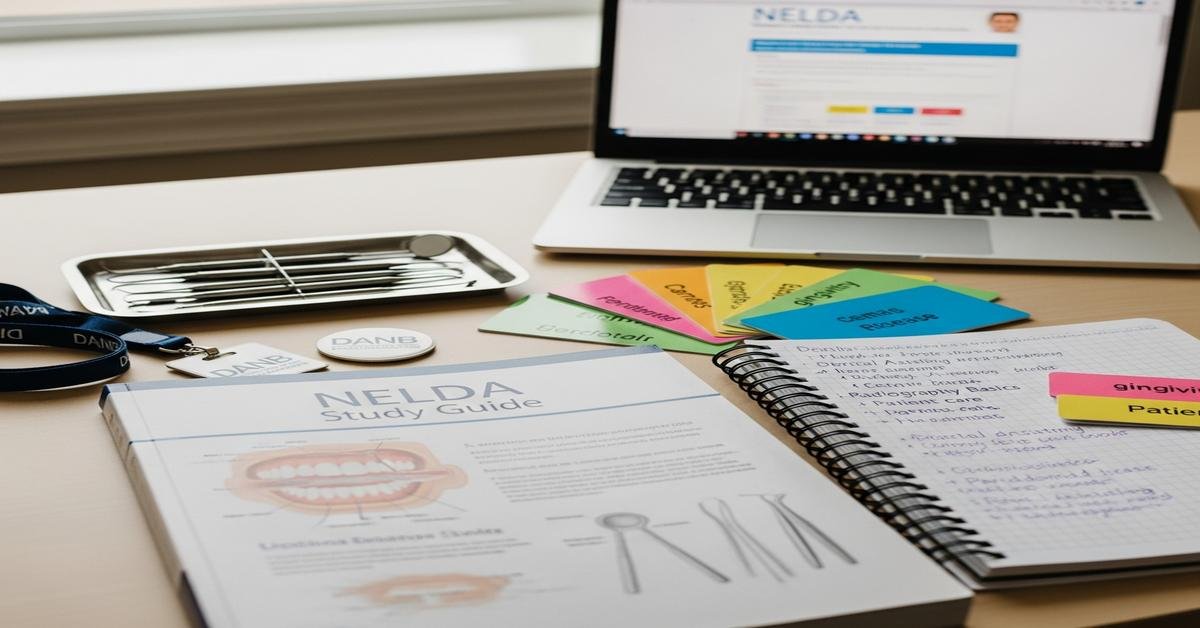
The DANB NELDA exam checks whether you can keep patients safe, follow the rules, and assist smoothly at the chair. This guide focuses on high-yield basics you will see again and again: infection control, radiation safety, anatomy and morphology, plus the day-to-day skills that make procedures efficient. You will learn the “why” behind each rule, so you can remember it under pressure and apply it in the operatory.
How the NELDA Exam Is Structured
NELDA typically combines entry-level knowledge in three core areas: Infection Control (ICE), Radiation Health and Safety (RHS), and Anatomy, Morphology & Physiology (AMP). The test is computer-based and multiple choice.
- Scoring: DANB uses scaled scores. A score of about 400 or higher usually means a pass. Scaled scoring evens out small differences between test forms. That is why you must focus on consistent performance, not raw percentages.
- Timing: Expect tight timing. You need to answer steadily without dwelling too long on any single question. Flag and return if stuck.
- Question style: Many questions test real-life judgment. They ask “what to do next” in a given scenario. Memorize facts, but also practice decisions.
A Smart, Simple Study Plan
- 3–4 weeks out: Review all three domains, one per day. End each session with 15 practice questions. Spaced repetition helps you keep details fresh.
- 2 weeks out: Focus on weak spots. Mix question sets by topic to practice switching gears like on test day.
- Final week: Short, daily refreshers. Run through checklists and image errors. Do not cram late at night—fatigue hurts recall and judgment.
- Daily musts: 10–15 image error IDs, 10 PPE/sterilization flashcards, 10 anatomy/tooth ID items.
Infection Control (ICE): What You Must Know Cold
Infection control prevents disease spread. Every step has a reason: break the chain of infection and protect patients and staff.
- Standard Precautions: Treat all blood and body fluids as potentially infectious. This avoids missed risks from unknown histories.
- Hand hygiene: Soap and water for at least 20 seconds if soiled. Alcohol rub (60–95%) if not visibly soiled. Hands are the most common transmission route.
- PPE order: Don: gown, mask, eyewear, gloves. Doff: gloves first, then eyewear, gown, mask. This sequence reduces contamination spread from dirtiest to cleanest surfaces.
- Immunizations: Hepatitis B series recommended for dental workers. Why: dental work risks sharps and blood exposure.
- Instrument processing flow: Dirty → clean → sterilize → store. One direction prevents cross-contamination.
- Cleaning step: Use ultrasonic cleaner or instrument washer. Scrubbing by hand raises sharps risk.
- Sterilization essentials:
- Steam autoclave typical cycles: 121°C/250°F for ~30 minutes (gravity displacement) or 132°C/270°F for ~3–10 minutes (pre-vacuum). Time and temperature matter because they kill spores, not just bacteria.
- Dry heat: ~160–170°C (320–338°F) for ~1–2 hours. Used for items that corrode in steam.
- Unsaturated chemical vapor: high-temp vapor with chemicals; good for some metals; needs ventilation.
- Biological indicators (spore tests) weekly. Only a spore test proves sterilization is working.
- Use internal and external chemical indicators on each pack to show the pack met conditions.
- Critical, semi-critical, noncritical:
- Critical (penetrate soft tissue/bone): sterilize.
- Semi-critical (touch mucosa): sterilize or high-level disinfect if heat-sensitive.
- Noncritical (touch intact skin): clean and use intermediate- or low-level disinfectant. The level depends on blood presence.
- Surface management: Use barriers for hard-to-clean surfaces. Disinfect touched surfaces with EPA-registered products and respect contact time. Time-on-surface is what kills microbes.
- Environmental spills: Blood spills need a higher-level disinfectant (e.g., appropriate bleach dilution). Organic matter shields microbes; stronger or longer contact is needed.
- Dental unit waterlines: Keep ≤500 CFU/mL. Flush lines between patients and maintain with products per manufacturer. Biofilm builds fast in narrow tubing; treatment prevents contamination.
- Sharps: Do not two-hand recap. Use one-handed scoop or a recapping device. Put sharps in puncture-resistant containers immediately.
- Exposure incidents: Wash area, report at once, seek medical evaluation. Timely action reduces infection risk.
- Waste: Follow local rules for regulated (biohazard) waste. Label and store properly to protect handlers.
Radiation Health and Safety (RHS): Dose, Quality, and Protection
Goal: get a diagnostic image with the lowest reasonable dose. Every setting and position decision supports that goal.
- ALARA: As Low As Reasonably Achievable. Justifies every exposure. Fewer retakes mean lower dose and higher efficiency.
- Patient protection: Use fast image receptors (F-speed or digital). Rectangular collimation reduces dose greatly compared with round. Lead apron with thyroid collar protects radiosensitive tissues.
- Operator protection: Stand at least 6 feet away and at a 90–135° angle to the beam. Distance and angle cut your scatter exposure.
- Filtration: At or above 70 kVp, use at least 2.5 mm aluminum filtration; below 70 kVp, at least 1.5 mm. Filtration removes low-energy photons that add dose without improving image.
- Inverse square law: Intensity ∝ 1/distance². Doubling distance quarters exposure.
- kVp, mA, time:
- Increase kVp → longer gray scale (lower contrast), more penetration.
- Increase mA or time → darker (more density).
- If image too light, increase time slightly or check sensor placement and collimation first to avoid unnecessary dose.
- Image geometry: Paralleling technique preferred. It reduces distortion. Use a longer PID to reduce magnification. Bisecting can cause elongation or foreshortening if angulation is off.
- Common errors and fixes:
- Foreshortening: excessive vertical angulation. Decrease the angle.
- Elongation: insufficient vertical angulation. Increase the angle.
- Cone cut: PID misaligned with receptor. Reposition using aiming ring.
- Overlap: incorrect horizontal angulation. Align central ray through contact areas.
- Blur: movement. Stabilize the receptor and instruct the patient not to move.
- MPD (maximum permissible dose): Occupational ~50 mSv/year; general public ~1 mSv/year. Declared pregnant worker limit is lower during gestation. Limits protect long-term health.
- Quality assurance: Calibrate equipment, check darkroom safelights (if using film), and track retakes. QA lowers dose and saves time.
- Radiographic anatomy fast IDs:
- Maxillary sinus: radiolucent area above premolars/molars.
- Zygomatic process of maxilla: J- or U-shaped radiopacity over molar roots.
- Mental foramen: round/oval radiolucency near mandibular premolars.
- Mandibular canal: radiolucent band with radiopaque borders near molars.
- Genial tubercles: radiopaque ring at mandibular anterior midline with a radiolucent lingual foramen.
- Lamina dura: radiopaque line around roots; PDL space is the thin radiolucent line just inside it.
Anatomy, Morphology, and Physiology (AMP): High-Yield Foundations
- Numbering systems:
- Universal: permanent 1–32 starting from maxillary right third molar; primary A–T.
- Palmer: quadrant symbols with numbers 1–8 from midline.
- FDI: two-digit codes; first digit is quadrant (1–4 permanent, 5–8 primary), second digit tooth 1–8 from midline.
- Tooth ID tips:
- Maxillary first molar often has cusp of Carabelli on the mesiolingual cusp.
- Mandibular first molar has five cusps commonly.
- Maxillary centrals are wider mesiodistally than laterals; mandibular centrals are very symmetrical.
- Surfaces and angles: Know mesial, distal, facial/buccal, lingual, occlusal/incisal. Learn common line angles (e.g., mesiobuccal) for charting and restorations.
- Eruption sequence (typical):
- Primary: central incisors ~6–10 months first; first molars and canines later; second molars ~2–3 years.
- Permanent: first molars ~6 years; mandibular centrals ~6–7; maxillary centrals ~7–8; canines and premolars later; third molars last if present.
- Enamel, dentin, pulp: Enamel is hardest and radiopaque; dentin is softer and less radiopaque; pulp is radiolucent. This helps read radiographs and avoid pulp exposure during procedures.
- Periodontium: Gingiva, periodontal ligament, cementum, alveolar bone. Inflammation breaks attachment; early signs include bleeding on probing. Assistants need to recognize these findings during exams.
- Occlusion (Angle’s):
- Class I: normal molar relationship; mesiobuccal cusp of maxillary first molar in mandibular first molar’s buccal groove.
- Class II: maxilla ahead (retrognathic profile). Div 1 protrusive incisors; Div 2 retroclined centrals.
- Class III: mandible ahead (prognathic).
- Muscles of mastication: Masseter, temporalis, medial and lateral pterygoids. They power chewing; lateral pterygoid helps protrusion and opening.
- Salivary glands: Parotid (Stensen’s duct opposite maxillary 1st/2nd molar), submandibular (Wharton’s under tongue), sublingual (Bartholin’s). Duct locations explain where saliva stones can cause swelling.
- Cranial nerves to know: Trigeminal (V) for facial sensation and mastication; Facial (VII) for expression and taste ant. 2/3; Glossopharyngeal (IX) for taste post. 1/3 and gag; Vagus (X) for gag and palate.
- Caries classifications (Black’s): I pits/fissures, II posterior interproximal, III anterior interproximal, IV anterior interproximal including incisal, V cervical third, VI cusp tips/incisal edges. This guides matrix choice and access.
Chairside Basics, Instruments, and Materials
- Operatory zones (right-handed operator): Operator at 11–1 o’clock, assistant at 2–4, transfer zone around 3–4, static zone 12–2. Zones prevent collisions and keep instruments flowing smoothly.
- Instrument transfer: Use the closest end for a quick, safe handoff. Keep patient’s field clear and eyes on the work.
- Isolation:
- Rubber dam: punch, clamp, frame, floss ligatures. Why: moisture control and patient safety (aspiration prevention).
- Cotton rolls and dry angles: quick isolation but watch for mucosal trauma and dryness.
- Matrix systems: Tofflemire with wedges for Class II; Mylar strip for anterior composites. Wedges seal the gingival margin and reduce overhangs.
- Handpieces and burs: High-speed for cutting enamel; low-speed for finishing and caries removal. Proper bur selection saves time and tooth structure.
- Impressions: Alginate must be mixed to the correct water/powder ratio and seated quickly. Why: setting starts fast; delays cause distortion.
- Etch–bond–composite: Etch enamel longer than dentin; keep dentin moist (not wet) to avoid collagen collapse. Follow the adhesive’s exact instructions—bonding is chemistry-sensitive.
- Cements:
- Glass ionomer bonds chemically to tooth and releases fluoride.
- Resin-modified glass ionomer adds strength and faster set.
- Zinc phosphate is strong but acidic and exothermic; mix on a cool glass slab in small increments.
- Light curing: Check intensity, keep tip close and steady, cure per manufacturer. Under-curing risks postoperative sensitivity and failure.
Records, Communication, and Ethics
- Medical history: Update every visit. Medications change risks (e.g., anticoagulants, bisphosphonates). History shapes treatment safety.
- Vitals: BP around <120/80 mmHg normal; pulse 60–100 bpm; respirations 12–20; temperature ~98.6°F/37°C. Abnormal values may postpone care.
- ASA status: I healthy; II mild systemic disease; III severe systemic disease; IV severe disease constant threat to life. Higher ASA often means shorter visits and stress reduction.
- Consent and privacy: Obtain informed consent; maintain confidentiality. Following laws protects patients and the practice.
- Charting basics: Know MO, DO, MOD, incisal, cervical, etc. Accurate records prevent errors and improve continuity of care.
- Scope and supervision: Duties and supervision requirements vary by state. Always work within your allowed functions and the dentist’s direction.
- Abuse/neglect reporting: Dental teams often must report suspected abuse. Bruising patterns or oral injuries that do not match the story are red flags.
Medical Emergencies and Basic Pharmacology
- Syncope (fainting): Supine with legs elevated, loosen tight clothing, maintain airway, oxygen if available. Why: improves cerebral blood flow quickly.
- Hypoglycemia: Confusion, sweating, tremor. Give oral glucose if conscious; never give liquids to an unconscious patient.
- Asthma: Assist with rescue inhaler (albuterol). Sit the patient upright. Oxygen as needed.
- Anaphylaxis: Epinephrine auto-injector (adult 0.3 mg of 1:1000), call EMS, oxygen. Epinephrine reverses airway swelling and shock.
- Angina: Stop treatment, sublingual nitroglycerin 0.4 mg; repeat every 5 minutes up to three doses if needed and if systolic BP adequate. If pain persists, suspect MI and call EMS.
- Seizure: Protect from injury, do not place anything in the mouth, maintain airway after convulsions, monitor breathing.
- Antibiotic prophylaxis (selected cardiac patients): Many with prosthetic heart valves, prior infective endocarditis, certain congenital heart conditions, or heart transplant with valve issues may need it. Common adult regimen: amoxicillin 2 g 30–60 minutes before. Penicillin-allergic alternatives exist (e.g., azithromycin). The dentist confirms indications and dosing.
- Local anesthesia basics: Watch for toxicity signs (tinnitus, metallic taste, agitation). Aspirate to avoid intravascular injection. Monitor patients with cardiovascular disease closely when using vasoconstrictors.
High-Yield Memory Aids
- PPE Don → “GMEG”: Gown, Mask, Eyewear, Gloves.
- X-ray dark vs. light: Dark = too much mA/time or too little distance; Light = too little mA/time or excessive distance.
- Paralleling preference: “Parallel for precision.”
- Black’s Classes: “I pits, II post prox, III ant prox, IV ant incisal, V cervical, VI tips.”
- Major salivary ducts: “Stensen’s by the smile” (parotid by molars), “Wharton’s below” (submandibular under tongue), “Bartholin’s small and many” (sublingual area).
Practice Questions (With Explanations)
- Which step best verifies that an autoclave is sterilizing effectively?
- A. External chemical indicator
- B. Internal chemical indicator
- C. Spore test (biological indicator)
- D. Autoclave pressure gauge
Answer: C. Only a biological indicator confirms spores are killed. Chemical indicators show conditions were reached, not that sterilization occurred.
- To reduce patient dose the most during radiography, which change helps most?
- A. Longer exposure time
- B. Round collimation
- C. Rectangular collimation
- D. Lower kVp to 50
Answer: C. Rectangular collimation greatly cuts area exposed. Lowering kVp can increase dose if it causes retakes.
- A bitewing shows overlapping contacts on all posterior teeth. What went wrong?
- A. Vertical angulation too steep
- B. Horizontal angulation incorrect
- C. Patient moved
- D. Exposure time too short
Answer: B. Overlap results from incorrect horizontal angulation. Aim the central ray through the contacts.
- Which classification is a carious lesion on the cervical third of a canine?
- A. Class I
- B. Class III
- C. Class V
- D. Class VI
Answer: C. Class V lesions are at the cervical third on facial or lingual surfaces.
- Which is the correct first response to a patient who faints?
- A. Give water
- B. Place in supine position with legs elevated
- C. Administer nitroglycerin
- D. Call EMS immediately
Answer: B. Supine with legs elevated improves blood flow to the brain and usually reverses syncope quickly.
- Which radiographic landmark appears as a J- or U-shaped radiopacity over maxillary molar roots?
- A. Zygomatic process of the maxilla
- B. Coronoid process
- C. Maxillary tuberosity
- D. Hamular process
Answer: A. The zygomatic process creates the characteristic J- or U-shaped radiopaque image.
Test-Day Strategy
- First pass: Answer what you know fast. Flag harder items. This builds momentum and protects time.
- Read the stem carefully: Look for words like “first,” “best,” “most important,” and “except.” They change the target.
- Eliminate aggressively: Cross out two wrong answers first. A 50/50 guess beats a 1/4 guess.
- Picture the operatory: Visualizing a real setup helps with PPE, transfer, and x-ray positioning questions.
- Manage nerves: Slow breathing before the exam lowers stress hormones and clears your head.
Last-Week Checklist
- Recite PPE donning/doffing order without notes.
- List sterilization cycles and weekly spore test rule.
- Explain ALARA, operator distance/angle, and rectangular collimation.
- Fix five sample radiographic errors out loud (what happened and how to correct).
- Identify 10 radiographic landmarks from images.
- Run through tooth ID, eruption order, and Black’s classes.
- Review emergency steps for syncope, hypoglycemia, asthma, and anaphylaxis.
- Practice 30 mixed questions in one sitting to simulate the pace.
Final Thoughts
Focus on fundamentals you can explain in your own words. If you know the “why,” you can adapt to any scenario on the exam and in the operatory. Aim for clean infection control, smart radiation safety, solid anatomy, and calm emergency responses. That mix is exactly what NELDA looks for—and what patients count on every day.

